Hispanic Heritage Month and the imperative of solidarity By Lorna Rivera, Ph.D. Each year, Hispanic Heritage Month brings both excitement and anticipatory disappointment. As a Latino Studies professor and director of the Gastón Institute at the University of Massachusetts Boston, I love the events that celebrate Hispanic Heritage Month with live music, dancing, art, and delicious Latin cuisine. These celebrations matter. They affirm who we are and honor the many contributions Latine communities have made to this country. The disappointment lies in the elephants in the room. What exactly are we celebrating when so many in our communities are struggling? There is currently so much trauma connected to immigrant family separations, hate crimes, wars, and crimes against humanity. We are witnessing attacks on civil rights, efforts to outlaw ethnic studies, challenges to diversity and inclusion initiatives, and the continued dismantling of social safety nets as color-blind rhetoric and claims of “reverse racism” are used to divide communities. And then there are the everyday realities: bills and rent to pay, rising grocery prices, higher gas costs, and the constant stress of making ends meet. More than ever, we need the kind of solidarity that Martin Luther King Jr. and Coretta Scott King advocated for. At a press conference in support of the Employment Non-Discrimination Act of 1994, Mrs. King said: “Freedom and justice cannot be parceled out in pieces to suit political convenience. I don’t believe you can stand for freedom for one group of people and deny it to others.” |
|
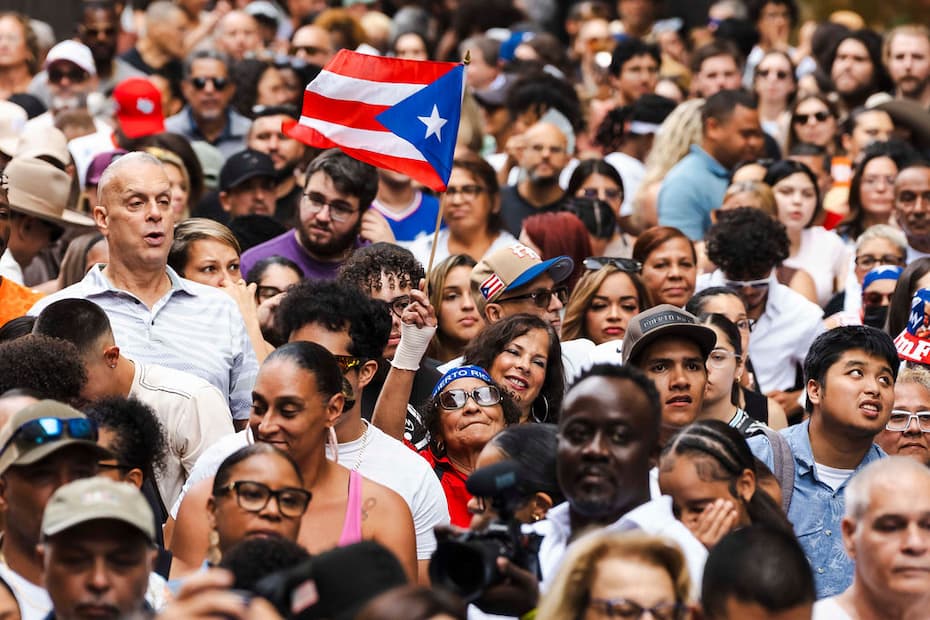
A woman waves a Puerto Rican flag in the crowd at the Embrace Massó ¡Con Salsa! Block Party on Saturday, September 12, 2026. (Photo: Embrace/Soul Solid Visual) |
|
Hispanic Heritage Month is also an opportunity to broaden our understanding of who we are as a people and whose stories get told. Too often, our public conversations assume people are either Black or Latino. What about Afro-Latinos? Afro-Latinos are "simultaneously ethnically Latino and racially Black,” according to Fordham Law professor Tanya Kateri Hernández. While ethnicity reflects culture and heritage, race is a social construct that shapes how people are viewed and treated. For Afro-Latinos, being both Black and Latino often creates shared experiences of both marginalization and solidarity. Yet despite their growing presence and contributions, Afro-Latinos often remain invisible in discussions about both Latinidad and race. This invisibility matters because anti-Blackness remains a reality both within the broader society and within Latine communities themselves. Our research at the Gastón Institute found that Afro-Latino communities frequently experience media omissions, marginalization, and racism. Hernández argues that efforts to build lasting and transformational coalitions for social justice cannot succeed unless Latino anti-Blackness is recognized and addressed. We cannot build solidarity while ignoring the realities of race and racism in our own families. At the same time, Afro-Latino communities are hubs of cultural innovation, civic leadership, economic resilience, political organizing, and community building. A 2024 report by James Jennings, Ph.D., and Boston Indicators found that Greater Boston's Black population is now among the most diverse in the nation. Much of this growth is being driven by multiracial, multiethnic Black residents, specifically Afro-Dominicans and Afro-Puerto Ricans. The Gastón Institute found similar patterns statewide. More than 53,000 Afro-Latinos live in Massachusetts, and their population has grown by 57% since 2009. Most of them are of Puerto Rican or Dominican descent and live in the Greater Boston region. These communities and their contributions can no longer be overlooked. This Hispanic Heritage Month, let's celebrate the rich tradition of Afro-Latino political advocacy, cultural expression, and community organizing that has created solidarity between Black and Brown communities locally and across the United States. Let's also support organizations such as Hyde Square Task Force, Sociedad Latina, and the Veronica Robles Cultural Center that preserve culture, cultivate youth leadership, and strengthen communities through the arts. The arts are critical to cultural preservation and the reproduction of values, history, and traditions. Through artistic expression, we honor our ancestors, tell our stories, and affirm our shared humanity. This month, let's be intentional. Let us celebrate the contributions of Afro-Latino communities to our history, our present, and our future. And let us recommit ourselves to the solidarity required to confront anti-Blackness, defend our communities, and build a more just society. Lorna Rivera, Ph.D., is Director of the Mauricio Gastón Institute for Latino Community Development & Public Policy and Professor, Leadership in Education Department at the University of Massachusetts Boston. |
|
|
|
|