How the Black Church is meeting the moment
By Khari Thompson
To stand in the sanctuary of Peoples Baptist Church of Boston is to stand in the midst of history itself.
Not just because it is a place that represents the oldest Black congregation in New England, an "invisible institution" rising from Black Bostonians’ refusal to be denied their right to worship in the days of legalized segregation.
Or because figures such as Dr. Martin Luther King Jr. once preached there, or that it held a critical role as a community gathering and organizing space during the days of the Civil Rights Movement.
But because it's a reminder of the Black Church’s unique tradition: one born of struggle and joyful resistance in the fight for justice.
That’s the world Rev. Art Gordon comes from—and why, ultimately, he’s now the pastor at Peoples Baptist Church.
“The engagement with politics, civic engagement, and activism was always something that was central to the life of Black churches,” Gordon, now in his second year leading Peoples Baptist, told Embrace. “I've always grown up in that tradition, and I believe that our faith should influence our politics.”
Which is why, on the day Peoples Baptist Church unveiled its monument marker commemorating more than 200 years of providing a home for Black Christian worship in the city, Gordon’s sermon spoke out against anti-immigrant sentiment, restrictions on democracy, and the rising tide of hate infiltrating American Christianity.
Not everyone, he realizes, might agree with what he’s preaching. There’s even the chance he might face pressure not to speak up. Gordon recalls how one of his predecessors, Rev. Aaron William Puller, was once famously arrested alongside William Monroe Trotter for protesting showings of the racist film The Birth of a Nation.
But that example is more of an inspiration than a deterrent.
"It goes back to that truth-telling that this institution has been a part of in Boston's history," he says of Puller’s protest. "I was called to preach long before I was called to a church. I've been cultivated and trained and raised in this tradition. ... I'm gonna have to tell the truth."
In today’s political climate, where White Nationalist Christianity has found a firm mainstream foothold even in the White House itself, Gordon is preaching an older Christianity he deems truer to the Bible, which he refers to as a book of “liberation,” “love,” and “justice” rather than one of order and condemnation.
Rev. Laura Everett says the “love” part of the equation is especially important.
“You can't speak prophetic truth to a people you don't love. The way you move people is by loving them,” she said.
Everett has led the Massachusetts Council of Churches—a statewide network of 18 Protestant and Orthodox denominations—for nearly 15 years.
Among her major concerns is the rise in Christian nationalism: according to Public Religion Research Institute, roughly one in three Americans, and a majority of Republicans, now qualify as "Adherents" or "Sympathizers" of Christian nationalism—the idea that America must be a “Christian” nation and adhere to its tenets. In the same way the Bible was once used by proponents of slavery and segregation to justify their beliefs, today’s model of nationalist Christianity can be heard in rallying cries for ICE deportations, Islamophobia, and anti-LGBTQIA+ discrimination.
Such endorsements of discrimination, cruelty, and exclusion, she says, directly contradict what the Gospel is all about.
“What I am deeply concerned about is this idolatry of an American exceptionalism that is putting nationalism above love of God and love of neighbor,” Everett said. “For those of us who are Christians, we've got some serious soul-searching to do. … If the church is just for itself, then it's a country club."
One of her colleagues with the Massachusetts Council of Churches, Rev. Kenneth Young, agrees. Moreover, that soul-searching can’t happen if you try to separate faith from politics.
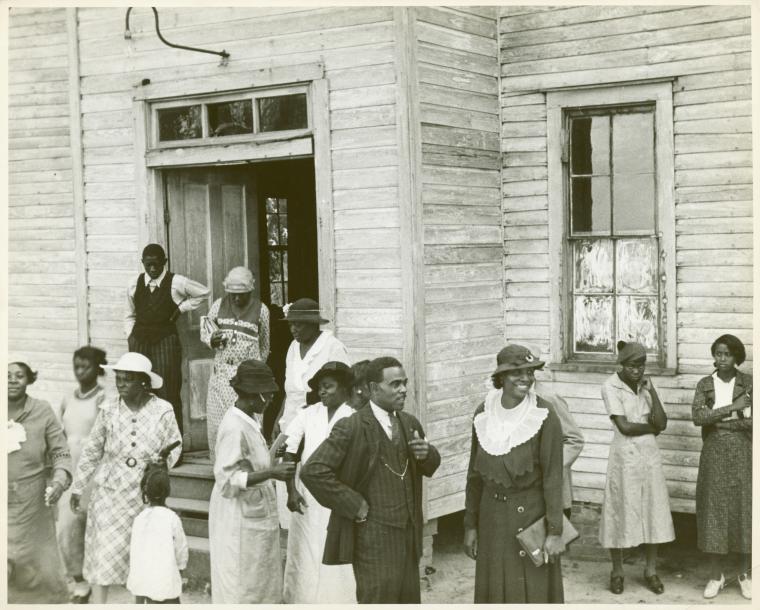
"The birth of the [Black] church itself is political," Young said. "Building their own is a political statement. … My ancestors built their church with their own hands… and their church was burned as a threat. And they went down the road to build more."
Young, like Gordon, was born and raised in the tradition of Southern Black Baptist preachers before his family came up to Massachusetts.
After years of studying the history of the Black Church and all the battles it has fought for racial equity, Young has a pointed message for the country.
“If we ought to be who we say we are—Land of the Free, Home of the Brave—then we should not have Haitian brothers and sisters with monitors on them, tracking wherever they go. That's an oppressive system,” he said.
It’s harder to commit to exclusion and oppression, all of them note, when you see yourself in others. Gordon points to the expansiveness of Coretta Scott King, one of the earliest advocates linking racial justice to LGBTQ+ liberation, and Dr. King, who once described us as being tied together by a "single garment of destiny”—a concept people who follow our work at Embrace know well—as inspiration.
“The greatest commandment is to love one another, is to love God and to love your neighbor as you love yourself," explains Gordon, "And if that's what we preach, then that's what we have to live.”