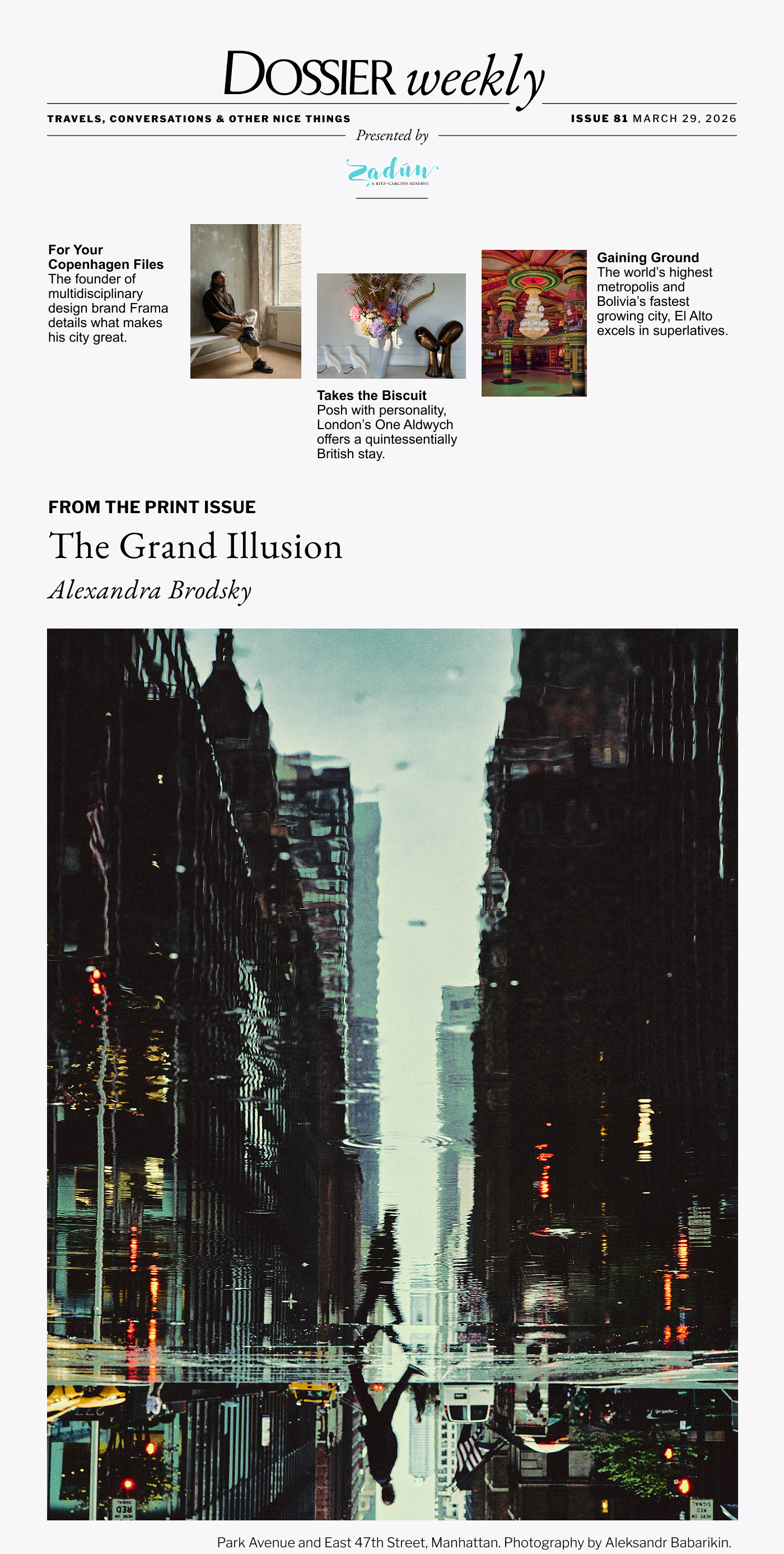
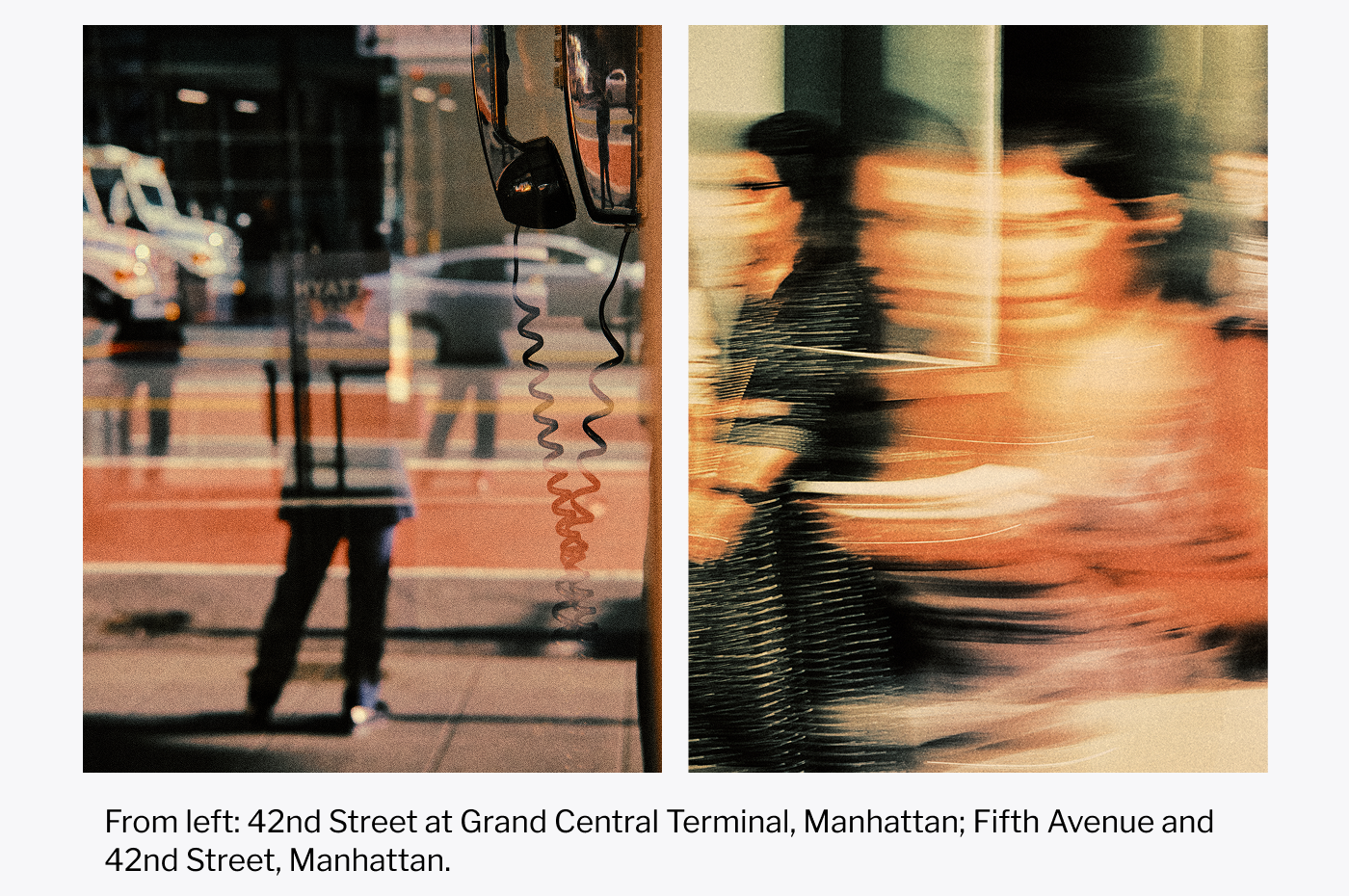
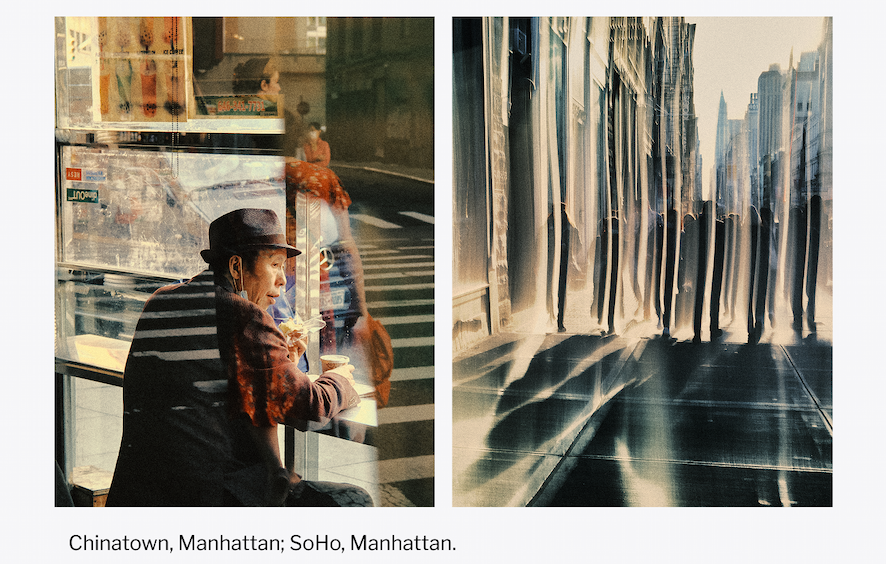
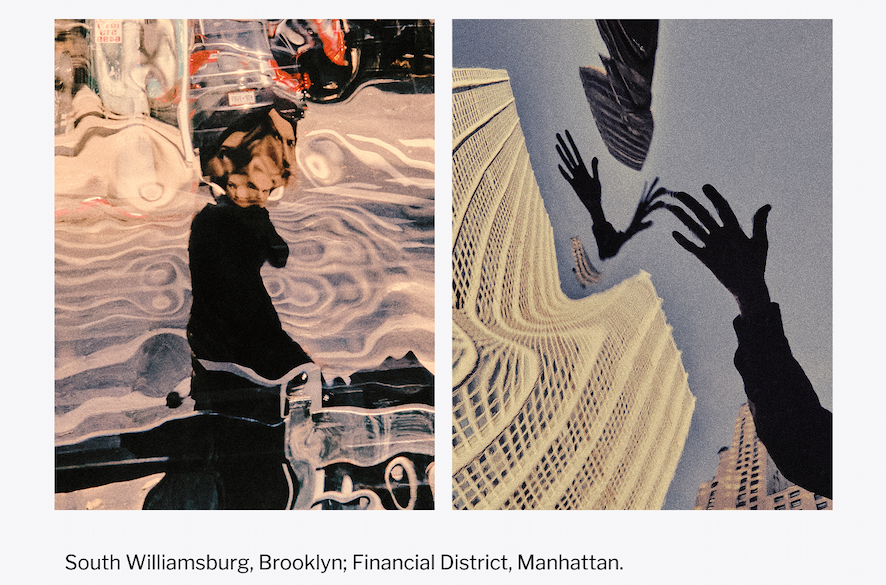
Photography is a unique medium in the way that the camera’s image serves as both a document of reality and an object shaped by its creator. Every photograph contains information about the world, but its interpretation is subjective. Photographer Aleksandr Babarikin’s work perfectly embodies this intersection.
Born in Russia and raised in Belarus, Babarikin moved to New York City four years ago, a transition that evolved his work: While initially drawn to his home country’s pastoral scenes, Babarikin found that New York’s urban landscape “opened up a whole new world.” The city’s streets “inspired new directions,” and he began creating images that recall New York photographer and painter Saul Leiter’s dreamy, poetic work from the 1940s and ’50s. Babarikin, in fact, cites Leiter as an influence, responding to the way Leiter constructed “something entirely new out of the mundane, finding beauty in the everyday. Leiter’s focus was less on the subject itself,” Babarikin explains, “and more on feeling, atmosphere, and depth. That approach creates images that carry an emotional weight, almost like an impressionist painting.” Both photographers lean heavily toward the atmospheric, layering dreamlike reflections and mirrors, movement and gesture.
Babarikin often experiments with materials. He places crystals, ointments, and liquids in front of the lens to alter what the camera sees, often combining this practice with slow shutter speeds. Babarikin’s practice is founded on the belief that photography can “move beyond documenting and instead evoke mood, ambiguity, and imagination” — using both fact and attitude to create an entirely unique reality. |
|
Read the full feature and more close takes on a wide world in our latest print issue. Order now. |
|
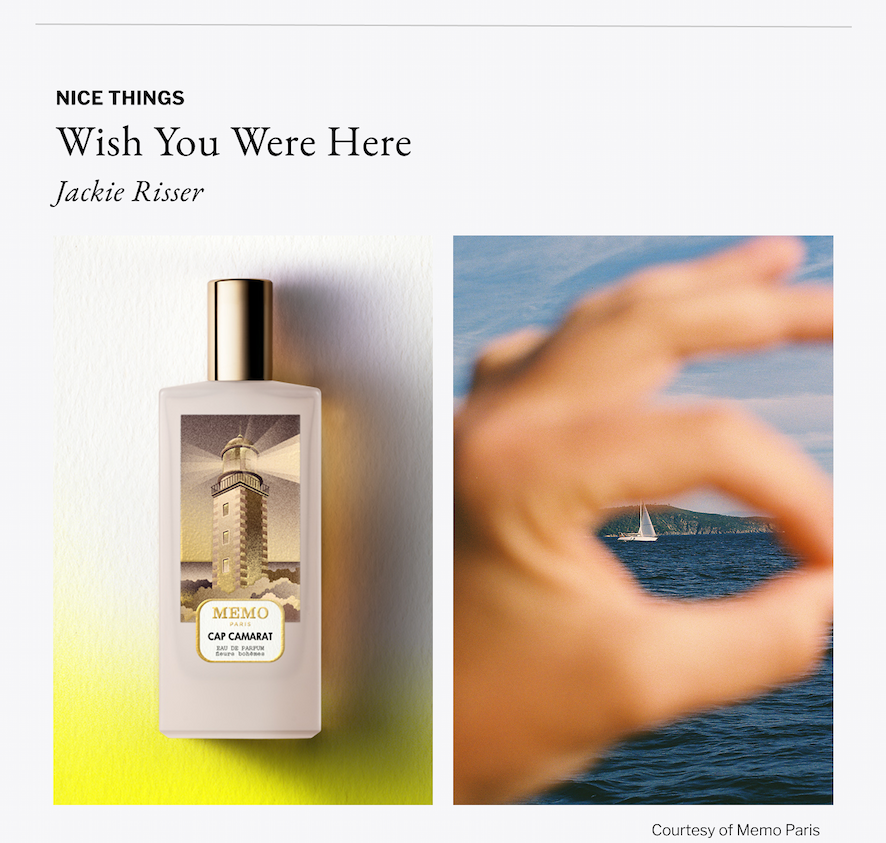
The onset of spring sparks wanderlust — I yearn to shake off frigid temperatures and those little balls of fluff from my nubby sweaters, preferably trading them for the salty air of a sun-drenched locale. Until I can physically sink my toes into white sand, I've been traveling through the transportive scents of Memo Paris. Founded in 2007 by husband-and-wife duo Clara and John Molloy, Memo Paris defines its fragrances as "travel notes," collaborating with a team of perfumers to bottle the soul of distinct destinations using high-quality, natural ingredients. For instance, Ilha do Mel is a sensual concoction channeling the Brazilian "honey island" with juniper berry essence, jasmine absolute, and gardenia. Meanwhile, Madurai reflects the radiant Indian city through golden Indian turmeric, Sambac jasmine blooms, and juicy peach. Marfa layers orange blossom absolute, tuberose absolute, and white musk to evoke the mystical Texas town. One spritz of the brand’s newest scent, Cap Camarat, washed away this neverending winter with its refreshing, Saint Tropez-inspired blend of ylang-ylang, vanilla absolute, and amyris essence. Nearly as delightful, each perfume package comes elegantly ensconced in a furoshiki (traditional Japanese wrapping cloth) — a lightly scented souvenir from your olfactory adventure. |
|
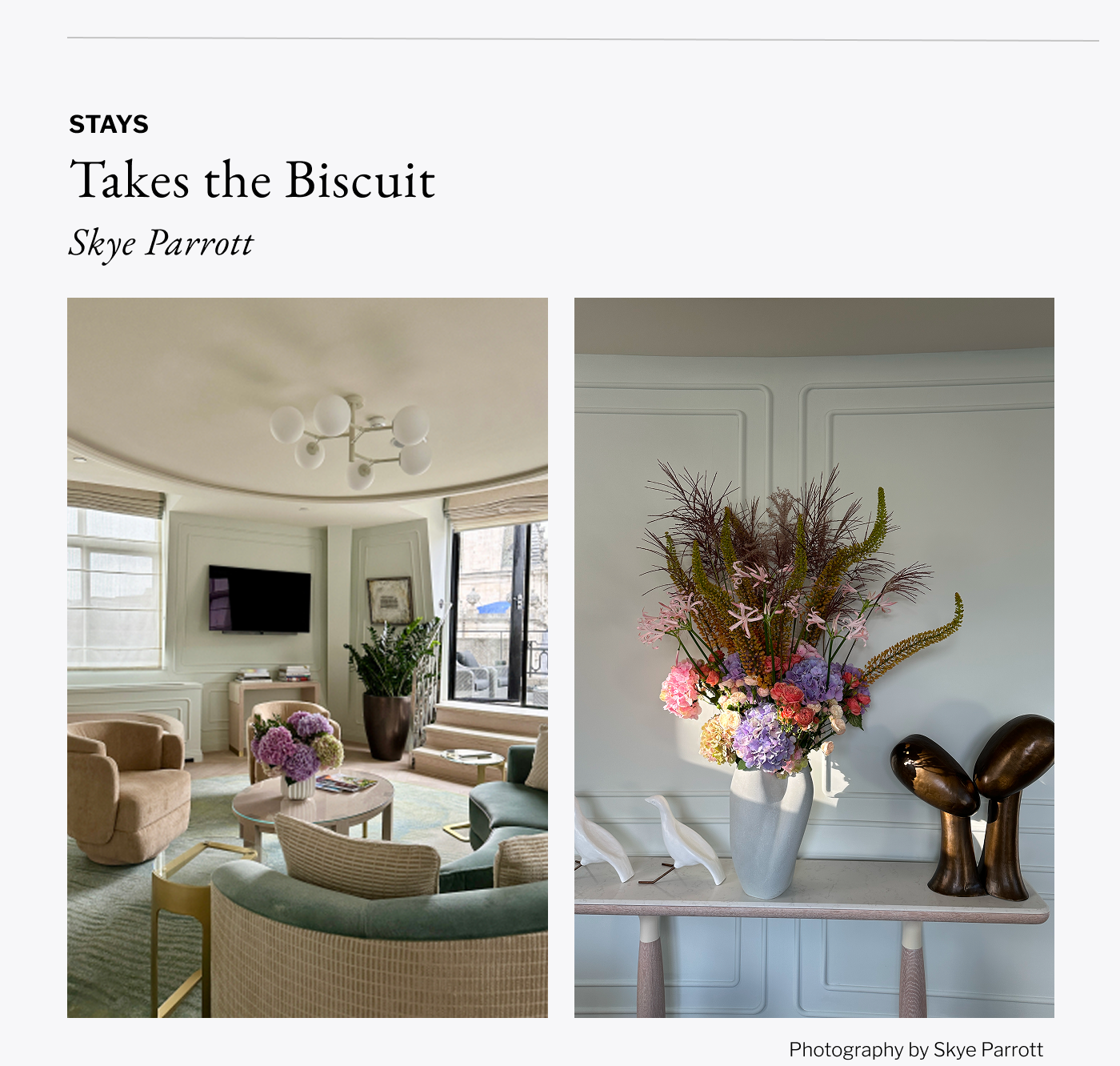
Before stepping inside One Aldwych, my daughter and I were welcomed by a doorman. “Ms. Parrott? Nova?” he asked. As he took our bags and ushered us up the stairs, he inquired about our journey to London, chatted briefly about his day, and told me that my mother and other daughter hadn’t yet arrived. I visit a lot of excellent hotels, but I’ve never been spotted on the sidewalk and greeted by name before walking through the doors. It was a level of professionalism and friendliness that gave me a taste of the stay in store. Housed in a 1905 Mewès & Davis-designed building (the architects also designed The Ritz London), the hotel is an oasis in the buzzing heart of Covent Garden. I visited with my mother and daughters in the summertime, and the property was a centrally located jumping-off point for exploring the city (where my mother actually lives, but she enjoyed a staycation with us in a different part of town). Our top-floor suite was so beautiful my daughter declared, “I wish we lived here.” She would be willing to share a bedroom with her grandmother permanently, she told me, in order to achieve that. Alongside the many things that recommend it, One Aldwych is a certified B Corp, the first (and only) five-star hotel in London to be awarded that designation (and one of only 18 hotels in all of the United Kingdom to hold it).
The best view … The Robert Angell, designed by Fabled Studio, has a soft, feminine interior that nicely fit the trip. All of the room categories feature similar decor, with some on the upper floors (like ours) built under mansard roofs, giving the bedrooms the cozy feel of an impossibly chic ship’s cabin.
A memorable space … One Aldwych’s building was formerly the headquarters of the Morning Post newspaper, and its lowest levels, once home to the printing press, have been repurposed for a fitness center and swimming pool. My mother and daughters love to swim, so they used the pool several times a day.
A dish I’d recommend … All of the food was excellent, but the best thing I ate was a tie between the perfectly cooked medley of vegetables at the fancy dinner we had in the hotel’s signature restaurant, Indigo, and the marinated mushroom served with my eggs and toast at breakfast. The mushroom was really exceptional (so I actually think it wins).
Something unexpected … Like any proper London hotel, One Aldwych offers afternoon tea. The hotel’s tea, however, is themed around Charlie and the Chocolate Factory. (Framed copies of various editions of the book, along with original artwork, are showcased in the hallways, heading towards the bathroom). With snozzberry jam on scones, chocolate swudge milkshakes mixed by waterfall, and gold-flaked fizzy lifting drinks, it was a big hit with my kids. (It also may win an award for being one of the sweetest meals I have ever consumed).
The best amenity … One Aldwych is serious about its flowers, so much so that the hotel has a resident florist. Mark Siredzuk’s creations are visible throughout the property, from the lobby’s towering centerpieces to fresh arrangements in guestrooms. In the above photo, they’re sitting next to sculptures, art being another feature of the hotel: There are over 400 original pieces in its collection. Books, nodding to the building’s publishing history, are also offered in guestrooms and were presented as arrival gifts for my daughters. These touches give the hotel a distinctive personality and are a reminder that it is independently owned and curated.
A secret corner … Our suite had an incredible private terrace. It wasn’t sunny during our stay (because, well, London), but it still offered quite a view over the city’s theater marquees. Nova spent much of our visit out there, reading and drinking tea.
|
|
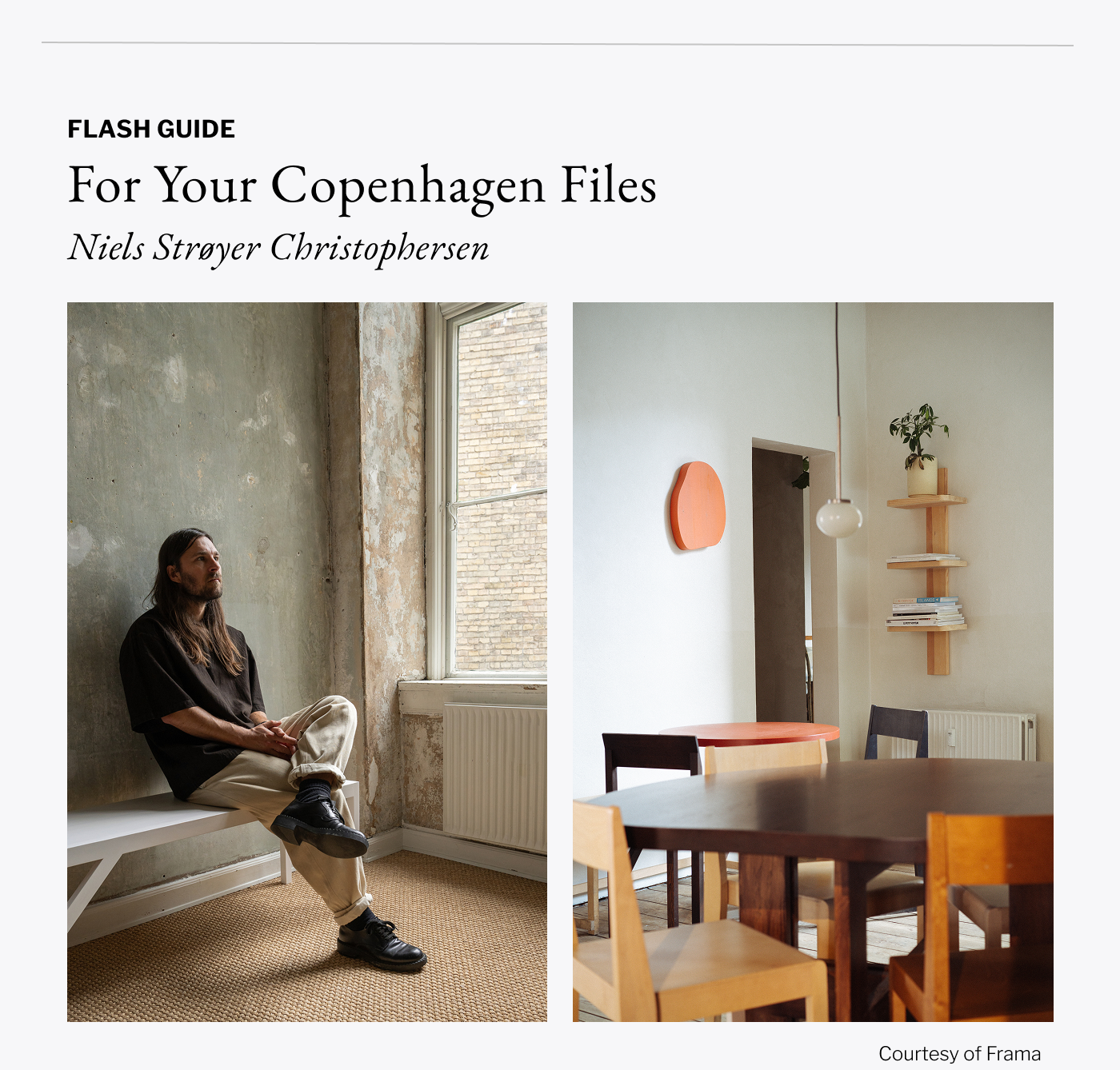
Minimalism, uncompromising craftsmanship, and an emphasis on natural materials are hallmarks of Danish design, each of which are distinctly captured by Frama, the Copenhagen-based, multidisciplinary brand founded by Niels Strøyer Christophersen. Initially a destination for wooden furniture and lighting, Frama has expanded into lifestyle objects, self-care offerings, fragrances, dining environments — Apotek 57 and Bar Vitrine, more on that later — and, as of this past winter, the coffee bar Cabin. “The vibes of Copenhagen are super casual, which I really appreciate,” explains Christophersen. “At premium experiences, like fine dining, ballets, and even classical concerts, you can show up in casual outfits, which says a lot about the norm of the society.” Here, he shares a few more favorite things about and places in his city.
Something to eat and drink … Bar Vitrine is a rather special place and a particular favorite project of mine. Our Indian-born head chef, Dhriti Arora, creates distinct bar food that always involves lots of spices. Combined with a great wine selection and key location in the city center, it is a must-try.
Something to see … We have quite a few museums in Copenhagen, but these two are often overlooked. The David Collection offers a wide variety of artworks and objects in its small space that are all very inspiring to study. Den Frie Udstilling was built as an anti-movement against the “over-academization” of art education. It was focused on allowing people with non-conventional art backgrounds to attend exhibitions.
Something to take home … The pace of Copenhagen, its casual approach to every day, and the appreciation of simple pleasures is something worth taking home. It brings a nice tranquility to your life to slow down a bit.
Only in Copenhagen … There is a saying in Danish culture: freedom with responsibility. This [means] that people can feel and act free, but it comes with responsibility and respect for the environment and spaces. This metaphysical thing creates a special vibe and character in Copenhagen that is unlike many other capitals.
A secret place … If weather allows, I recommend visiting a secret garden called Haveselskabets Have (Garden Company Garden). Bring a pastry, a bottle of cider, and a cherished book. The gardens offer small niches, interesting arrangements, and architectural elements — all in a compact area. Copenhagen changes dramatically in every season, so the vibe will be unique depending on when you visit. Danes also try to make the best of every type of weather. During the winter season, for example, you can attend winter jazz festivals, have sauna experiences, or watch great movies at the cinema. |
|
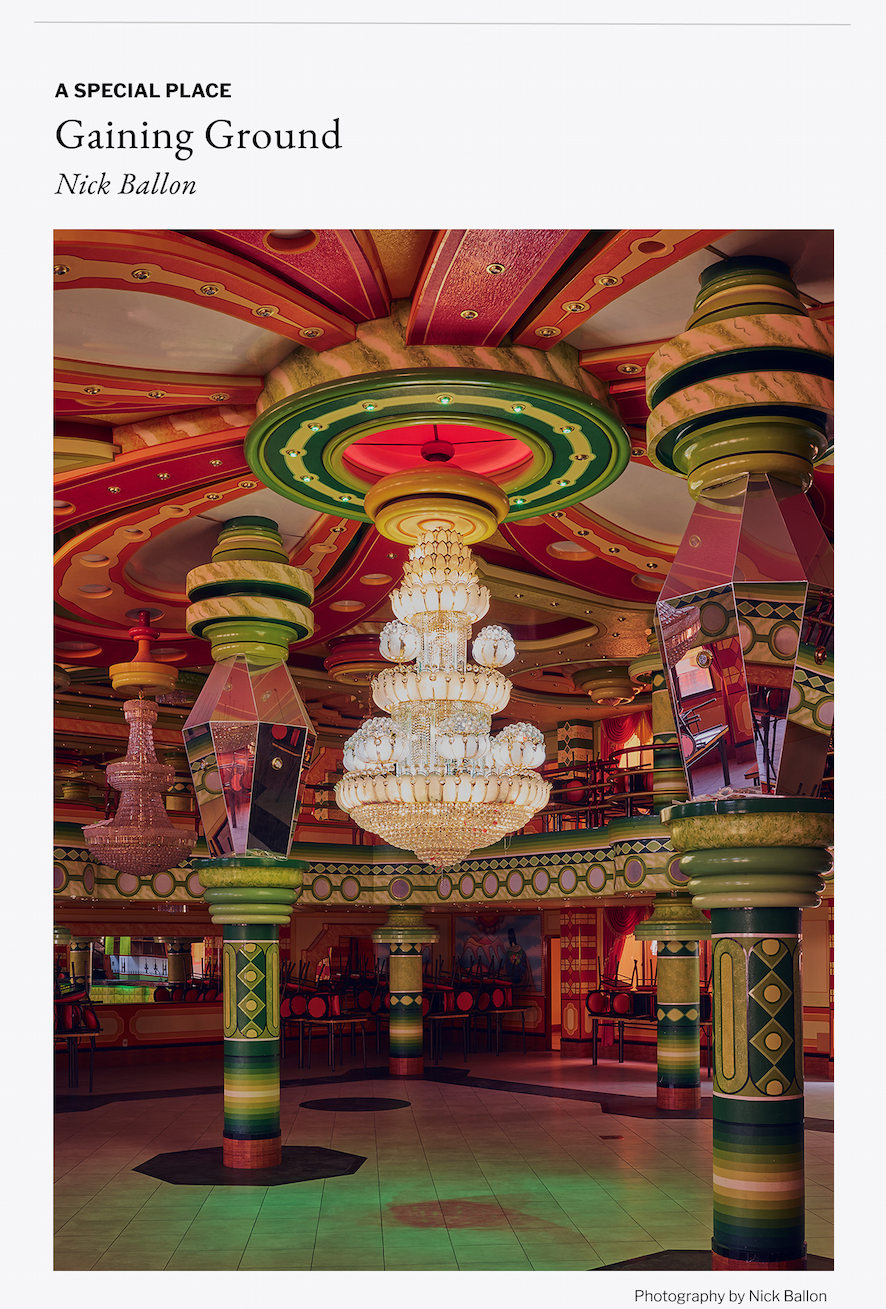
El Alto, Bolivia, represents chaos and energy far from my day-to-day life in the sleepy seaside town of St Leonards-on-Sea in the United Kingdom. My father was born in Bolivia and used to ride his Jawa motorbike on the dirt roads of El Alto way before it became a city of more than a million inhabitants. In his 1950s youth, it was a barren area home to the international airport, leading down into the mouth of La Paz, Bolivia’s de-facto capital. El Alto excels in superlatives. At nearly 14,000 feet above sea level — overlooking La Paz in the basin below and across to the snow-capped heights of Mount Illimani — it is the highest major city in the world. It’s also Bolivia’s fastest growing metropolis. And with nearly half of its inhabitants believed to be under the age of 30, it has a fair claim as Bolivia’s youngest city — and one of the most youthful on the planet. All of this brings contradictions. In a predominantly rural country, El Alto is a dusty, sprawling conurbation of half-built brick towers, disorderly traffic, ramshackle markets full of sundry car parts, pirated DVDs, confident tricksters, and witchdoctors. The Salón de Eventos Príncipe Alexander, pictured above, is an emblazoned expression of Neo-Andean ideals in the form of building. Its self-taught architect, Freddy Mamani, hails from La Paz and is at the forefront of the Neo-Andean movement. His buildings, cholets, express the rise of a new, wealthy class of Bolivian and Indigenous bourgeoisie. Inside of them lie kaleidoscopic fractals of color and grandeur, chandeliers that outsize cars, and staircases that spiral through these colossal expressions of heritage, class, and wealth. I am currently working with the book designer Tom Booth Woodger on a publication featuring photographs from Ekeko, my project on El Alto. You can follow its journey on Instagram @nickballon.
Word to the Wise … If you’re looking to engage with Bolivian culture to the max, visit El Alto’s humongous, open-air market for Feria 16 de Julio (the July 16th Fair), which showcases the heart of the city’s youthful, rebellious nature. You can barter for handknit hats, local cuisine, even cars! To get there, which is arguably part of the fun, take the city’s public transit cable car (Mi Teleférico), riding the red line towards the plateau.
|
|
Bright Ideas. When I was a kid, my mother bought me a neon duffel bag for summer camp. She wanted the bag to basically glow in the dark, lest it got lost in the shuffle. Now, as an adult and avid traveler, I understand the importance of distinct luggage. My newest piece delivers on exactly that: It’s a cherry-red carry-on from Roam Luggage, with a high-gloss hard shell, like it’s covered in lipstick. The brand also prides itself on being highly customizable: You can select the color of its ultra-smooth, 360-degree wheels; side and top handles; zipper; and binding, as well as have your case monogrammed. Also of note are the structural details, such as an easily accessible front pocket for your laptop and a removable two-section, interior zip pouch that functions like a built-in dopp kit. Mother would definitely approve. – Sophie Mancini
If the Shoe Fits. An early spring visit to my quaint (but snowy) hometown of Chagrin Falls, Ohio, meant I needed to ditch my California-issue Vans for something more appropriate for the elements. Enter Overland’s Flynn Chelsea boots. Made from water-resistant suede, they break in beautifully with a subtle, casual crease. Plus, their covered elastic makes them easy to slip off when an evening of catching up continues around a friend’s fireplace. –John Chuldenko
Senior Moment. Shoresy, a Canadian hockey comedy, recently released its fifth season on Hulu. Created by Jared Keeso and Jacob Tierney (whose other hockey show Heated Rivalry recently went viral), Shoresy is a crude yet heartwarming showcase of love in all forms, through the hyper-specific lens of small-town, senior AAA hockey. –Alessandra Berge |
|
54 Franklin St #2R NY, NY 10013. ©2026 Dossier Projects, LLC.
|
|
|
|
|