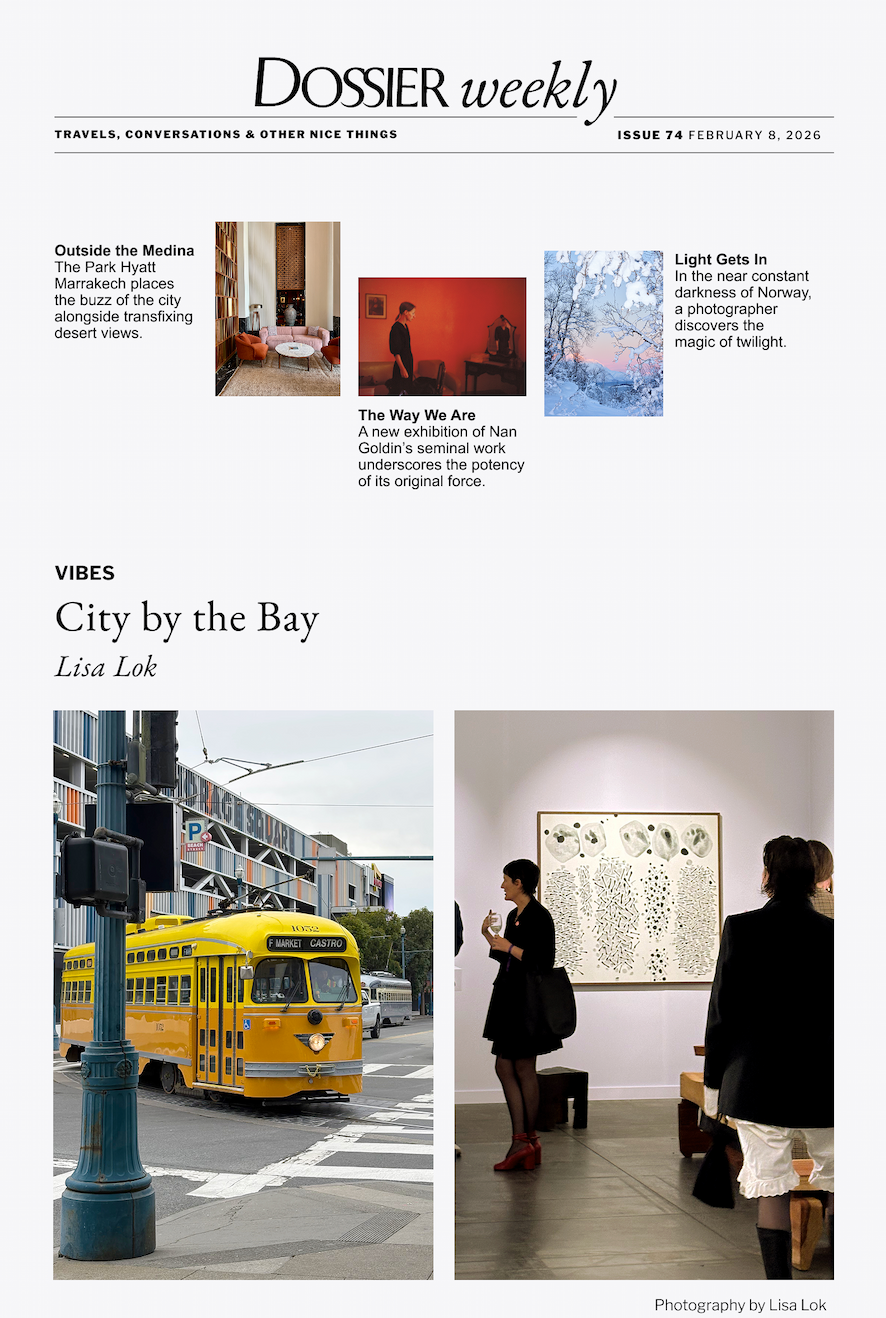
The opportunity to leave the frigid single-digit temperatures of New York City behind is reason enough to board a plane to San Francisco, where winter days are more often defined by sunny skies and a low of 40 degrees Fahrenheit. But I had another impetus: SF Art Week. Designed to celebrate community across the arts, the vibrant annual event is in its third year, its growing success indicative of what is being branded by longtime Bay Area locals as the region’s “renaissance.” Following a series of tech booms and busts, accompanied by their economic and cultural ripple effects, the Bay seemed suspended in a liminal state, lacking both its social edge and its uncensored spirit. In short, it needed something to believe in.
In 2022, a collective effort to reignite the destination began, led by the Bay Area Host Committee, a non-profit founded four years ago with a single mission: to unite the Bay Area through sport by building pride, connecting communities, and reenergizing the entire region. Focused on “bringing the best to the Bay while celebrating the diversity, innovation, and fandom that make the region unique,” the committee has led the area’s preparations for last year’s NBA All Star Weekend and NWSL Championship, today’s Super Bowl, and this summer’s FIFA World Cup. The results have included not only notable improvements to transit infrastructure (such as Muni and BART) but also a conscientious commitment to building longer-term jobs and economic security, using the sporting events as a springboard. Alongside the committee, the city’s top athletes are playing a key role in the revitalization. Stephen Curry’s new bourbon bar The Eighth Rule is reinvigorating Union Square, just one of the ways the Warriors' influence is extending beyond the court. Curry and his teammates are also regularly repping at San Jose Sharks, Bay FC, and Golden State Valkyrie games, and vice versa — a camaraderie that has been commended for creating more and more diverse role models for the region’s youth. These “stronger together” efforts have further been applauded for bringing people from across the political spectrum together in a polarizing climate. The movement is not just about sports, locals say. It’s a “whole vibe.” The Bay Area is a whole vibe. Even though I was in San Francisco for the art, I felt it: an electric frequency creating a cultural groundswell. The Minnesota Street Project’s new, alternative art fair, Atrium, showcased small, emerging, and underground contemporary galleries. At Creativity Explored X Open Invitational, global artists with disabilities shared their work. Fog Design + Art, a trailblazing platform now in its twelfth year, formed the bedrock from which SF Art Week emerged. As for the enduring influence of tech, Lily Kwong’s latest work, “ Earthseed Dome,” which uses a robotic arm to 3D print soil embedded with seeds, exemplified how — with an open-mind and fertile imagination — seemingly opposing forces can symbiotically coexist.
Here are a few other incredible works I encountered.
|
|
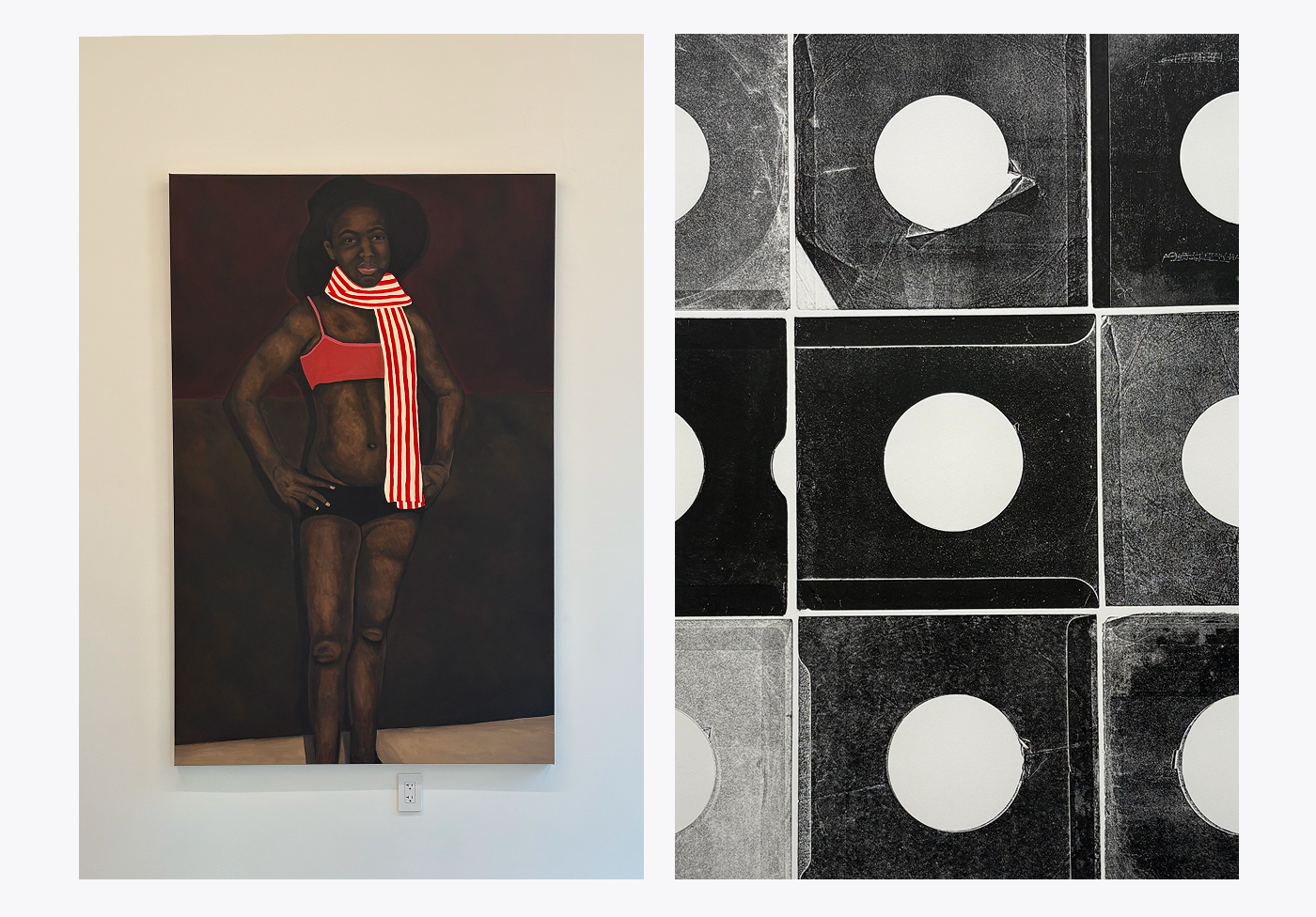
Auudi Dorsey at Jonathan Carver Moore. In his newest and largest work to date, “What’s Left, Never Left,” Dorsey draws on archival photographs and historical records while continuing his research into African American communities and their leisure spaces facing erasure. The work’s bold, often abstract moments of striking color force you to focus on the expressions and humanity of his subjects, while Jonathan Carver Moore’s admirable gallery space advocates for underrepresented voices.
Rebecca Manson at Jessica Silverman Gallery. Time: You Must Be Laughing, Manson’s debut solo exhibition, depicts intricate, larger-than-life ceramic butterflies, moth wings, and flowers. The colors of each individual clay “smush” make up the details of the wings or petals, while, in the center of the exhibition, a molded ceramic-and-glass swing set recalls Manson’s childhood. Leaves, cigarettes, a Funyuns bag, and other playful reminders of youth are scattered across it on the brink of expiration. The sheer scale of the artist’s pieces transports you back to a feeling of smallness and recalls the wonderment of seeing the world not quite as it is.
Christian Marclay at Fraenkel Gallery. For his sixth solo show with the gallery, Marclay focused on the packaging, distribution, and consumption of vinyl records. Comprising prints, collages, and videos, the work proposes new ways to think about music. As a music lover and designer, I’m instinctively drawn to album art, and this abstraction into texture and collage took me right back to my art school days and the excitement of blending existing imagery to create something new.
Suzanne Jackson at SFMOMA. At the age of 82 years old, Jackson is finally getting the retrospective she deserves. Suzanne Jackson: What Is Love spans the artist’s full career, from the 1960s to present day, beautifully capturing her signature use of color, light, and experimentation through her canvasless paintings, which illuminate her experience as a dancer, poet, and theater designer. The almost liquid quality of her suspended pieces, connecting objects of all sorts, reminded me of the Magic Gardens in my hometown of Philadelphia. They’re truly something to be seen in person.
Lee Materazzi at Eleanor Harwood Gallery. Playmate, Materazzi’s fourth solo show with the gallery, rewards presence and patience. Her photographs and sculptures turn “materials that are on hand” into works that are playful and profound — witty explorations akin to Marcel Duchamp’s “Readymades” for today. They’re full of humanity, embracing the emotions of micro-moments that we often forget, yet are confronted with again and again.
Word to the Wise … Additional Bay Area art events to have on your radar include Art + Water, a nonprofit founded by San Francisco-based author David Eggers that will give established artists a free studio space on Pier 29 while teaching emerging artists and offering public programming. Additionally, Further Triennial is set to launch in 2027, focusing on Northern California artists spread across numerous institutions.
|
|
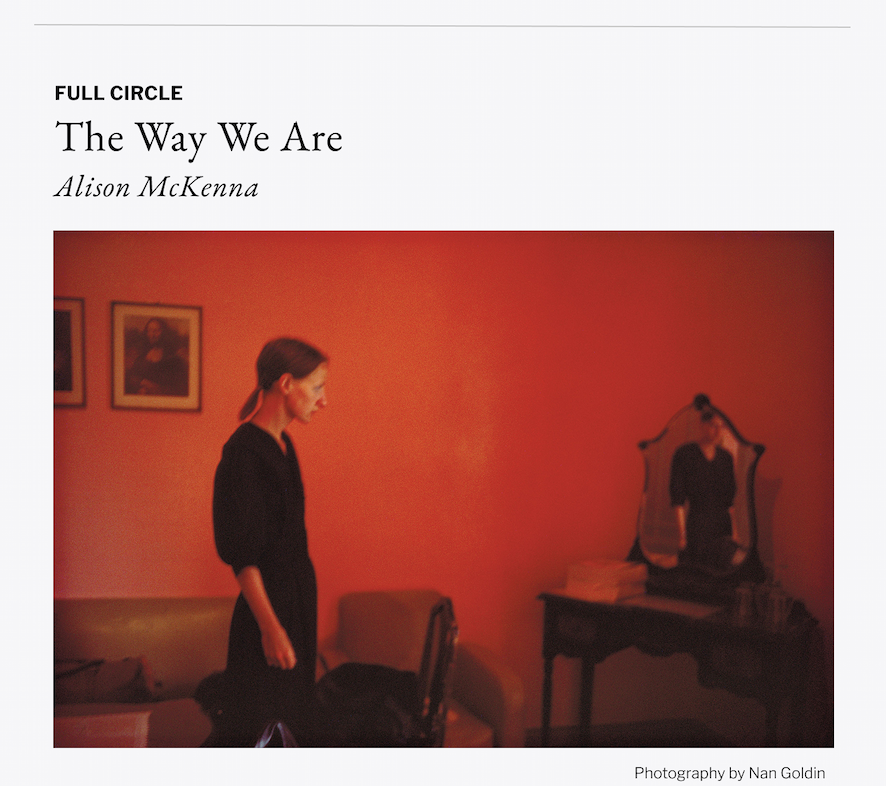
The Ballad of Sexual Dependency is a photographic installation by Nan Goldin, created between 1973 and 1986. First presented as a slideshow among friends in lofts and nightclubs on New York City’s Lower East Side, the work offered an intimate, unflinching portrait of a chosen family living on the edges of love, addiction, desire, and survival. This exhibition at Gagosian, Davies Street, London, marks 40 years since the work was first published as a book by Aperture in 1986. It is also the first time the installation has been shown in the United Kingdom. Installed in an intimate room at Gagosian, the survey comprises 126 archival pigment prints, each produced in an edition of 10. I first met Goldin at the wedding of mutual friends, Egon and Michelle. The afterparty took place in someone’s apartment in Chelsea, Manhattan, though the details are hazy now — it was nearly 30 years ago, in 1996. My husband and I, already deeply familiar with Goldin’s work, were immediately bowled over by her presence: charming, magnetic, and utterly of New York. For a brief moment, we felt as though we had been swept into her orbit — and, in many ways, we had. |
|
That meeting marked the beginning of a seven-year professional and personal odyssey. My husband went on to run Goldin’s studios in New York and Paris, and we eventually lived in her infamous live-work space at 334 Bowery in Manhattan. That Bowery studio was our home for three years; it was also the setting for many of the photographs that appear in The Ballad. What had once seemed like a distant, almost mythic body of work gradually revealed itself as something lived — unfolding around us in real time — beautiful, tender, and profoundly human.
The Ballad documents Goldin’s friends, friends and lovers, and friends’ children over a 15-year period. The work is radically raw; there’s no computer manipulation, no staging, no props. It was always about reality — about getting as close as possible to the truth of the moment. Goldin’s impulse to record everything stems from childhood, from growing up in a family where events were denied or erased. Photography was a way to create an indisputable record.
This is the bottom line of her work: her story and her life, told honestly and without apology. That unfiltered document has since become a celebrated totem of contemporary art, defining Goldin as a global figure. Yet, the work retains its original force — its intimacy, its urgency, and its recurring relevance — unchanged.
|
|
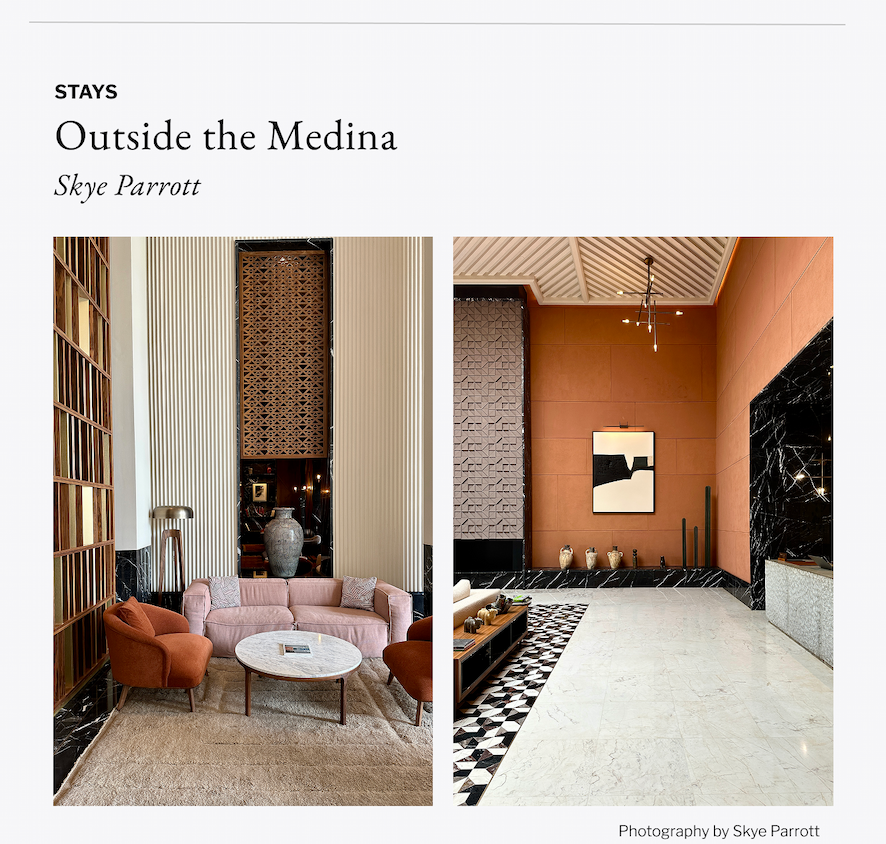
Marrakesh is the first city I ever visited in Africa. I was in my early 20s and I immediately fell in love with it, entranced by how somewhere such a short plane ride from Paris could be so thoroughly and entirely far away. I have returned to Marrakesh countless times in the ensuing decades; it never gets old for me. Part of that is the city’s dynamism, part of it is how quickly it changes. The first time I visited, my boyfriend and I rented a scooter. The urban hum dissolved into red desert almost as soon as we rode outside of the city walls. Now, from Marrakesh’s main thoroughfares, arranged in the points of a star, entire neighborhoods roll out towards the Atlas Mountains. There are subdivisions and luxury resorts close enough to the city to enjoy its buzziness, but removed enough to allow for a decidedly non-urban stay. One of the newest is Park Hyatt Marrakech, which opened in 2024. Set on 17 acres, surrounded by the Al Maaden Golf course, it is a 10-minute taxi ride from the medina but truly another world.
The best view … My favorite space in the hotel is its lobby (above left), designed by Imaad Rahmouni. It’s extraordinary, big and open with soaring ceilings but also eminently cozy. I also really appreciated how seamlessly it mixes traditional Berber elements and craftsmanship with modern design.
My favorite photo … I love this corner of the lobby (above right), which features an abstract painting by Gianni Lucchesi above cacti and Berber ceramics — and, in the foreground, camel sculptures. Aside from being visually pleasing, it speaks to something larger: the property’s mission to bridge the traditional and the modern, contextualing heritage Moroccan designs and crafts within a greater design conversation.
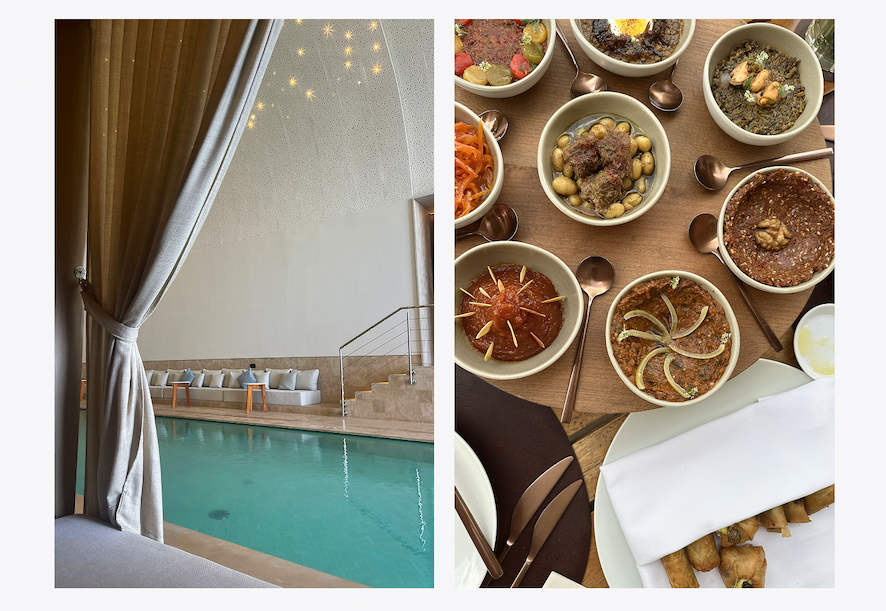
The best thing about the spa … I had one of the best massages of my life at the spa, delivered by a very strong, competent, and attuned female therapist. This photo (bottom left) was taken from one of the cabanas surrounding the large, heated indoor pool. There are also several outdoor pools, including the main one off the lobby and a family pool.
The best thing I ate … The property has several restaurants. This meal (bottom right) was at Tfaya, its Arabesque brasserie, where chef Issam Rhachi reinterprets Moroccan classics. His signature dish is a platter of chhiwates, a Darija (Moroccan Arabic) term that means “tasty food.” In this case, it’s eight to 12 dishes that rotate with the season. The second dish is a vegetable couscous from the restaurant’s sizable vegetarian menu. |
|
The best amenity … I love gardens in semi-arid, Mediterranean climates, like Marrakesh. When I visited in the early summer, the hotel’s gardens were bursting, overflowing with palms, bouganvillea, and a fragrant mix of rosemary, citrus, and olive trees. |
|
I’m not one to boast, but I’m a packing expert. I was born in the American Midwest, was raised in the South, lived in Asia, and worked in corporate America before, ultimately, starting my own designer label, Tibi. I’m a mom and a wife, and while I’ve been to Paris 53 times, I also travel frequently to Dubai, Australia, Chengdu, London, Milan, New Orleans, Vancouver, Prague, and (maybe more importantly) to various hockey and junior competitive tennis tournaments around the country as well as to locales like Legoland. In fact, as I write this, I am overlooking San Francisco, 3,000 miles from my home, New York City. In other words: Trust me. There’s a certain satisfaction to packing smart. I don’t aspire to fit everything into a carry-on, but it is important to me that, wherever I find myself, I’ve packed enough to address every possible weather/dress code/terrain without sacrificing personal style, and that I’m at ease in each new environment. This mission requires understanding yourself and your destination. I’ve distilled my learnings here, with some simple ways to ensure you’ll also get it right. Every time.
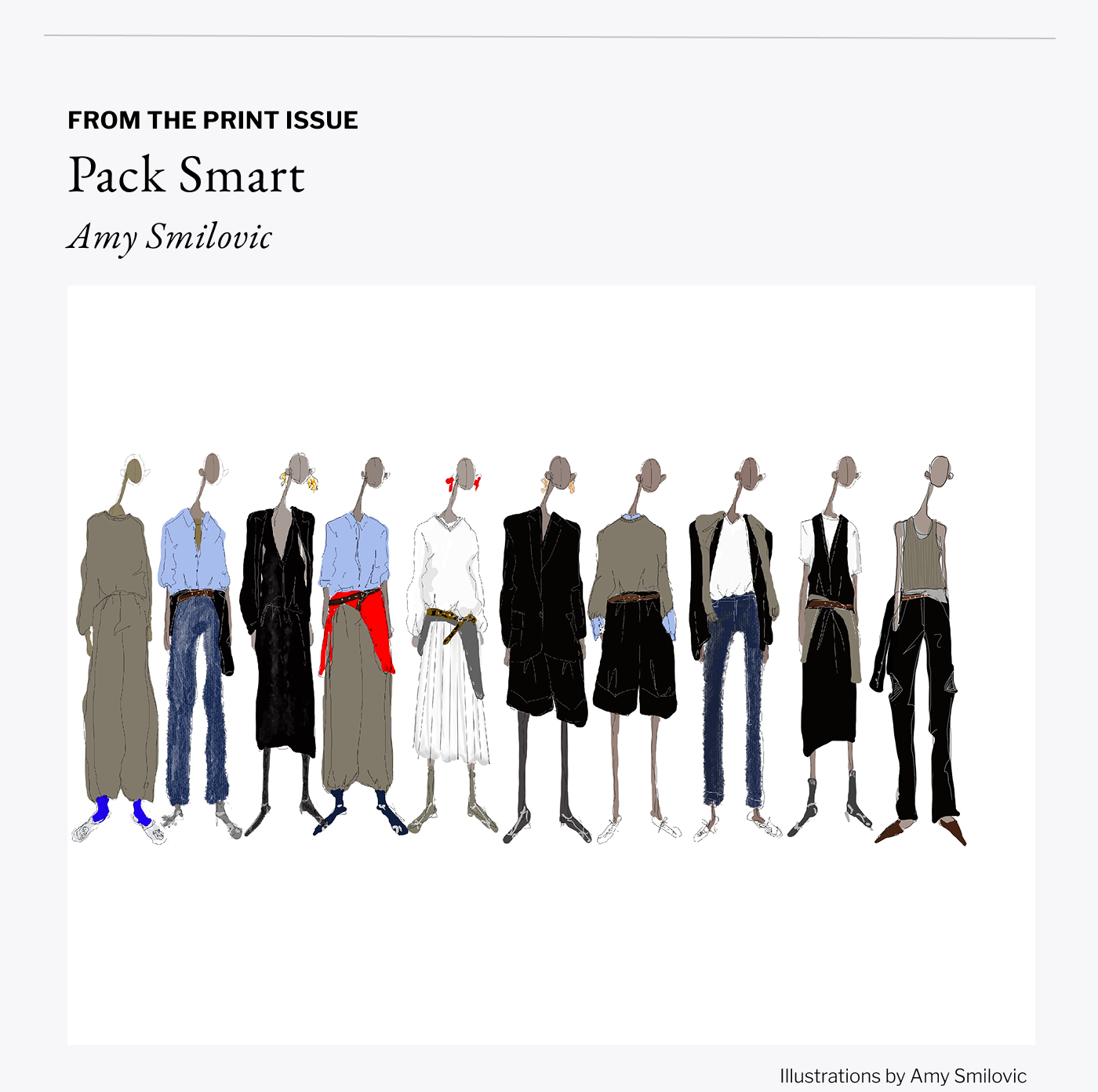
1. Avoid packing “outfits.” Instead, pack pieces that will satisfy The Four T’s: Task, Terrain, Temp, and Tone, which is to say: the activities, environment — cobblestone? cement? sand? — climate, and vibe of the destination and events.
2. Prioritize separates with varying color, texture, and shape. Alternating these elements adds dimension to what you’re wearing and will keep you from feeling repetitive while working with a limited wardrobe. For example: I pack bottoms with a wide shape range: pants that are low and tapered, super wide, or jogger style, plus traditional Levi’s and a pencil skirt.
3. Pack not only to layer, but to delayer. When you take items off, they should be malleable enough to wrap around the waist or shoulders. If delayering requires a coat check or a servant to hold your garments, it’s not pragmatic.
4. Pack items that can be worn at least three ways. PDW (Play, Dinner, Work) applies to packing as well. Pieces that can carry you between activities while helping you feel appropriate is the goal. For example: A blazer takes me from work to dinner to roaming a city to barre class, slung over my workout attire.
5. Carefully consider your strategic additions. Accept what you already have, what you really still need to purchase before your trip (again, noting what you already have), and most crucially: what you’ll buy once you’re there. Do a little research on the heritage souvenirs of your destination and hold space for them in your suitcase. |
|
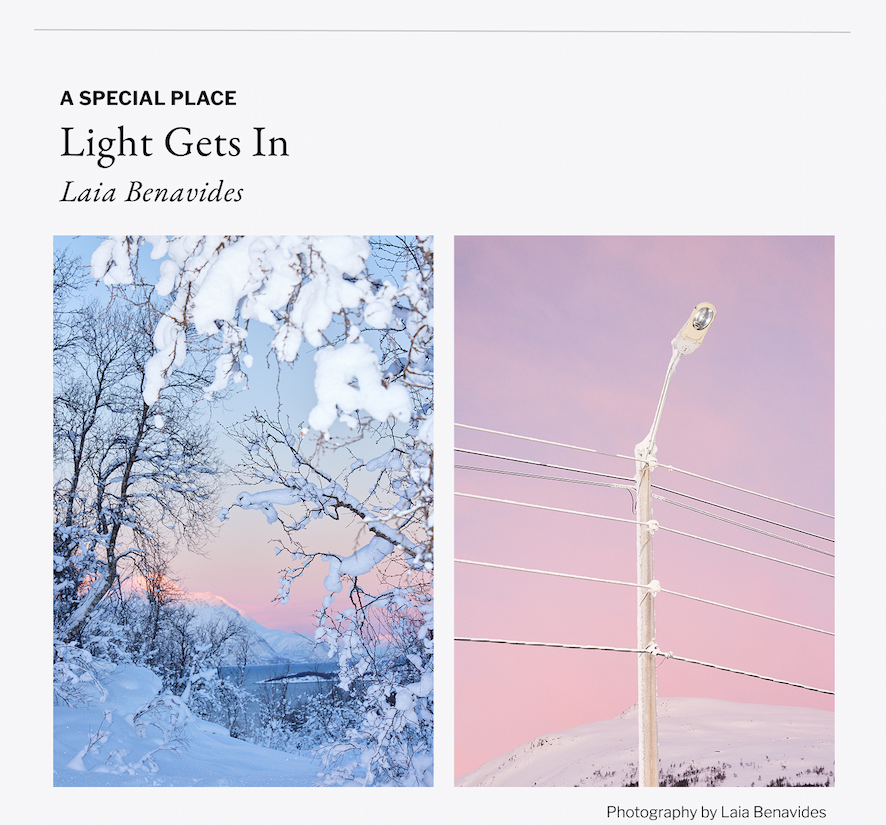
Prior to my departure to Norway, everyone warned me: Don’t get too excited, you might not see the northern lights; it could be cloudy every day. But there was something else that worried me more. I wanted to create a photo report, and what always inspires me when developing a project is light and color. When you travel to the Arctic Circle in November, you have neither. There is almost constant darkness, and temperatures of around –4 degrees Fahrenheit. In the two weeks before the trip, it had been snowing there nonstop. Still, I packed my flash and told myself: Whatever happens, happens. On the plane, we met a girl studying in the city of Tromsø. She told me to lift my window shade to glimpse the last sun I would see for months. In Tromsø, the sun often doesn’t rise for weeks, but it passes very close to the horizon. And that changes everything. You experience strung out twilights. The sky shifts for hours, moving through pastel tones, soft pinks, intense roses, and bright night blues. The snow makes everything blend together; the landscape loses its edges. At night, all color disappears. We only knew we weren’t inside a black-and-white movie when the red lights of a car appeared on the road. We picked up our rental car from the airport and headed to a motel near the Lyngen Alps. Our idea was to spend the night, then leave very early to visit some incredible cabins in the middle of the forest at Trasti & Trine, near the town of Alta. I woke at 7 a.m. to a pink sky and went outside with a coffee in hand. Suddenly, I didn’t feel the cold. I couldn’t stop taking photos. On our drive, we crossed fjords without warning. Out of nowhere, the GPS would guide us onto a ferry, and we would be floating between white mountains and tiny villages made up of colorful houses. We were incredibly lucky: There were no clouds, no snowstorms — just silence, colorful skies, snow, and snow-drenched trees that seemed to have their own personalities. Each was different, as if they were posing. What should have been a three-hour drive lasted seven hours. We stopped constantly to look closely at any detail. Everything was magical. |
|
A Foot Inside the Door. I am generally a “pad around the apartment in my socks” kind of guy who has never had a fondness for house shoes. However, the recent cold snap in New York City, which coincided with a stop by the Hästens showroom, changed my mind. The Swedish company is known for creating some of the world’s most sublime beds and bedding. For those not ready to splurge on one of its heavenly mattresses, these down boots are a comfy consolation. Made from cotton satin and filled with a mixture of goose feathers and down, they are pillowy duvets for your feet — and the ultimate cold-weather accessory for those happy to stay inside. – T. Cole Rachel
Tradition, Evolved. The real luxury of living in Paris is that one of the city’s finest restaurants is just downstairs from my apartment, in a quiet, residential corner of the 17th arrondissement. F rédéric Simonin’s Michelin-starred, eponymous restaurant is a warm and comfortable (yet still very chic) space, where dinner is served in four, five, or eight seasonal courses that change weekly. Calling the cuisine simply “French” would be reductive: It’s rooted in the great techniques of French gastronomy (Think Robuchon-style mashed potatoes) but approached with a fresh, modern sensibility. My favorite dish was the perfectly seared scallops served with topinambur chips and truffle in a yellow wine reduction. – Anna Kaplan
Object Lessons. Aligned with the city’s cultural resurgence, San Francisco’s boutiques are back. My current favorites include menswear brand Evan Kinori’s shop, which is housed in a 100-year-old Victorian building in the Mission District, ideal for enjoying quiet moments surrounded by minimal, thoughtful garments and handmade objects. Modern Appealing Clothing in Hayes Valley is a go-to for standout designs from the likes of Comme des Garçons, Sofie D’Hoore, Casey Casey, and other lesser-known yet incredible creators, while Bernal Cutlery’s two locations serve up chef-grade knives, beautiful kitchen tools, and elevated pantry staples. – Elissa Polls
True Fantasy. The Parisian hotel La Fantaisie, with its Martin Brudnizki-designed interiors, feels both incredibly French and incredibly playful, not a combination you find every day. Its restaurant manages the same trick, serving up classic French dishes — all well executed, all entirely unfussy — in an invitingly colorful and feminine space. On a recent evening, I found myself digging into an excellent scallop carpaccio (brightened by a drizzle of lemon olive oil, it was as pretty as a painting), a mushroom tartelette (creamy, sprinkled with breadcrumbs), and a Black Angus ribeye steak (perfectly cooked, smothered in Béarnaise sauce). Walking past the restaurant’s open kitchen, I may have spied the secret to the deliciousness: a hunk of butter the size of a cinder block. But no matter. What will undoubtedly bring me back is the French fries. Some of the best I've ever had, they were impossible to stop eating, tasting exactly like the ones from McDonald’s smell, but these were real. –Skye Parrott |
|
54 Franklin St #2R NY, NY 10013. ©2026 Dossier Projects, LLC.
|
|
|
|
|