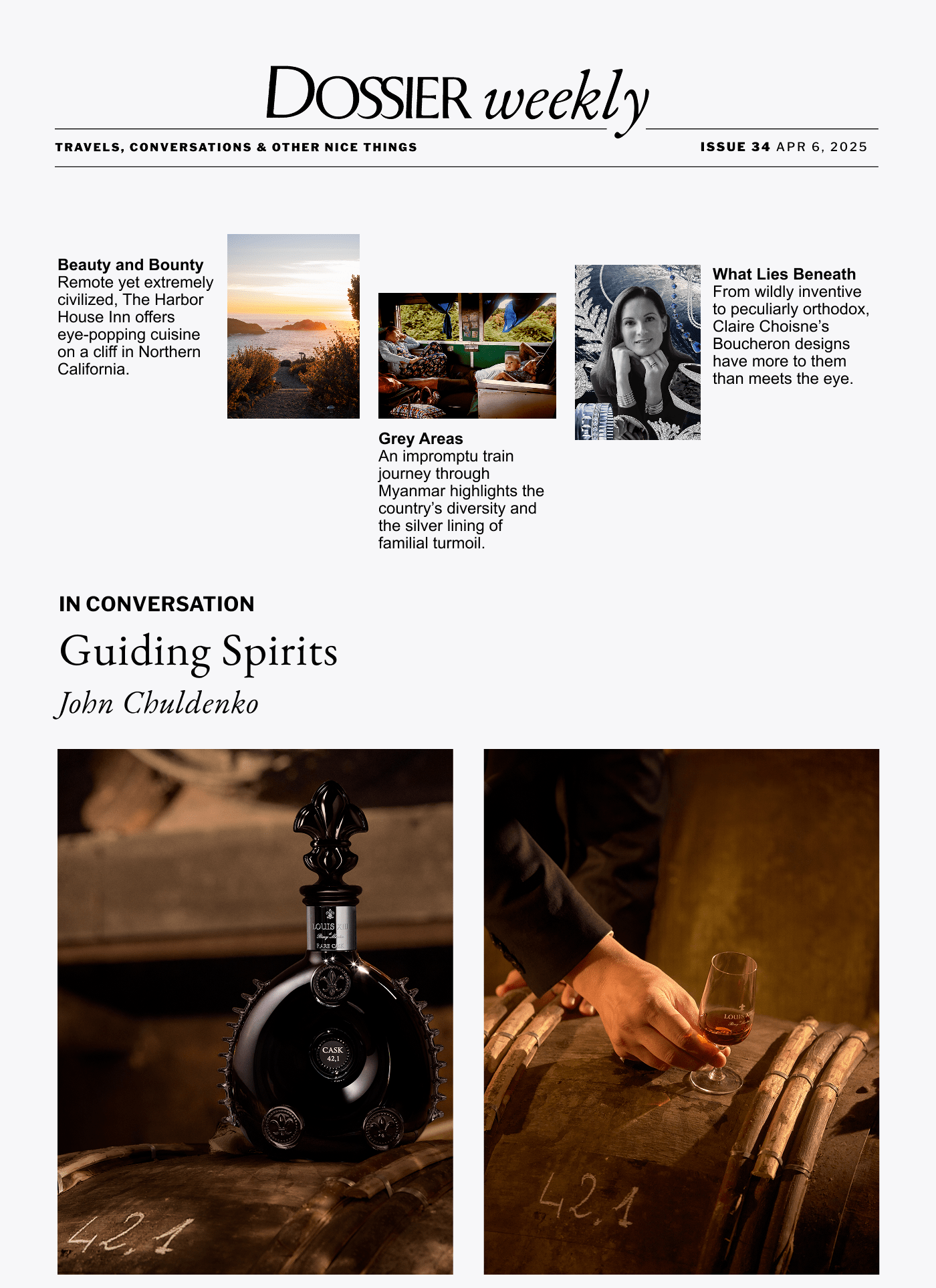
Cellar Master Baptiste Loiseau spends his days in an interstitial space, in a dialogue between the future and the past. Part caretaker, part alchemist, the cognac genius is guided by instinct, surrounded by legacy, and deeply humbled by both nature and time.
The fifth Cellar Master in Louis XIII Cognac’s 151-year history (and also its youngest ever), Loiseau is well aware that his work may not be appreciated for generations. But he’s an artist, a conductor of sorts, blending eaux-de-vie by ear until he achieves the perfect harmony of flavor and fragrance that defines this Rémy Martin spirit as perhaps the most prestigious and elevated cognac in the world. In a recent conversation, Loiseau provided a peek behind the curtain of this enigmatic performance, speaking to his process, challenges, and the house’s newest release, Louis XIII Rare Cask 42.1. JC: When first assuming the role of Cellar Master, did you feel ready?
BL: Inheriting the responsibility of a 150-year-old legacy like Louis XIII is never something you feel entirely ready for. I felt an immense sense of responsibility, but also a thrill, accepting this torch from Pierrette [Trichet], who has always inspired me. This role is a continuous dialogue with the past and the future, building upon the masterpiece I inherited while also setting aside the best of our terroir for my successors. As Cellar Masters, we follow the common quest of recreating perpetually the timeless signature of Louis XIII.
JC: What are the challenges in blending the cognac?
BL: Blending Louis XIII is not about following a recipe, but orchestrating a symphony of flavors that have evolved over generations. The challenge lies in the variability of our terroir and, consequently, of the eaux-de-vie. Each cask holds a unique expression of our terroir and a particular harvest. Predicting how these individual elements will mature and interact over decades is a constant balancing act. I listen to my instincts and let time do its work. Time cannot be rushed, as eaux-de-vie rest in the cellars and evolve to show their greatest facet. We might have an eaux-de-vie that initially shows incredible promise but does not develop the desired depth and complexity during maturation. Maintaining the consistent character of Louis XIII in the face of all these variables is one of the greatest challenges, as it implies acting upon the past while preparing the future.
JC: Where do you start?
BL: The creation of Louis XIII cognac begins in the heart of the terroir of Grande Champagne, the first cru of Cognac. This terroir is known for its chalky soil — that later gives the eaux-de-vie their aromatic complexity and aging potential. The journey continues through fermentation and distillation, concentrating the aromatic essence within each eaux-de-vie. My tasting committee and I meticulously evaluate each eaux-de-vie, searching for the rare gems that demonstrate exceptional aromatic complexity, structure, and the potential for extraordinary aging. This rigorous selection is crucial. As these eaux-de-vie slumber in the cellars for decades, some for a century, they slowly reveal their intricate personalities. While there isn't a predetermined number of casks used for Louis XIII, each blend is an intricate tapestry woven from hundreds of eaux-de-vie, resting for their last years in tierçons, traditional casks of over 100 years old, handcrafted from Limousin oak.
JC: What’s unique about this new Rare Cask cognac?
BL: This Rare Cask presents unexpected and distinctive floral notes of rose, peony, and lilac on the nose, which unfurl to reveal deeper, darker aromas of wax, nuts, and undergrowth. Pleasingly fresh on the palate, Rare Cask 42.1 offers exotic fruits such as pineapple, passion fruit, and orange blossom on the mouth — joined by aromatic herbal notes such as thyme and rosemary. On the finish, we find more subtle notes of chocolate, tobacco, and iris. It is an expression of Louis XIII Cognac I had never encountered before.
JC: How did you approach its creation?
BL: Rare Casks are unpredictable wonders of nature: finding one is an exceptional moment in the life of a Cellar Master, as such a discovery may never happen in a single lifetime. I did not have control over it but decided in the moment this wonder of nature was ready to be revealed to the world.
JC: How did you know this was the one?
BL: I could have never imagined being transported by an aromatic profile that is so meaningful to me; it carried me away, back to my childhood, bringing my emotions to the forefront. I wish for those who have the chance to taste it to feel these same emotions.
JC: How should one appreciate a rare cognac?
BL: Rare Cask 42.1 comes as a ritual set, granting connoisseurs everything they need to serve and present a pour of it. I recommend pouring a half to whole ounce (at room temperature and neat) into the accompanying crystal glasses.
Begin your discovery of the precious liquid by delicately approaching your glass to your nose. Close your eyes and take the time to appreciate the duality between power and delicacy, amplitude and finesse. The journey of senses continues with the tasting of one drop, as one drop is enough to measure its power and discover its facets. Each drop will carry you away to a new discovery until the long finish.
JC: The choices you’re making today won’t be appreciated for many decades — how do you think about legacy?
BL: Legacy is the milestone of my role as a Cellar Master. Today, we are building the future. Knowing my decisions today will affect the results of tomorrow makes my job as challenging as it is rewarding. I am confident in our processes and in the transmission of the legacy of Louis XIII. Being a part of this heritage and savoir faire is so incredibly special.
|
|
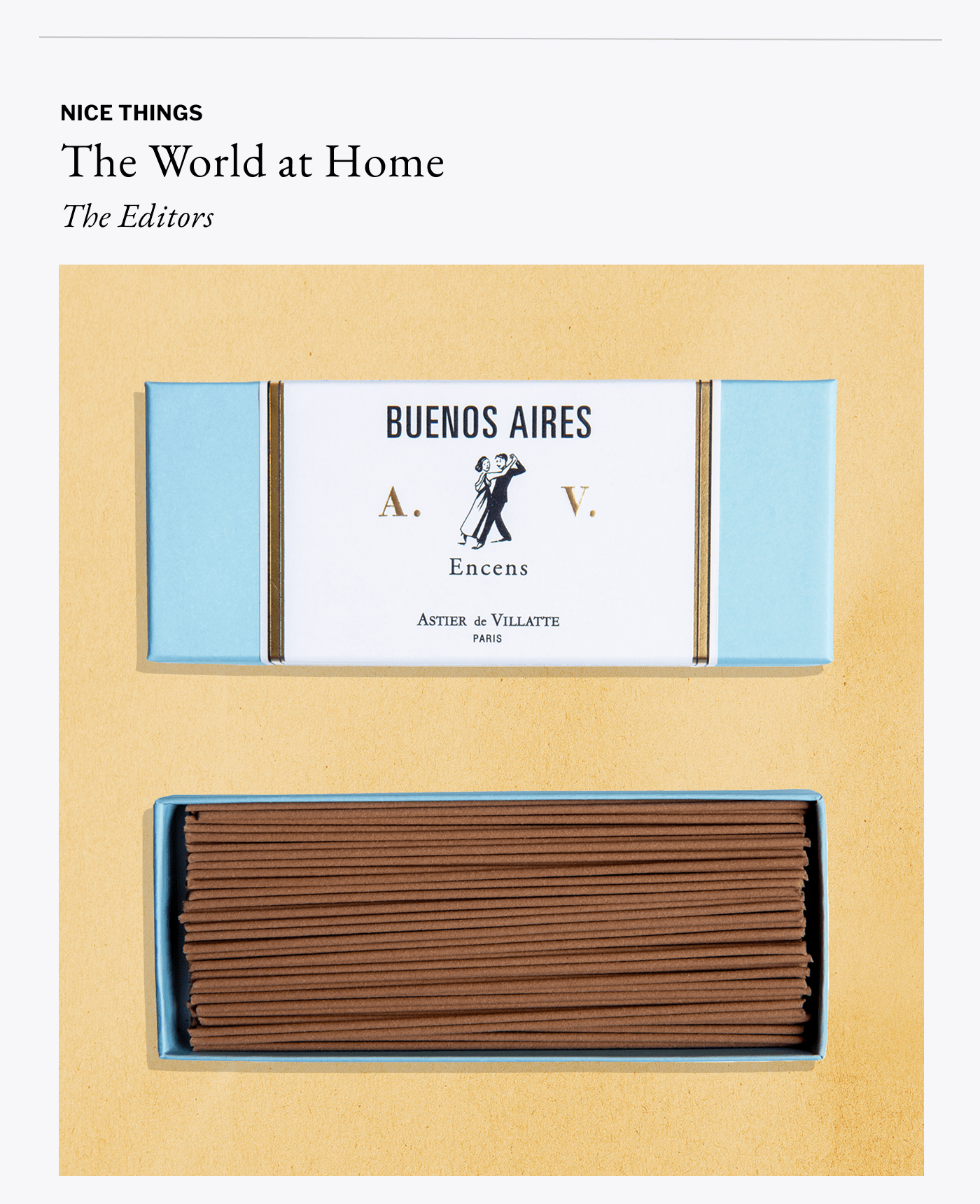
Whether it’s the perfume of heavy spices floating through Jaipur or the smokey, earthy aroma of the American Southwest, fragrance possesses the elusive power to transport us and conjure memories — often more than any tangible souvenir or photo can. The Paris-based workshop Astier de Villatte’s travel-inspired incense collection packages this magic into elegant, flammable bundles. Each stick is crafted using ancestral traditions and techniques on Awaji Island in Japan, recognized as the birthplace of the country’s renowned incense. Astier de Villatte’s Buenos Aires Incense is particularly apt for this blooming season, with notes of pink peppercorn, mandarine, ylang-ylang, rose, magnolia, violet, heliotrope, musk, and tonkato — an intoxicating bouquet that drops you into the white flower-scented streets of the vibrant South American capital on a heady, steamy night. Shake up a clarito cocktail (extra-dry gin and dry vermouth garnished with sugar and a lemon peel) to complete the journey. |
|
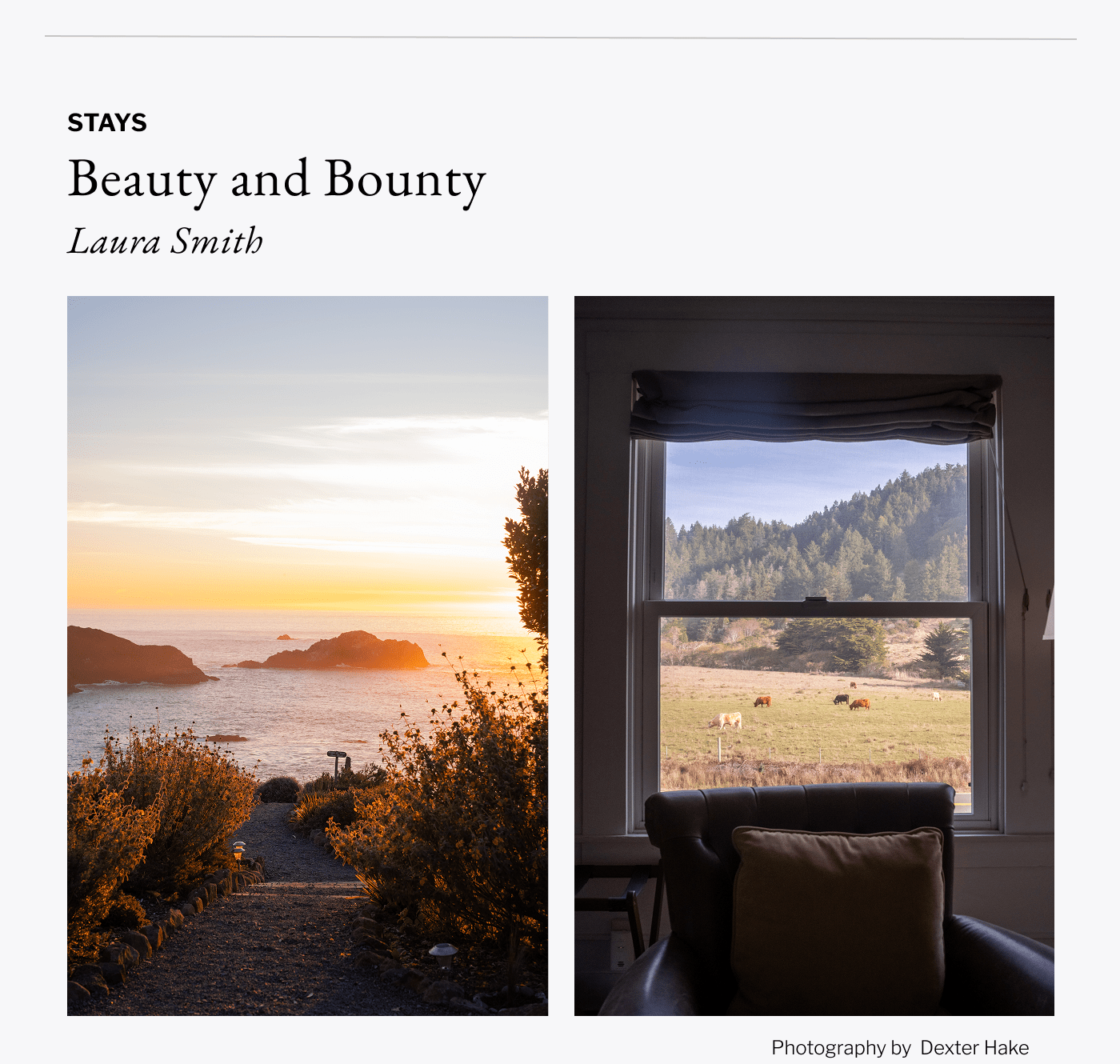
I know more people who want to go to The Harbor House Inn than have actually been. It seems that the small inn in Elk, California, is on every Bay Area resident’s bucket list. And for good reason. Situated on the dramatic Mendocino coast, it’s the picture of Northern California I had in my mind before I moved here: moody cliffs overlooking turbulent aquamarine surf that surges against coastal rock formations. The Harbor House Inn is about three hours from San Francisco and about as wild as you can get in California. The inn itself is gorgeous — a 1916 craftsman-style building designed to showcase the natural beauty of the area’s redwoods. Each room has a classic, vaguely nautical and quintessentially Californian feel, with a cozy fireplace. But the first thing I did upon arriving — before even putting my bags in my room — was to rush down to the inn’s private cove to take in the view. The beach is strewn with iridescent abalone shells and purple sea urchins, and the sound of the waves crashing up close reminds you that you are small and nature is big, and whatever you were worried about before you got here doesn’t really matter. I watched a pair of otters drag morsels from the ocean and hide them on a rock and, yes, the otters were as cute as you’re imagining (those tiny industrious hands!).
There are two reasons people come to The Harbor House Inn. The first is obviously the view, yet the main draw is the inn’s 20-seat, two Michelin-starred oceanview restaurant. Its 13-course tasting menu is mostly derived from The Harbor House Inn's own farm or directly from tidepools visible through the windows. The restaurant even makes its own salt from the sea. My favorite courses: the purple sea urchin over chawanmushi, the mokum carrot that had been braised for three hours and topped with a fava bean miso, and the candy-cap mushroom ice cream. Still, it was really all the little local touches that made the meal extraordinary: the lace lichen, sea vegetables pulled from the cove, edible flowers from the garden. I was 30 weeks pregnant that night and I hadn’t been able to truly enjoy food until that moment. Somehow, The Harbor House Inn restaurant broke the fog of seven months of morning sickness. And what a way to rejoin the land of the eating, if only for one magical night. It’s not easy to get to Elk. The single-lane roads are windy. Some call the inn’s restaurant the hardest restaurant to reach in California. But the best things in life often take some extra effort. |
|
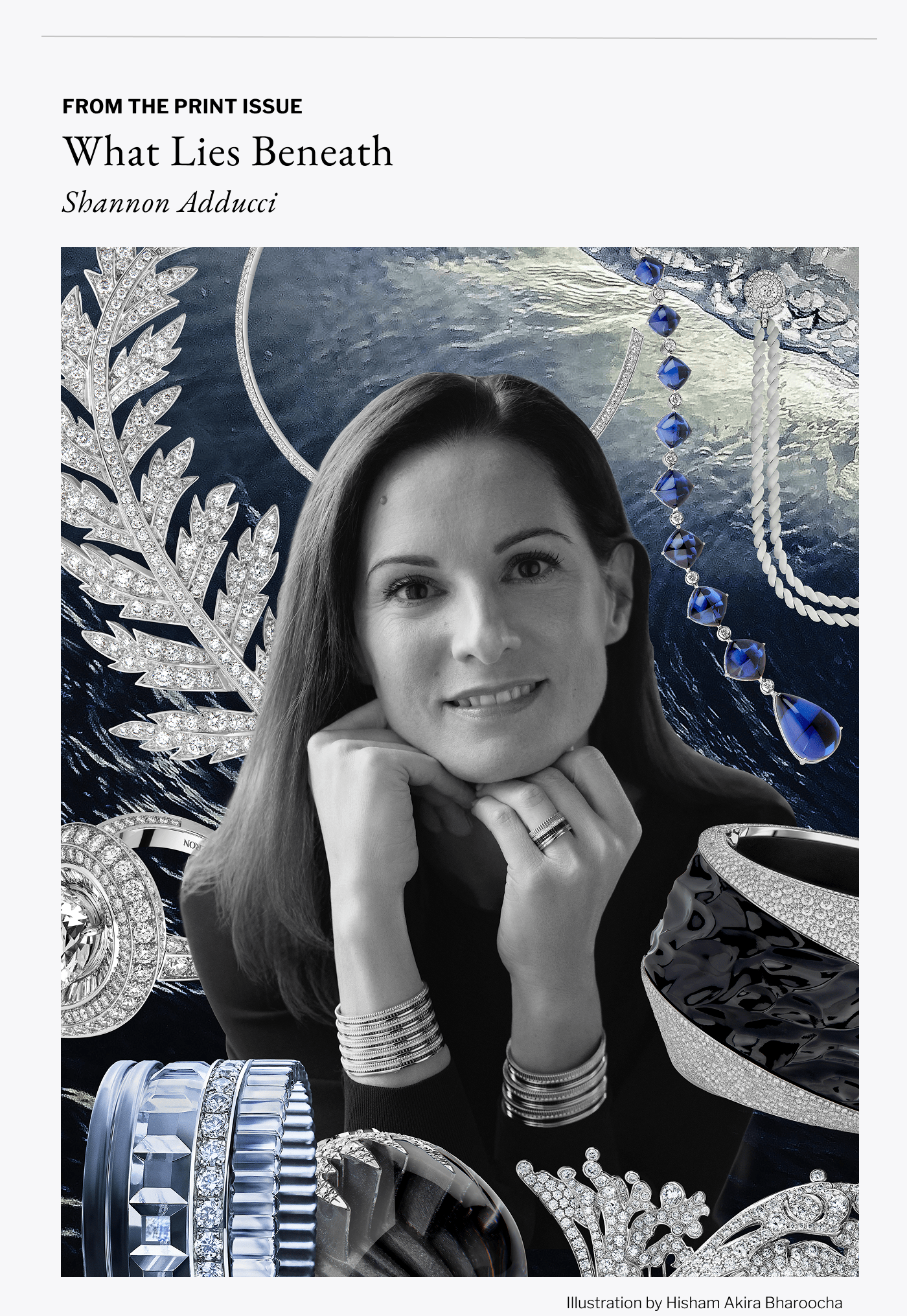
The idea of capturing water came to Claire Choisne during an inspiration trip to Iceland. Choisne has been the creative director of Boucheron over the past 13 years, and she was researching for the heritage French jewelry house’s latest high jewelry collection, Or Bleu. The inspiration eventually led to the creation of a special-edition piece that uses 5D optical data storage (sometimes referred to as “Superman memory crystal”) to record the sound of moving water, depositing the audio inside of ring patterns sculpted into Glassomer (a solid silica nanocomposite that can be processed like a polymer) — all of which sits on a slick but unassuming band. The Nordic island’s black sand also captivated Choisne and her innovation team, who found a German company that could compact the sand using 3D printing and polymer binder, which was precision-sprayed onto the sand in fine layers. The creative director juxtaposed the sand with diamonds to recall the white foam of the incoming tide. Another piece, the Cascade necklace, recreates a different body of water that inspired Choisne: a sparse but vertically impressive waterfall documented in a photograph by Santino Martinez. Choisne and her team of jewelers used 1,816 white diamonds to create the jewel, which measures nearly five feet tall and can be converted into a shorter necklace and a pair of earrings. Choisne’s collections, which take about two years from conception to realization, tap into all of the extravagance and decoration that one would expect from a Place Vendôme jeweler — only bigger and even more elaborate: diamond-dripped bibs, exceptionally rare gemstones and out-there settings, pavéd trompe l’oeil bows and other gigantic pieces in the spirit of haute couture (belts, breastplates, epaulets), plus recreations and reinterpretations of archival pieces. Since 2020, Boucheron has divided its high jewelry collections into two categories: Histoire de Style, which pays homage to its archives and the legacy of the brand’s founder Frédéric Boucheron with collections that play up heritage details, such as the use of rock crystal or the 145-year-old Question Mark necklace; and Carte Blanche, which gives Choisne exactly that to imagine new frontiers of jewelry design and execution.
Even within these more fashion-forward collections, the designer takes a meticulous approach. For example, to achieve a specific hue of red for the Tie the Knot hair jewel in the More is More collection, Choisne and her team worked for months to finally arrive at just the right color, using lacquer, titanium dyed with a cataphoresis treatment, and red bioacetate. “Nothing is ever set in stone, so we must be very agile in our thinking,” explains Choisne. “As we all share the same vision, the way we work is very fluid.”
Read the full article alongside more close takes on a wide world in our print issue. Order now.
|
|
This photograph was taken on a train journey from Yangon, Myanmar, to Mandalay in 2017. I was visiting my sister, who was working for an NGO in Yangon, and, unfortunately, my stay coincided with my sister discovering her husband’s infidelity. She subsequently decided to join me to explore parts of the country she hadn’t yet seen.
We travelled extensively by train, alongside local people from all walks of life. During the long train rides, we unpicked the details of the disloyalty, drawing parallels to our own father’s unfaithfulness, discussing the effects it would have on her young family and how she could control the narrative with her two boys.
Family is the central theme of this image. At the time, it felt like I stole the picture, as the parents lay asleep, entwined; their son awake, gazing into the distance. They exude an air of calm and serenity while speeding through the landscape towards tomorrow’s uncertainty.
This photograph takes me to a special place in my mind, reminding me of that bittersweet time my sister and I shared, something that we wouldn’t have necessarily planned. Even though it was precipitated by unfortunate events, ultimately we ended the journey closer and with a little clarity on her future.
I often come back to this photograph, even more so now that I have a young child of my own. |
|
Fortuitous Connections. On a recent trip to New York, I had two dissimilar friends for two different dinners make reservations at Bridges, a bistro deep in Manhattan’s Chinatown. This wasn’t by chance: The food and the experience are divine. The king crab, lime leaf, and daikon is nothing like you might imagine; it’s even better, and ideally enjoyed with a rosy sparkling gamay. A comté tart with morels and peas is a petite explosion of cream and flake, topped with three sculptural mushrooms and snappy, grassy peas, beautifully complemented by a light, mineraly Austrian red. Delightfully, the precision and elegance of the food are also perfectly paired — with an easy vibe and unpretentious waitstaff. –Erin Dixon
Shifting Sounds. Tamino’s voice and musicality immediately drew me in. The Belgian-Egyptian artist blends Western folk rock and Egyptian influences in hauntingly beautiful melodies. About a year ago, I saw him live with both a rock band and traditional Egyptian musicians, including his oud teacher, who played a mesmerizing solo. His third album, Every Dawn’s a Mountain, which came out last month, features American singer-songwriter Mitski and explores themes of loss and change through nomadic harmonies. His North American tour just began. –Anna Kaplan
Spring Has Sprung. As the first whisperings of spring start to appear in New York, I’m compelled to read poetry — not only because it’s one of the few things that can take me fully out of my mind (which I need now more than ever) but also because poems perfectly articulate the ineffable feelings that arrive with the seasonal shift. Edited and introduced by the 24th Poet Laureate of the United States, Ada Limón, You Are Here: Poetry in the Natural World features 50 previously unpublished works from some of the nation's most accomplished poets, including Joy Harjo, Diane Seuss, Rigoberto González, and Jericho Brown. In the face of global chaos, having this beautiful collection in my bag feels like the psychic equivalent of walking in the woods and letting my soul touch some grass. –T. Cole Rachel
|
|
54 Franklin St #2R NY, NY 10013. ©2024 Dossier Projects, LLC.
|
|
|
|
|