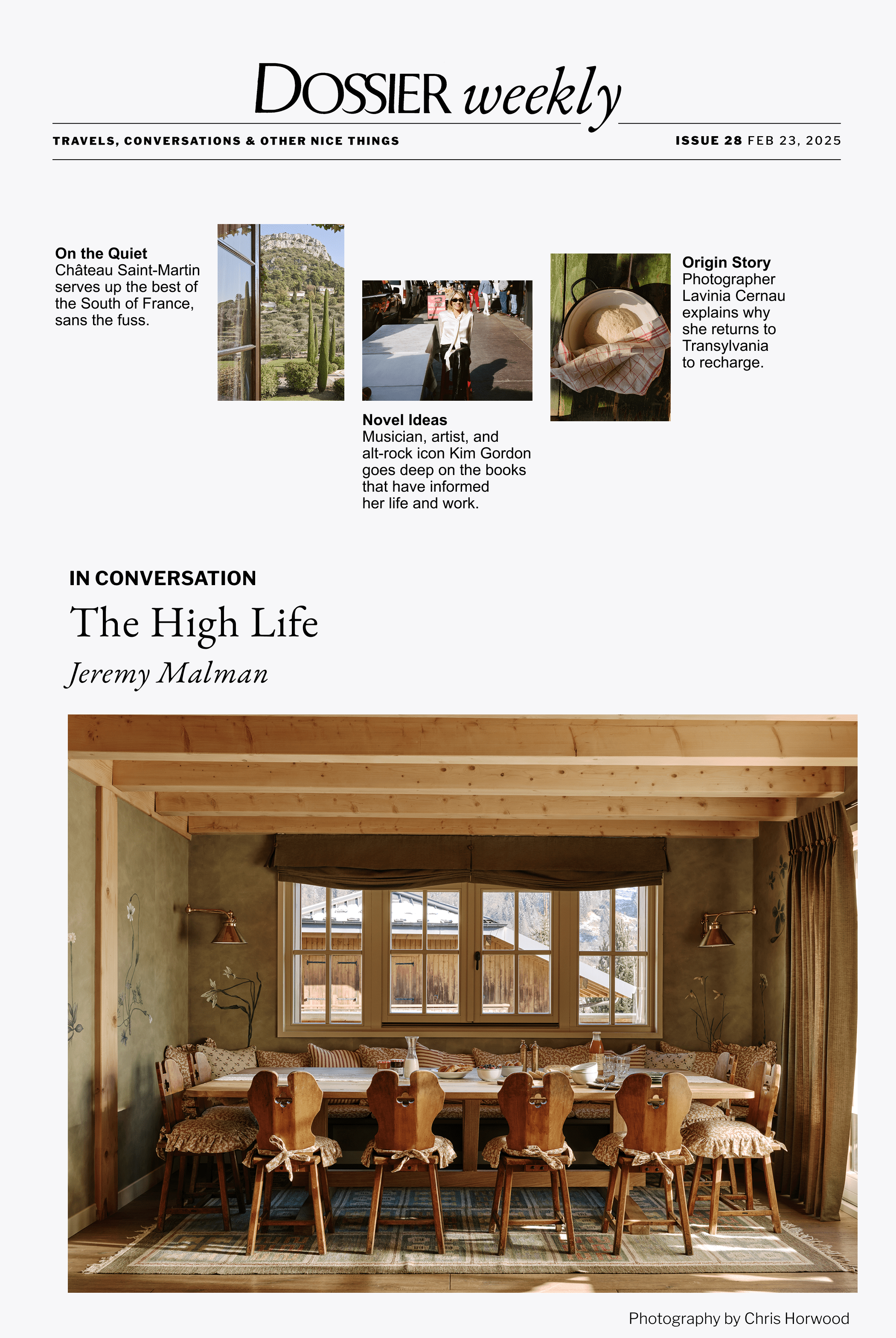
A great hotel stay is measured by the degree to which it offers a reprieve from your day-to-day, allowing you to fantasize (probably) about being the opposite of whatever it is you’ve just flown away from. For example, I like to pretend that I’m old-money wealthy but of course really down-to-earth and low-key about it. I’m well-mannered and well-read, so, although I obviously don’t need the money, I write romance novels in my spare time … in Italian. The specificity of this fantasy, which includes a full head of wavy hair (I’m bald) and the exact number of books sold (which in real life equals none) suggests that I could truly benefit from some time away. A recent trip to Morzine in the French Alps couldn’t sort the hair, but it did tick the other boxes. While there, I stayed at Chalet Sarcleret, a meticulous rental property designed by Nicole Salvesen, a partner at London-based interior design company Salvesen Graham. The home is managed by Alikats, which offers a curated portfolio of catered and self-catered chalets in Morzine, all designed for low-environmental impact. For a few days, the chalet allowed me to be exactly who I dreamed to be, which led me to ask Salvesen a few questions about her background and the village.
JM: Tell me about Morzine. How did you find it and come to design the chalet?
NS: Morzine sits in the Portes du Soleil, a vast ski area straddling the French and Swiss border. It offers fabulous skiing in the winter and a wide array of summer activities, all hard to resist. We hadn’t made a concrete decision to buy somewhere in the Alps, but while holidaying one summer in Morzine, we happened to spot the chalet in an agent's window and were instantly drawn to it. It offered the opportunity to make it our own while staying close to the center of town. JM: Your aesthetic feels sophisticated because it’s not just one thing: The spaces you've created are a lovely, textured hybrid of styles and periods. But I’d like to know what your style was like as a teenager. I didn't Google you, so I don't know when you were born, but I would guess you were into new wave or alternative music, like New Order and The Smiths, and you dressed accordingly?
NS: I would love to fit that mold, but I was more “jazz hands” and musical theatre! I adored decorating my bedroom as a child and a teen, forever changing the layout and painting the walls. I was lucky to have a mother who was a brilliant homemaker but also wasn’t precious, so she allowed me the freedom to experiment. I do think the way I dress and the way I decorate have a synergy; I love to throw an outfit off with something unexpected in the same way I approach a room. I was also lucky to travel a lot as a child, as I was born in Asia and my father continued to live across the continents. My love of color and texture was most certainly influenced by everything I set my eyes on while travelling with my dad.
JM: What’s the best trip you've ever taken?
NS: I think it would have to be my honeymoon. We went to Kenya: to Diani and Lamu — heaven — and then on a wonderful safari in the Masai Mara. It captured a real moment in time and was such a wonderful trip. We were so full of hope, imagining all of the exciting things to come and settling into our new lives together as a married couple.
JM: I tend to get very anxious around travel, especially when doing new things in new places. But on this trip, my anxiety abated because the service was so good. Can you talk about the guest experience you’re looking to create?
NS: When I think about my perfect place to stay, it is somewhere that has all the comforts of home, but better. That was the driving force behind so many of the chalet’s design decisions.
Additionally, we were looking for a team to partner with in Morzine and were thrilled to meet Al and Kat [Judge] from Alikats. We instantly connected with their ethos regarding sustainability and guest experience. I make no secret of my love of delicious food, and Kat has designed a fabulous menu based on the company’s model of locally sourced food cooked in creative ways. Their initiatives also encourage guests to explore greener modes of transport to the Alps, such as train travel.
JM: What’s the worst thing a client has ever asked you to do — and, more importantly, did you do it?
NS: It might sound simple, but we are known for color and warmth, so the worst thing a client asked us to do was create a home with grey walls! And the answer is: Yes, we did. We were in the early stages of our careers, in the days when you are chosen simply because you happened to be an interior designer, not for the specific type of interiors you are adept at creating. Looking back at this — and all of the odd requests from clients (“Can you fill my pond with newts?”) — the ones that challenge you are wonderful. They are how you learn, stretch, and adapt to become a fully rounded designer.
|
|
When Kim Gordon published her arresting memoir Girl in a Band in 2015, she detailed, among other things, her experience as a founding member of pioneering alt-rock band Sonic Youth, her work as a visual artist, the dissolution of her marriage, and a dissection of her California childhood. The book was, in many ways, concerned with the subject of endings, but, ultimately, it signaled a creative rebirth for Gordon, who has spent the subsequent years continuing to write and make art and music, both as a solo artist and as a part of Body/Head. Earlier this year she released a celebrated solo record, The Collective, and has spent most of 2024 on the road. When we spoke, she was packing for an upcoming string of European shows, yet still managed to unpack the books that have most informed her life, work, and thinking.
TCR: Do you remember the first book that really had a profound effect on you?
KG: Yes, The Lonely Doll by Dare Wright. It's a kid's book, but it's kind of creepy. I must've been like four or five when I first saw this book; it's all of these black-and-white photographs of a doll with teddy bears. There’s a baby bear and a father bear, and all of them are placed in these very adult-seeming situations. I forget the exact plot, but the doll shows up and the little bear finds her and brings her home. Later, she gets into trouble by going into this wealthy-looking Upper East Side apartment and getting into the homeowner's jewelry, putting it on. The father bear comes home and I think he spanks her. It’s sort of perverse. But there's something really existential about the photographs that cemented in my mind this idea of what New York was and what a wealthy person's apartment should look like. It also influenced my idea of fashion in a certain way. The book itself is actually kind of depressing. I got a copy of it for [my daughter] Coco when she was little. I remember reading it again and thinking: Wow … This is kind of disturbing.
TCR: What books did you gravitate towards as you got older?
KG: As a teenager, I read a lot of D.H. Lawrence. I think it was because his books had a lot of very sensuous parts to them. They were very sexual, but I also just loved his writing. The imagery is so evocative and almost visceral. I remember loving Women in Love in particular. It’s just such a beautiful book. I was going to reread it recently. I got a copy and started reading the intro and was like: Oh, this is about post-industrialization. Thinking about it inspired the lyrics for a song I then wrote called “ ECRP.” It’s a sort of anti-war song that collects all of these ideas that warn: This is where technology can lead you. Somehow the two were connected in my mind. I probably only started reading D.H. Lawrence because my brother was reading it or something, but I really did like his writing. So much so that I remember doing a watercolor inspired by the book.
TCR: Are there any contemporary novelists you love?
KG: Denis Johnson. He wrote great female characters. I love The Stars at Noon. The whole atmosphere of that book is fascinating. This American woman has gone to Nicaragua in the early ’80s, and there is a coup that is happening, or has just happened. She’s moving around in this very fractured country trying to survive …
Read the full article alongside more close takes on a wide world in our latest print issue. Order now.
|
|
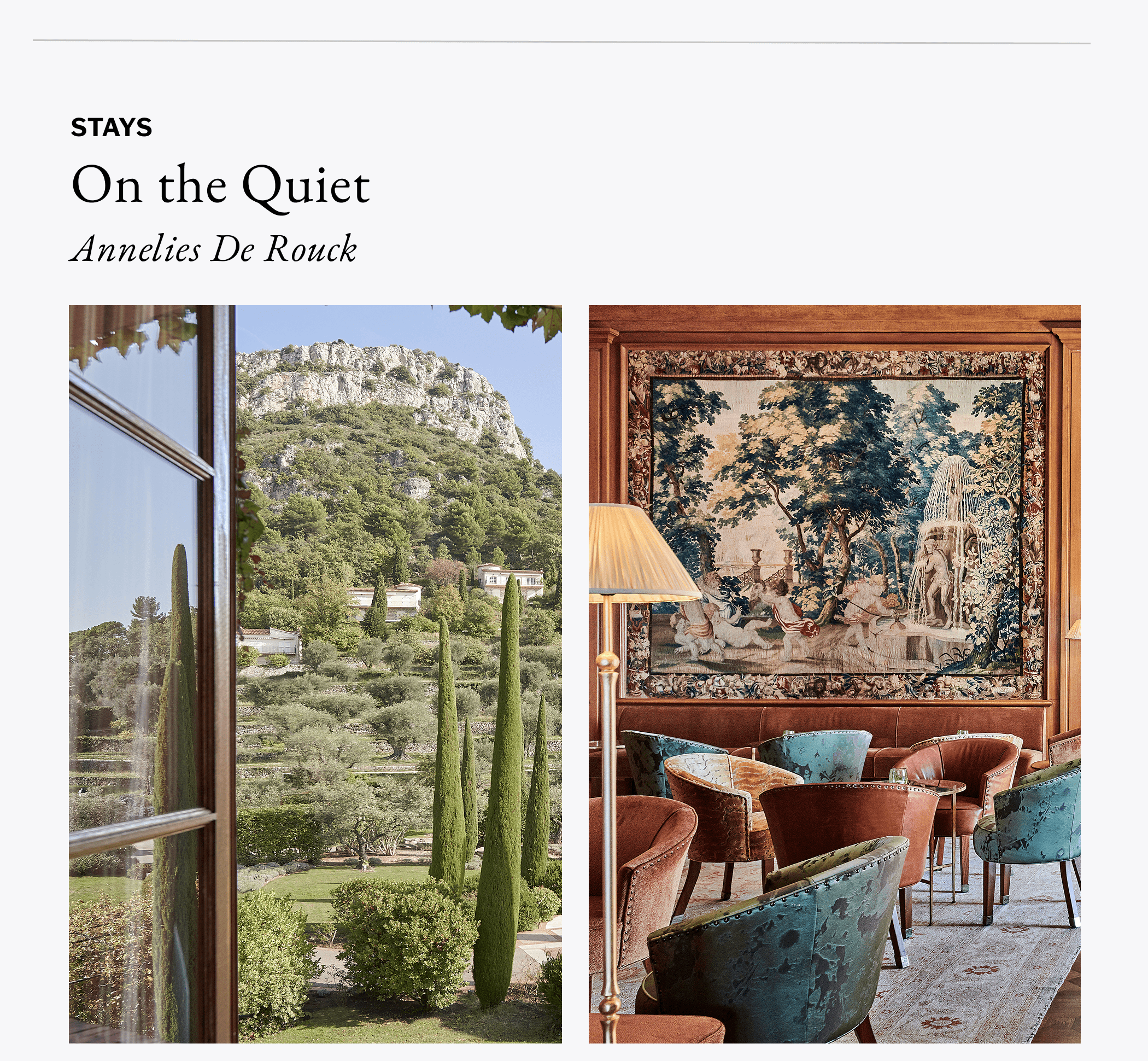
Château Saint-Martin is just a quick uphill drive from France’s Nice airport, but it couldn’t be further removed in spirit from the flashy resorts lining the Côte d’Azur. Discreet and romantic, this is not a place to see and be seen. It’s a retreat from all that. As a private person who isn’t much driven by a destination’s Instagram factor, I found it to be just my cup of tea. In fact, I barely saw anyone there with a phone in hand. Instead, I observed families and couples connecting. I shared the sauna with a mother-daughter trio that had traveled all the way from Australia. I had breakfast next to three generations of an Indian family. The atmosphere was warm, friendly, and conducive to undistracted conversation, which eventually propelled me towards the garden for a quiet ramble. The grounds are beautifully landscaped to accentuate the property’s hillside location, with textured terraces and little nooks adding to its intimacy; I even discovered a somewhat hidden hot tub with a gorgeous vista. Rooms and villas house private outdoor spaces with similarly scenic panoramas. One romantic suite features an outdoor shower hewn out of a rock, with views all the way to the Mediterranean. I also explored the wood paneled bar, which is situated next to a lounge with fireplace, and visited Spa Saint-Martin by La Prairie for an excellent facial administered by a friendly, softspoken therapist. After being happily holed up for 24 hours, I ventured out to nearby Saint-Paul-de-Vence, a lovely historical village beloved by artists, renowned for the legendary Colombe d’Or restaurant, and home to Fondation Maeght (France’s oldest art foundation). This creative provenance is reflected back at the château via a masterful interplay of colors and textiles. Every little detail is considered — the decorator even found an elegant way to conceal the fire extinguishers. And I have saved the best for last: the food. Michelin-starred chef Jean-Luc Lefrançois (who is also a triathlete, making him probably the slimmest chef I’ve ever met) spoiled me at every meal. Light, seasonal, and vegetable-centric, his dishes were indulgent but never heavy. The château’s pastry chef is equally exceptional, baking the best macarons I’ve had in France. |
|
The interior of Le Sirenuse — the iconic family-owned hotel in Positano, Italy — immediately makes a statement. It’s detailed, charmingly eclectic, and unmistakably of the Amalfi Coast. The art and furniture, books and glasses are a big part of what makes the property special; location, service, cuisine, and all the rest notwithstanding. Those looking to bring a bit of the hotel’s impeccable taste home could do worse than the Bora by Carlo Moretti tumblers from its cocktail bar, available via the Emporio Sirenuse shop. Handblown by artisans on the Venetian island of Murano, the glasses are signed and dated — and look even better when colorfully mismatched. |
|
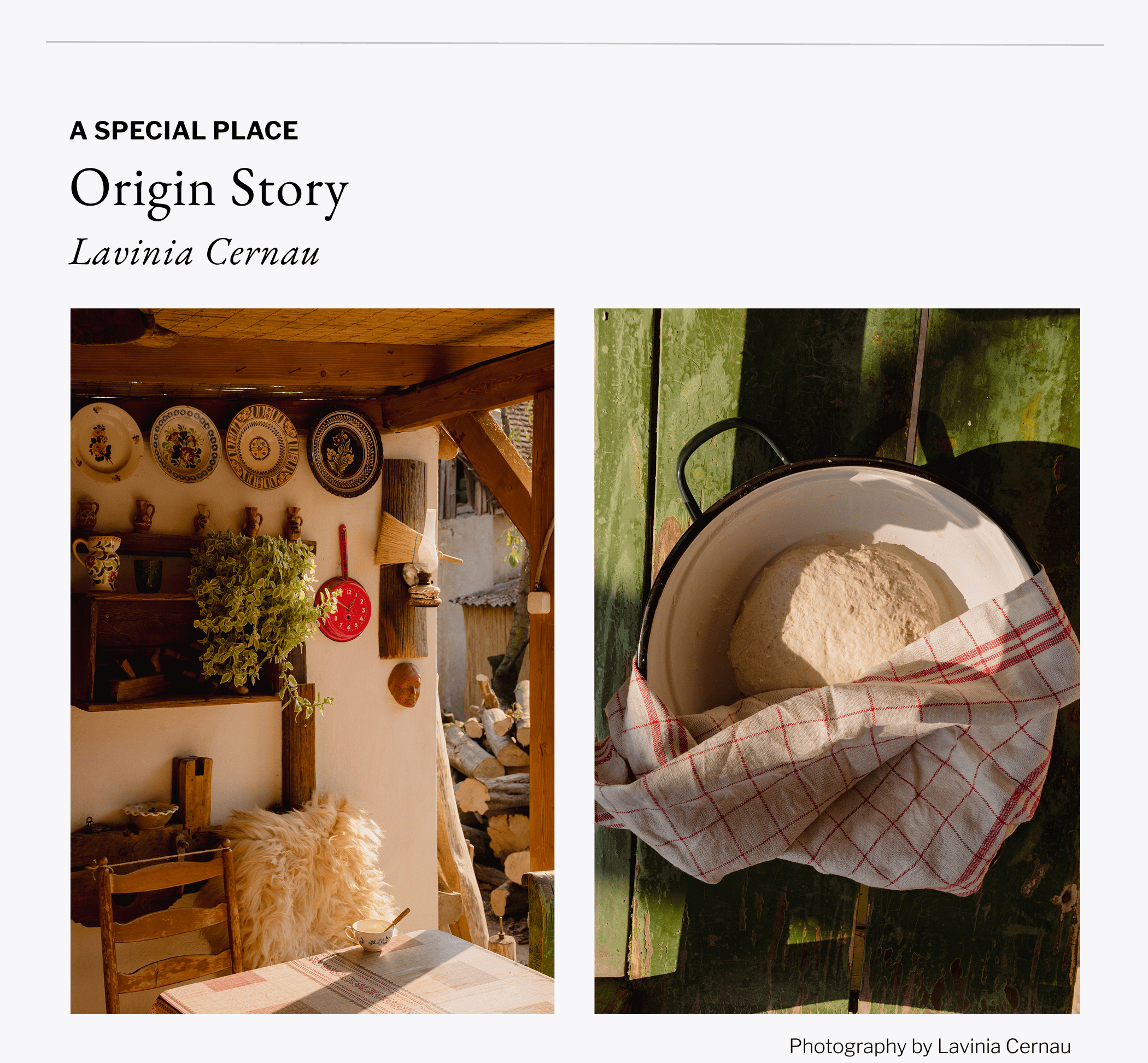
Summer was in full swing, but a storm was brewing at our mountain retreat the day I took these photos. The whole valley sat beneath a heavy curtain of anthracite-blue clouds. Sunset sent its last light across the hill and stopped to rest on the most beautiful white horse grazing under our old mulberry tree. I took a deep breath and relished the moment.
I think it was Plinius (right?) who said something along the lines of "Home is where the heart is." For me, home is idyllic Transylvania, which sits deep in my being and made me who I am today. It’s scenes like this that remind me again and again how beautiful nature is here and how at peace I am when I return.
Freshly baked bread and a cup of coffee in the crisp morning air is another thing I love. Dough will always remind me of my grandma and her gorgeous baking, her slow process and her hands. It's absolutely lovely to return home after all my travels. It is where I recharge and prepare for what's next.
Transylvania, the “land beyond the forest,” is where fables mix with facts. The south of the region is home to many Saxon villages: Biertan, Mălâncrav, Viscri, and Meșendorf are just a few with fortified churches built between the 12th and 15th centuries. Six of them are UNESCO World Heritage Sites, and King Charles III has made the region even more famous by buying several houses in these villages. Both Romanians and foreigners travel to the area to connect with its cultural heritage. Here, you can bed down early, rise with the roosters, admire centuries-old frescoes, and get a feel for a slow pace of life.
|
|
Keep on Truckin'. Over its seven decades, the Toyota Land Cruiser’s boxy charm and unstoppable character have fueled a cult-like following. Driving this latest iteration, configured in Heritage blue with a white roof, I get it. Looking out over the rectangular ridges stamped into the hood feels like adventure (even if those adventures are a 10-year-old sleepover and a week of school commutes). The new Land Cruiser drives delightfully like a vintage truck, floating and bouncing with an air of playful invincibility, transforming even the most mundane of errands into a joyful expedition. –John Chuldenko
This and That. At least once a week, my boyfriend suggests we go out for Indian food — a few years back he briefly lived in Chennai and, ever since, he’s craved its cuisine. Baar Baar, in New York’s East Village, is among our top finds. Its menu features classics, such as samosas and golgappe, as well as reimagined dishes, so we opted for the tasting menu — a mix of both. The pork ribs were a standout, their sweet mango flavor perfectly balanced by pickled kohlrabi. Fair warning: The menu included a lot of food (which I’m happy to report was even better as leftovers). –Alessandra Berge
Kindred Spirits. About three years ago, I delved into the world of sake, tasting everything from junmai ginjo to nigori and researching the spirit’s history: sake’s origins date back to 300 BC. This makes me somewhat qualified to describe Sake ONO, which I recently tried. Its crisp, floral profile boasts notes of melon and citrus, despite the sake being crafted from just four ingredients: rice from Niigata (a northern city situated along the Sea of Japan, where the ONO brewery is located), mountain water that flows through the brewery’s estate, brewery-produced koji, and brewery-made yeast. Shockingly, I was advised to pair the sake with cacio e pepe. It was delicious — the spirit perfectly complemented the pecorino romano’s umami flavors. And with the remaining sake, I made David Tanis’ tangerine sake sorbet, an ideal intermezzo for a winter dinner. –Elysha Beckerman
|
|
54 Franklin St #2R NY, NY 10013. ©2024 Dossier Projects, LLC.
|
|
|
|
|