Back in 2008, the very first print issue of Dossier arrived from the printer on a Saturday morning. I was in my pajamas when I answered the door, so excited as I ripped the box open. I had been working on it for an entire year; I couldn’t wait to hold it in my hands.
I pulled out the magazine, flipped through it, and promptly began to cry. These were not happy tears. They were tears of disappointment. All I could see were the mistakes — the places where the printing was too dark, or the colors hadn’t come out quite right, or the true stuff of nightmares for any editor: typos.
They were errors, but they weren’t really what I was crying about. There is no way anything I unwrapped that morning could have lived up to my expectations, not for the magazine or for myself. I wanted it to be perfect because I wanted to be perfect, and when it wasn’t (because nothing can be), I was heartbroken.
I have spent the ensuing years making magazines, a job that requires a clear-eyed assessment of the work my team and I do. And objectively speaking, I can tell you now that the issue was very good. I wish I could have let myself celebrate. How cool to start a magazine from scratch, in our 20s, and produce something that has stood the test of time. It wasn’t something to cry about. It was a triumph.
The newest first issue of Dossier arrived this year on the first day of December. It was early in the morning again, though I wasn't in my pajamas. I was running through the narrow streets of Cannes, France, where my team and I were attending ILTM, the biggest luxury travel conference of the year. (Fashion friends, imagine if every fashion week converged and happened simultaneously over three days and you’re still only beginning to approach the event’s intensity level.) When I received the package, I paused, remembering that long-ago morning and how I felt. Then I took a deep breath and opened it.
One of the best things about getting older is how so many of the insecurities that were the constant, drumming companion of my youth have fallen away. Rather than crying when I saw the magazine, I smiled. Then I smiled some more. I may have even jumped up and down a little bit, right there on those cobblestone streets.
|
|
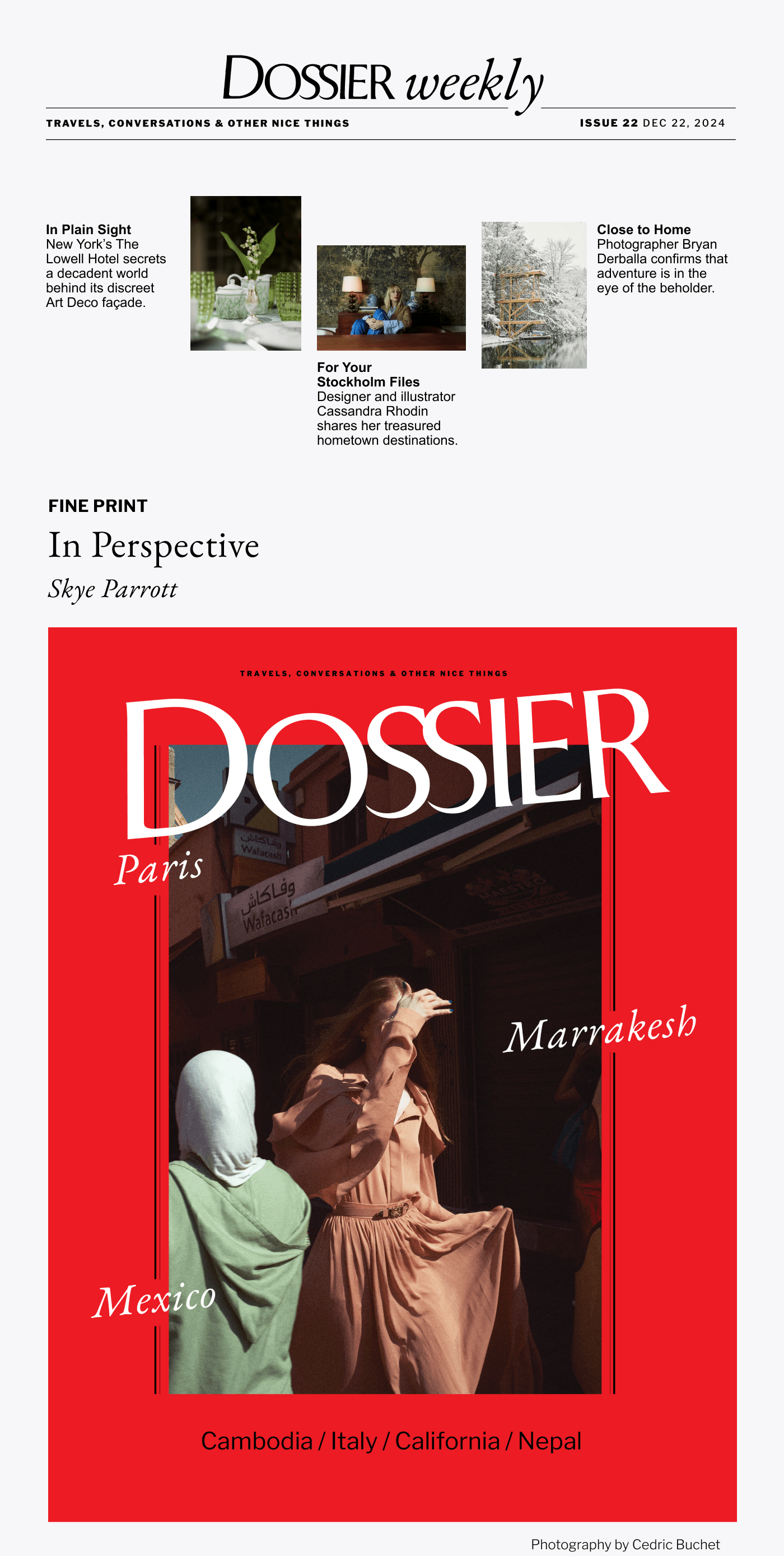
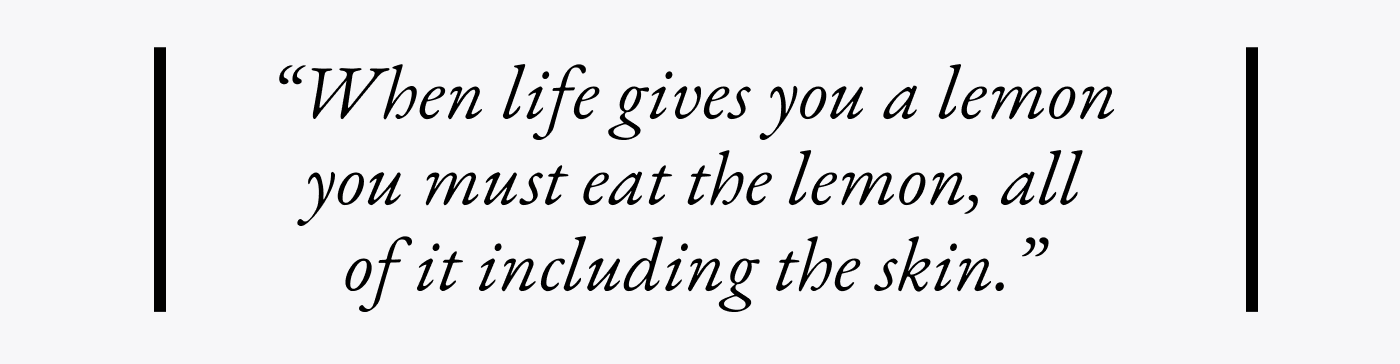
This print edition of Dossier looks great. It continues the work our team did at Departures but imbues it with a fresh, new energy. The issue is beautiful, the stories meaningful, the object big and delicious and something you want to dig into — and then put on your bookshelf or coffee table to save, so you can flip through it again and again, and share it with others. It brings together so many years of our collective learnings about storytelling, balancing creativity, accessibility, and usefulness. And holding it feels luxurious, which is exactly the point; we hope it inspires you to take the luxury of time to spend with it. It is a high note to end the year on, a stark contrast to last year. This time last year felt a little sad. We were wrapping up the final issue of Departures, saying goodbye to a project our team loved, and although we knew what we were going to do next, it was just talk. None of it was real yet. There’s a piece from an artist I adore, David Shrigley. His work is a fantastic combination of bright and weird, and often includes words, which are sometimes silly and other times deeply profound. It says: When life gives a lemon you must eat the lemon, all of it including the skin. I have thought about that line a lot this year (so much so that my husband bought me a print of the work, which is hanging in our kitchen. So now I really think about it a lot). That’s what my team and I did this year. We took the lemons and ate them whole. They may have been a little bitter sometimes and the seeds were definitely crunchy, but now here we sit, at the end of 2024, with something new: a stack of these newsletters under our belt and our first print edition. None of this was achieved alone. It would not have happened without our whole, incredible team, obviously. But it also would have been impossible without so many other people — from contributors to brand partners to agencies to behind-the-scenes advisers, and, of course, our readers. I want to wrap this up with a gigantic "thank you" to each of you for your support. Now, we’re going to do our best to get a little rest for the next couple of weeks before we kick it all off again in January — with many more exciting things to come. And some crunchy lemon seeds, too, no doubt. I’m sure they’ll be delicious.
|
|
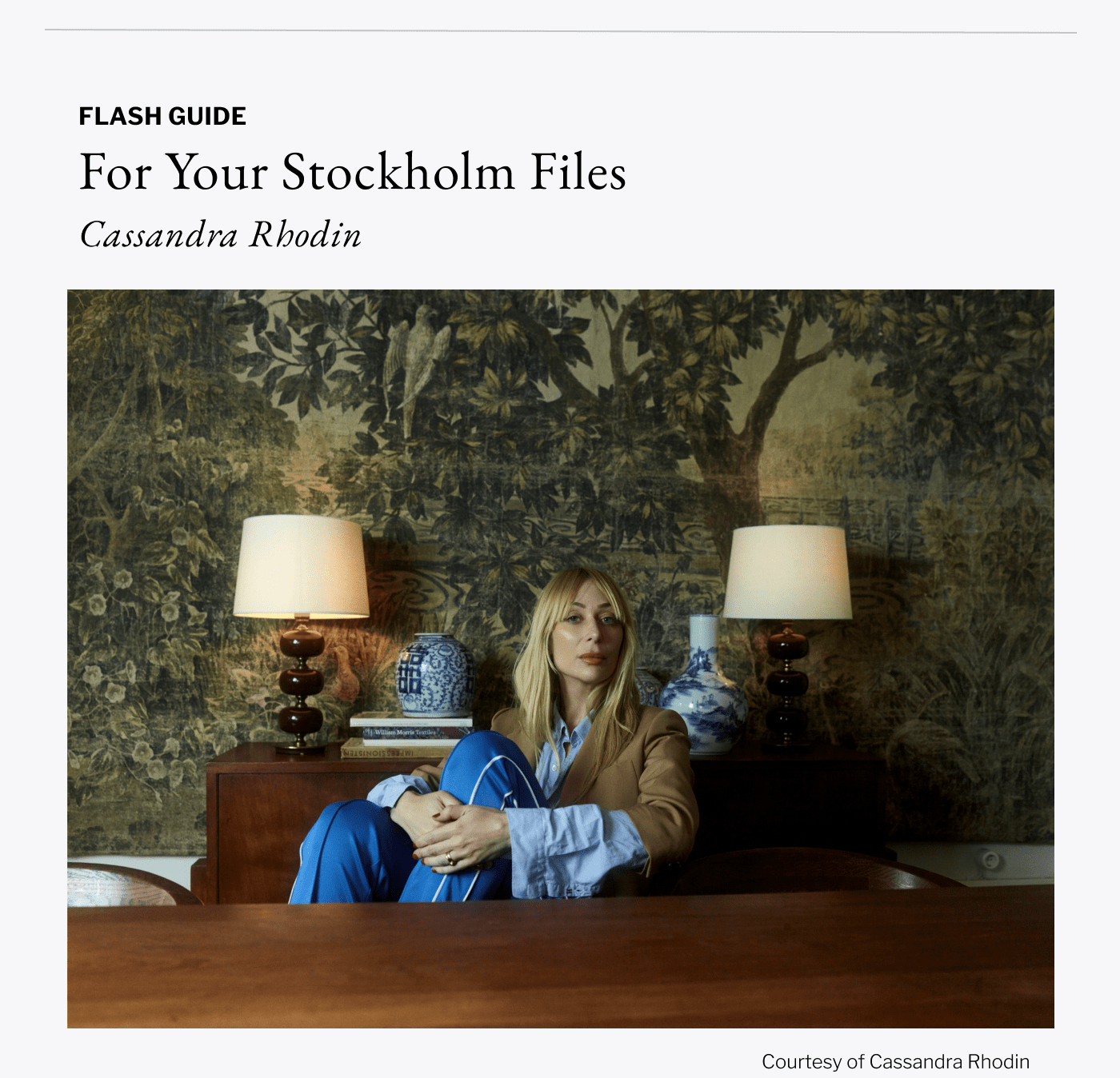
Cassandra Rhodin is the creative force behind Mini Rodini, the Swedish kidswear brand beloved by fashion (and fashion-curious) parents. Conceived with an eye towards sustainability, the brand combines high-quality, comfortable fabrics with delightfully idiosyncratic prints — all hand-drawn or painted by Rhodin, a former fashion illustrator and native of Stockholm, Sweden. Her upcoming spring/summer collection, titled “Stockholm i mitt hjärta” (Stockholm in My Heart), is inspired by the beauty of the city — its waterways, sprawling archipelago, and the rich history that whispers through the cobblestone streets of its Old Town, which dates back to the 13th century. “It’s a tribute to the timeless spirit of the city,” Rhodin confirms, “and to the nature that is present everywhere. Stockholm, in its serene grace, embodies simplicity and understated quality.” Here she shares a few of her favorite places in her hometown.
Something to eat and drink … Östermalms Saluhall is a food lover’s paradise that has drawn Stockholmers and tourists since 1888 with high-quality food and produce from 18 traders, many representing family businesses passed down through generations. The architecture of the building itself is a treat for the eyes. Blå Porten is a restaurant and cafe situated at a historic gate dating back to the 17th century, which was once part of the entrance to the royal grounds. It was a gathering place for the artistic crowd when I was a kid; today, you can enjoy a drink or lunch in the beautiful garden. Also, the greenhouses at Rosendals Trädgård house a year-round restaurant and café. Adults can relax with a drink while their kids roam in the apple garden, explore the labyrinth, and participate in gardening activities.
Something to see … Stockholm has no shortage of gorgeous museums. One of my favorites is Waldemarsudde, which was once the home of Prince Eugen, a Swedish royal, painter, and art collector. The museum presents his collection along with Swedish and international art from the late 19th and early 20th centuries, including works by Sigrid Hjertén, Isaac Grünewald, Edvard Munch, and Auguste Rodin. The museum’s surrounding gardens even offer a fun treasure hunt for kids. Moderna Museet, renowned for its exceptional modern and contemporary art, is also great for kids, offering interactive workshops and colorful exhibitions. I highly recommend their baby painting workshop, where little ones can paint with organic, edible colors made from ingredients such as buckwheat, turmeric, beetroot, wheatgrass, and lingonberry. (Just be prepared for a bit of mess.) Liljevalchs, one of the city’s premier art museums, is home to the legendary Vårsalongen (Spring Salon), which has been a beloved tradition since the 1920s. You can also spend an entire day in Royal Djurgården, which has plenty of restaurants, cafes, museums, and lush, green areas. Enjoy a scenic walk by the water from the city center or take the small ferry from Södermalm (Old Town). In the summer, don’t forget to bring your swimwear! Swimming in Stockholm is a uniquely enjoyable experience thanks to its clean waters, natural environment, and variety of easily accessible swimming spots.
Something to take home … A custom remix of Abba songs featuring you singing the band’s greatest hits alongside holograms of its members — available at Abba The Museum.
Only in Stockholm … Stockholm is surrounded by water on all sides. I recommend taking a boat ride (about one hour) to Birka, Sweden’s first Viking city, located on the island of Björkö. Built in the 700s, Birka is now a UNESCO World Heritage site. It offers fascinating insights into the Viking way of life, with extensive archaeological excavations that have revealed a great deal about the historic settlement.
A secret place … Fjällgatan is one of my favorite spots in the city, and it’s all about the view. Walk up the charming hills of Södermalm and enjoy an ice-cream while overlooking the Baltic Sea, Old Town, and Djurgården. But make sure to buy your ice cream at the right place: the small yellow kiosk with homemade Italian gelato. |
|
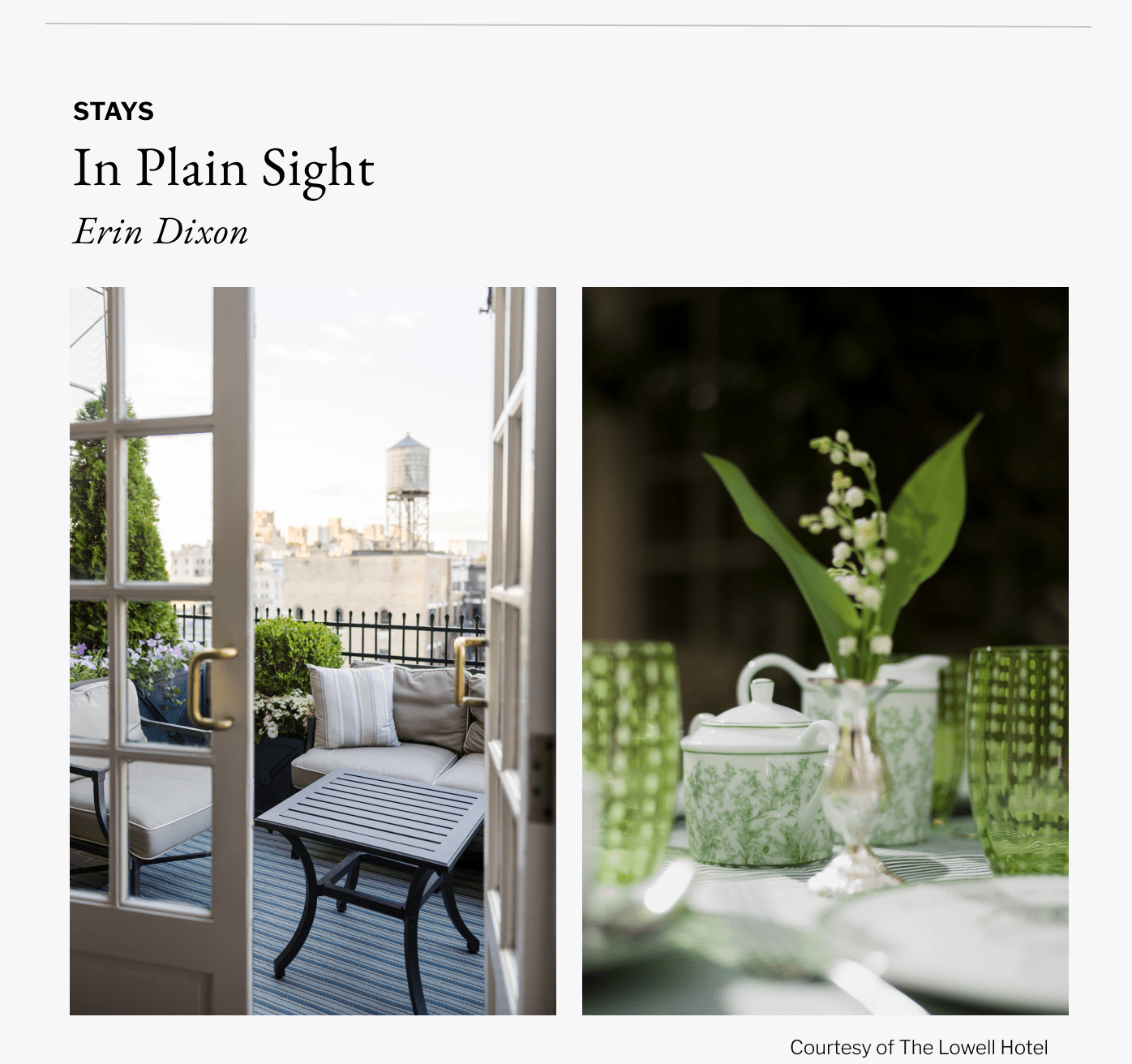
An American transplant to Amsterdam once told me that among her biggest cultural surprises was that the Dutch consider window curtains to be suspicious: “What would you need to hide?!” her characteristically direct Dutch neighbors asked. It seems a convenient stance, given the human inclination for voyeurism and the unassailable truth that glimpsing opulent tableaus secreted behind modest facades is a gift of big-city living. The Lowell Hotel — tucked into a (relatively) quiet street within Manhattan’s landmark Upper East Side Historic District — not only recalls these clandestine pleasures, it also invites you into a remarkable one, as validated by scribbled notes from my visit: Don’t be fooled by The Lowell’s modest façade. This is the place where old New York, which is to say Old World glamor, remains the standard. Which is not to say the property’s façade is lacking. The Lowell has resided within an Art Deco landmark structure since its 1927 inception, an exterior the property has impeccably maintained. Still, it’s the interior that makes the place — starting with the subtle floral scent that greeted me upon entry and the weighty tasseled room key I received at check-in. Turning it to open door 15a, I encountered a still life-worthy tableau featuring wine, fresh fruit and flowers, and a handwritten greeting from the hotel’s manager. My suite’s genteel entry room was joined by a generous living room and oversized bedroom. In each, weighty fabrics, noble antiques, stocked bookshelves, and water tower-crowned cityscapes juxtaposed, bestowing the space with a distinctly Upper East Side brand of cultured restraint and a residential feel — like a Gilded Age pied-a-terre. To the point, nearly half of The Lowell’s 74 guest rooms and suites boast functional wood-burning fireplaces, complete with a fireplace butler who sets the blaze to suit a guest’s choice of “warming scents and spices” and accompanies it with wine and bespoke snacks prepared by the hotel’s chef de cuisine. Stuffy would seem to be the obvious undertone of such an environment, but that’s where The Lowell’s savvy comes into play. Its staff radiates the no-nonsense kindness of real New Yorkers, and in 2017 the independently-owned hotel unveiled a sweeping renovation that reimagined the first floor, spanning its lobby, The Club Room, Jacques Bar, and Majorelle Restaurant. Along with the redesign came fresh programming inspired by the past, such as seasonal cocktails in Jacques Bar rooted in the space’s muse, the designer Yves Saint Laurent’s famous Marrakech gardens. Likely not coincidentally, another offering introduced this spring was the Dior Lily of the Valley Afternoon Tea in Majorelle Restaurant. (Saint Laurent, of course, famously took over Dior’s namesake atelier at the age of 21 after the latter’s untimely death.) I enjoyed the tea in the restaurant’s year-round atrium garden, where a colleague and I chatted over a tiered tray of warm scones with clotted cream, seasonal English tea sandwiches, and petit sweets served with tea or champagne — in our case, both. Along with our order, we received insight into the tea’s inception (created in collaboration with Dior Maison) from our New York born-and-bred, French-speaking waiter. The lily of the valley was Dior’s lucky flower, he informed us; the designer sewed a sprig of it into his dresses. When we commented on the waiter’s own lily, worn in brooch form, he told us that his girlfriend had given it to him the day of the tea’s official opening, May Day. Our plates, he continued, were made in Limoges, France, and carry inscriptions of the designer’s quotes. The Dammann Frères Jardin Bleu tea we were sipping referenced Dior’s love of the garden of his childhood home, Les Rhumbs, in Normandy. Painted rose-petal pink, Les Rhumbs also inspired the tea’s Happiness Pink Cake, as the designer’s memories of this home were among his fondest. Seeing the cake regally wheeled out, impeccably wrapped in pink marzipan and trimmed with looping white icing, brought back my own recollections of childhood joy — that of a dessert cart spilling over with decadent pleasures. |
|
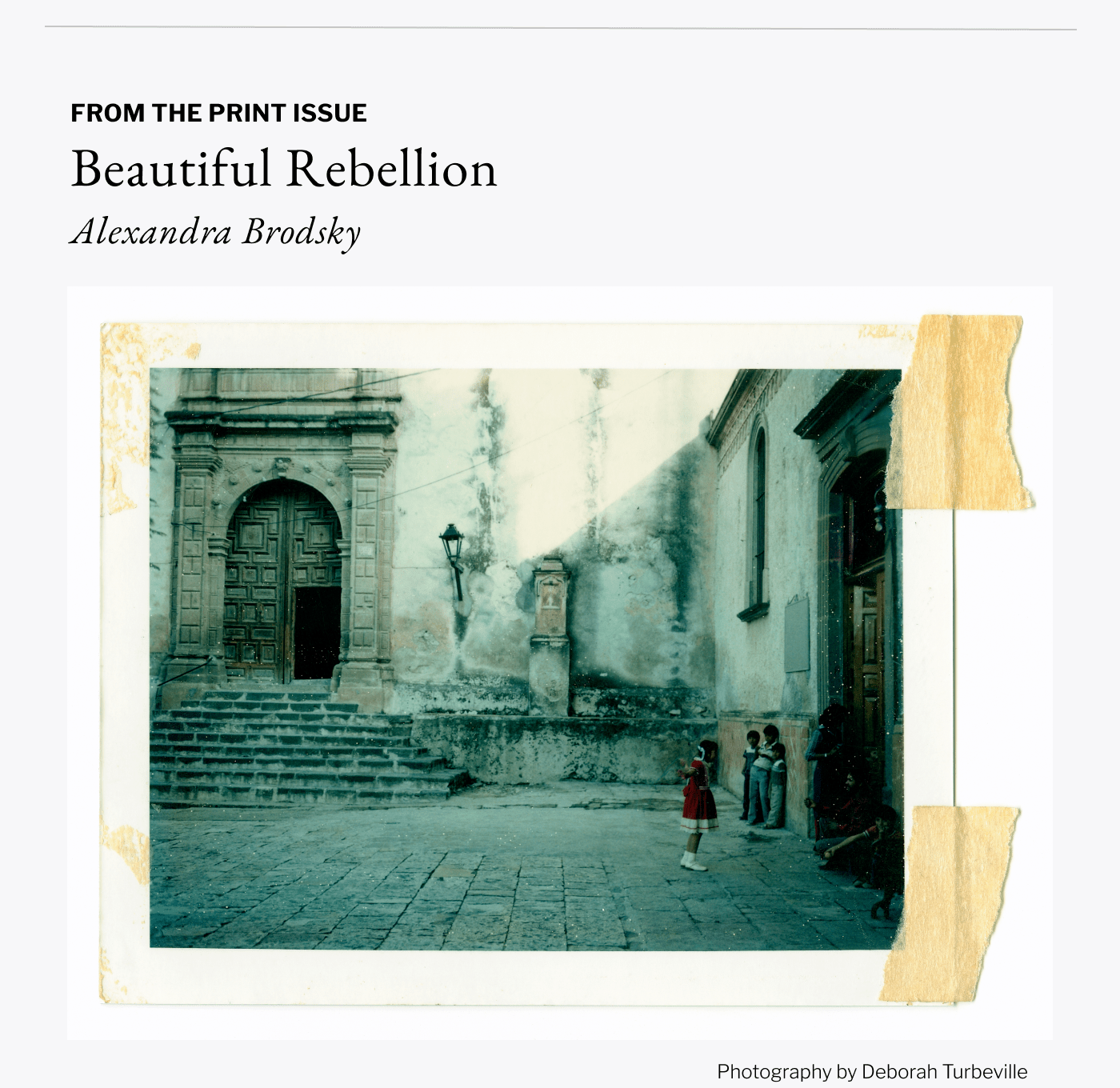
If you followed the tony American and European fashion magazines of the early 1970s, you may have seen some of the era’s seminal fashion photography: Francesco Scavullo’s cover of Raquel Welch in Cosmopolitan, September 1973; Helmut Newton’s “Limelight Nights” series in British Vogue, October 1973; or Guy Bourdin’s 1977 Charles Jourdan campaign. These works embraced a newfound cultural zeitgeist of “female liberation,” with an overt sexual aesthetic. The glamorous women in their photographs held their own in a man’s world (and against a man’s gaze) with glossy lips and long, red nails. Aspirational modern life was depicted in saturated color and slick surfaces, meant as an expression of independence and power. This was fashion photography from almost an entirely masculine point of view.
The brash aesthetic met a direct challenge in 1975 when Vogue editorial director Alexander Liberman commissioned Deborah Turbeville to photograph swimsuits. Turbeville was fairly new to photography at the time, having served primarily as a fashion editor. Legend goes that Liberman told Turbeville he “expected the unexpected” from her. She delivered with her now iconic “Bathhouse” series, published in the publication’s May issue. The story generated substantial controversy: The clothes seemed beside the point; her models, rarely facing the camera, were arranged in odd, slightly macabre poses; the mood is voyeuristic and erotic. And the environment — an abandoned turn-of-the-century bath house — seemed the absolute antithesis of fashionable (some even read the location as an ill-conceived reference to the Holocaust gas chambers, which Turbeville emphatically denied). The images bluntly undermined the era’s fashion photography conventions …
Read the full article alongside more close takes on a wide world in our Fall Winter 2024 print issue. Available now. |
|
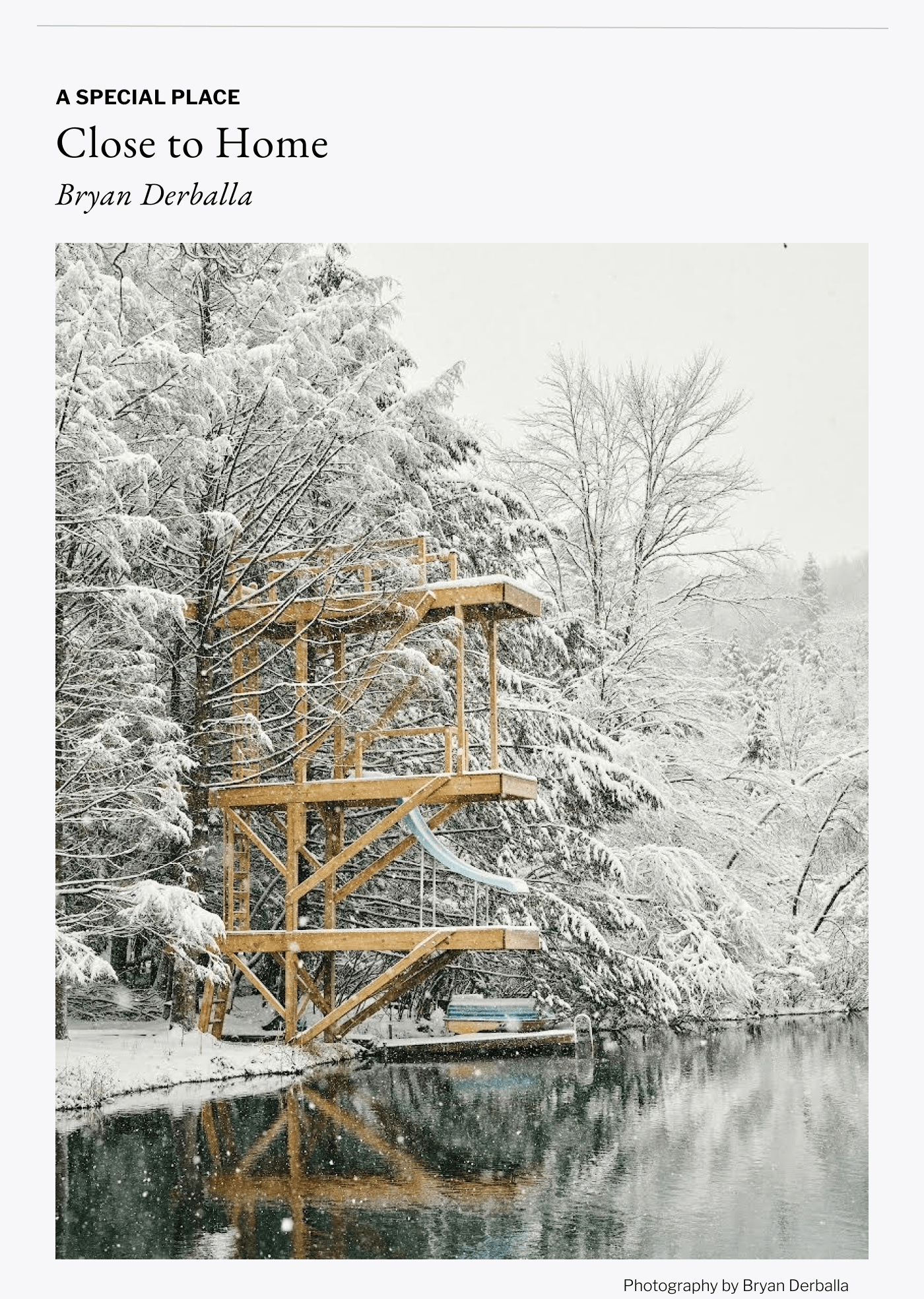
I’ve been lucky to travel to dozens and dozens of countries through my work as a photographer or, simply, motivated by my own cultural curiosities. One of the unexpected benefits of extensive travel is how much it makes me appreciate home. And I’ve spent a lot of time and effort to make my home as fun and exciting as my travels.
My house in the Catskills came with a nice swimming pond, but I wanted to add a little adventure to it, so I built this diving platform. It was partly inspired by the cliff jumping I did growing up in the mountains of North Carolina but also by the Bjarke Ingels-designed diving tower in the Copenhagen harbor. Along with the platforms, I also built a ropeswing, a zipline, and various docks to make the pond a summer hub of activity for my friends. But I like to swim year-round and take cold plunges in the dead of winter, using aerators to keep the pond from freezing over. I particularly like to swim on snowy days, like the one in this picture. As much as I love experiencing new places, I’m just as happy in my own backyard. |
|
Just Add Snow. Los Angeles is a land of make-believe. And while we don’t have a true winter to speak of, braving a 55-degree evening to preview The Fairmont Century Plaza’s Swiss Chalets provided me with an opportunity to don a sweater and play pretend. Arranged on the patio adjacent to the bar, each private chalet seats up to eight guests in cozy après-ski style: wrapped in wood and faux-fur pelts, surrounded by twinkling lights, and joined by a vintage Veuve Clicquot snowmobile. The prix-fixe menu is hearty (especially for LA) with its truffle-finished roasted chestnut soup, duck confit with the perfect balance of salt and crunch, and herb spaetzle (the chef’s favorite). The sharable fondue course is also a must. It’s as close to visiting Switzerland as you can get while remaining in view of your agent at CAA. After a few glasses of glögg, I can imagine this becoming an LA holiday tradition. –John Chuldenko
Case Study. Up until very recently, my idea of living on the edge was to carry my iPhone with no case, because — as I would often point out to people who were amazed by my no-case bravado — that is how they were designed to be used. And then, while taking a phone call and juggling an iced coffee, I dropped my phone on the sidewalk and watched it shatter. So, along with a new phone, I picked up a case, eschewing Apple offerings (I love you Apple, but your phone cases are not great) in favor of Mujjo’s newly revamped Iphone 16 cases. Surprisingly sleek, they’re made with Danish calfskin leather that feels soft and expensive — but not as expensive as replacing a dropped phone — and allows for easy access to all of the new iPhones’ buttons that I still haven’t figured out how to use. –T. Cole Rachel
Into the Light. Nestled in Manhattan’s Meatpacking District, Genesis House is much more than a motor showroom — it’s a cultural hub featuring a tea pavilion, library, and fine-dining restaurant. Every element is thoughtfully designed to honor Korean traditions while embracing modernity. Recently, on what felt like the coldest Saturday of the season in New York, my husband and I visited its restaurant, which is perched on the West Side Highway overlooking the Hudson River through floor-to-ceiling windows. While we could see the cold outside, we felt the warmth created by the inviting environment inside and our two-hour lunch tasting menu, which included sliced amberjack with dongchimi brine poured tableside, wagyu tartare topped with a squid ink tuile, and braised pork soup with noodles and scallions in a rich pork broth. Beneath the restaurant and the Genesis Motor showroom (check out the Electrified GV70) lies the Starscape experience. Open through January 12th, this immersive light and sound installation designed by Ethan Tobman draws inspiration from Dongji, the Korean winter solstice, a journey through the longest night of the year. –Elysha Beckerman
That’s a Wrap. Filson’s Lined Maciknaw Wool Packer Coat is a coat with a capital "C". Hefty, long, lined in flannel, and accentuated by sheepskin shearling, this is a jacket for sleigh rides, Aspen nights, and winter storms — or cold weather brunches in Tribeca. I am a longstanding Filson fan, having found that the age-old company makes items of true high-quality. But this coat takes the cake: a glamorous but gritty menswear item that you can cherish forever. –Alex Frank |
|
54 Franklin St #2R NY, NY 10013. ©2024 Dossier Projects, LLC.
|
|
|
|
|