The Tasmanian Aboriginal people have lived on the island for at least 65,000 years, long before European colonization. While the Palawa descend from the same peoples who first inhabited Australia, the Tasmania group became isolated from the continent when rising seas formed the Bass Strait around 12,000 years ago. The Palawa then developed their own culture and traditions deeply rooted in their relationship with Country. In Palawa culture, Country is a living entity, binding people, waterways, skies, seas, flora, and fauna through a shared sense of care and responsibility.
It is a philosophy I began to grasp while walking through the native bushland surrounding Saffire Freycinet — a luxury lodge located at the edge of the bay inside Freycinet National Park, on the eastern coast of Tasmania — with Mick Quilliam, a Palawa man and First Nations artist. Indicating a rosemarylike shrub, he explained that the plant, kunzea, was prized not only for its distinctive flavor but also for its medicinal properties. Every plant serves a purpose, he elaborated. Nothing is taken without intention, and what is taken is given back, reflecting a relationship with the natural world grounded in reciprocity and balance.
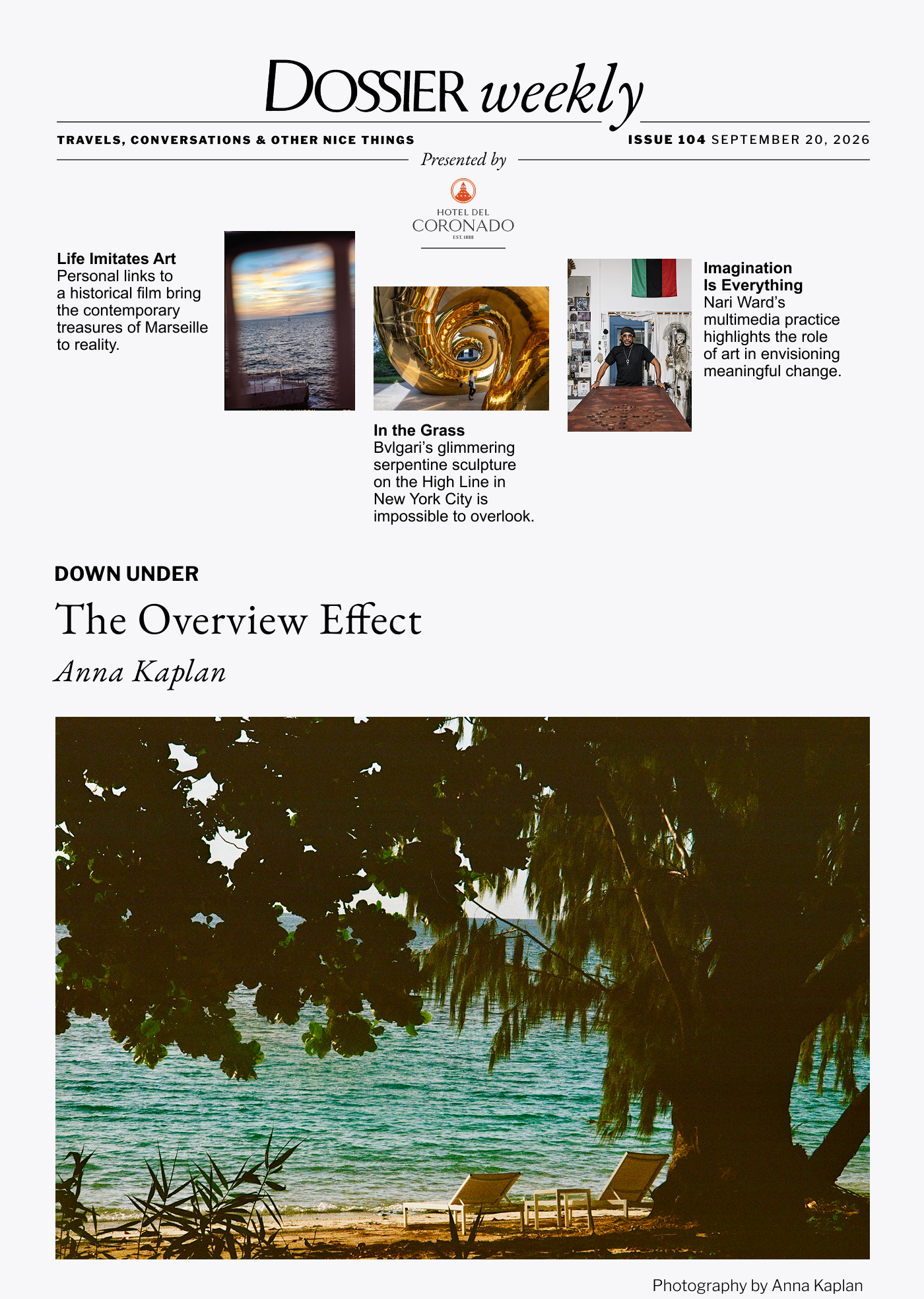
As I continued my journey, from Tasmania’s east coast to the coral-fringed shores of Lizard Island on the Great Barrier Reef and finally to subtropical Brisbane, Australia, I discovered that this attunement was not unique to Lutruwita (Tasmania’s Aboriginal name). It was present at every destination. The region’s spectacular landscape influences the way people live and reveals how Australia prioritizes living in harmony with nature. Just be mindful of the occasional venomous spider and snake. Saffire Freycinet. At Saffire Freycinet, every space is designed to draw your gaze outward, which is not to say that the interiors are not impeccably considered. But they are never the main event. Instead, all eyes are directed toward the Hazards, the pink-granite mountain range rising across the bay. Quillam explained that the volcanic formation is believed to be an ancient goddess lying down, a perspective that lends an even greater sense of presence to the peaks, whose silhouette seems to watch over the entire Freycinet Peninsula. Saffire blends seamlessly into its environment. The luxury here is its connection to Tasmania, to the surrounding nature and everything it has to offer. With just 20 suites — and a private villa coming in late 2026 — the atmosphere remains personal and of the place, with an exceptional restaurant dedicated to distinct local ingredients, such as earthy wattleseed, fragrant kunzea, and cured wallaby meat, paired wonderfully with Tasmania’s other great (but little-known) treasure: its wine. Thanks to a cooler climate than mainland Australia, conditions in Tasmania are often compared to those of Burgundy, France, producing elegant, expressive wines — from taut, characterful pinot noir to peppery syrah and crisp riesling. Freycinet Oyster Farm. My biggest revelation in Tasmania, however, wasn’t the wine — or the wallabies and Tasmanian devils. It was discovering that I actually like oysters. Perhaps the idyllic backdrop of the Hazards played a role. After pulling on waders, a small group of us gathered around a table set directly in the shallow waters of Freycinet Marine Farm. Our guide unfolded a crisp, white tablecloth before revealing a bottle of sparkling Tasmanian wine, limes, Tabasco, and ponzu sauce. Next came the oysters: plucked straight from the lease, shucked on the spot, and handed to us one by one. As an oyster skeptic, I preferred mine with a generous dash of Tabasco sauce. The purists in our group, however, insisted that a squeeze of lemon or lime was all they needed. Lizard Island. Flying over the Great Barrier Reef on the way to Lizard Island Resort, watching immense coral formations unfurl beneath the plane in impossibly turquoise water, I’ve never felt so small. Unexpectedly, it was an incredibly soothing experience. The island — also a national park — lies just an hour by charter flight from Cairns, and the Great Barrier Reef may be one of Australia’s most celebrated natural wonders, home to thousands of marine species, but Lizard Island feels worlds away from its busier corners. Shared only by Lizard Island Resort, a Watson’s Bay campground operated by Queensland Parks and Wildlife Service, and the Lizard Island Research Station, which is dedicated to understanding and protecting the reef, the island offers a rare sense of remoteness, including extraordinary access to and views of the Coral Sea. The Reef. Lizard Island Resort is the only all-inclusive resort in Australia located directly on the Great Barrier Reef, allowing you to step straight off the beach and into the reef. My spacious suite opened directly onto the sand, bordered by waters teeming with extraordinary marine life: blacktip reef sharks, stingrays, bright-blue starfish, and the occasional sea turtle. Venturing further to the outer reef to snorkel, I was met by a vibrant world of coral and tropical fish, discovering a new species around every corner. Nothing quite compared, however, to the thrill of spotting a baby blacktip reef shark gliding gracefully just a few feet below. Brisbane. After the quiet and calm of Lizard Island, stepping into the bustling Queensland capital felt disorienting, like being pulled from a beautiful dream. Yet, what I found was a tropical oasis of another kind. The Calile Hotel could best be described as a temple of serenity. Its soft, modernist lines, pastel hues, and open-air spaces create a sense of calm. The hotel projects the warmth of a home and is, in fact, a family affair. Catherine Malouf works alongside her two brothers, Cal and Michael. More than just a sumptuous place to stay, with several restaurants and bars that have become destinations in their own right — notably the property’s Greek restaurant Hellenika and nearby CBD Middle Eastern-inspired Golden Avenue — The Calile is the heart of the James Street precinct in Fortitude Valley. Once an industrial area, James Street now brings together Australian fashion labels, design stores, galleries, cafes, and acclaimed restaurants within a leafy, walkable setting. There is a harmony here between architecture and nature, the clean geometry of the buildings softened by palms, gardens, and the warmth of Brisbane’s subtropical climate. |
|
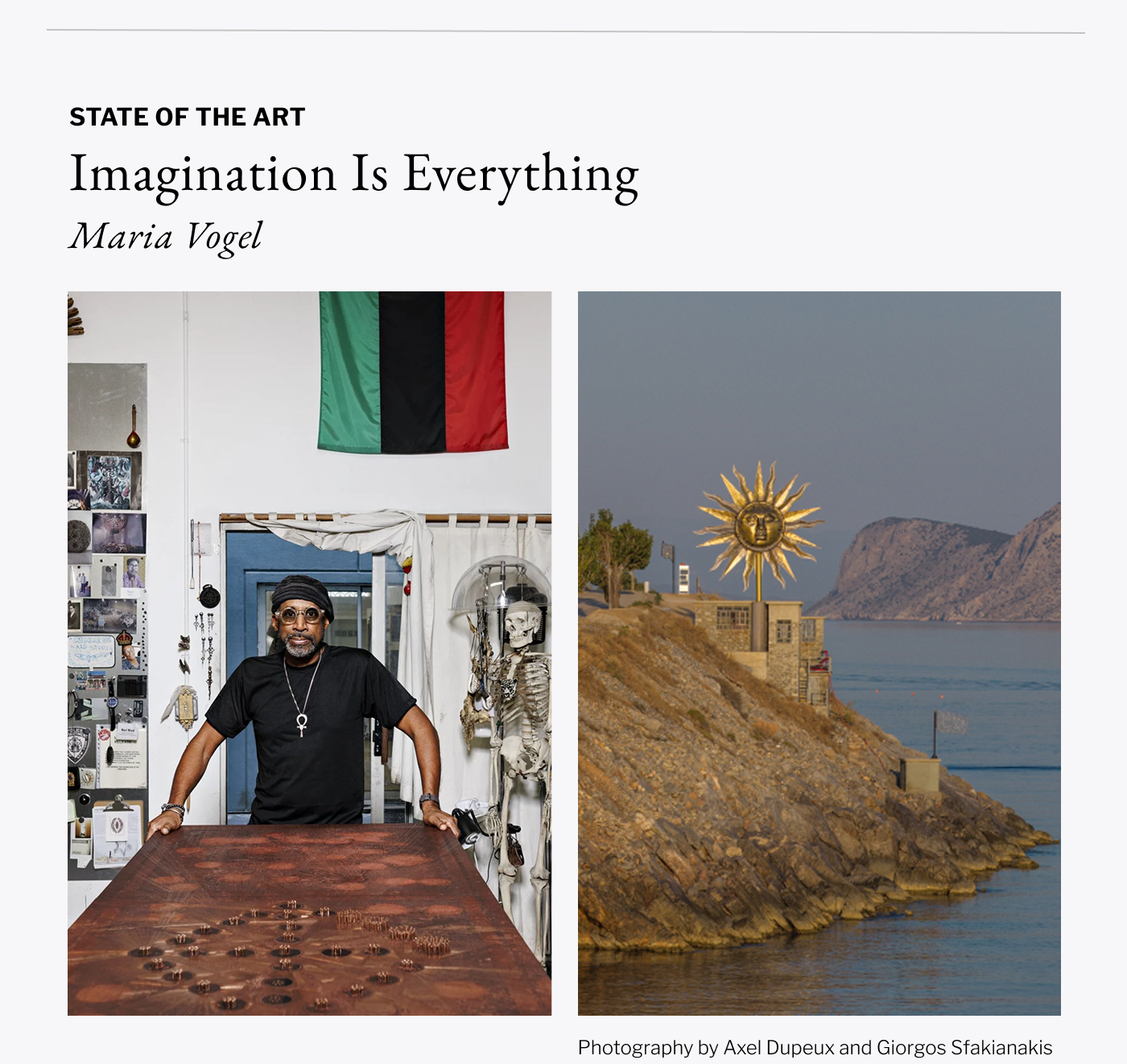
For decades, Nari Ward has situated his multimedia art practice at the intersection of the past and present, in service of shaping the future. Using found materials primarily sourced from his longtime neighborhood in Harlem, New York City, Ward creates objects that offer a shared sense of community, while addressing themes connected to race, migration, and democracy — among other related ideas.
Embarking on a show at the Deste Foundation for Contemporary Art’s seasonal destination, Project Space Slaughterhouse, on the Greek island of Hydra (yes, the one with the giant, photogenic Jeff Koons’ sun sculpture, “Apollo”), Ward sought to address the social and political realities of Greece’s African population. The result is Until That Day, a multidimensional journey of form, meaning, and the color red. As visitors make their way through the former slaughterhouse space, they encounter a wire flag interlaced with house keys, a telephone booth where bottles seem to float midair on a bed of springs, interactive dominoes games, the reoccurring use of a fire hose.
The exhibition’s title takes its name from a 1963 address by His Majesty Haile Selassie I, Emperor of Ethiopia, a speech in which he pleads for global cooperation between nations. Ward’s vision, which he carries out in this immersive space, similarly embraces the ever-increasing need for global unity. Maria Vogel: If you had to choose one of your works that feels most urgent right now, which would it be? Nari Ward: Until That Day. Not only is it my newest work, but it also draws on a powerful speech that Haile Selassie delivered to the United Nations in 1963. In that speech, he called on nations to work together in pursuit of world peace and global solidarity. We are at a pivotal moment, one that calls on us to reflect on what needs to be done and to consider the possibility of a different future. Before meaningful change can happen, we first have to imagine it. For me, that is one of art’s essential roles: to imagine new possibilities. Until That Day is rooted in the idea that global unity and solidarity are not only aspirations but possibilities worth envisioning and working toward. MV: What is one artwork apart from your own that holds particular meaning to you? NW: Piero Manzoni’s “Artist’s Shit” work and the body of work from this artist that deals with value and power have been especially influential. By transforming one of the most abject materials into a coveted art object, Manzoni exposed how cultural, economic, and institutional systems construct value rather than simply recognize it. His work continues to challenge the authority of markets and museums, revealing how power determines what is considered precious, collectible, and worthy of preservation. MV: How has the context in which your work is shown changed how that work is understood? NW: Context is essential to meaning. The exhibiting of the work is also an aspect of how a work lives in the world. If it is shown in one’s living room, studio, or a museum, each space brings with it a particular regard and level of connection for the audience. MV: Can you point to an exhibition that has shifted how you think about your practice or the role of art today? NW: The Wifredo Lam exhibition at MoMA [Museum of Modern Art in New York City] was especially meaningful because it highlighted an artist who, although trained within the Western artistic canon, chose to return to Cuba and draw upon the folklore, mythology, and spiritual traditions of his own cultural heritage. Rather than imitating European modernism, Lam transformed it into a poetic and deeply original visual language rooted in Cuban experience. To me, art should always strive to give form and presence to what lies beyond our immediate understanding, to make visible the unseen, the intangible, and the mysterious. MV: What kind of exhibition or context would you want your work to inhabit that it hasn’t yet? NW: I would like to do a project with the New York City Fire Department, perhaps as an artist in residence, creating art in dialogue with the firefighters and the fire station elements. |
|
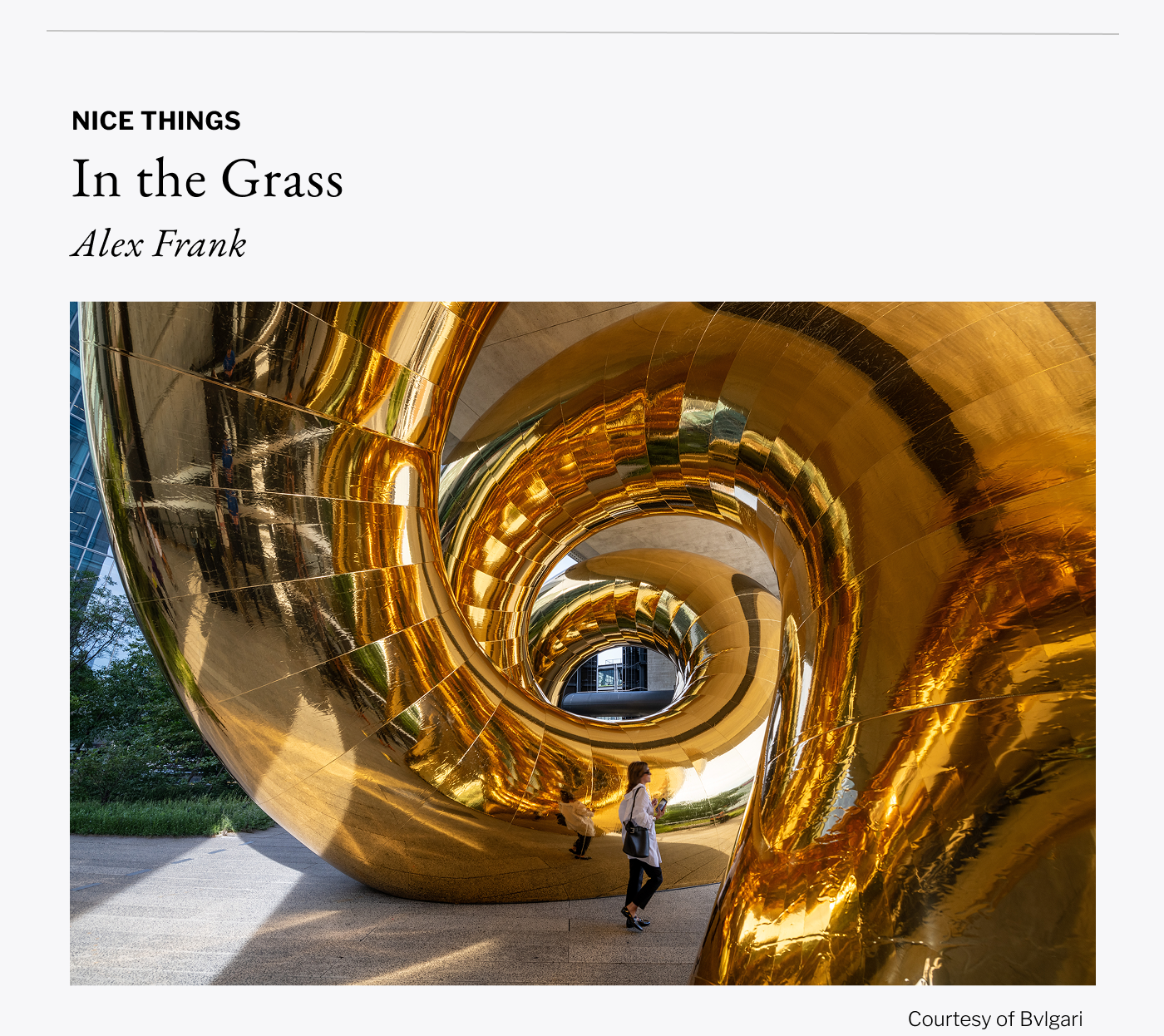
It is hard to stand out in the sea of sparkles that is New York Fashion Week, and yet Bvlgari somehow found a way to shimmer ever stronger: At the opening of “auruBOROS — Urban Memory and Collective Dream,” the Roman brand’s very first public-art installation in America, it unveiled a massive sculpture by Berlin-based artists Marco Canevacci and Yena Young of Plastique Fantastique.
The piece, near Manhattan’s Little West 12th Street, atop the High Line, resembled a golden, glimmering knot of oversized coils — which reflected and refracted the sunset — in a shape inspired by one of Bvlgari’s Serpenti motifs, the iconic timepieces and designs that crawl up the arm like snakes. And shining just as brightly that evening? Dua Lipa, who breezed into the opening fresh off of her big summer wedding in Europe, wearing a gorgeous, bulbous, brilliant High Jewelry Serpenti bracelet that twinkled on her arm like a constellation of stars.
The artwork is on view in New York through September 20, marking the fourth stop in Bvlgari’s Serpenti Infinito series. An ongoing journey exploring the endless dialogue between Bvlgari’s legendary Serpenti and art across cultures, the series has previously included artistic collaborations and creations in Shanghai, Seoul, and Mumbai. |
|
On paper, and in photos, Positano seems perpetually suspended in the mid-20th century. When John Steinbeck wrote an essay on the Amalfi Coast town in 1953, he threw a lure to his readers: “It is a dream place that isn’t quite real when you are there and becomes beckoningly real after you have gone.”
His essay reflected the moment. Unlike the French Riviera or the Swiss Alps, Italy’s Amalfi Coast only became an international tourist destination post-World War II, after Allied troops landed near Salerno and occupied an old stone house built into the granite cliffs of the Chiunzi Pass, used as a field hospital that they named Fort Schuster. This was also when some Italians repatriated from the United States, bringing a few American pop-culture fascinations with them. Cue Patricia Highsmith’s The Talented Mr. Ripley (1955), Dean Martin’s album of Neapolitan standards (1962), and Renato Carosone’s “Tu vuò fà l’americano” (1956 ) — the song, in case you didn’t know, is about an Italian who lives like a young American, drinking all that “whisky and soda.” Instagram and fashion brands still place the Amalfi Coast squarely in the early ’60s, chasing Jackie O’s iconic wardrobe and cultural footprint on the region.
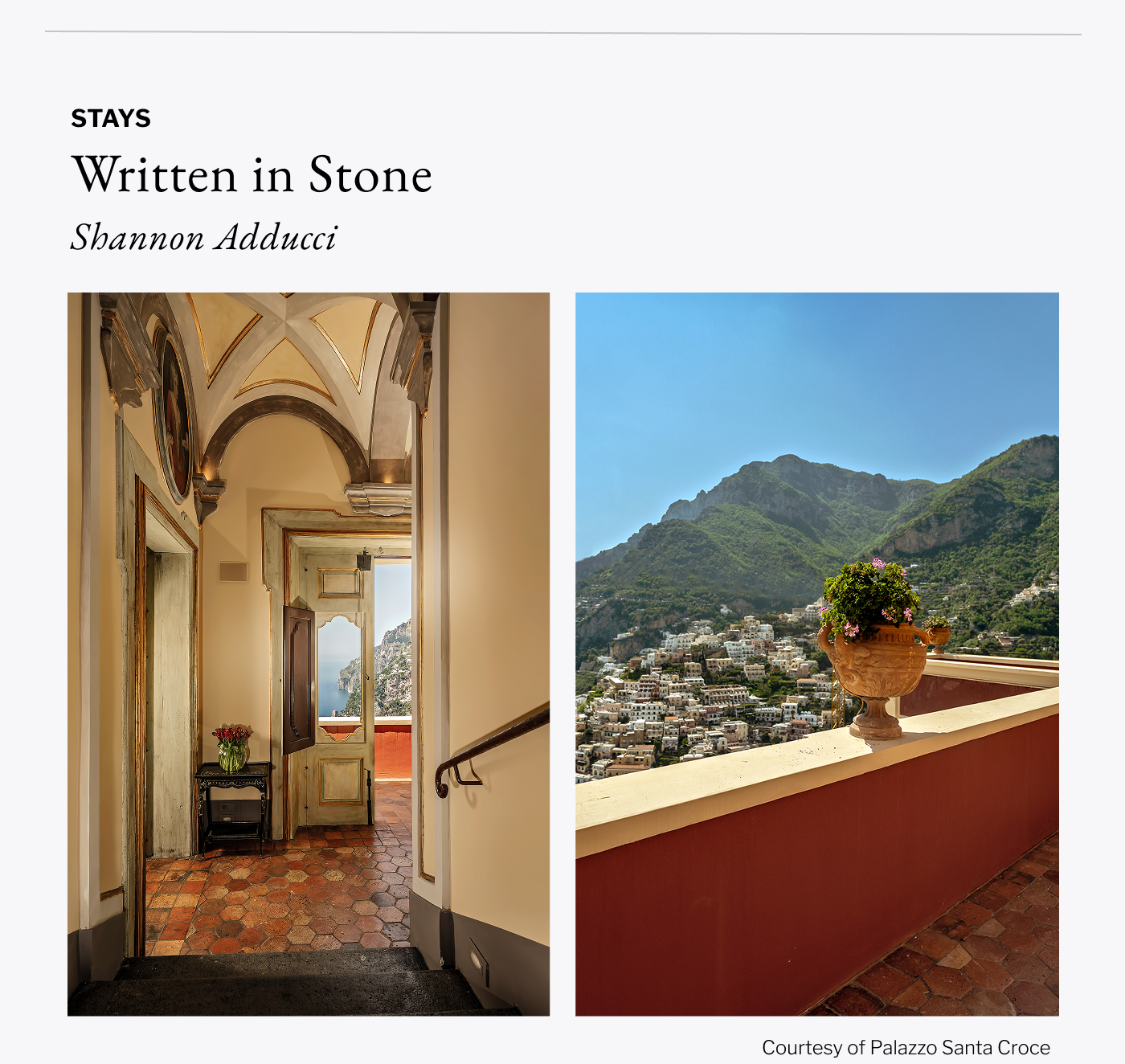
But all of that midcentury halcyon nostalgia can obscure the fact that, just like the rest of Italy, the area has layers upon layers of ancient history ripe for exploring. Palazzo Santa Croce is witness to this reality. It was built in the 17th century, used first as a monastery, then as a bishop’s residence, then as a grand Baroque palace with plenty of aristocratic and bon vivant dalliances through the next centuries. Pablo Picasso, Alberto Moravia, and one Mr. Steinbeck were all guests of the palazzo’s former owner: the Bauhaus artist Eduard Gillhausen, who lived in the villa with his wife following World War II until 2003.
While a previous restoration had already unearthed the palazzo’s ecclesiastical details, Il San Pietro’s Cinque family, who took over the property in 2024, wanted to imbue its own brand of buoyant design particulars into the interiors. Throughout the five-bedroom, seven-bathroom villa, they repainted original frescoed ceilings and handcrafted stuccos in more celestial hues, refinished antique doors in lighter washes, and replaced heavy, papal-like tapestries and textiles with summer linens, done in cheery turquoise and coral hues. Antique majolica tiles and vintage marble washbasins make the spacious original bathrooms feel both authentic and adequately updated. The lower level of the palazzo, meanwhile, has been converted into a Roman bath-inspired spa, the only villa in Positano to have its own private, dedicated wellness area.
Outside, Vesuvius-sourced organic stone paving and the palazzo’s Pompeian red facade is a reminder of even deeper local roots. For centuries, it was believed that the Lattari Mountains prevented the eruption of Mount Vesuvius in 79 AD from reaching the Amalfi Coast. But excavations underneath Positano’s Church of Saint Mary of the Assumption over the past 20 years have proven that pumice and ash did reach the area. The still-active archeological site has revealed the town’s own preserved Roman frescoes, in the same clay red as the palazzo’s exterior.
Lest it all become too much of a history lesson, there’s always the simplicity of a morning cappuccino on the expansive terrace, expertly prepared by the palazzo’s dedicated butler, Mimmo. A stay at Santa Croce also comes with access to the nearby Il San Pietro’s amenities, to satisfy cravings for a Slim Aarons moment, be it poolside under an orange umbrella, on its famed cliffside tennis court, or at the beach club with a plate of lemon spaghetti in hand. |
|
I remember hearing of Marseille for the first time while watching Mayrig, a film about a 5-year-old Armenian emigrating to the southern French city with his family. I was only 11, and the storyline had so many similarities with my own life: the same Armenian roots, emigration from the same place at the same age, even character names matching those in my family.
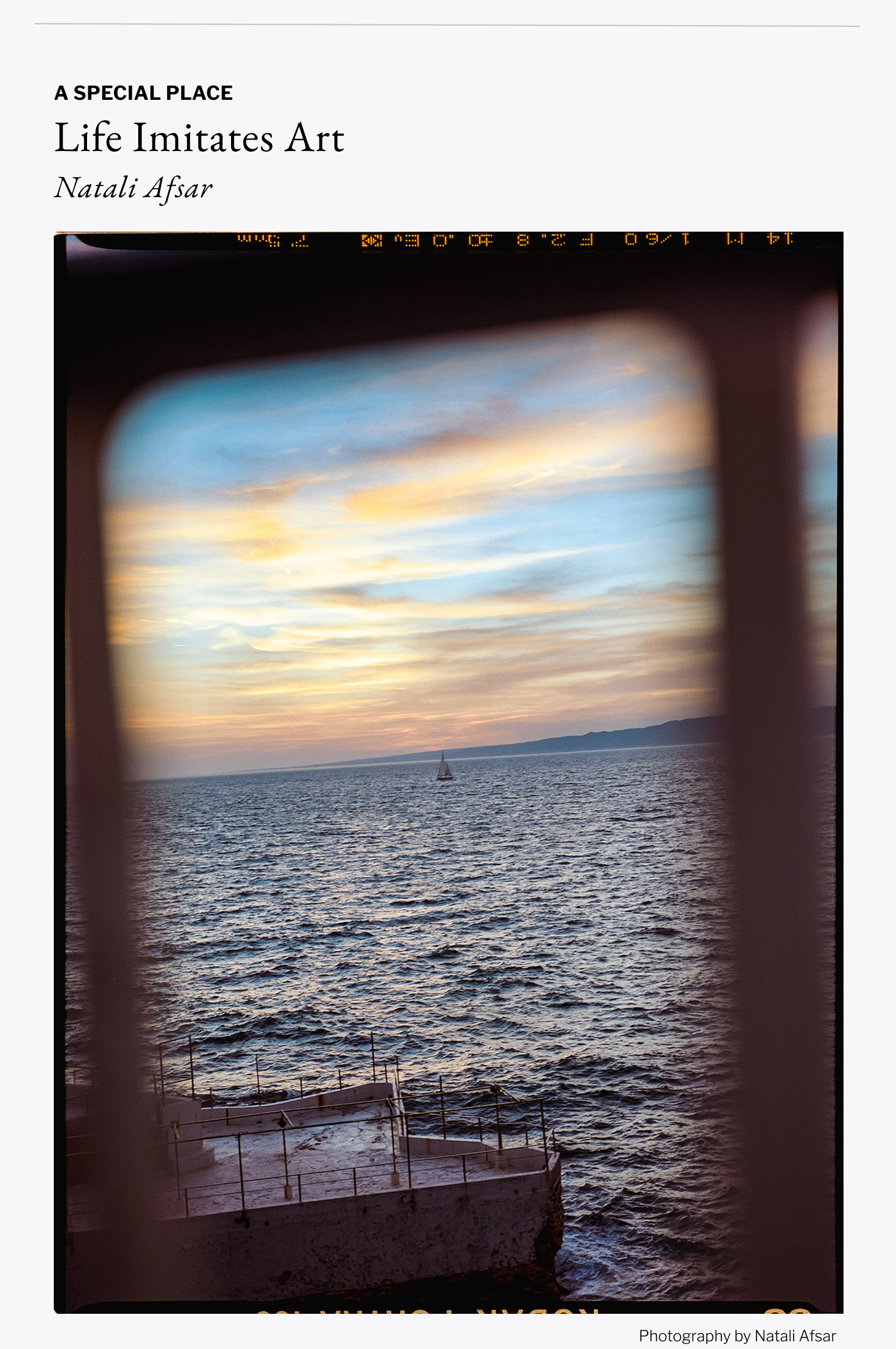
Two decades later, the film turned out to be almost prophetic. Just like its main character, I left a traditional career for a creative one. Then, this past summer, Marseille became my second home. My first anchor in the city was a daily rendezvous at the Mouillage de Malmousque, a rocky seaside spot where every evening at golden hour, a group of sailboats can be spotted departing toward the archipelago.
I could talk endlessly about the beauty of Marseille’s Massif des Calanques, or of the city’s food and design scene, how no two sunsets feel the same. It’s the kind of place where, if you look a little lost, strangers will stop to ask if they can help you find your way, or where, on a rainy day, a bus driver will divert their route to drop you closer to your destination.
At times, it feels as if the whole city conspires to make me feel at home, forever securing its special place in my heart. Word to the Wise … Stay at Les Bords de Mer or Tuba Club. Dine at Poissonnerie Kennedy and Chez Gilda. Visit The Vallon des Auffes, Les Goudes, and the Mucem museum; and be sure to take a sunset sail on the Bruine Beer or Le Don du Vent — both come with dinner on the deck. |
|
The Golden Apple. After watching Lupita Nyong’o, Samantha Morton, Anne Hathaway, and Zendaya in Christopher Nolan’s The Odyssey, I was reminded of how much I enjoyed A Thousand Ships by Natalie Haynes. This book recounts the Trojan War through the eyes of women. Its perspectives are powerful and moving — at times painful. I empathized with and rooted for its characters, even when I felt deeply conflicted by their actions, grateful for a perspective on Greek mythology that is often left out of the story. —Ava Castañeda Nothing’s Wrong. When I grow up, I want to be David Byrne. His recent performance at the Hollywood Bowl was a captivating, artful statement of deliberate simplicity and soaring humanity. Byrne and his band roamed about the stage wearing their instruments (not unlike his American Utopia show on Broadway) with choreography that felt like a celebration of endearing imperfection. This time, the performance surfaces were covered in LED video panels, allowing Byrne to stretch creatively (and also to present a slideshow). I left the Bowl that night gratefully aware that this must, indeed, be the place. —John Chuldenko Conversation Starters. My latest obsession is just about anything from Autumn Sonata, a design atelier crafting beautiful home essentials, from towels and bathrobes to tablecloths. Its prints have a wonderfully Old World quality, born from their creators’ process, which includes scouring European estates and preserving craft traditions. Among my top finds is the Eva Toiletry Bag, constructed from soft cotton with water-repellant lining. Its geometric Japanese-inspired print with naturalistic undertones brings a touch of elegance and much-needed order, no matter where in the world I happen to be. —Elissa Polls |
|
54 Franklin St #2R NY, NY 10013. ©2026 Dossier Projects, LLC.
|
|
|
|
|