Adventure seekers often head to the northern reaches of the British Isles in search of wilderness — with the expectation that they will find something raw and elemental, almost unruly in its beauty. Scotland’s textile industry is both an extension of and a counterpoint to this romantic ideal: It’s borne from the animals that roam this land and fed by the powerful waters that once kept its mills spinning, yet the garments its fabrics shape are designed to keep the harsh elements at bay.
An hour-and-a-half drive north from Edinburgh, by the expansive estuary of the River Tay, Dundee is smaller and grittier than the fairy tale-like Scottish capital. Back in the 19th century, it was known as “Juteopolis” for being one of the world’s leading producers of jute and host to around 150 mills. One of the mills, long-decommissioned, is now home to post-industrial chic Hotel Indigo — the best spot to spend the night in town.
Though the industry experienced a progressive decline through the 20th century, with the last mill shuttering in 1999, the city’s manufacturing past is kept alive in the activities of contemporary factories and celebrated in the galleries of its most notable museums, including the resilient Verdant Works Museum, the historical The McManus, and the newer V&A Dundee.
The McManus — housed in a pointy, Gothic Revival building — seeks to chart the many avenues of design that emerged out of the region’s heritage, from fashion to jewelry to graphic design. “Though there’s not really big manufacturing anymore, there are places that work on niche products: micro factories that come out of the industrial past that we have,” says museum services manager Gareth Jackson-Hunt. “Scotland is known for high-quality products that can only be made in a particular way, on a particular island, the same way they have been done for years. That’s one of the things that we hold on to; we are quite proud of our traditions.”
This singular know-how has lured in some of the world’s finest maisons to produce garments here: Chanel has owned super-high-end cashmere manufacturer Barrie for over a decade. Back in 2025, Dior showed its cruise collection at Drummond Castle, drawing from Scotland’s workshops, ateliers, and factories to create its looks. Le Kilt, La Fetiche, Johnstons of Elgin, Harris Tweed, Begg x Co, and Pringle are just some of the labels that trade on those skills to turn out knitwear and accessories of the highest caliber. Tartan, in particular, captivates designers across the world with its double-edged identity: its ability to signify rebelliousness and tradition at once — as explored by the V&A’s traveling exhibition Tartan. “Tartan has a mythical status; its origins are shrouded in mystery and speculation,” says V&A touring and program manager Daniel Smernicki. “It has been used to transport people to other worlds, physically and emotionally, to a Scottish dreamscape.”
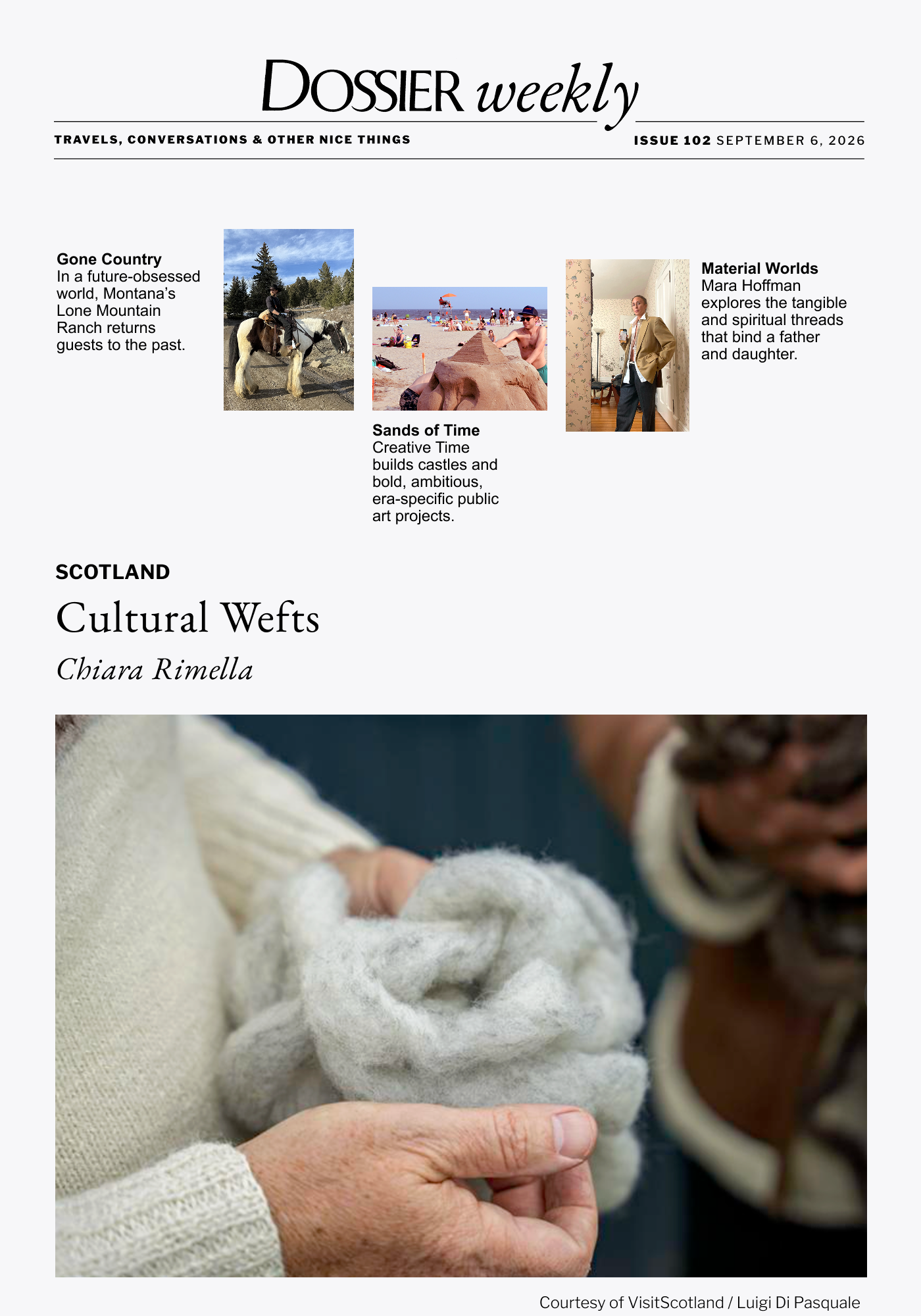
Remarkably, even if the country has built much of its current textile reputation on the weaving of cashmere, for decades (aside from a few experiments), it didn’t produce its own yarns until Lunan Bay Farm opened in 2016. Here, farther north on the east coast by the eponymous bay, Jillian McEwan and her husband, Neil McEwan, tend a flock of approximately 200 cashmere goats. Their fleeces, which must be carefully combed to gather the undercoat once it starts to cast, are precious: Fluff from three or four goats is needed to make a single sweater.
By definition, it’s relatively small-scale production, but it has attracted the attention of mainstay luxury fashion brands interested in supporting an environmentally conscious approach that’s also focused on animal welfare. “We’re now at a stage where it needs to be scaled up in a responsible way,” explains Jillian as her sprightly herd jumps on benches and wooden pedestals, hungry for snacks. Guided farm visits — during which guests are allowed to pet the animals while learning how the cashmere is made — also contribute to the longevity of the business. “There’s a lot of interest from other farms now that see the goats as a benefit because they’re improving the pasture [and] also making this amazing product that we already have as a global brand. It’s the cherry on the cake.” Just beyond the grazing field, past tufts of vegetation swaying in the wind, the vast sweep of the beach is flanked by rugged cliffs and the silver, resplendent ocean: a Scottish dreamscape where wilderness and craft collide. |
|
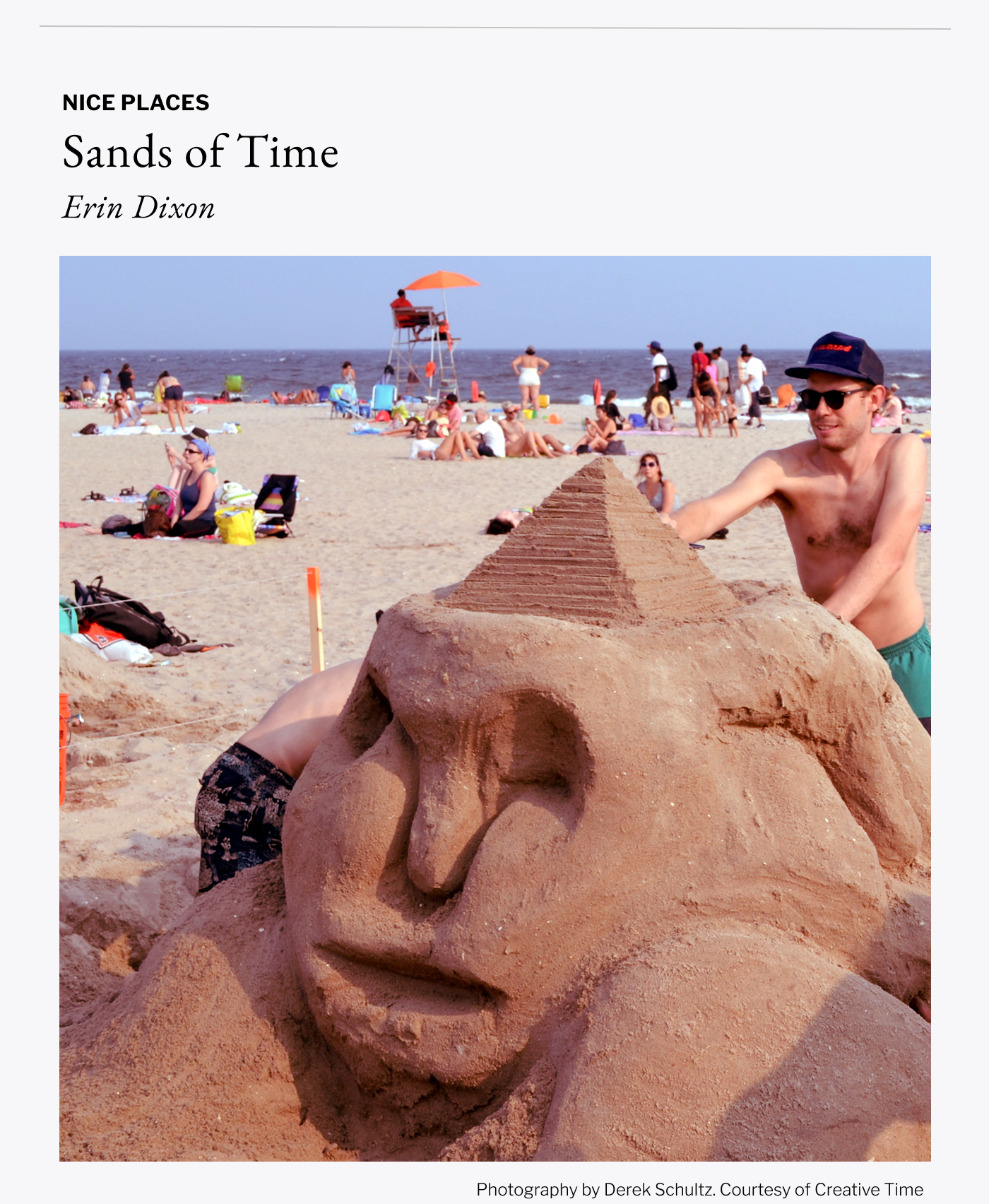
Legend has it that leisurely beach play first turned art form when artist Philip McCord crafted a macabre scene out of sand to solicit spare change from boardwalk tourists in Atlantic City, New Jersey, in 1897. The subsequent 130 years of shaping grains have seen a castle topping out at nearly 70 feet; carved portraits of Mahatma Gandhi and Nelson Mandela; and a disappearing sculpture featuring bubbles, ice, and a live saxophonist positioned atop three plinths of sand. The latter was created in 2013 by artist Jamie Isenstein as part of Creative Time’s Sandcastle Competition, an event that returns next Sunday, September 13, after a 14-year hiatus.
A typically head-turning manifestation of the New York City nonprofit’s valiant mission to present “bold, ambitious public art projects that contribute to the dialogues, debates, and dreams of our times,” the event promises a last gasp of summer as fashioned by a cross-disciplinary roster of artists. Creators include Anthony Akinbola, Rachel Rossin, and Gabriela Ruiz, with judges ranging from polymath Waris Ahluwalia to director of the Brooklyn Museum Anne Pasternak.
The cyclone of camaraderie, competition, and public art will culminate after judging concludes with the Sandcastle Benefit Bash at Rockaway Hotel, a closing celebration and fundraiser (you can still snag tickets) to help sustain Creative Time’s ongoing operations. Since 1974, the organization has commissioned and presented over 350 works, including “Tribute in Light,” (2002), the twin beacons of light that illuminate lower Manhattan annually on the anniversary of 9/11, and Kara Walker’s sugar-sphinx, “A Subtlety,” at the Domino Sugar Factory (2014) — all guided by three core values: art matters, artists’ voices are important in shaping society, and public spaces are places for creative and free expression.
If you can’t make it to Rockaway Beach for the competition, you can still support Creative Time via its online shop, by donating to the organization, and by building your own castle in the sand. |
|
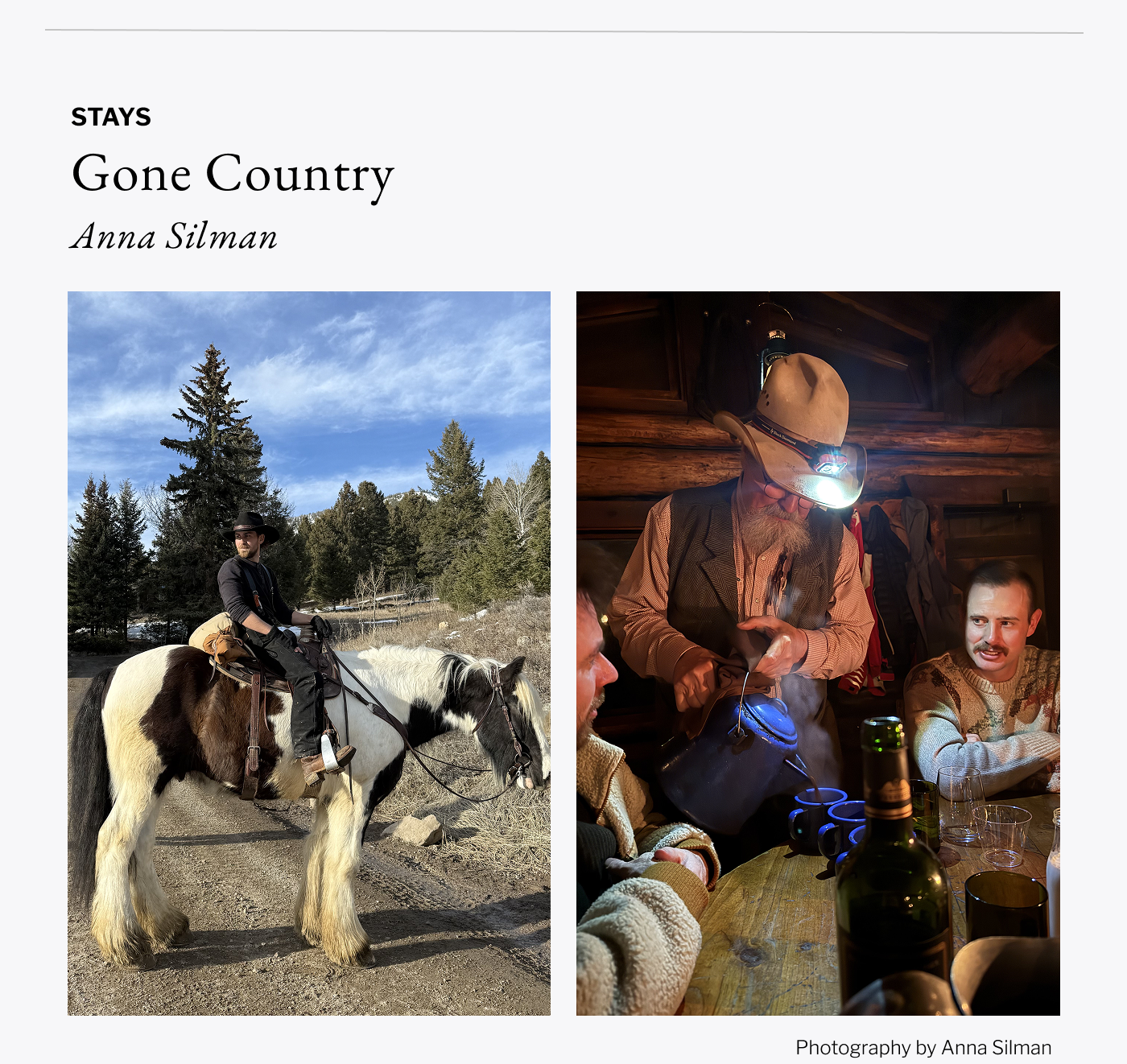
As dusk blankets the sky over Lone Mountain Ranch, four horse-drawn sleighs pull up outside a log cabin in the woods. Inside the cabin, kerosene lamps cast an amber glow through the space while heat radiates off the immense 1890s-era Monarch woodstove. “I swear some nights they’re trying to melt me like the Wicked Witch of the West up here,” jokes Bruce Anfinson, a ruddy, bearded cowboy singer who has been performing at these dinners in Big Sky, Montana, for 33 years. As he regales us with ditties about horses and homegrown tomatoes, servers in cowboy hats pass out thick slabs of prime rib, turkey potpie, and huckleberry-apple cobbler. We could just as easily be back in 1981, when the property hosted its inaugural sleigh-ride dinner, or in 1915, when the area was first homesteaded as a working cattle ranch.
Meriwether Lewis and William Clark passed through the state in the early 1800s, and their writings about Montana’s open spaces and endless skies pulled newcomers west. In recent years, the state has become a destination for wealthy developers and second-home buyers — some inspired by the television drama Yellowstone, others chasing the dream of privacy, land, and perhaps even an apocalypse compound with a view. Rising housing costs have become a defining issue in nearby Bozeman, while booming Big Sky now commands some of the state’s highest real estate prices. Against this backdrop of rapid change, Lone Mountain Ranch, purchased in 2013 by Auric Road hospitality’s Jason Liebman and Paul Makarechian, has tried to hold on to the rhythms of an older Montana.
“Finding meaning in the work of luxury hospitality isn’t always easy. It’s a lot of money and shiny things,” explains general manager Anthony Ardisson, a local Montanan in a shearling jacket and a cream cowboy hat. “But I feel like when people come here, they feel the way you want them to feel when you come to an authentic Montana ranch.”
I wake up each morning to the sounds of North Fork creek babbling outside Chipmunk cabin, one of 26 cabins scattered across the property. Built in 1927 from thick trunks of lodgepole pine, the space is full of homespun touches: wall lamps in the shape of antlers, hand-illustrated cartoon maps of 1930s Yellowstone in distressed wood frames, a record player with a collection of country LPs. I’m feeling very frontierswoman as I light the woodstove each day — if the early settlers also had a soaking tub with Lone Mountain-brand epsom salts and a mini-fridge full of artesian sparkling waters. A thermos of coffee arrives on the porch at 7 a.m., with a note telling me that “nature is nurturing you and helping you flourish.”
Across a snowy field glows the ranch’s bustling restaurant, Horn and Cantle, where families flushed from the slopes dig into heaping plates of saucy wild-game bolognese and succulent bison short ribs that fall off the bone. Behind an unassuming leather curtain lies the Auric Room, the founders’ wink at a New York private members club. After surrendering my phone, I’m ushered into a sleek lacquered space flanked by leather banquettes, where waiters in velvet waistcoats (curated by Yellowstone’s costume designer Janie Bryant) serve ultra-premium pours of bourbon and flights of bluefin tuna to Big Sky’s high rollers. The rest of the property is wilderness: 148 acres of thick forests roamed by red foxes and elk, crisscrossed with more than 50 miles of Nordic ski trails.
Naturalist guide Randy Hall, who has worked and lived on the ranch for two decades, leads me on a two-hour snowshoe hike through fields of thawing sagebrush and hilltop trails that he carved himself. He pauses to gesture up at an Engelmann spruce straining to face the sun. “This tree has a vibration, and if we could ever calm our bodies down enough, we could tune into that,” he explains. While he’s skeptical of the billionaires arriving in the state trying to privatize public lands, he doesn’t feel that tension here: “It’s still the same ranch I knew 20 years ago. You get here, and everything in your body slows down.” |
|
My dad, Monte Hoffman, lived in a big, ivy-covered, red-brick Victorian house in Buffalo, New York. He lived there from the time he joined the Buffalo Philharmonic Orchestra as a classical concert cellist in the 1960s until he died, in May of 2024.
The house has nine closets between three floors. Each was packed with the clothes he wore through every decade, through every version of his body, every trend, every aesthetic he adopted. Because of his profession, he had an impressive collection of tuxedos, with their accompanying cummerbunds, bow ties, and small vests. Beyond the tuxes, his taste really ranged, depending on the decade: Italian shirts and pants, Tommy Bahama “Caribbean wear,” Coogi sweaters, Dockers, Versace jeans and hand-embroidered tunics, and multicolor-striped bell-bottoms from his “hippie” era. Hundreds of pieces were crammed into the closets, all on wire hangers.
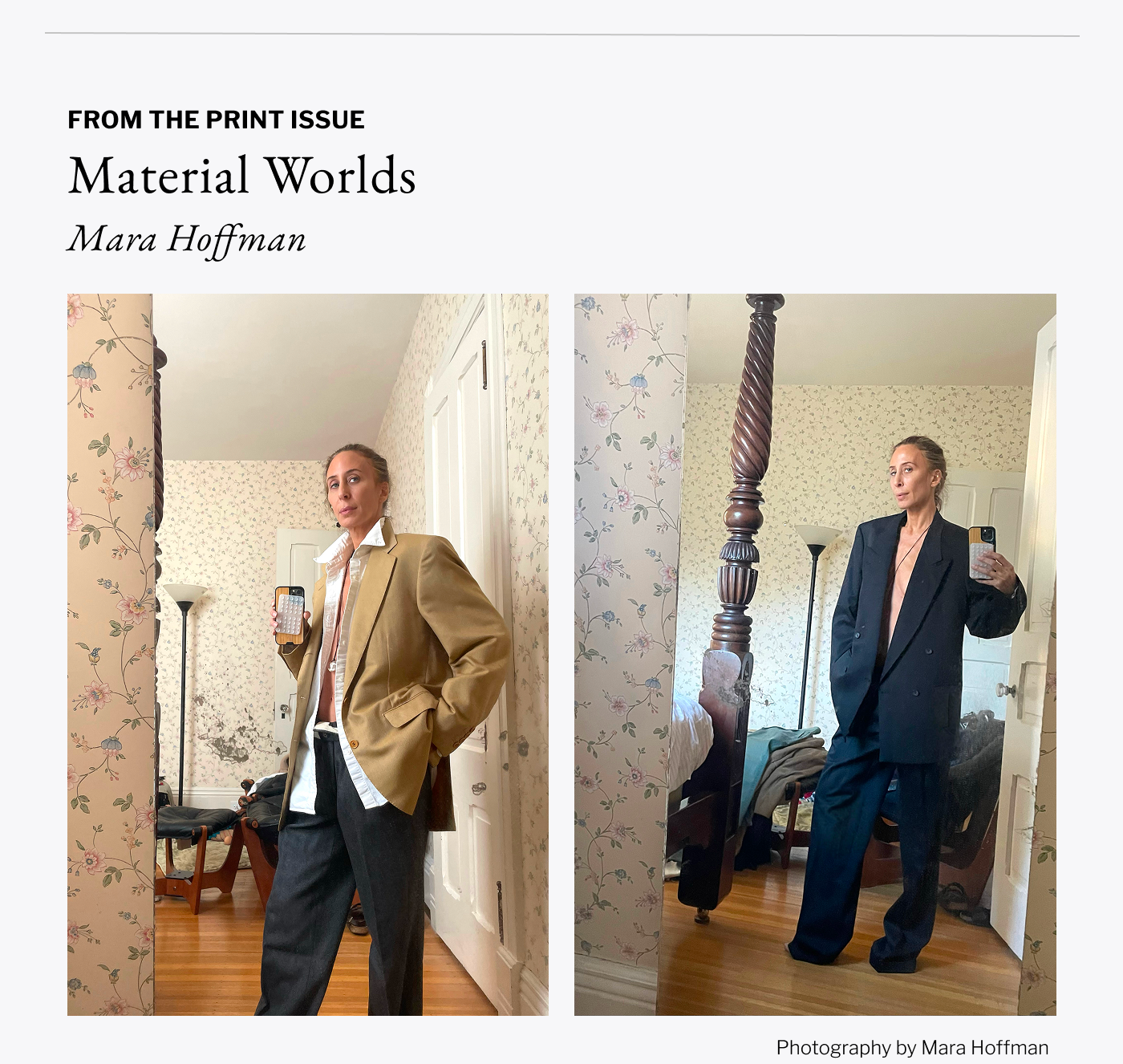
For many years before he died, I would rummage through his closets and drawers to find decades-old gems. I was always so delighted that these pressed, cotton, tailored, button-down shirts, with French cuffs and a monogrammed MKH over the heart, fit me. I loved imagining that my father (at one point in his life, as a grown man) had been my same size. I have a very slim frame, and the father I knew growing up and as an adult was never close to my build. But his clothes tell another story.
Each trip home to see him was like a visit to the gift shop of an impressive museum of someone’s very eclectic life, of someone who held on to everything. It gave him great pleasure when I would find things of his that I wanted, a validation as to why he held on to it all. He would brag about its designer or value. He loved that his fashion-designer daughter wanted to wear the garments that had defined his aesthetic over the years of his life.
My dad was my person. He adored me. He drove me crazy. He challenged me. He was so proud of me. We’ve passed lifetimes with each other, and this last one as father and daughter was sweet and complicated and deeply bound to a contract around care and love and timing.
About three months before he died, I told him I was closing my brand. He was so scared for me, beside himself at first, perhaps terrified that I wouldn’t make it any other way — or maybe that I would disappear. He eventually came to his senses and remembered who I am, remembered that I am an artist who creates from my heart for purpose, for the absolute alchemy of it all. I will always find a way to make meaning, to make beauty from anything, everything. Death and all.
On the morning of May 25, 2024, I went to his house to shower and change. After spending the previous nights in a recliner beside him in hospice, I was exhausted, aching, and in the final stretch of walking him home. It was a role that I knew was also part of our contract, a job I had always prayed I would be lucky enough, have the honor to fulfill — to hold him through his very last exhale, to deliver him lovingly with grace and dignity to his next celestial incarnation. After showering, I went through his closet and found one of his concert shirts. It was a cotton-and-polyester blend, something I would not usually wear, but today it was okay. It was right. It wasn’t a shirt for a tuxedo but for a concert that required a black suit. It was still pressed and stiff. It felt appropriate. I had a strong knowing that today would be the day, and it was important that I was dressed for it. For him, his life, for us. Read the full feature and more close takes on a wide world in our Spring/Summer 2026 print issue. Order now. |
|
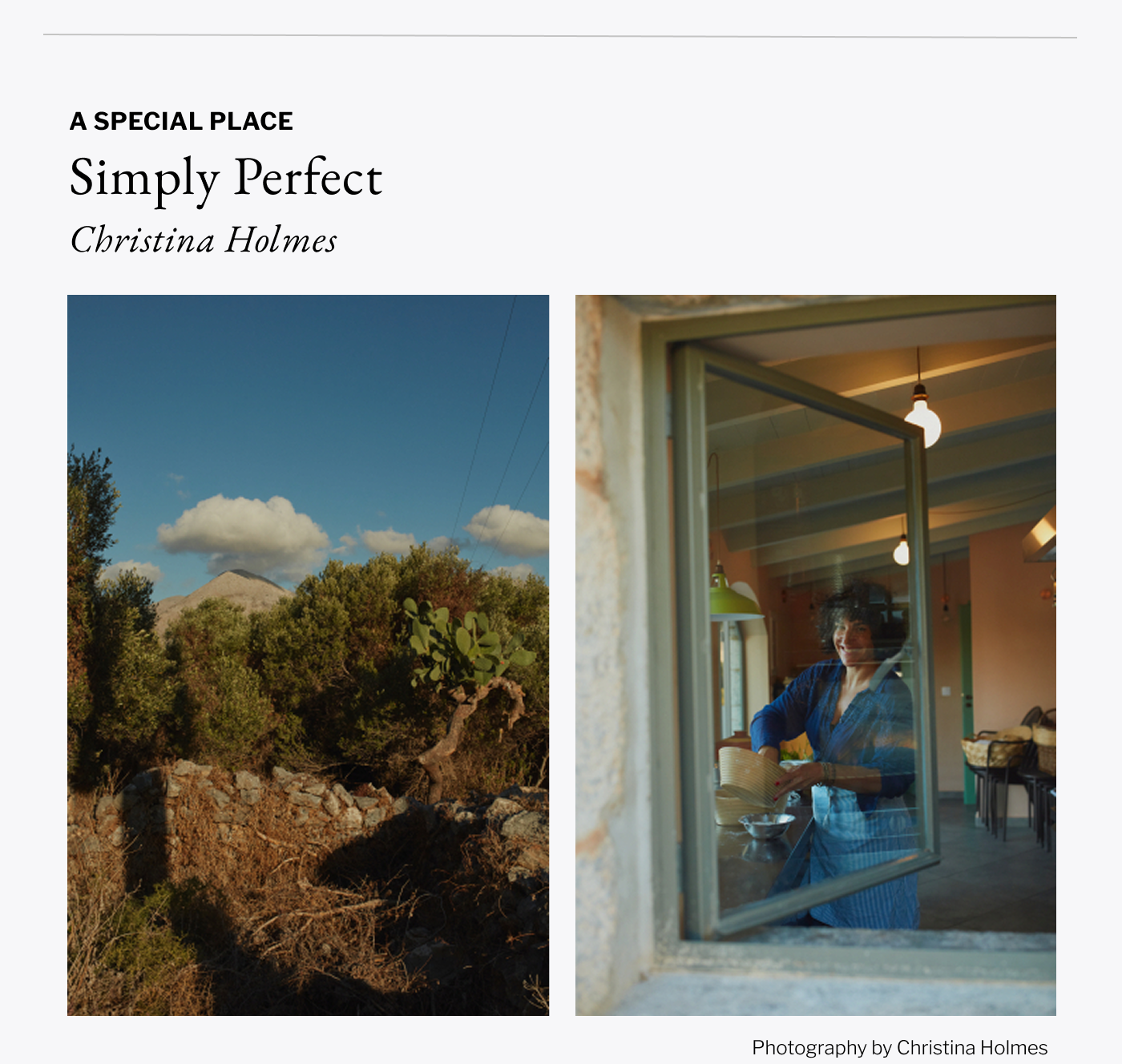
Mani, Greece, was introduced to me by my friend Jade George nearly five years ago over a conversation about food — or salt, to be precise. She mentioned the island’s unique array of natural cavities jutting into the sea, glistening with salt crystals that are hand-harvested. The destination seemed desolate to me at first glance, with sharp edges and hard lines. In reality, it is one of the softest places I have ever encountered. The clouds touch land here, just as Mani’s residents feel naturally grounded. The endless sea glistens with possibility, and the climate fosters an abundance of local wilds. Village after village is nestled amongst the rugged terrain, each moving at its own pace. Ahead of my travels, George also introduced me to chef Stavriani Zervakakou, whose restaurant Aspasia resides on the peninsula. Zervakakou’s family has a rich history in the region, with her brother Michalis Zervakakos acting as her right hand in the kitchen. The meal she prepared was simple, layered, flavorful, and perfect.
Word to the Wise … When visiting the Mani Peninsula, be sure to book a stay at Fameliti Casa Torre in Stavri. A car is not recommended for the village, but it is for a drive to Gerolimenas for an overnight at the well-appointed Kyrimai Hotel, where a seaside pool is the ideal place to enjoy a spritz as the sun slips down to the horizon. If you’re feeling adventurous, take a daring drive to Vathia for impeccable views. |
|
Outside the Lines. Need to distract yourself from the end of summer vacation and return to everyday realities? Zoé de Las Cases’ Hôtels coloring book invites you to leaf through a selection of charming and iconic hotels from around the world then bring them (and your future travel dreams) to life with watercolors or colored pencils. —Anna Kaplan Worth Its Weight. My skincare routine is down to a science, meticulously curated to create a daily ritual and modified every few days to add a little pep in my skin’s step. Monastery’s Gold face oil is my latest addition. I use the transformative oil after my serum instead of a moisturizer to smooth and plump my complexion, leaving it dewy, hydrated, and worthy of the compliments it has recently been receiving. —Elissa Polls By Any Other Name. As someone in their 20s who is very much making it all up as I go, Adults hits close to home. The Hulu comedy follows five friends living together in New York City, attempting to navigate jobs and the general chaos of becoming an actual adult. It has the comfort of Friends, with a current, unhinged energy. I flew embarrassingly quickly through the first season. Lucky for me, Season 2 came out on August 27. —Margot Barland |
|
54 Franklin St #2R NY, NY 10013. ©2026 Dossier Projects, LLC. |
|
|
|
|