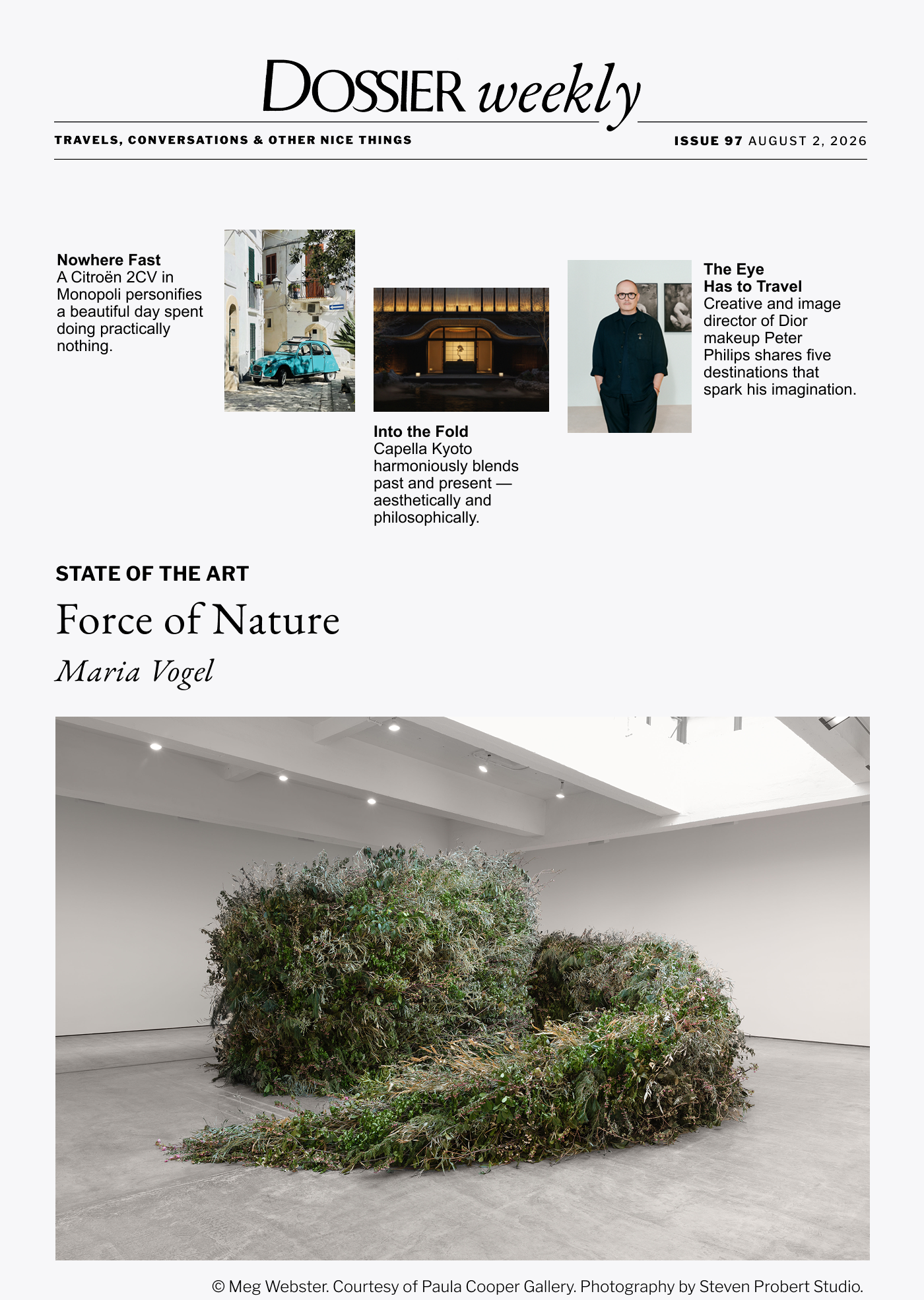
Meg Webster is having a moment. In the past few years, Webster’s sculptures, made entirely of natural materials, have featured prominently in exhibitions across the world — though her environmentally-centric art practice dates back to the 1980s. (Her first solo exhibition after completing her Master of Fine Arts degree took place at Donald Judd’s exhibition space on Manhattan’s Spring Street.)
With deceitful simplicity, Webster employs ordinary organic matter to construct installations that offer a new experience of the material: Hardened beeswax is shaped into an 8-foot-high, curved barrier; sticks are arranged in a dense, spiraling pattern. Her work offers a transformative sensory experience, in which the body becomes a curious participant.
Equal parts commanding and moving, Webster's practice is a quiet yet effective display of environmental awareness, as underscored in her recent solo exhibition, Thicket, at Paula Cooper Gallery in New York City. The artist’s creations are also currently on view in a number of group shows, including Directionless at Hauser & Wirth Menorca; This Land: Considering the American Landscape at The Church Sag Harbor; and Until the Moon Comes Over the Mountain at the Parrish Art Museum in Water Mill, New York. Maria Vogel: If you had to choose one of your works that feels most urgent right now, which would it be? Meg Webster: “Glen,” 1988, is a circular enclosure of earth meant to be entered by viewers. Its curved, planted terraces surround viewers with many flowering and herbaceous plants, allowing them to feel deep intimacy with ecologically significant species. MV: What is one artwork, not your own, that holds particular meaning for you? MW: “Der Bevölkerung,” 2000, by Hans Haacke in the courtyard of the Reichstag building in Berlin. On the facade of the Reichstag, in large Gothic letters, there is a dedication: Dem Deutschen Volke, literally “to the German people.” In the courtyard of the same building, [Haacke] installed a raised bed with, in the same typeface, the dedication: Der Bevölkerung, "to the population." The shift from “the German people,” with its ethnic and historical connotations, to “the population,” understood as everyone living in Germany and participating in German society regardless of citizenship or ethnic origin, is central to the work.
Members of [the national] parliament are invited to contribute sacks of soil from their respective constituencies, allowing whatever seeds are enclosed in the soil to germinate over time. The resulting garden is a living blend of all of the country’s legislative districts.
I am particularly drawn to this conception of “soil” as a living organism, blended from all parts of the country and left to grow untended, which allows the soil to become an active participant in the work and create a natural, wild garden. The work is a powerful fusion of nature and politics, and it resonates with the way I approach gardens: as living spaces that embrace wildness and change, foster the coexistence of species, and allow life to unfold on its own terms. MV: How has the context in which your work is shown changed how that work is understood? MW: Typically installed indoors, my work is made of natural materials that are given particular forms, which can feel like nature is displaced in the gallery. This heightens the experience of the materials, allowing visitors to focus on an aesthetic experience and to intuit that this experience carries a range of broader meanings. MV: Can you point to an exhibition — your own or someone else’s — that has shifted how you think about your practice or the role of art today? MW: I was very moved by a show of masks at the American Museum of Natural History some years ago. As you considered the masks, you could sense your vision penetrating into the work and the material. I have tried to incorporate this integration of feeling and form into my packed soil and salt pieces by allowing the viewer to perceive the work both visually and with their bodies. MV: What kind of exhibition or context would you like your work to inhabit that it hasn’t yet? MW: I would like to exhibit outdoors, in a permanent place where a community can live with, visit, garden, and care for a complex series of ecological rooms — where they can grow food and where habitats are created: waterfalls, ponds, wetlands, terraces featuring many plants, walkways, and seating. Caring for the work becomes an important part. The work's permanence allows living things to exist within the artwork. |
|
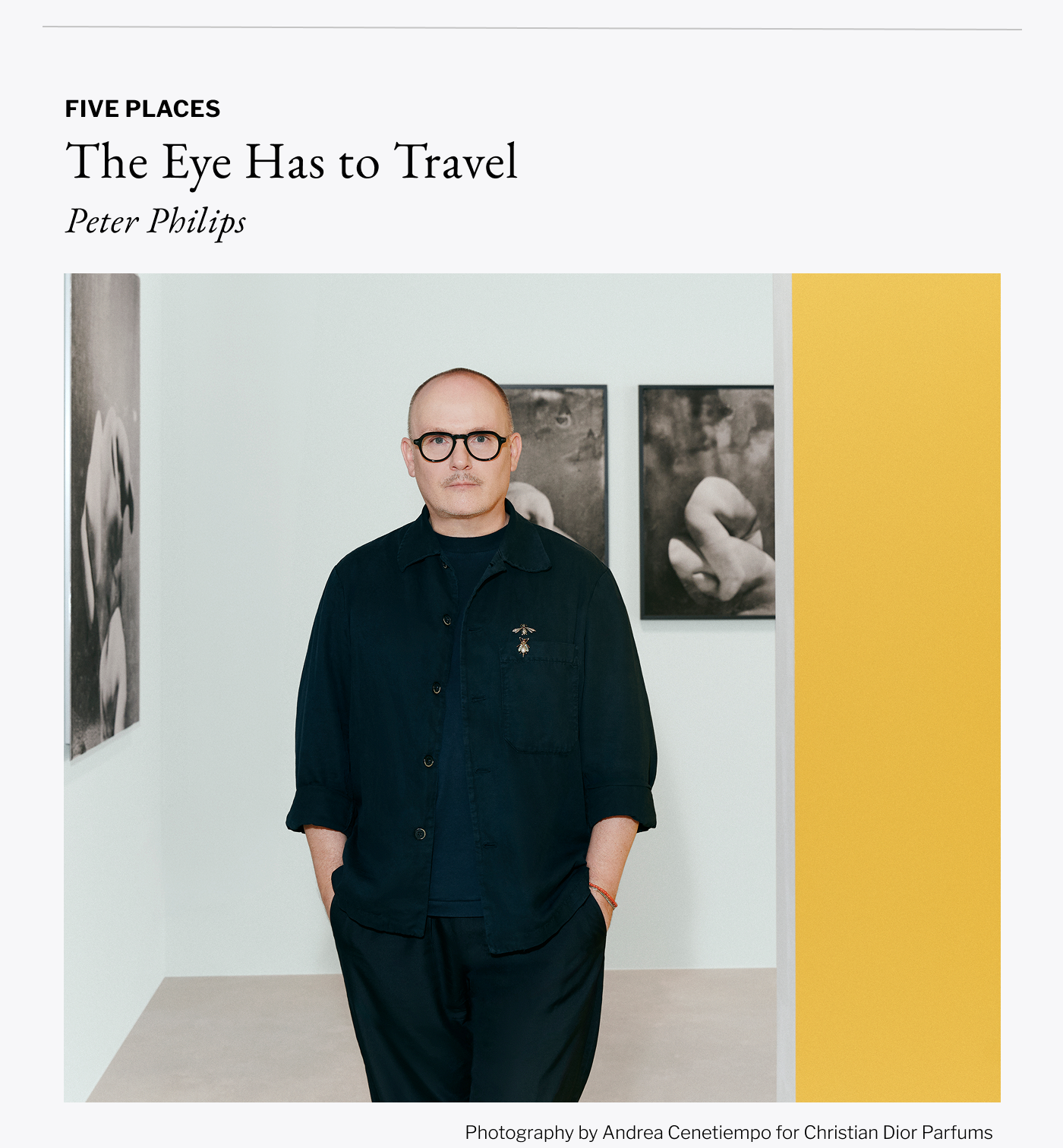
As creative and image director of Dior makeup, Peter Philips takes inspiration from manifold influences, anchored by a fine arts education in Antwerp, Belgium, and fueled by continuous global travels. Below, in no particular order, he shares five of his favorite destinations. Together, they form a kaleidoscope map to Philips’ imagination, with a red thread connecting the recommendations: They’re all extremely pleasing to the eye. Rubens House, Antwerp. Antwerp is where my roots are. It’s where my family is from and where I grew up. Every corner I turn brings back a memory. There’s the cathedral and the Rubens House — the former home and workshop of artist Peter Paul Rubens, now a museum, garden, and library — as well as plenty of other magnificent museums, the most beautiful train station, great restaurants, and a wonderful zoo in the center of the city. Calouste Gulbenkian Museum, Lisbon. I have a house a bit outside of Lisbon, in the countryside, and this equals pure relaxation. Like many European cities, Lisbon is drenched in history, which is fascinating to discover. The Calouste Gulbenkian Museum has a fabulous collection of art that includes the magnificent portrait of Helena Fourment by Peter Paul Rubens. Dover Street Market, Tokyo. I fell in love with Tokyo the first time I visited. When I'm there, I always make sure to go to Dover Street Market in the Ginza district, starting on the seventh floor and walking my way down. The store is very inspiring. I also have friends in Tokyo, and they kindly guide me around. We eat well, enjoy the buzz and (at the same time) the peaceful pace of the city. Picking up snacks at the train station, then taking the bullet train is a treat. LUMA, Arles. For the last nine years, I’ve been going to Arles, France, in late June or early July. We organize the Dior Photography and Visual Arts Awards for Young Talents, a wonderful competition for young photographic talents. The visual arts are an important part of our company’s culture, of our DNA. Communication through visual arts is a gift, and giving young artists a platform to express themselves is very rewarding. By doing so, I’ve had the chance to discover this wonderful city, with its historical layout, its delicious little restaurants, galleries, and the majestic LUMA museum, designed by Frank Gehry and situated in a beautiful park. The Marais, Paris. Paris is where I live now. I’m fortunate to have a wonderful apartment in the Marais, my peaceful hub. Paris is a city with loads of emotions, lots of energy. More than one place, it’s the city as a whole that inspires me — its exhibitions, museums, restaurants, and shopping. Paris has so much to offer; she’s very demanding but also very generous. |
|
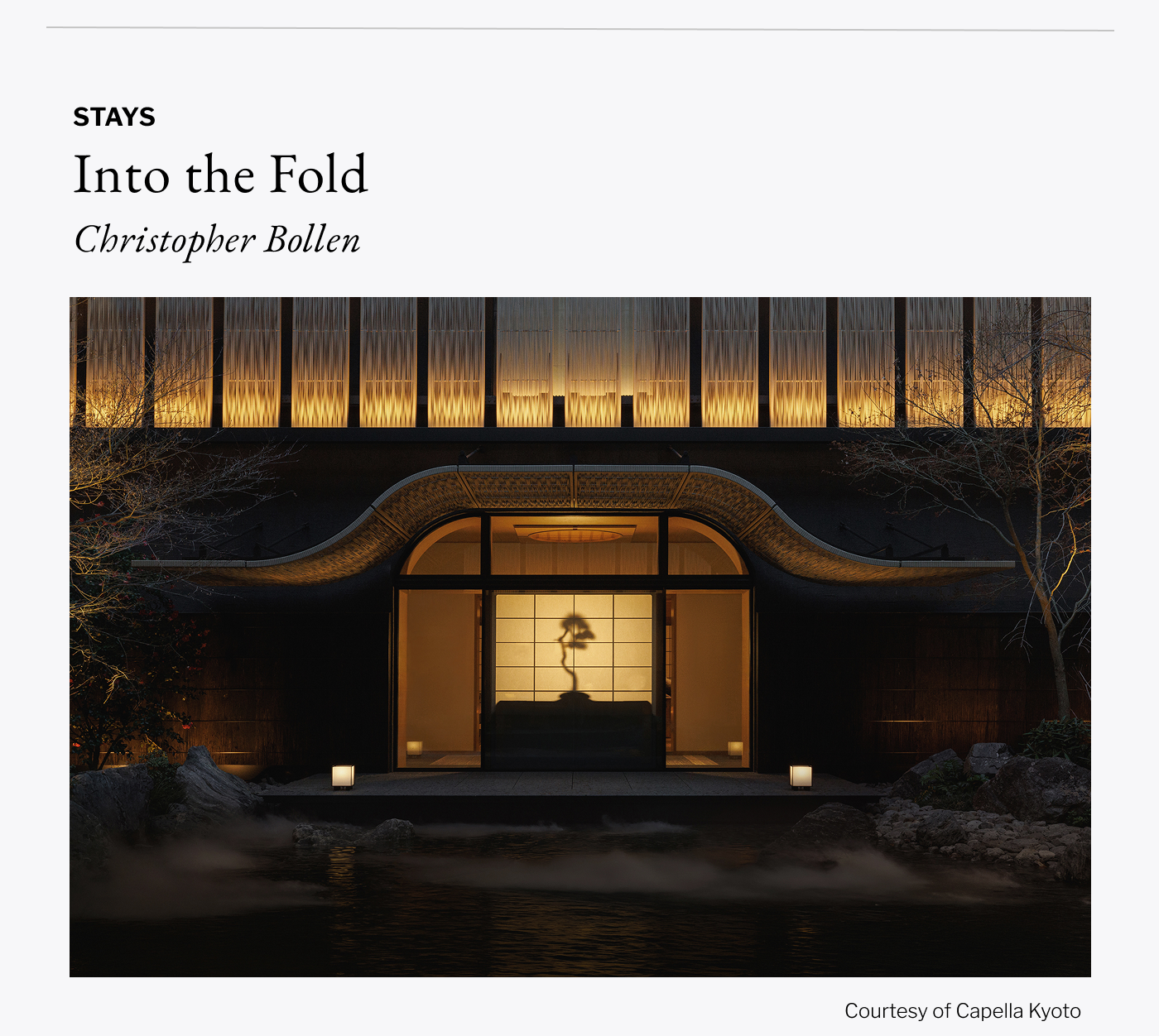
Kyoto isn’t just the city of shrines and temples. It’s the city of shrines and temples anchored every 10 feet, wedged between a restaurant and a sneaker store — a temple down the next alley, a shrine on your walk to the metro. In a city where there is so much history and holiness, it’s a challenge for any new luxury hotel to put down roots without seeming like an alien invader. Thankfully, Capella Hotels and Resorts' newest property, located in the Miyagawa-cho neighborhood, manages to feel like a blissful retreat from a grinding day on the tourist beat, like an authentic extension of the Kyoto vibe. But, then, preservation and community growth were a foundational part of the property’s beautification plan.
Built on the site of a former elementary school — which, itself, was rebuilt after it was bombed in World War II — Capella Kyoto shares the block with some pretty impressive neighbors. On one side is Kyoto’s oldest Zen Buddhist temple, where, I was told, the Japanese tea ceremony was first formalized. On the other side is the legendary Gion Kobu Kaburenjo Theater, where geiko (geisha) and maiko (their apprentices) train and perform.
When Capella tapped Japanese architect Kengo Kuma to design its Kyoto hotel, the company mandated that the project include restoring the theater, sustaining one of the city’s great cultural treasures and creating an implicit spiritual link between Kyoto’s past and future: Geisha performances are often held in the hotel’s lobby in the afternoons, a rare treat for visitors, who would otherwise have to pay huge dividends for the experience.
But all of that is the wrapping for the sublime reward of staying at Capella Kyoto. The property’s clean, geometric exterior, shrouded in wood latticework, gives way to the interior calm of a meditation room, like turning the volume down from 10 to zero in an instant. The hotel is built in the configuration of a traditional machiya townhouse, which doesn’t seem far off from a hacienda, in terms of a four-sided house built around an inner courtyard.
This courtyard is devoted to a pool of water laced with river rocks, and Kuma designed its flow based on the changing sunlight and shadows cast throughout the day. Of the hotel’s 89 rooms, six face the courtyard, each with its own balcony, which doubles as a private onsen bordered by a small Zen stone garden. The rooms themselves are a jigsaw puzzle of sizes, including grand suites with raised dining rooms fitted with tatami mats. All showcase sleek woodwork and muted light diffused by a plethora of rice-paper shoji screens. The effect is an instant mood lightener; you can’t imagine raising your voice or making any sudden movements in this environment.
There are also 500 art objects interspersed throughout the hotel, from antique painted screens to contemporary fiber works by local artists. My favorite décor items were the floral arrangements, seemingly redesigned daily in the ikebana fashion, using pink peonies and calligraphic tree branches.
The property hopes not only to redefine hospitality but also the Kyoto food and drink scene — usually a low-key affair ending before dark. Capella Kyoto boasts three restaurants, including traditional Japanese and French destinations. Its star, though, is a 12-seat chef’s laboratory called SoNoMa, meaning “space of imagination,” the first international expression by three-Michelin-starred Single Thread, led by chef Keita Tominaga. A 3-hour, 11 -course meal at the restaurant might include olive oil from Northern California poured over vegetables from the nearest market, fueling a cultural and culinary dialogue between Sonoma, California, and Kyoto.
When I was planning my trip to Kyoto, my friends encouraged me to stay at a ryokan for its allegiance to strict tradition. But maybe there’s a way to live in the present without sacrificing the beauty and culture of the city. Maybe that possibility is now open and taking reservations. |
|
Too often, our fashion imagination runs narrower than it should, especially as it pertains to geography. Paris, Milan, New York City, and London have long been treated as the immovable global pillars of luxury. But what Nisha Kanabar, born and raised in Tanzania, understands — and what anyone who has spent time in any of Africa’s many bustling cultural capitals can intuitively feel — is that across her continent’s 54 countries, a vast and dynamic community of designers is reshaping how fashion is imagined and made, one garment at a time.
In 2018, Kanabar launched the first iteration of Industrie Africa, a digital showroom dedicated to showcasing and supporting this extraordinary creative ecosystem. “When we launched, I could feel things bubbling, simmering, getting a little more confident. There was a pulse. But I also realized that there was a gap in the way the rest of the world was able to find the clothes — it wasn’t so much a lack of talent but a lack of translation,” recounts Kanabar. “I wanted to make the conversation around African brands feel inevitable and contemporary and cool and fully part of the global language — a fashion language.” This goal led Kanabar to add e-commerce to her website in 2020.
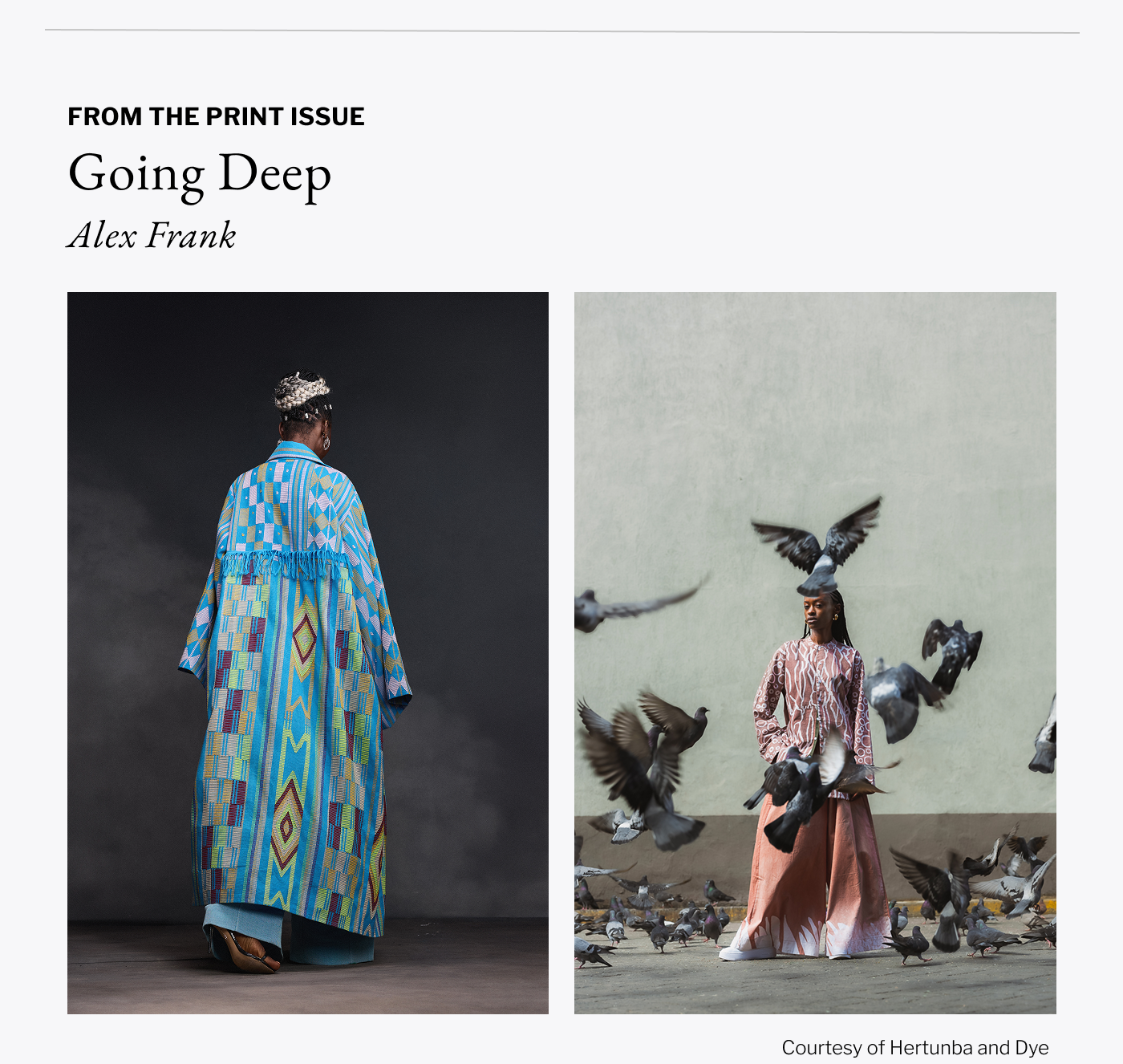
Now, taking the five-plus years of firsthand insight into the structural realities of operating global fashion retail from Africa that she has gained, Kanabar has announced the next evolution of Industrie Africa: She has closed the brand’s online shop and replaced it with IA+, an advisory that collaborates with luxury partners — from hospitality brands to cultural institutions to retail partners. The new division’s debut project: SoLA (Society of Luxury Artisanship), a concept boutique on Zanzibar’s Bawe Island, provides a peek into this vision. It also evidences an ongoing global shift toward lifestyle brands that collapse fashion and travel — and reflects the evolution of Kanabar’s objective to carry African fashion and culture beyond the digital realm into physical spaces. Here, she spotlights five designers who are doing the same. Hertunba. Derived from the Yoruba title “Otunba,” Hertunba is a sustainable brand founded by Florentina Agu that employs local women in sewing, weaving, and threading, while also ensuring that 90% of excess materials are repurposed into handcrafted decor, such as rugs and pillows. “The construction, the textile work, the marketability of the product — it’s just magic,” confirms Kanabar. “It’s really trans-seasonal.” This Is Us. Founded in 2016 by Oroma Cookey-Gam and artist Osione Itegboje, This Is Us is made entirely in Nigeria. Produced through a hyperlocal process, its fabric is grown and woven in Katsina before being hand-dyed at the centuries-old Kofar Mata dye pits in Kano, in the north of the country. “As a designer from the continent, it is really difficult to hit a certain price point in your production because of the lack of economies of scale,” Kanabar explains, “but This Is Us really nails creating the building blocks of your wardrobe.” Onalaja. Onalaja dresses by Kanyinsola Onalaja are meticulously handcrafted and finished with intricate beading, crystals, and ornate embellishments. “They’re incredibly opulent,” says Kanabar. “They have this couture-like beading element, using patterns that have ancient symbolism, or certain motifs that are really unique to what they’re doing.” Dye Lab. Dye Lab by Rukky Ladoja specializes in àdìre, a traditional hand-dyed textile indigenous to the Yoruba people of Nigeria, created using batik wax to produce vibrant colors and prints. The label is known for its modern take on the agbada, reimagining the traditional garment in whimsical patterns and playful details. “Dye Lab has gained this cult momentum and cult status for how uniquely it utilizes hand dyeing, the batik, and patchwork techniques,” Kanabar elaborates, “their use of color, the way they mix and match patterns.” Tongoro. Made in Senegal, Sarah Diouf’s Tongoro sources materials across the continent and collaborates with local tailors, with a long-term goal to help build a stronger Africa-based manufacturing ecosystem. “Tongoro was a pioneer in this space,” Kanabar says. “It was built — marketed itself from the very beginning — as a ‘Made-in-Africa’ brand. It’s been worn by Beyoncé, by an incredible following of celebrities..” Read the full feature and more close takes on a wide world in our Spring/Summer 2026 print issue. Order now. |
|
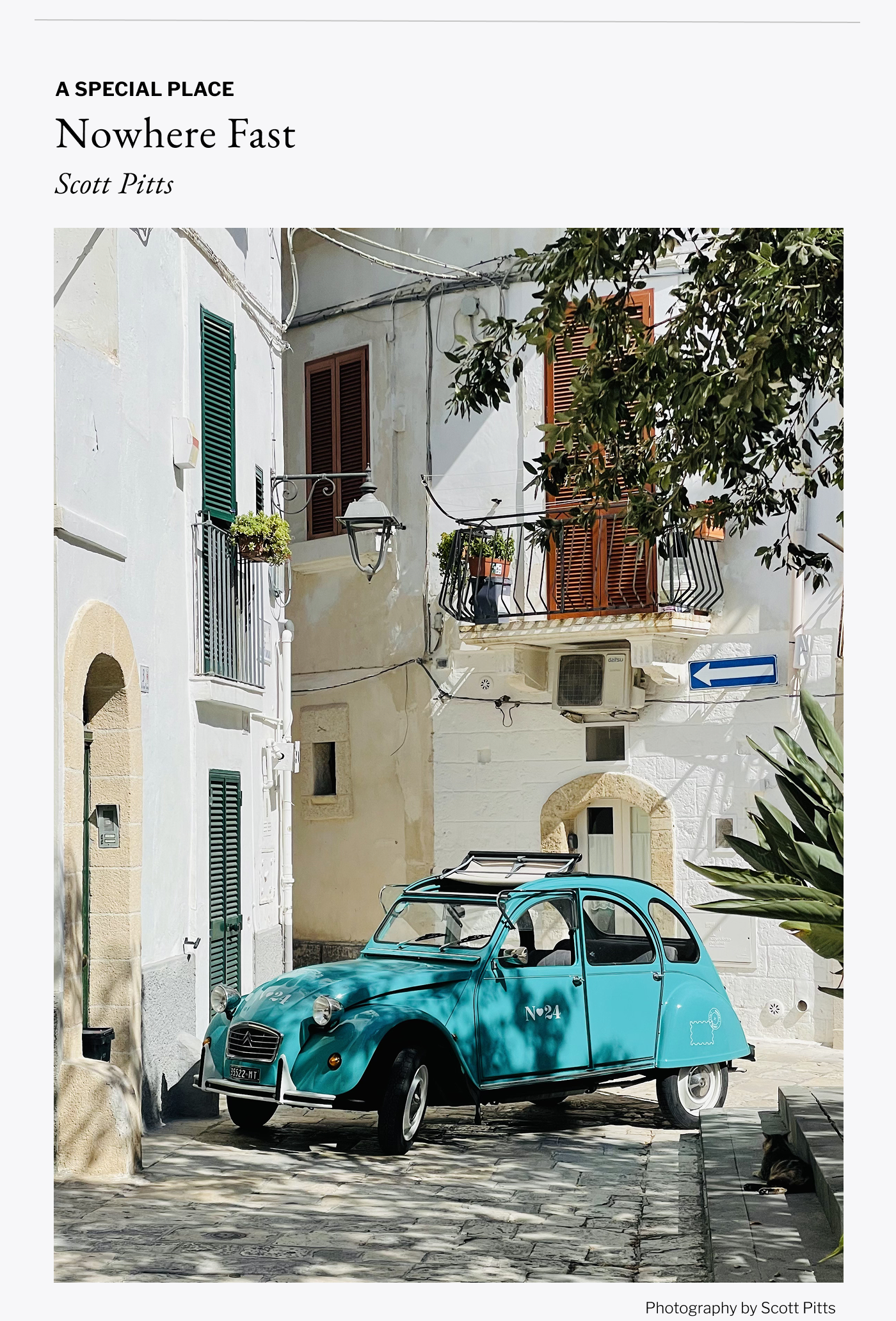
I took this photograph just outside our room at Locanda Don Ferrante in Monopoli, Italy, where white-stone streets glowed brightly under warm, southern Italian light. A turquoise Citroën 2CV driven by a shopkeeper looked as though it had been placed in the town by a set designer. It was handsome, sun-faded, and perfectly lit — ready for its close-up. But what I remember most isn’t the car; it’s the afternoon that followed.
We stopped at Gustavo Salumeria and ordered sandwiches to go: airy focaccia layered with thin ribbons of mortadella, sharp provolone, briny olives, and fresh greens. Lunch in hand, we walked toward the sea and climbed onto the large, black rock formations that hold the Adriatic Sea at bay. Locals were already stretched out, eyes closed, faces turned toward the sun. No one seemed to be in a hurry. That’s when I truly understood il dolce far niente, the "sweetness of doing nothing." |
|
Better with Time. The Rimowa Classic Cabin is the Porsche 911 of suitcases. Devoid of bling and unnecessary adornment, it’s a pure, elegant, timeless design refined over decades. The case glides silently over the terrazzo in Milan and handles every curbside bump at LAX with a solid, reassuring thunk. Each time I scrape it into the plane's overhead bin, I’m reminded that this functional, well-crafted object only gets better with a little patina. –John Chuldenko Foundational Rejuvenation. California’s Napa Valley offers a lifetime of destination-worthy spa treatments, but The Structural Facial by Vintner's Daughter at Auberge du Soleil Resort stands out for its measured luxury. The therapy combines the brand’s three signature products — Active Renewal Cleanser, Active Treatment Essence, and Active Botanical Serum — with red-light therapy, microcurrent technology, and targeted massage. Notably, Vintner’s Daughter draws on the same principles as its founder April Gargiulo’s family vineyard, which is just up the road from the stunning Auberge property, meaning: No shortcuts are taken. –Elissa Polls Artful Aperitivi. Perched above the Tyrrhenian Sea on the Monte Argentario peninsula, Hotel Il Pellicano's Pelligrill feels like the terrace of a close friend's Tuscan villa, where one drops by nightly for an aperitivo. The evening I visited, the sky was dip-dyed shades of blue and pink, a Negroni did its mind-unwinding work, the sardine toast played its brackish role, and the gentleman serenading the terrace made a compelling argument for another round. –Elysha Beckerman |
|
54 Franklin St #2R NY, NY 10013. ©2026 Dossier Projects, LLC.
|
|
|
|
|