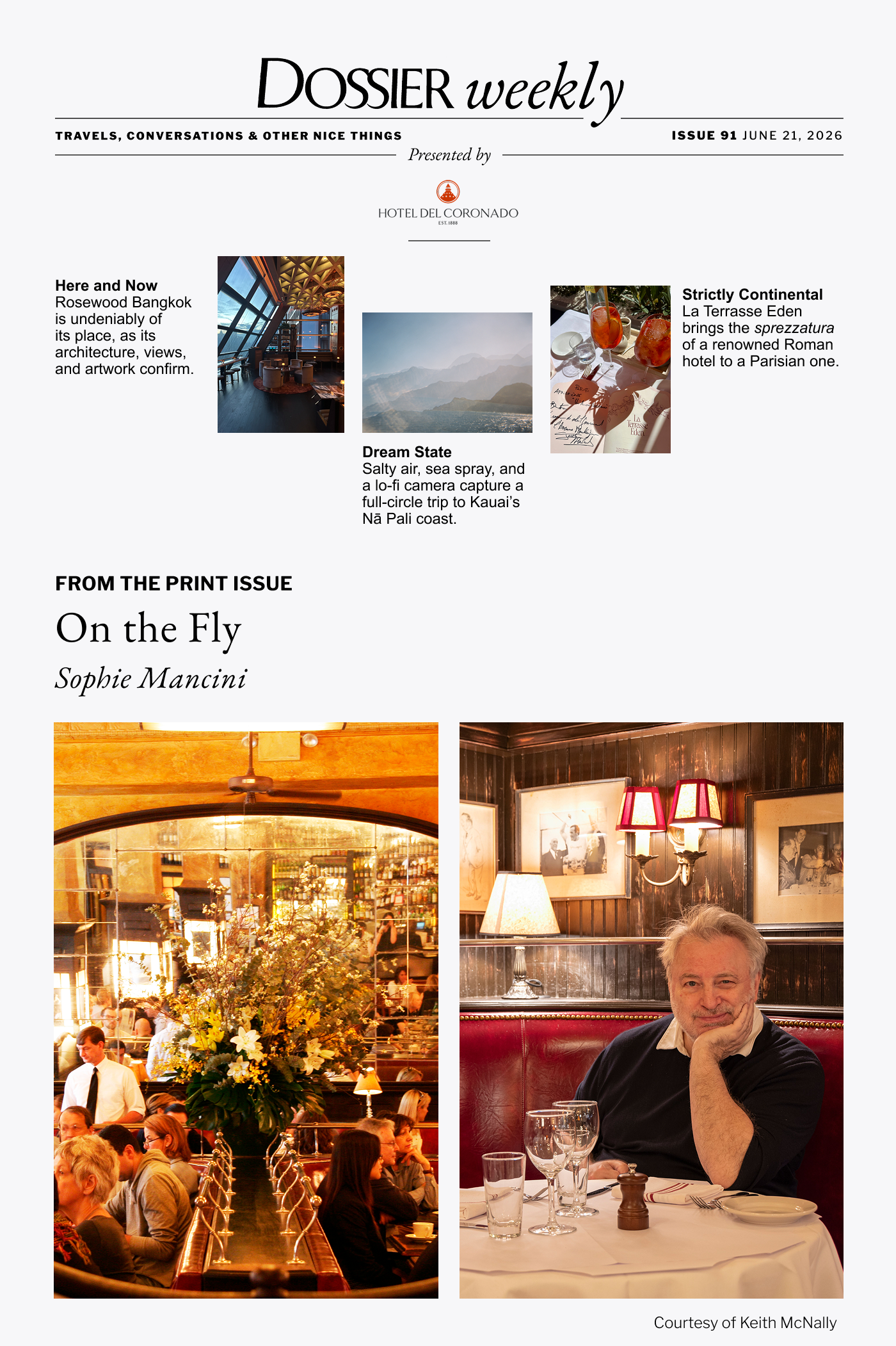
For whoever has not been to Balthazar, the storied downtown New York City brasserie — or any of Keith McNally’s restaurants (Minetta Tavern, Pastis, Morandi, to name the current; The Odeon, Café Luxembourg, Nell’s, Lucky Strike, Pravda, Schiller’s Liquor Bar, Augustine, Pulino’s and its second act as Cherche Midi, to name the past) — the lighting is akin to sitting inside of a snowglobe while thick curtains of honey drip down the sides. “There’s no such thing as an ugly person,” the restaurateur once posted on his notoriously candid Instagram, “only bad lighting.” McNally’s Instagram reads like a diary. Self-deprecating, irreverent, and sometimes poignant, his captions pull back the curtain on the inner workings of New York hospitality and his personal life in equal measure.
After McNally’s stroke in 2016, which critically impaired his speech, the platform became a way for him to reclaim his voice. Alongside home-interior photos, a 2025 post reads: “This was the beautiful house I owned in Notting Hill, London, from 2011 to 2018, before my stroke, suicide attempt, and divorce. Even though I paid 6 million pounds for the house (and then spent another 3 million renovating it), I never ‘owned’ this gorgeous house. Ultimately, nobody ‘owns’ anything. Everything in life is Leased. Even our own bodies.” In 2025, McNally’s words were given a more formal platform. He released the memoir I Regret Almost Everything, now a New York Times bestseller. In one passage, he writes, “Correspondence has always been a major part of my life, but since my stroke it’s become crucial, because writing is the only time I feel I’m not being pre-judged on appearance. Consequently, it’s the only time I feel normal.” So, one morning, I texted McNally. Sophie Yun Mancini: What have you been up to this morning? Keith McNally: I wake at 6 every morning, make an espresso and try to devise ways of canceling my days’ without causing offense. And then I begin writing. Since early July I’ve been revising and rewriting my memoir, I Regret Almost Everything, for the paperback. SYM: I just finished your memoir. It’s remarkable. KM: my days’ meetings is what I meant to write. SYM: i understand. i try and cancel my meetings as well. (without causing offense, as well) KM: I really wanted to cancel this meeting. SYM: because you’re busy? tired? or just couldn’t be fucked to text a stranger? all are understandable. KM: I’m always behind with things. Ideally I would stay home all day and think about what I should be writing. I’m a colossal procrastinator. SYM: where do you think that comes from? KM: Let me delay answering that until I’ve had a second coffee. SYM: [haha emoji reaction] There’s a quote in your book I really want to ask you about this: “Charm played a more important role than competence in America.” Do you still believe this? KM: Unfortunately, yes. SYM:Who is the most charming person you know? KM: He just died: Tom Stoppard who was a friend of mine. Tom was exceptional. He possessed charm, grace, wit and enormous ability. What’s your favorite Stoppard play? SYM: I could google something and lie, but to be completely honest, I’ve never experienced a Stoppard play. Does that make you think less of the very little you know of me? KM: Yes. No, of course not! Do you go to the theater much? SYM: I don’t, embarrassingly. Even though I grew up in New York, which has so much access to them. Sometimes I feel like the more access one has, the less they take advantage. I’ve never been to the Statue of Liberty. Which of course is not a play, but just to illustrate the point of not embracing what’s right in front of you. I read a lot of Shakespeare growing up though. Yet have only seen one Shakespeare play in real life. KM: Me neither. In fact, I’ve never met anyone who’s actually been to the Statue of Liberty. Which one Shakespeare play have you seen? SYM: Hamlet, at The Globe, in London. It was haunting. All lit by candles, no electric light KM: Who played Hamlet? SYM: I can’t remember. It was a while ago. An ex boyfriend surprised me with tickets. It was very thoughtful. The relationship did not last but my impression of the night stayed with me as so very magical. KM: Was it in the indoor theater attached to the Globe, the Sam Wanamaker theater? SYM: Hm. I remember it feeling semi outdoors actually. Is that possible? My memory is so unreliable when it comes to facts and plot. I can always remember how I felt but never what actually happened. KM: Between 18 and 40 years of age I saw about 35 Shakespeare productions without understanding a fucking word. SYM: Did that make you enjoy them less? KM: I didn’t enjoy them at all. I couldn’t wait for each one to end. I’d be watching Measure For Measure and be thinking about what main course I should order in the restaurant I planned to go afterwards. I was watching great productions of Shakespeare because I’d read they were ‘great’ productions not because I found them great. I was completely faking it. Then, at 42 or 43 I got fed up faking it and sat down and ‘studied’ about 17 Shakespeare plays over the course of 3 years. Slowly, line by line until I understood the language. SYM: This reminds me of a moment in your memoir when you read Don Quixote, pretending to like it... Is there anything you’ve pretended to like for so long, you’re now unsure what your actual feelings are? Or, your feelings unconsciously changed through the act? Have you ever tricked yourself into believing something? KM: All of the above. I also think it’s possible to hold two opposing views on something at the same time. I know I do. All original chat grammar and punctuation has been maintained to preserve the nature of the conversation. Read the full feature and more close takes on a wide world in our Spring/Summer 2026 print issue. Order now. |
|
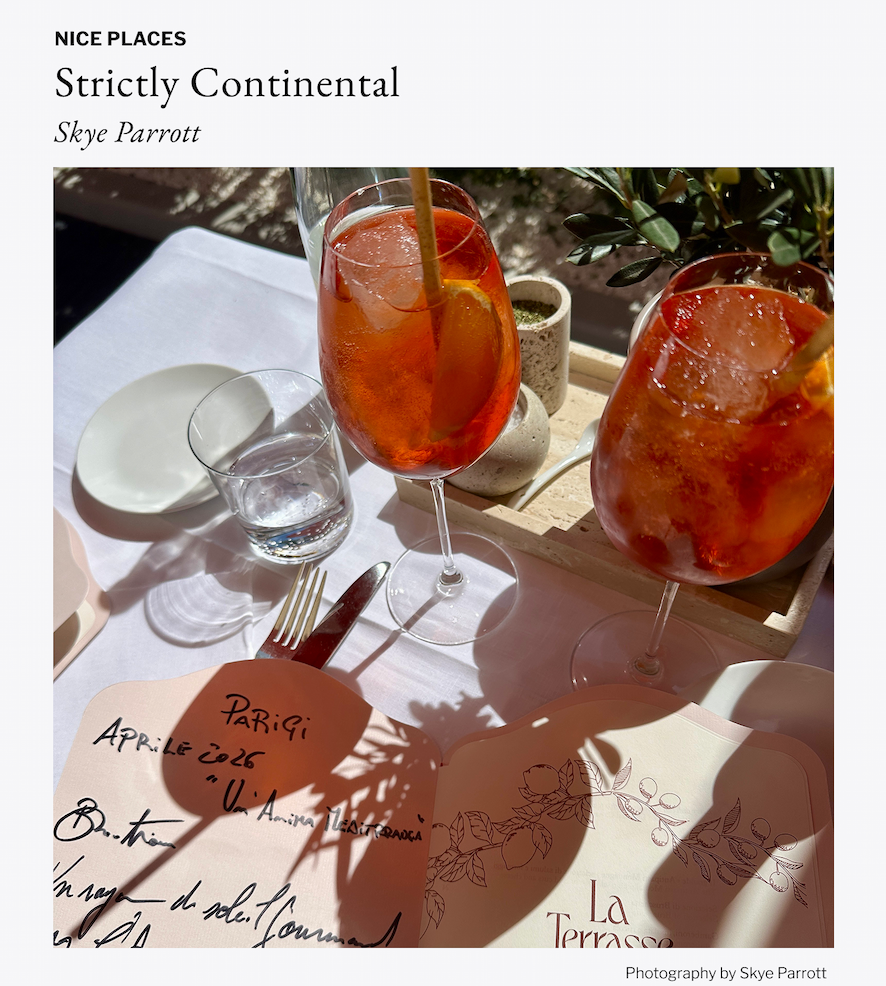
If you happen to be in Paris this summer but also wish you were in Rome, I am happy to propose a solution to your conundrum. Hotel Eden, one of Rome’s loveliest properties, has popped up for the summer on the terrace of its sister property, Hôtel Plaza Athénée. I recently attended the afternoon opening of the seasonal space, La Terrasse Eden, with a friend.
Sitting under the shade of Plaza Athénée’s signature red awning, surrounded by olive and lemon trees, we enjoyed dishes from a menu created by Eden’s executive chef, Salvatore Bianco, full of the flavors and spirit of Italy. There was burrata with confit datterino tomatoes, courgette flowers with ricotta and pecorino, and (virgin) spritzes that we sipped while people watching on avenue Montaigne. It was the best of two of my favorite cities, and I’m not sure if I can think of a nicer way to spend a sunny day, wherever it may be. |
|
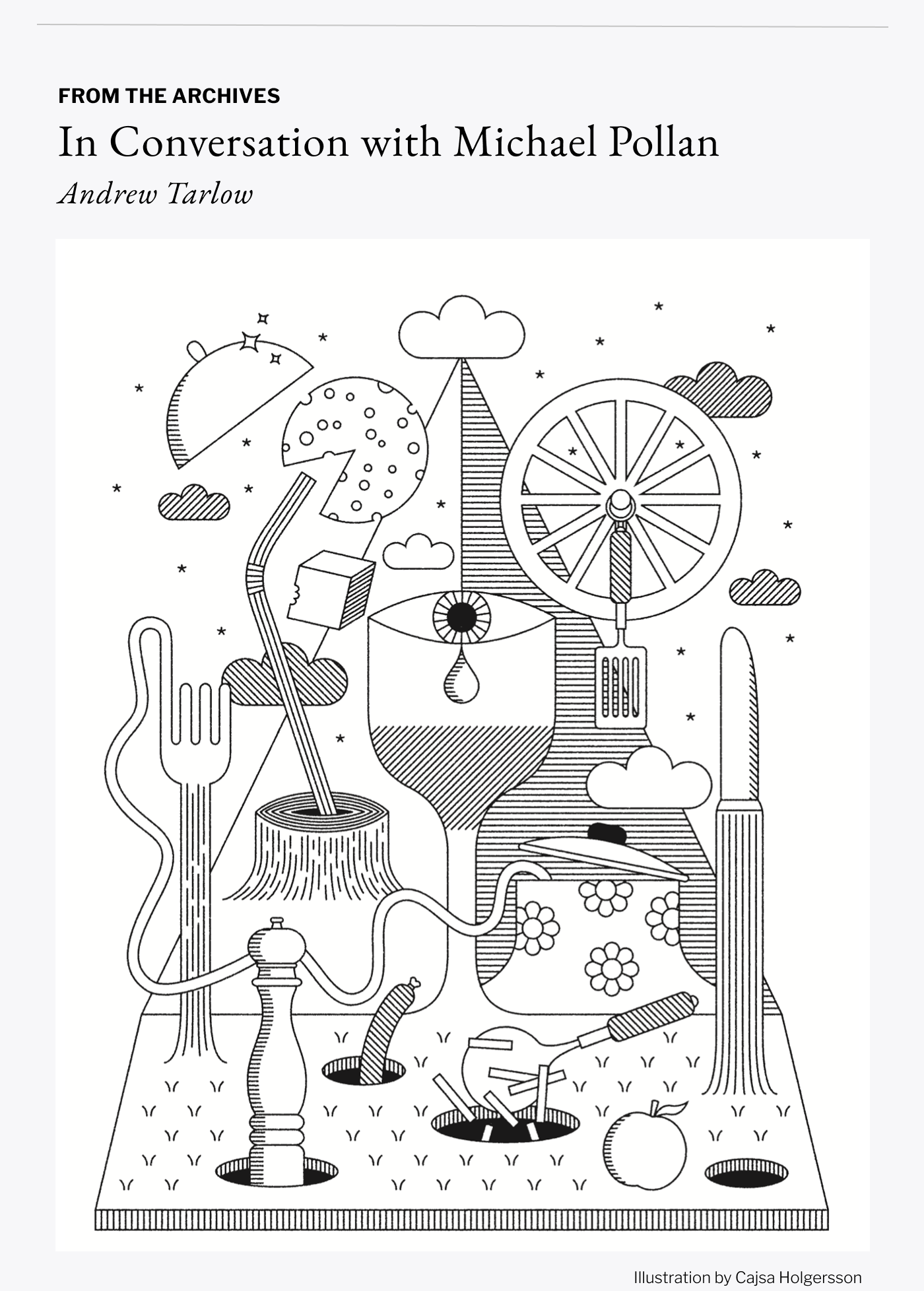
From the Archives revisits relevant cultural conversations from Dossier’s first life. While listening to this terrific podcast, in which Michael Pollan speaks to not only his new book exploring consciousness but also paralyzing preconceptions and the dangers of anthropomorphizing AI, I was reminded of the below exchange between Pollan and Andrew Tarlow, tackling a hot topic of 2008: food systems. Tarlow’s Brooklyn restaurant Dinerwas among the first to champion a no-tips, living-wage staff model and to dig deep into local ingredient sourcing, including whole-animal butchery, writing a new, enduring restaurateur rule book. The conversation, like Pollan’s work, highlights an empirical yet human and humble approach to better understanding societal concerns. –Erin Dixon Originally published in Dossier Journal No. 2, 2008. In the academia of Western nutrition, Michael Pollan is the unassuming king. His 2006 bestseller The Omnivore’s Dilemma initiated a national dialogue about the catastrophic state of American eating. Going beyond the aesthetic ramifications of obesity, Pollan examined an institutionalized scheme that strips not only the nutrition but also the pleasure from our tables. His follow up, In Defense of Food, presents a personal solution to this public problem. Confronting confounding modern health claims with signature simplicity, Pollan warns of nutritional additions, food pyramids and — of course — Twinkies, while ultimately encouraging us to heed his straightforward suggestion to: “Eat food. Not too much. Mostly plants.” Andrew Tarlow: How did you become such an expert on food? Michael Pollan: Well, I don’t have an academic background in it. My understanding of it really comes from the journalism I’ve been doing. I’ve spent a lot of the last five or six years — more than that I guess, about eight years — following the food chain and writing stories about where our food comes from. Whether it’s organic or, you know, modern feedlot beef or genetically modified potatoes. For each of these stories, most of which I did for the New York Times Magazine, I had to follow the food back to the farm. I learned an awful lot about agriculture that I didn’t know. So I think that any real understanding of food begins with an understanding of farming. I’ve been lucky to spend a lot of time on farms, both organic and industrial, in feedlots and confinement hog operations and big chicken houses, so I’ve had this kind of odyssey through both the best and the worst of the American food system. That’s been the big education I’ve had. And then I’ve had, you know, education at the hands of chefs feeding me and learning about food from good cooks. AT: Do you think we can actually save the planet by eating correctly? MP: Well, first, the planet is not in trouble, we are — the planet’s going to be fine whatever happens. But to save ourselves by eating better — yeah. I don’t know about completely, but we can go a long distance. I mean, reforming our food system would go a long distance towards helping with climate change, which is the most serious environmental problem. AT: Capturing carbon through grass-fed animals? MP: Well, that would help, but also not releasing so much carbon by doing things the way we do. And, you know, it’s synthetic fertilizer, it’s global transportation, it’s feedlot meat. All these things make a tremendous contribution to climate change. And we can undo that by essentially resolarizing the food system. You know, right now we have a system that’s based on fossil fuel, which we’re running out of. But the great thing about food is that, by its very nature, it’s a solar technology because every calorie of food begins with photosynthesis. So how do we get back to that? Read More |
|
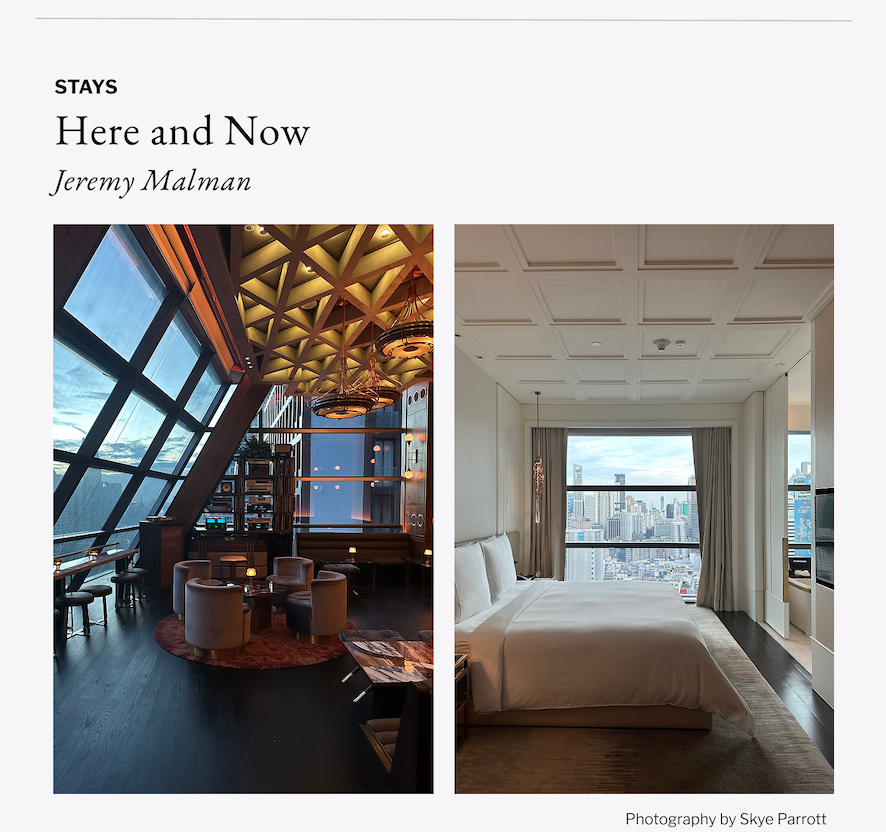
The 30-story tower that houses Rosewood Bangkok was designed by the same firm responsible for New York City’s uber-luxe Hudson Yards. But unlike the anodyne decadence of that development, which makes you feel like you could be anywhere, Rosewood Bangkok is true to the company's “sense of place” ethos. Arriving at the hotel, I was reminded that I wasn't just anywhere, I was in Bangkok — the high-rise is designed to resemble two hands folded together, a traditional Thai wai greeting, and it features local artists' work throughout.
The property’s central-city location, in the upscale Ploenchit district, also refuses to let guests forget where they are. My suite on the 23rd floor was a muted, decadent space with floor-to-ceiling windows running the full length, continuing into the bathroom, facilitating an unobstructed view of Bangkok's massive skyline. All I wanted to do was take a bath while overlooking the city — like a spoiled housecat, I’m mostly interested in staying put. This is especially true at a Rosewood property, where every whim is satiated (I really wish the toilet paper roll was lit up with tiny, amber-colored LED lights). But with just 24 hours in the city, I was forced to explore the flower markets, street food, and everything that any normal person would want to experience.
Upon returning, I was intensely hungry, so thrilled to learn that our server at Nan Bei, the hotel’s Chinese restaurant, was operating from the belief that satiety could never be achieved. This is the only explanation for her encouraging us to order as much as we did. I don’t recall exactly how many dishes were served, but each was a showstopper, all made with locally sourced ingredients. If I had to choose just one dish to recommend, it would be the Peking Duck — not only because it was delicious, carved tableside, and served with homemade pancakes but also because the dish always reminds me of A Christmas Story, which makes me smile.
I was incredibly tired after dinner but couldn't imagine trying to sleep with that much food in my body, so I headed up to Lennon's. Located on the 30th floor, the speakeasy and vinyl bar invites guests to enjoy a cocktail with embossed, hand-cut ice cubes while listening to their favorite artist, whose work they're likely to find in the bar’s library of more than 6,000 vinyls. From the low-slung banquettes in Lennon’s, which felt like a cross between Muscle Shoals Sound Studio and an Eames lounge chair, I recalled the day, hoping to better understand Bangkok’s interminable thrall.
It’s an incredibly modern city with a robust public transportation system that seems to be powered via extension cords. There are colorful, gilded temples nestled alongside narrow canals en route to Iconsiam, a 70-story building housing a mega-mall featuring 8 million square feet of shopping depravity. There’s the constant hum of scooter traffic running past Michelin-starred street food, all within the calm embrace of a Buddhist sensibility, which allowed me to take it all in. This dichotomy is the adventure, the textured layers of the place facilitate an experience of being somewhere else. It’s definitively not anodyne, or simply decadent. It’s so much more than that, making the kingdom, and the Rosewood Bangkok, just as promised — specifically of this very special place. |
|
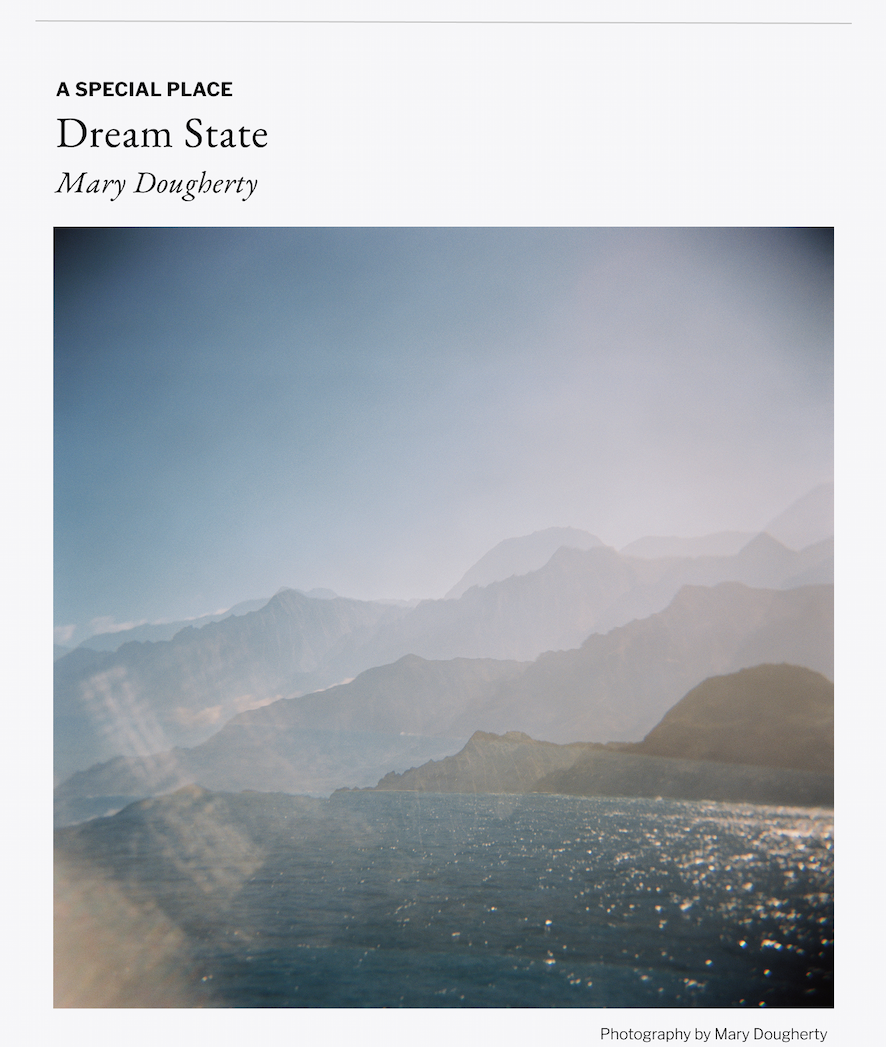
As a photographer who travels, I'm constantly debating how many cameras to bring on a trip. One that always makes the cut is my Holga. This lightweight, plastic camera shoots medium-format film. With it, I create the kind of abstract images that turn my memories into dreams.
On a recent family trip to Kauai, we visited the Nā Pali coast. We boarded a catamaran and encountered dolphins. They joined the journey and briefly led the way. It was as if nature were colluding to guide us to experience this wonder. I pulled out my camera and shot a triple exposure on the Holga.
The feeling of the sun shining brightly and the boat moving precariously as salty water sprayed the air is how I will always remember that trip. It was a full-circle moment for my family. My parents met in Hawaii, and we traveled to enjoy this beautiful place for their anniversary. Their origin story is something of ’70s lore, but it's possible to imagine anything happening in a place like this. Word to the Wise … On the North Shore of Kauai, you are close to the Nā Pali coast, amazing surfing, and luxury hotels, such as 1 Hotel Hanalei Bay. However, we found ourselves at home on the island’s South Shore, in Poʻipū. We loved Ko'a Kea Resort and enjoyed one of our favorite dinners at its signature restaurant, Red Salt. Waimea Canyon offers breathtaking views of the island. Take in the dramatic geology, then — as a treat on your way back, or every day — cool down with the best shaved ice on the island from The Fresh Shave. |
|
Think Globally, Act Locally. In the late ’90s, following the establishment of the North American Free Trade Agreement, the notion of globalization became a cultural boogeyman. Everything would become the same, they warned: Art, music, fashion, food would all become flat. Some fears have proved valid. On the other hand, the innovation that results from the unrestricted exchange of ideas remains one of humanity’s greatest powers, as I was reminded earlier this month at Maroma, A Belmond Hotel on the Riviera Maya. Here, Michelin-starred chefs Curtis Stone and Nello Cassese joined forces at Woodend, Stone’s signature live-fire restaurant at the hotel, to create a one-night-only, six-course Fire & Friends meal. The Australian-born, Los Angeles-based Stone’s use of the Mexican region’s ingredients and culinary traditions seductively harmonized with Italian Cassese’s expressions, as influenced by his adopted hometown, Rio de Janeiro. A briny bite of parmigiano, trout roe, and sea urchin invented by Cassese resided alongside Stone’s zingy steak tartare with yuzu and anchovy vinaigrette; Stone’s aesthetic hoja santa-wrapped kampachi in Caribbean green curry preceded Cassese’s simply comforting mezze maniche pasta in smokey gricia sauce. All the worldly dishes were served alongside astute wine pairings, with an unobstructed view of a starlit beach. –Erin Dixon Changing Contours. My understanding of contemporary art is admittedly limited. Despite many artists’ aim to convey complex ideas or raise difficult questions, I often find myself viewing their work in an instinctive manner: Is it easy to look at? Does it make me curious? Do I like the colors, the lines, the shapes? Maÿlis Noé’s creations are all about lines, movement, and a strong graphic sensibility. The Paris-based artist draws inspiration from cracks in the ground, the path of a thread, the trace of a gesture. The results are contemplative and soothing. Her first solo exhibition, Lines of Times, opens this week in Paris (on June 26) and runs through June 28, at 19 rue Beautreillis in the 4th arrondissement. –Anna Kaplan Wise Guy. In the days preceding Father’s Day, I decided to lean in and go vintage “Dad.” Without enough time to grow a beard, I chose, instead, to sample Clive Christian C Woody Leather fragrance. Rich, complex, and multifaceted, with subtle hints of orange (my daughter detected resin, like frankincense), it recalls seasoned leather and spice, making me feel wrapped in a first-edition classic novel. While I wasn’t anywhere near a gorgeous English library, I did pair it with a few sips of crisp, botanical gin and did my best to offer some fatherly wisdom. –John Chuldenko |
|
54 Franklin St #2R NY, NY 10013. ©2026 Dossier Projects, LLC.
|
|
|
|
|