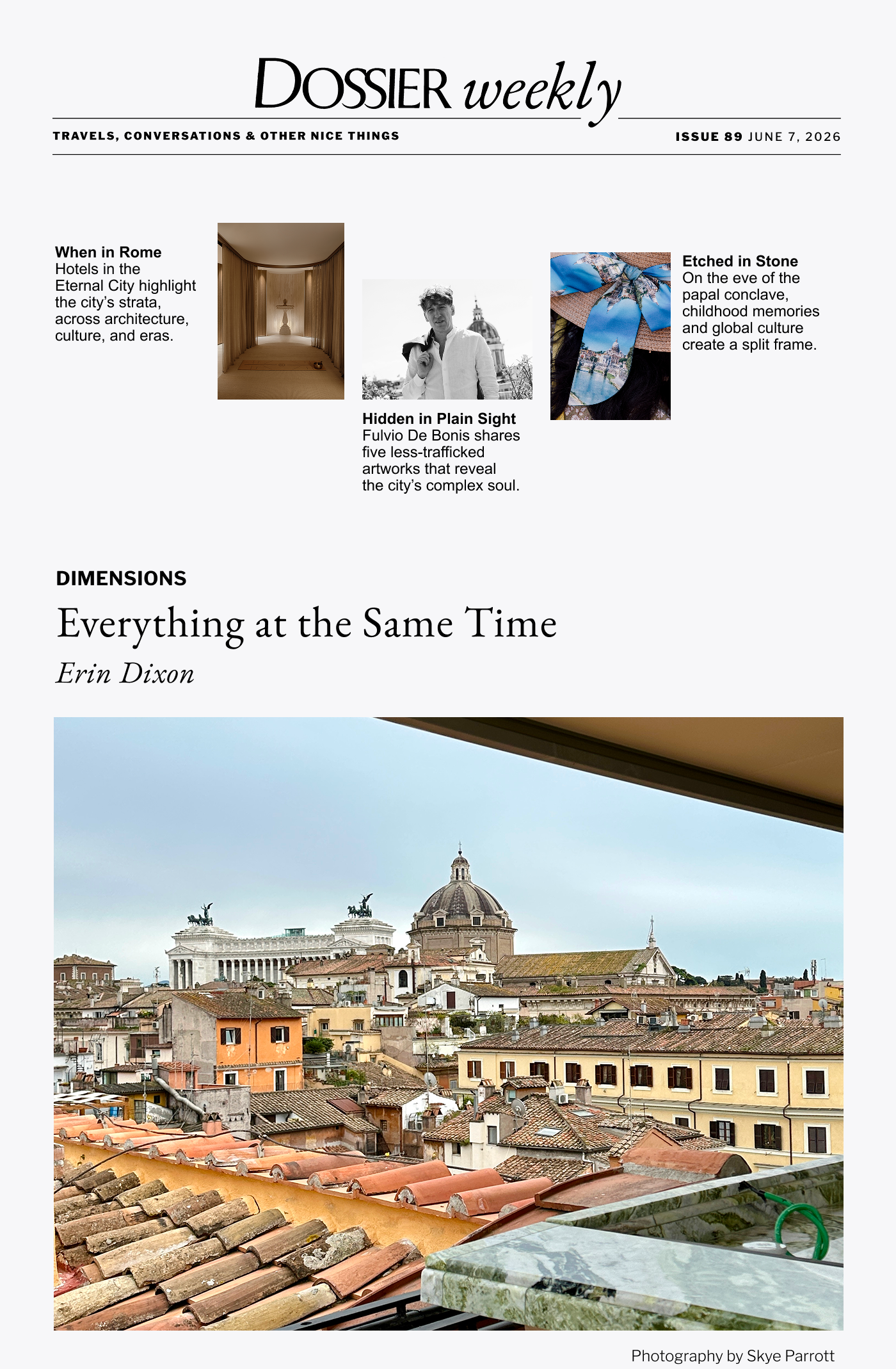
There is a certain hour in Rome, between sunset and nightfall, that reveals the climate of Giovanni Paolo Panini’s 17th-century capricci paintings of the ancient Italian city to be more truth than fantasy. The Tiber River’s humidity and the waning light smear reality’s edges, announcing the landscape’s luminous shades as nature’s gifts, rather than an artist's genius.
One spring season, around a decade ago, I walked the river’s banks daily at this time. I’d start from the frenzied Trastevere side of Ponte Sisto, meander down to Ponte Sant'Angelo (near the Vatican), nodding to its celestial messengers en route to Via dei Banchi Vecchi, where I’d pass idiosyncratic antique shops, stopping every blue moon at Il Goccetto for a goccetto of wine. The connecting streets would spit me out into Campo de’ Fiori’s clinking aperitivo hour. I’d continue past the Jewish Quarter, with its poetic Portico d'Ottavia, to Ponte Fabricio, crossing Isola Tiberina, eventually lopping back to my apartment in Piazza de’ Renzi. Tucked onto the first floor of a period building, it overlooked the vestibule, which was blanketed with jasmine vines erupting in fragrant nocturnal blooms.
Those months were a parenthesis. I’d gone to Rome to write and to consider life with a bit of physical perspective and solitude, which made the ancient Roman philosopher Seneca my most vocal walking companion. His maxims "It is not that we have a short time to live, but that we waste a great deal of it" and “They lose the day in expectation of the night, and the night in fear of the dawn” accompanied me as I climbed timeworn stone stairs to take in the humbling view from Gianicolo (Janiculum Hill), strolled through Villa Borghese’s manicured paths, pondered progressive exhibitions at MACRO, and generally wandered, in search of everything. Each location and discovery added a brick to my memory palace, fixing philosophy to place and cementing Rome as keeper of personal foundations.
Returning to the city for the first time after the pandemic carried with it the possibility of destabilizing that bedrock. But the center held. I found that Otaleg still makes transcendent liquirizia gelato in its unassuming nook, and Dolci di Nonna Vicenza still offers an unbeatable breakfast: freshly baked Sicilian brioche and cappuccini. Osteria La Gensola, Da Enzo, and Trattoria Da Augusto continue to serve pasta alla gricia and spaghetti alla carbonara that just can’t be properly replicated in the States. Even the quirky, bespectacled estate jeweler on Via dei Banchi Antici, with his rare wares and no formal shop name (he’s on the left if you’re walking away from the river), can still be faithfully found behind his polished desk with a loupe in hand or outside the front door, smoking.
Hotel de’ Ricci Roma dropped me back into the center of the medley. Just across the river from my old home, the boutique property is aptly designed as a home, comprising eight artful suites and an intimate dining room serviced by a highly curated, 1,500-bottle wine cellar and stately cigar lounge. The storied fish restaurant Pierluigi, around the corner, elegantly extends the property (both it and the hotel are owned by renowned Roman restauranter Lorenzo Lisi, which makes securing a reservation easy).
All of these stalwart destinations remain, standing on all that came before — whether “before” is measured in days, decades, or millenia — alongside a constant stream of new arrivals that ensures the city’s lifeblood keeps pumping.
Cultural insight into this space-time continuum came on that same visit, when I took a daytrip two hours northeast to Solomeo, to chat with Brunello Cucinelli. We began our catch-up by confiding our mutual love of Rome, and he immediately dug into his mind’s famously deep historical archive to share the origins of the city’s most notable moniker. “A close friend of the Roman emperor Hadrian once asked him, ‘When will Rome end?’” Cucinelli recounted. “And the emperor responded, ‘As long as there are brave men willing to be killed, Rome will stand. As long as there are architects who will design for eternity, as long as there are engineers planning and designing bridges, our Rome will live … It will not die with the last man standing.’ That’s why Rome was called the Eternal City.”
Eternal may be relative, but the city’s existence is always a relief. Whatever your conception of Rome is or was, you can likely still find it — and you’ll invariably find more. |
|
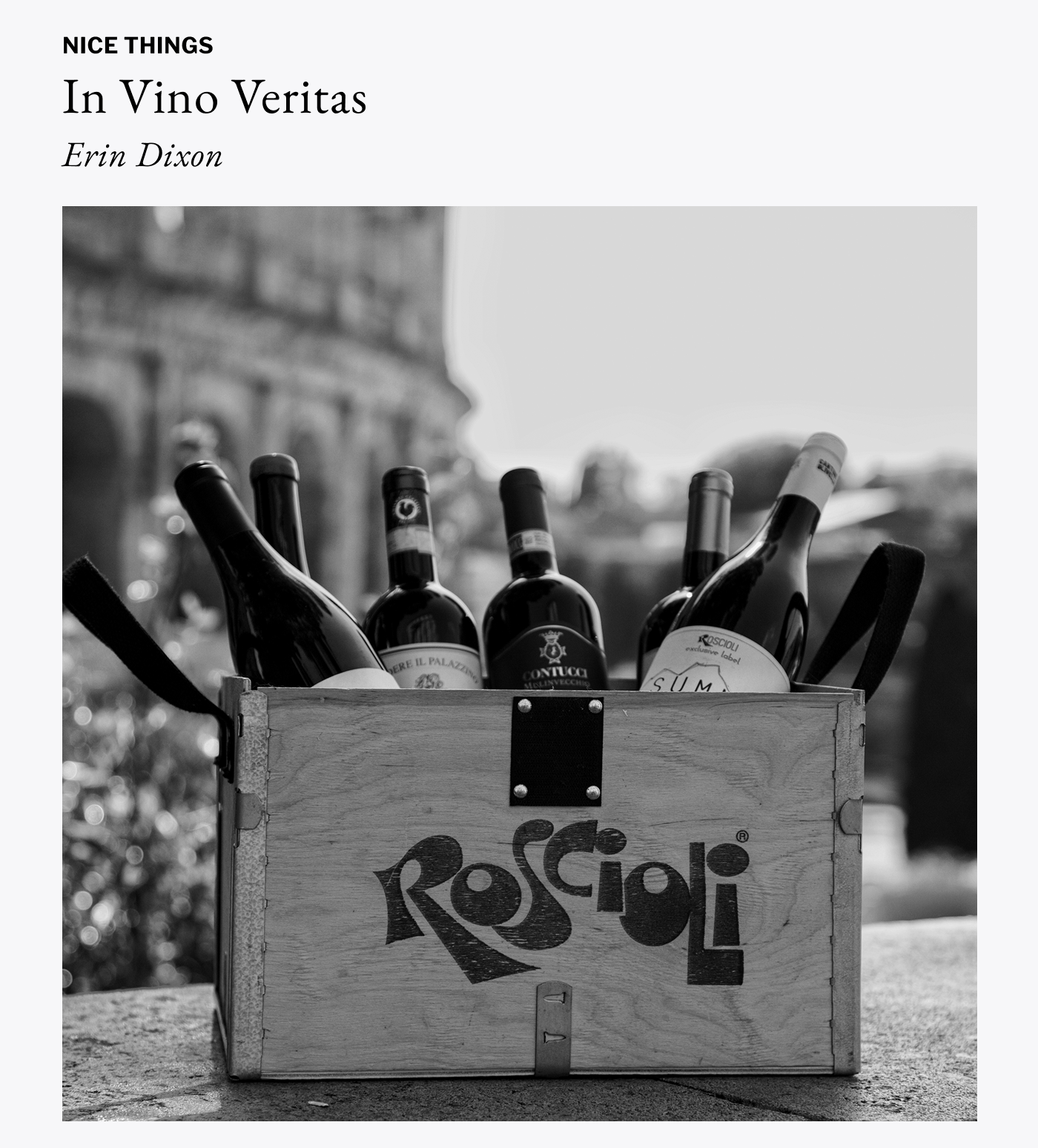
A subscription to the Roscioi Wine Club is one of the best gifts I’ve ever received. Its namesake — Salumeria Roscioli, a shop and restaurant in Rome’s historic center, a few paces from Campo de’ Fiori — has served as a culinary darling since its 1972 opening, and the destination remains one of the few in the city that still attracts tourists and locals in equal measure.
I was a fan even before my first visit, thanks to the company’s logo, which is articulated by tottering art deco typography similar to that found on the poster for the 1973 Federico Fellini film Amarcord, which, incidentally, means “I remember …”
For me, Salumeria Roscioli recalls porchetta sandwiches and crisp, mineral-driven Frascati white wine. For others, it’s reminiscent of Roman classics, like cacio e pepe and a glass of Cesanese red. For all, Roscioli is synonymous with top-quality, uncomplicated Italian cuisine, a reputation the company has maintained since extending its reach to New York City, where it now has a deli and restaurant, and launching its wine club in 2021.
Roscioli describes the club as a “project,” an approach reflected in its distinctly human communications. Each of two annual shipments contains a charmingly simple broadsheet, The Roscioli Wine Club Times, speaking to the collection, with QR codes on every bottle linking to videos featuring the stories and faces behind the respective wines. It’s a sort of lo-fi exclusivity, as the majority of the club’s organic, sustainably farmed wines come from allotments too small to make it to the US through conventional channels: wine shops, restaurants, grocers, and the like.
This doesn’t mean the selections are wildly fancy or expensive, but they are objectively excellent and reflective of the project’s passion: They taste and feel special, just like Roscioli, just like Rome — even when enjoyed at home.
|
|
The Eternal City is best experienced through its infinite layers. Each of these stays reveals a different one: the “Golden Age” of rail travel, the grandeur of an artistic salon, a local’s new favorite golden hour stop, and a modern interpretation of ancient Rome. |
|
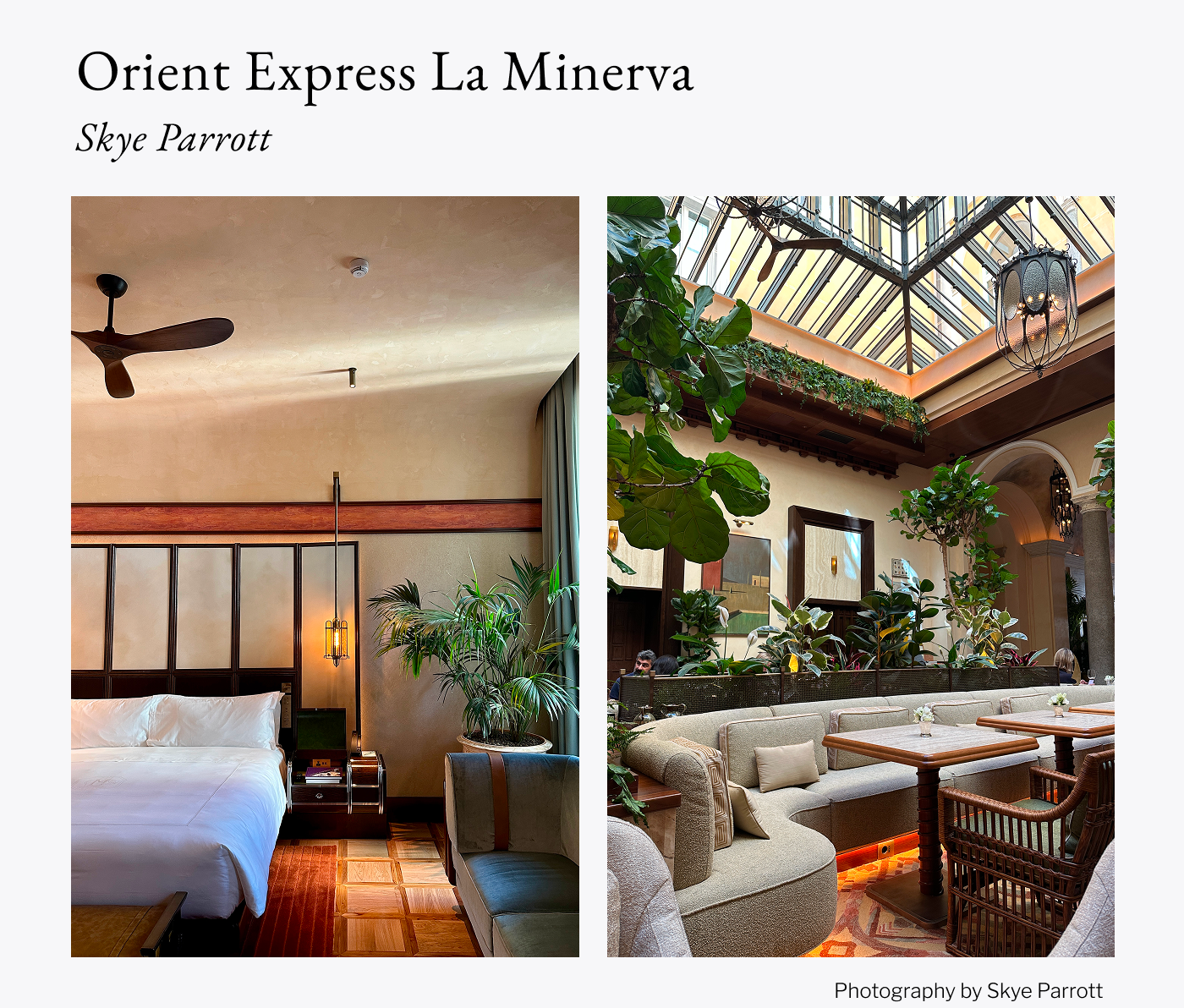
Stepping through the doors of Orient Express La Minerva, one has the uncanny sense of arriving at a train station. A very nice one, from the “Golden Age” of rail travel. Tucked behind the Pantheon, on Piazza della Minerva, the hotel — the first from the Orient Express brand — has 93 rooms, but it feels much smaller. Its nod to train travel is, of course, a deliberate choice, creating a unified sense of glamour across a now varied portfolio of hospitality offerings from Orient Express. La Minerva’s interiors are incredible. Its spaces are layered and indulgent, outfitted with an array of rich, polished woods; beautifully veined Italian marbles; and deeply textured fabrics. The French-Mexican artist and architect Hugo Toro designed them, down to the furniture, creating a decidedly modern hotel that also clearly references the art deco influences within the brand’s rail history. I loved the hotel’s lobby restaurant — La Minerva Bar, housed in a glass-ceilinged courtyard filled with greenery — as well as its most recent addition, a spa. The subterranean space is sumptuous and dark, offering a hammam and an array of treatments inspired by the spas of Istanbul: the train’s original embarkation point. Its skincare rituals draw from a more proximate inspiration, having been created by Furtuna Skin. The line is scientifically designed using organic ingredients, including olive oil and botanicals sourced from the company’s regenerative, 800-acre farm in Sicily — which, incidentally, can also now be reached on La Dolce Vita Orient Express train. |
|
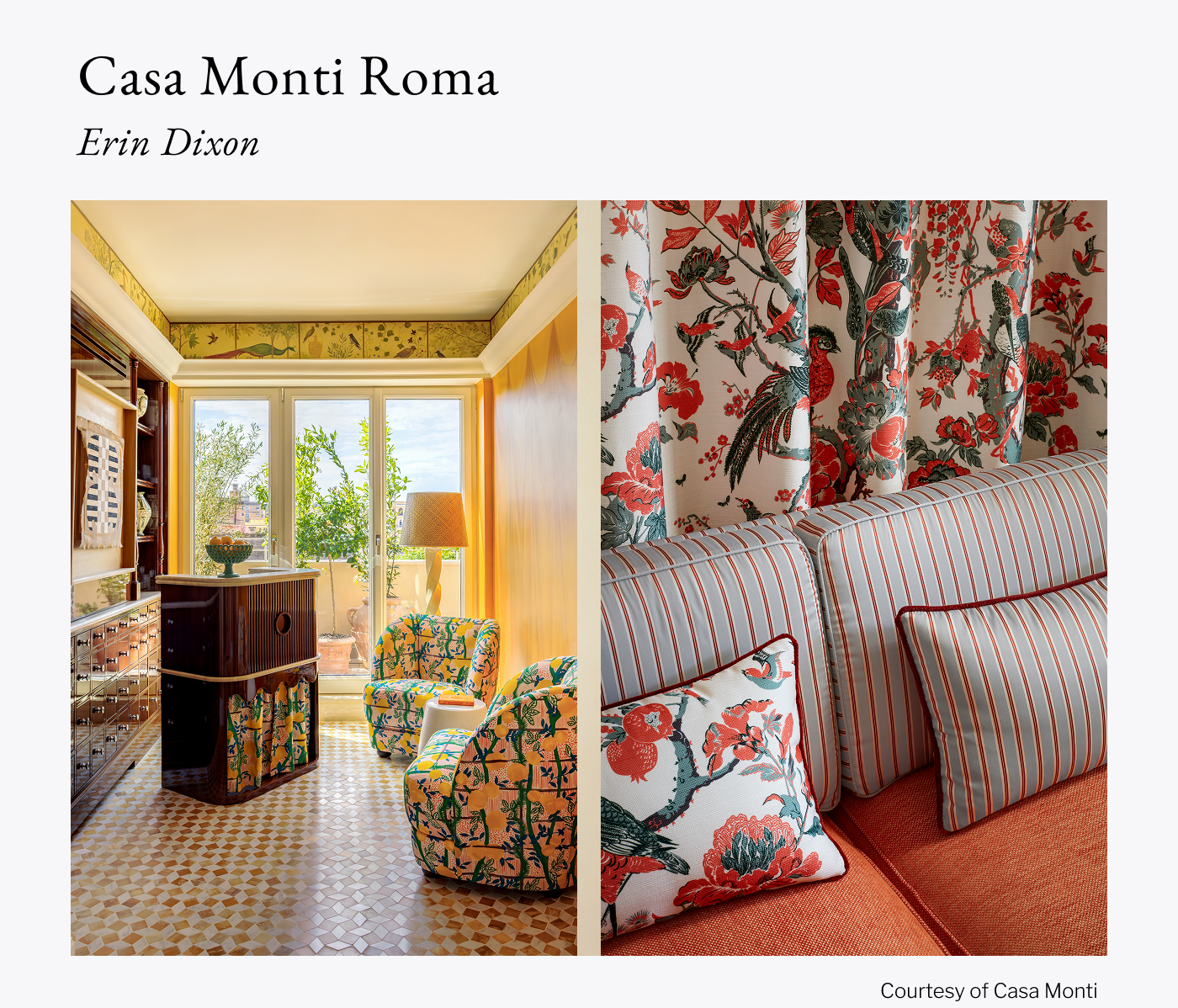
Nestled in Monti, every local’s favorite Roman neighborhood, Casa Monti Roma is both unmistakably of its place (eclectic like its historically artistic rione, yet effortlessly refined, like Rome) and delightfully unlike any other hotel in the city.
The family-owned boutique property’s decor is a joyful riot of bespoke graphic textiles and hand-painted ceramics. Mediterranean hues, original artworks, and curated bookshelves collectively exude a cinematic sprezzatura (ease and elegance), with eccentric, modern touches that extend to the hotel’s fanciful bar and ristoranti, each serving contemporary takes on traditional Roman dishes.
On the fifth floor, the capital’s first Susanne Kaufmann spa delivers a marble jacuzzi alongside journey-worthy massages and facials. Then there’s the rooftop terrace — among the city’s best-kept secrets, tucked away from the crowds, with unobstructed views of dusty cupolas and sun-bleached terracotta peaks, framed by Rome’s famous hills and umbrella pine trees. It’s ideally enjoyed in the evening with a classic aperitivo or house cocktail, as the city’s pastel sunsets suffuse the sky and church bells peal.
|
|
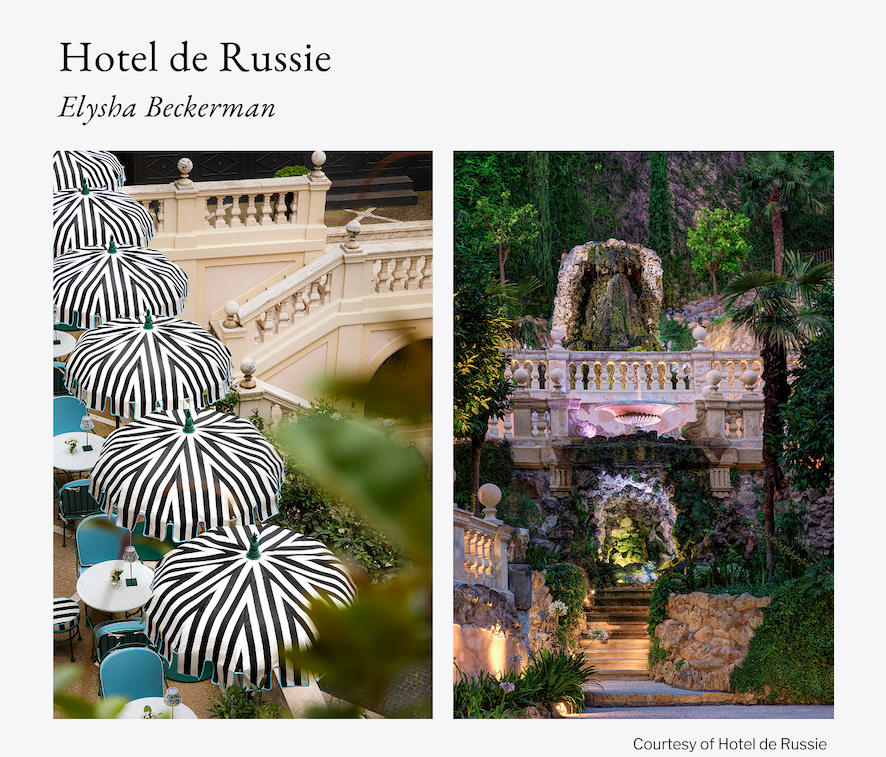
Hotel de Russie, a Rocco Forte hotel, resides in the centro storico of Rome, on Via del Babuino, between Piazza del Popolo, Piazza di Spagna, and Villa Borghese. Originally built by master architect Giuseppe Valadier in the 19th century as an aristocratic palazzo, the property offers a study of the city’s ever-evolving creative milieu.
Its name pays tribute to a chapter of history in which members of the Russian Imperial House, as well as visiting Russian aristocrats, diplomats, painters, and literary figures, claimed it as their unofficial Roman headquarters. In the ensuing decades, the hotel welcomed all genres of creative luminaries — from Mark Twain and Jean Cocteau to Ingrid Bergman and Pablo Picasso.
Sipping an aperitivo in the Secret Garden placed me in a pseudo dialogue with these famous former guests — the courtyard’s wisteria-draped walkways, stone fountains, aromatic citrus trees, and rare silence (for the city) enhancing the sense of time suspension. A plate of spaghetti al pomodoro and a glass of a red wine swiftly returned me to the present, extending what was meant to be a quick dinner across hours and offering me a front-row seat to what looked like a milestone birthday.
Around 40 guests were dressed in gowns or tuxedos, with candelabras running down their lengthy table. From where I sat, I could see joy and candlelight flicker across their faces and hear rapid Italian interspersed with laughter. Is this where I want to celebrate my next milestone birthday? I asked myself. The response came quickly: Certo.
|
|
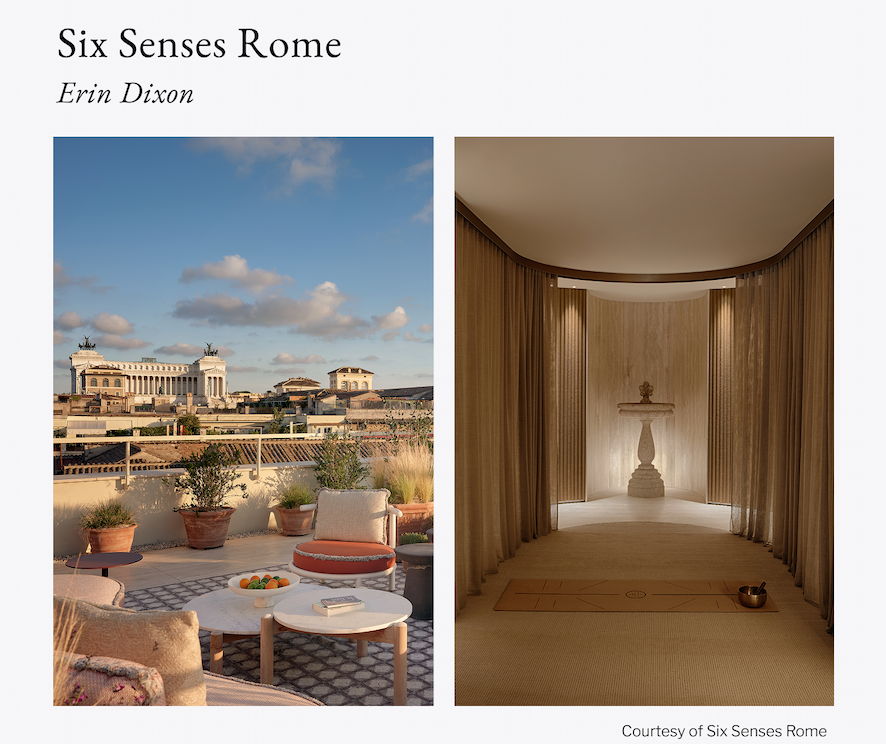
Smack in the center of Rome between the Trevi Fountain, Pantheon, and Victor Emmanuel II Monument, Piazza San Marcello can feel like a vortex: of tourist hoards and their flag-bearing leaders, of clustering government officials from the nearby Senate and Cultural Ministry, and, naturally, of actual Romans. But this easily overlooked piazza is actually a portal — to ancient Rome and to a future rebalanced self.
Six Senses Rome is housed within the piazza’s UNESCO-listed Palazzo Salviati Cesi Mellini, which was built as a shared residence in the late 15th century by the three noble families that give it its name. That said, the building’s true origins can be seen on the ground floor, through glass floor tiles that reveal what is thought to be the city’s oldest baptismal font. Dating back as far back as the 4th century and connecting by underground passage to the adjacent Chiesa of San Marcello del Corso, it still holds water in its basin, setting a spiritual stage for the hotel's modern Roman thermae.
Reproductions of ancient Roman baths, the three pools follow the traditional circuit of calidarium (hot), tepidarium (tepid), and frigidarium (cold) while reflecting Six Senses’ present-day promise: to help reconnect you with yourself, others, and the world around you via a holistic six-pillar wellness philosophy. The brand has gained global fame for its pioneering blend of ancient healing practices, biohacking technologies, and destination-driven culinary and cultural offerings.
The authenticity of this pledge was realized for me via a treatment performed by the hotel’s visiting practitioner Suraj Varma, an ayurvedic guru from Kerala, India, whose intuitive understanding of my physiological state seemed to channel a higher power — perhaps it did, here in this legendarily sacred place, blessed by atoning waters. Varma concluded my transformational therapy with a purifying discourse on healing: “Go slower,” he said. “Have real faith.” |
|
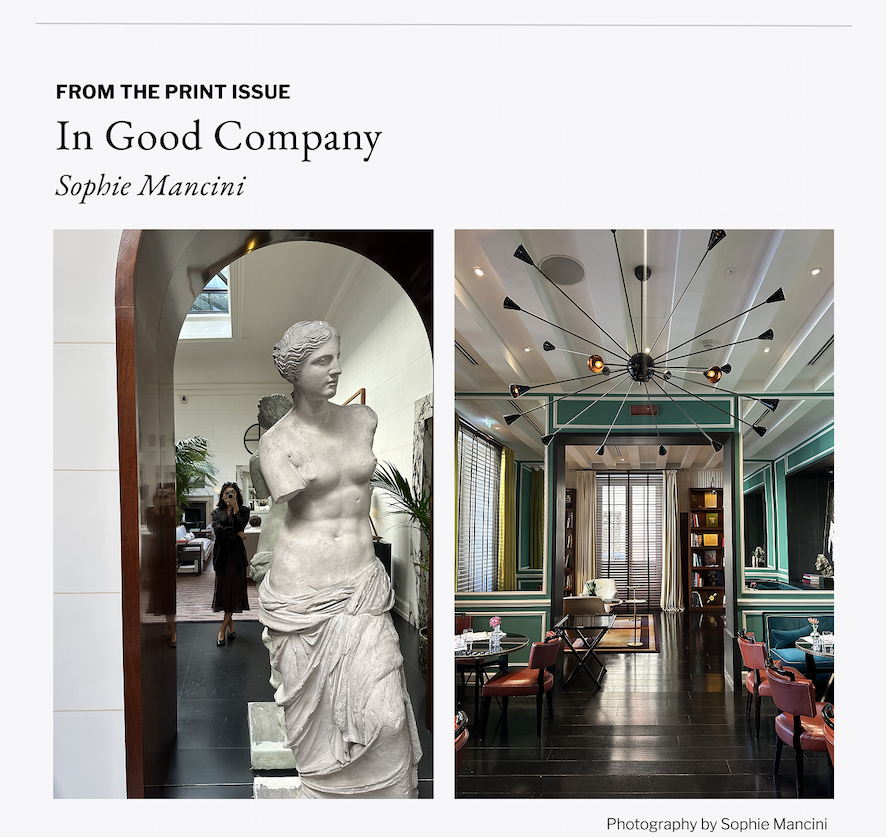
You notice the scent first. Walking into J.K. Place Roma, one is met with the fragrance of something cool. It’s a bit green, but sweeter, like the juiciness of ripe citrus, and it sets the tone for the whole stay: fresh, discreet, and understated. Tucked off a quiet cobblestone backstreet in the historic Campo Marzio district, this 27-room townhouse hotel sits just steps from Rome’s most coveted treasures: It’s minutes on foot from the Spanish Steps, the Trevi Fountain, the Pantheon, and Piazza Navona.
Interiors by Florentine designer Michele Bönan blend midcentury modern with classical touches. Rooms are light and soft, with carpeting in dove gray, four-poster beds draped with an ivory canopy, and bright marble bathrooms. The library downstairs is a popular place for sartorial Romans to gather for an aperitivo, colluding in little groups somewhere on the spectrum between business and pleasure. The floors, which also run through the restaurant and bar, are jet-black, high-polished wood, gleaming like the River Styx.
One of my favorite moments at the hotel — distinct in our modern app hellscape — was having the highly attentive and discerning staff present me with an actual paper map, having marked their favorite roads and sites in ballpoint ink. Analog, and ever elegant. Read more close takes on a wide world in our Spring/Summer 2026 print issue. Order now.
|
|
Rome is where both my “breath” and my story began. Growing up in the city, I absorbed its restless energy long before I ever formally studied its art. I had the immense fortune of being shaped by a place where the weight of history and the vibrancy of the present exist in a single, seamless moment.
In Rome, art functions as a vital current rather than a silent archive. It’s capable of dissolving the distance between centuries, fostering an immediate, instinctual connection that renders time irrelevant. A masterpiece here serves as a universal mirror; it captures the complexities of human emotion with an intensity that resonates as powerfully today as it did 400 years ago. In this way, art in Rome transcends geography and cultural origin, speaking directly to a shared human experience and offering a rare space where we recognize ourselves in the work of those who lived in a completely different time.
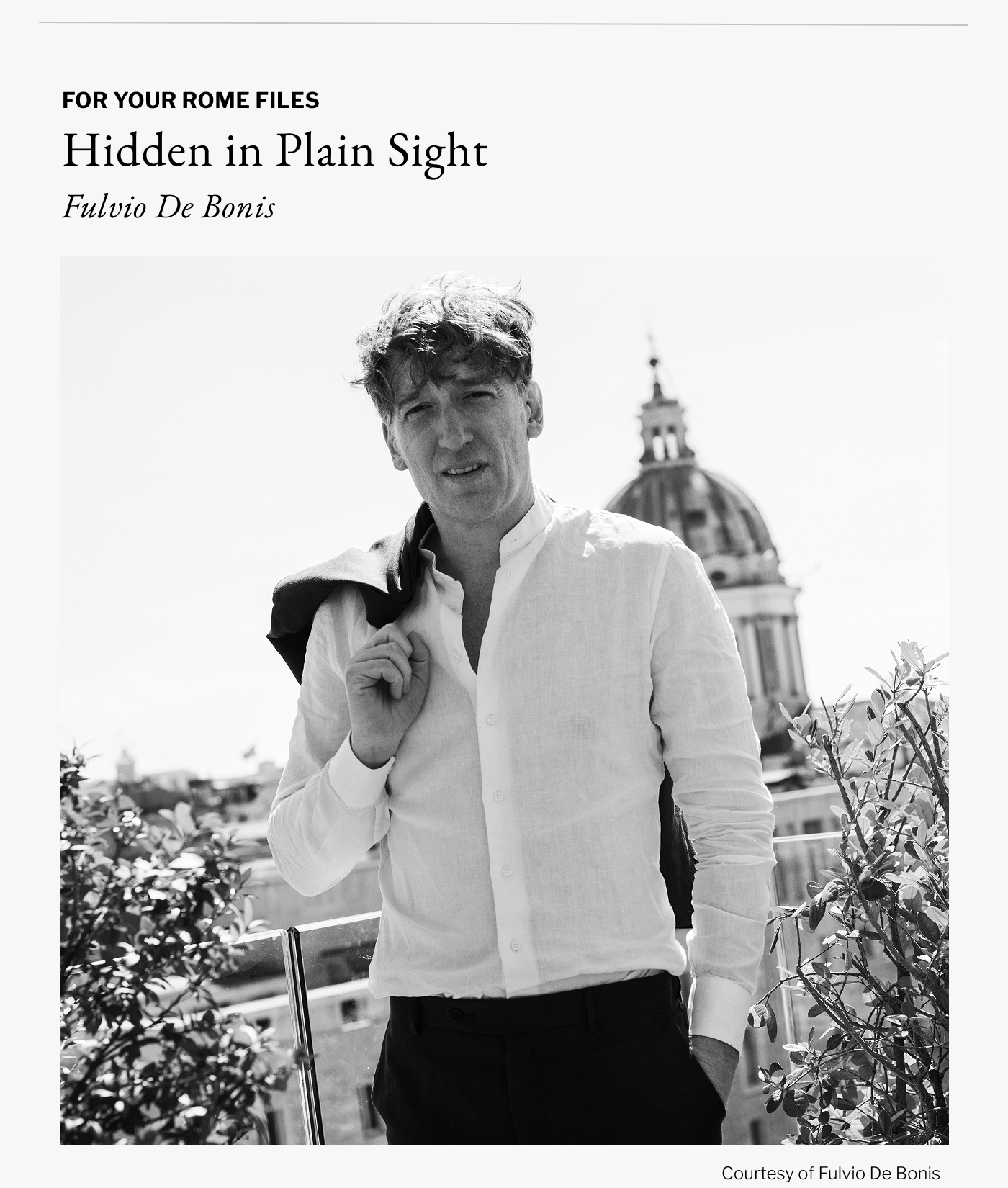
After training as an art historian and managing luxury hotels in London, England, I returned to Rome and co-founded Imago Artis Travel with my wife, Alessia, and business partner, Chiara. We built this company to celebrate Italy as an atelier of living culture: a pilgrimage for the soul, rather than a mere map of landmarks.
Below are five hidden artworks in Rome that I return to again and again. La Madonna dei Pellegrini by Caravaggio, Basilica of Sant’Agostino. This altarpiece maps my evolution from child to art history student to CEO. Though the painting remains identical, my own maturity has finally unmasked the profound tragedy it contains. The pilgrims’ soiled feet and Mary’s weary gesture anchor the divine, affirming that darkness is a vital, lived weight. The Sybils by Raphael, Santa Maria della Pace. Raphael orchestrates a celestial ascent, guiding the observer into a realm of absolute geometric and spiritual harmony. These ethereal figures hold faces from another world, yet their gaze remains arrestingly human. I find peace in this paradox: a vision of heaven that feels entirely within reach. The Boxer at Rest by an unknown artist, National Roman Museum, Palazzo Massimo. This Hellenistic bronze sculpture captures the raw, heavy weight of endurance. Its subject sits in a state of complete exhaustion, his face bearing the jagged scars of a thousand blows. I feel a deep connection to his weariness; he serves as a timeless mirror for the human struggle. His battered hands speak of a quiet, unyielding strength: the internal choice to confront a difficult path and, eventually, get back up. Sogni (Dreams) by Vittorio Matteo Corcos, National Gallery of Modern and Contemporary Art. Corcos captures a gaze that pierces through time. She sits suspended in 1896, yet appears to be observing our modern reality as if we were her own fever dream. I wonder if she views us with hope or dread, her eyes tirelessly grasping for a future we now inhabit. San Carlo alle Quattro Fontane (Church of St Charles at the Four Fountains) by Francesco Borromini, Via del Quirinale. This architectural masterpiece defies its cramped Roman corner through revolutionary geometry. Borromini’s undulating walls and forced perspective orchestrate a brilliant illusion, expanding a tiny footprint into a soaring, breathing sanctuary. It reveals that life’s journey transcends simple lines, existing instead within the fluid, complex forms we must navigate. |
|
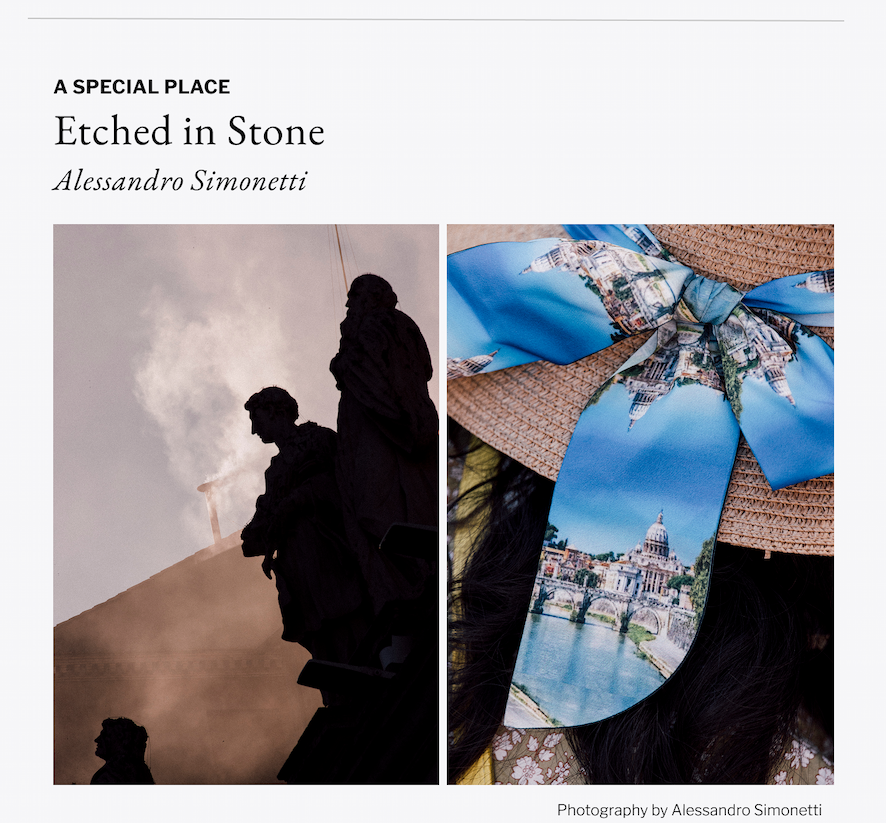
The atmosphere I encountered in Vatican City three days before the 2025 conclave was completely new to me, even though I grew up in the Eternal City, because my Rome is anchored not by monuments but by a few indelible points. My most vivid memories reside in the cobblestone triangle between the church of Santa Maria in Trastevere, Bar San Calisto, and Trattoria da Augusto.
I had a huge sense of freedom and adventure in the edgy Trastevere of the early '80s, where my older sister, Perla, and I would escape the summer heat by bathing in the piazza’s marble fountain, designed in the 8th century by Donato Bramante, with eventual additions by Gian Lorenzo Bernini and Carlo Fontana. Our days were marked by the sound of Moretti beers popping open and the cool relief of gelato from San Calisto. My father, known as "Er Pugile" (the Boxer), was a fixture there — the only bar in Rome where posters for both Roma and Lazio football clubs could peacefully coexist. They were surrounded by signed posters of Muhammad Ali and black-and-white photos of actresses — all recalling a Trastevere that was rougher, louder, and more intimate than it is today.
The scent of a Sunday pranzo (roasted meat and artichokes) still floats through my memory. At Trattoria da Augusto, a shredded page from a comic book my dad gave to the owner still hangs on the wall: a small, stubborn piece of our history. These memories are not just about places; they are the stages of our daily lives, where the city felt like family.
Rides home at night in our light-blue Volkswagen Beetle, passing obelisks, arches, pyramids, and churches, filled my eyes from a very young age. This visual immersion, a constant feast for the senses, prepared me — emotionally and visually — for the photographic work I would undertake during the last conclave, a full-circle moment when my childhood home met the global stage.
|
|
Think Twice. Are animals core celebs? Is it rude to ignore ghosts? How is a digital clock with a feather in its hat related to depression? These are but a few critical questions comedian Jacqueline Novak explored in an engulfing set this past Sunday at Aladdin Theater in Portland, Oregon, that exemplified the word “entertainment.” The show was part of Novak’s 2026 tour; her next stops can be found here. Buy a ticket because not only are her revelations a riot they’re also startlingly profound. For a preview, catch her podcast Poog, a nonlinear exploration of wellness and being that Novak co-hosts with her equally astute best friend, Kate Berlant. –Erin Dixon One More Time. When I travel, I usually make a point of eating somewhere different for every meal. That said, while in Paris, I had no hesitation about dining at Bistro Le Carreau twice in four days. The restaurant’s offerings highlight classic French brasserie staples, such as steak frites but also often incorporate Asian influences. Each day, its team curates a new menu based on fresh, seasonal produce carefully sourced from local partners. And every day it’s delicious. –Alessandra Berge |
|
54 Franklin St #2R NY, NY 10013. ©2026 Dossier Projects, LLC.
|
|
|
|
|