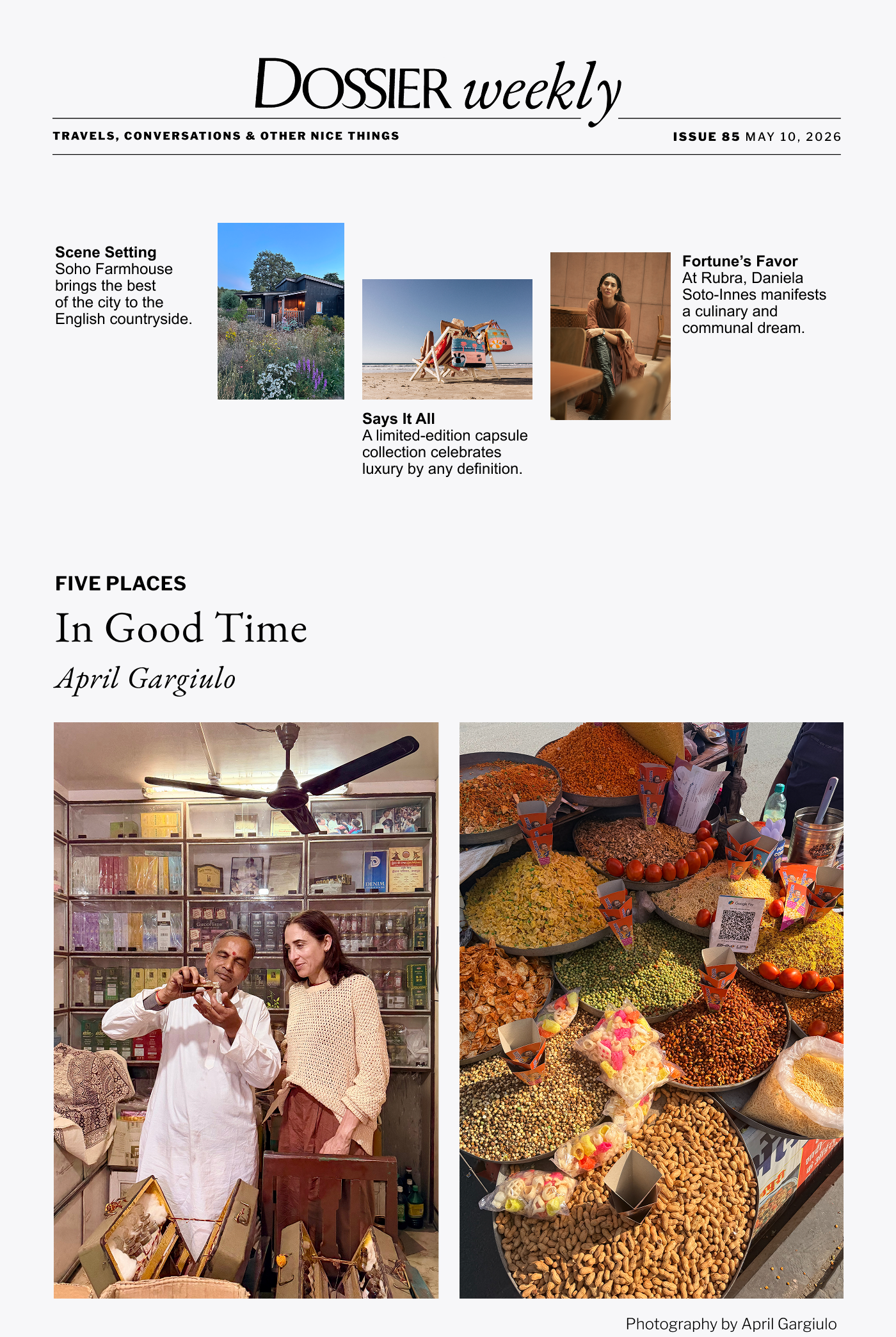
My background in winemaking taught me early on that time is not a constraint. On the contrary, it’s a collaborator. Vintner’s Daughter skincare was born from this belief — that the most meaningful things are made slowly. Perhaps that’s why I felt such a kinship with Jaipur and its craftsmanship traditions. In the northwestern Indian city, heritage isn’t something relegated to the past; it’s lived, practiced, and protected every day. On my recent visit there, I had the honor of spending time in ateliers, both ancient and modern, thanks to Grant Gibson. When I began planning my trip to Jaipur, many people I trust pointed me toward Gibson’s trips. He has traveled to Jaipur for decades, sourcing for his interior design clients. In recent years, Gibson has also started curating journeys. Through him, I was granted access to craftspeople and workshops I never could have found on my own. These artisans’ devotion to craft resonated deeply with Vintner’s Daughter’s philosophy. They use ancient materials and time-honored traditions complemented by modern techniques and technologies, many carrying forward knowledge refined through generations of family lineage. Here are five of my top discoveries within the city … Vijay Laxmi Sugandh. At this nearly 100-year-old apothecary, a fifth-generation herbalist walked me through his family’s remedies, which treat everything from indigestion to “melancholy.” The tiny, 100-square-foot shop — tucked into the middle of the bazaar and lined, floor to ceiling, with small bottles bearing handwritten labels — felt sacred. The Jantar Mantar. Built in 1734, this astronomical observation site houses 20 monumental, fixed instruments, including the world’s largest stone sundial. Children climbed the massive forms as I stood there, trying to comprehend the precision of these tools created centuries ago. Their scale and accuracy felt almost impossible Ram Niwas Garden. I stumbled upon a small, gated park — part of Ram Niwas Garden, across from Albert Hall Museum — and (on that particular day) found myself completely alone. The park’s fountains, rose garden, fern arboretum, and winding paths offered a quiet reprieve from the city’s intensity, which felt like an exhale.
Phool Mandi. This flower market was a riot of color and scent. Hand-harvested marigolds, roses, and armfuls of fresh flowers were stacked in vivid mounds, many featuring the same botanicals we use in our formulations. Seeing the flora in this raw, abundant state connected to the work we do at Vintner’s Daughter in a visceral way.
Jobner Bagh. The owners of this boutique hotel, where I stayed, are incredibly chic. Their names are Megha and Shiva Guhar, and they also have a small, highly curated shop on the property that is very special. It features pashminas, antique pottery, metalwork, art, and so many objects. Each item feels deeply personal, and the hotel is perfect as well.
|
|
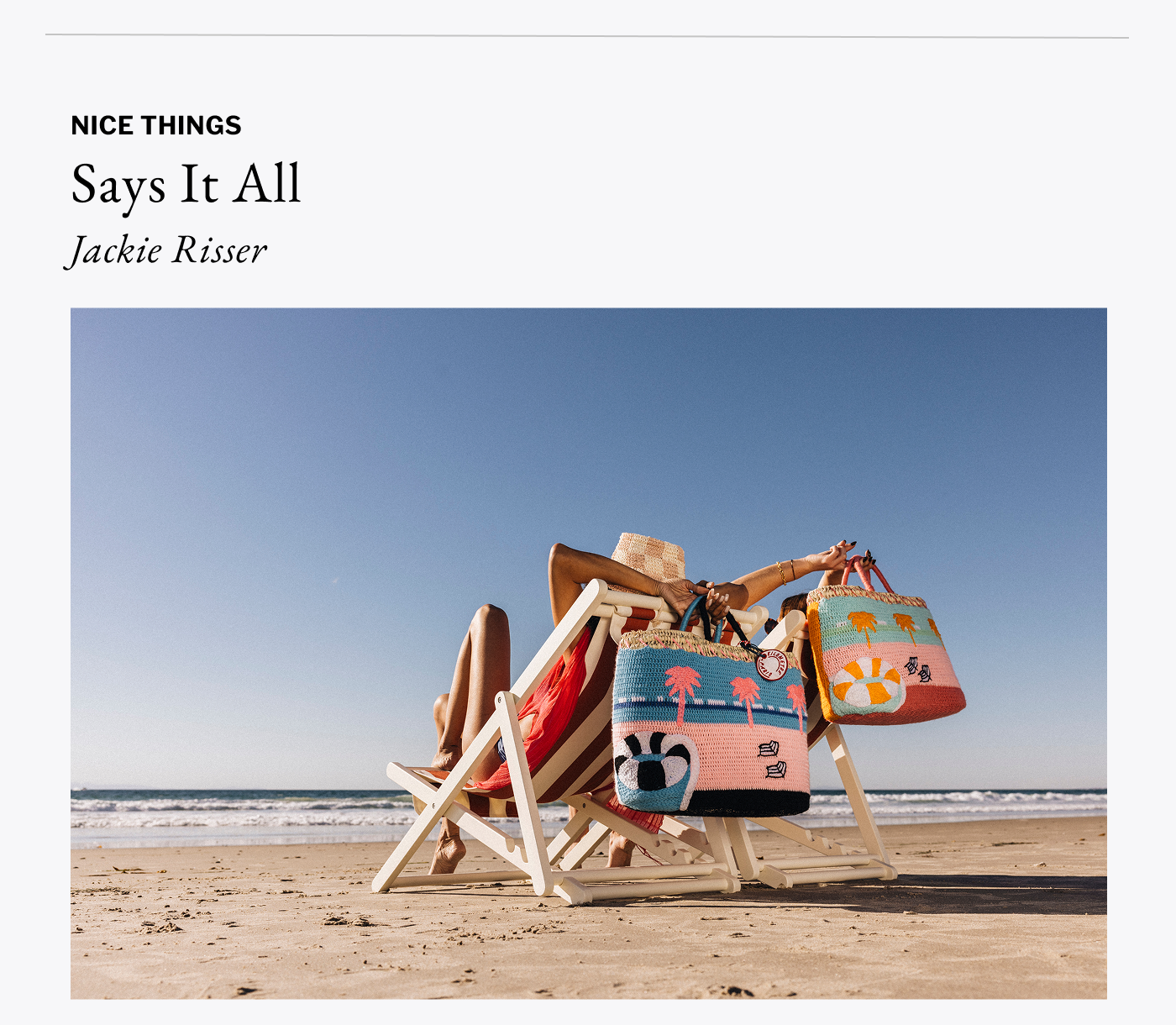
Luxury is an undeniably mutable, personal word. For some, it means time. For others, luxury signifies beauty, rarity, handicraft, or human interaction. The Ritz-Carlton’s recent collaboration with Kilometre Paris reflects a number of these definitions in a notably colorful manner.
Crafted by artisans from Essaouira, Morocco, the limited-edition capsule collection presents embroidered cotton khadi bandanas as well as woven palm straw bags, each capturing the character of an iconic coastal destination within The Ritz-Carlton portfolio, specifically: The Ritz-Carlton, Laguna Niguel; The Ritz-Carlton Bacara, Santa Barbara; The Ritz-Carlton, Amelia Island; and The Ritz-Carlton Key Biscayne, Miami. From a Santa Barbara tote-sized basket emblazoned with the city’s striated, cotton-candy sunset to an Amelia Island bucket-style basket placing celadon palm trees and parrots on a flamingo-pink background, each design reflects its spirit, color, and setting. At the same time, the creations also express the hands of their makers and honor their inspiration: As part of The Ritz-Carlton Community Footprints platform, a portion of an item’s proceeds will be donated to local charitable organizations tied to its respective resort.
|
|
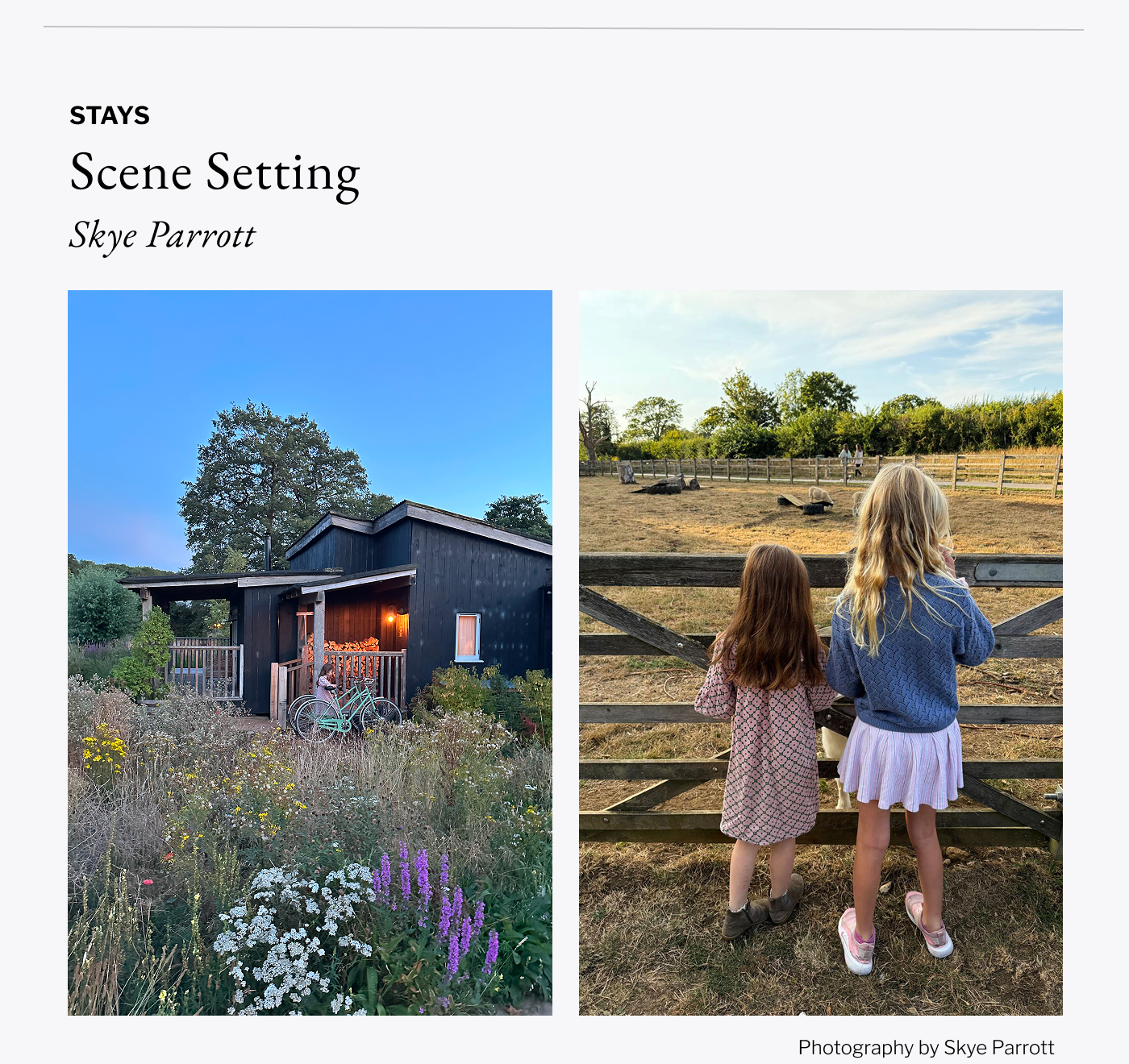
If you are going to the English countryside, there is no better time to do so than summer. That’s when I visited Soho Farmhouse, taking the Eurostar from Paris to London with my daughter, Nova (age 8), to meet up with my dear friend Liz and her daughter, Clementine (age 10). The four of us continued by train to Oxfordshire, and, in less than two hours, we had arrived at the property’s gates. Set on 100 enclosed acres with five restaurants, two pools, a spa, massive gym complex, horse stables, event spaces, shops, and 180 artworks (including two site-specific installations), the country retreat (of the international members’ club with the same name) has the feel of a sprawling summer camp for fancy adults.
There are 114 bedrooms and cabins for farmhouse guests; members also come from surrounding areas to use the property’s facilities. The result is a nice balance of lively and escapist. Restaurants and common spaces are well-populated (though never so much that you can’t get a table), while cabins — set on winding paths throughout the grounds — are quiet and sequestered.
It is also an eminently kid-friendly property, with activities ranging from horseback riding to tennis lessons to drop-off hours at the Teeny Barn. Our girls participated in all of these while Liz and I (truly) enjoyed the spa.
We did the Omorovicza Lazy Lake Experience, a self-directed circuit of outdoor hot tubs and mud masks capped by increasingly hot saunas and cold ice rooms, plus a bag of Omorovicza products to take home. The following day, Liz returned for a facial, while I tried FaceGym, the outpost of a London-based, now-international company that touts itself as a “face workout,” with the workout primarily comprising microcurrent stimulation, which doesn’t require much effort but does deliver results.
The best view … Watching Nova and Clementine play together. They had never met before but had a really great time. As soon as they were done with a meal, they would go outside to play, and they were able to run wild on the grounds because the property is self-contained. They loved having the agency to explore freely, and Liz and I loved having some time for adult catch-ups.
A relaxing moment … The weather in August in the Cotswolds is as good as it gets. Our days were warm and sunny, but the nights were still cool. (It’s England, after all.) Nova woke up early, so we lit a fire and stayed in bed reading cozily until the cabin warmed up.
A dish you’d recommend to a friend … Our dinner the first night was at Pen Yen, where everything was excellent, including a particularly spectacular miso black cod. We also had delicious burgers in the Main Barn. But as good as the restaurants were, it was the cabin amenities that really won me over. Our cabin was well-stocked with tea, coffee, smoothies and juices, snacks, even a tin of cookies that was continually replenished — and my favorite treat: cinnamon buns, which we heated up in the cabin’s oven for breakfast.
The best amenity … Standalone guest cabins are scattered on winding paths throughout the large property. There are bike racks everywhere, and the staff regularly restocks them with bikes of various sizes. The property is easily walkable, but biking is so much more enjoyable.
Something unexpected … Alongside the five restaurants, Soho Farmhouse also has food trucks set up around the pool. I was pleasantly surprised to discover one of them was It's Bagels. The company not only sells New York City-style bagels from its London shops, it was also founded by an old friend, photographer Dan Martensen. The truck’s branding was so good it gave me pangs of homesickness, so even though I have a rule of never eating bagels outside of New York, I made an exception.
A secret corner … The farmyard across from our cabins wasn’t exactly a secret, but it was an absolute joy to find the pigs, goats, and fancy chickens waiting for us each morning. The girls spent a lot of time sneaking grass and flower snacks to them through the fence.
|
|
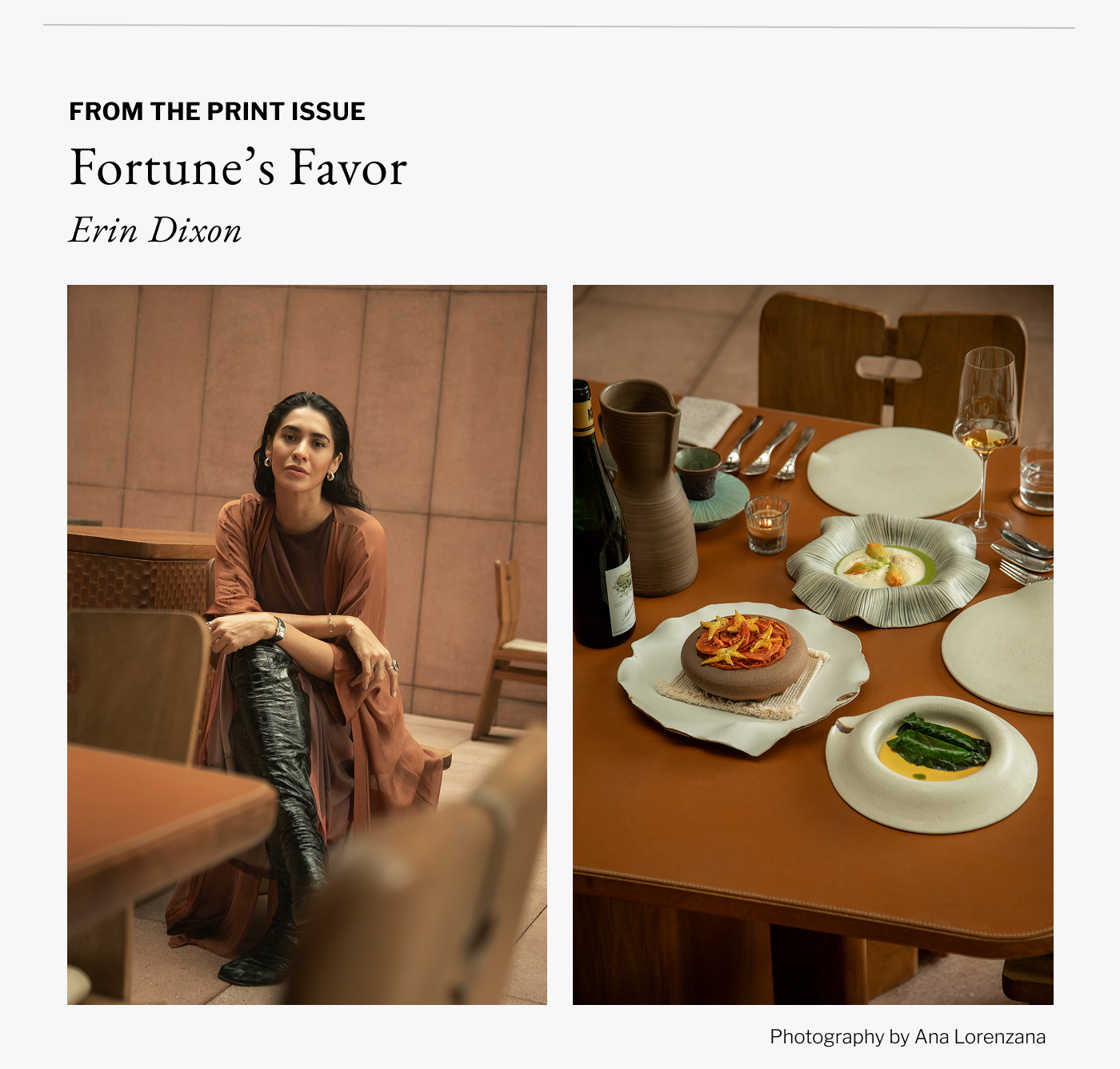
Every star chef has a secret — an ingredient or style, maybe a philosophy, that has accelerated their ascendence — but Daniela Soto-Innes’ secret isn’t what I expect. “There is this quote from the Dalai Lama that I like to say to myself every morning,” she reveals. “‘Remember that sometimes not getting what you want is a wonderful stroke of luck.’”
It’s a surprising viewpoint for the youngest woman ever to win World’s Best Female Chef by the World’s 50 Best Restaurants, in 2019 at the age of 28 — for someone who started her career at the age of 15, working after school at a Houston, Texas, hotel, having convinced its chef to let her intern in his kitchen; who parlayed another internship, in Enrique Olvera’s 2-Michelin-starred Mexico City restaurant Pujol, into opening the acclaimed chef’s first United States restaurant, Cosme, in New York City, when Soto-Innes was 23. Helming it won her the aforementioned award. Now, at 35, Soto-Innes is more than a year into running her own signature restaurant, Rubra, on the Riviera Nayarit in her native Mexico. It seems that she has pursued exactly what she wanted and has gotten it. But the difference between appearance and reality is precisely her point. “When I got the [World’s Best Female Chef] award I had, like, the most difficult time of my life because my grandma had just passed away, and I didn’t believe that a single person deserves to be called the ‘best of.’ I didn’t want to accept the award, but all the other people on my team were like: Do it for us. It was the first time that something like this had ever happened for [a Mexican woman] and the second time [for a woman based] in the U.S., but it was really difficult for me to cope with that type of attention. We were busy before, and then all of a sudden, we were busier. We were opening a restaurant in LA, and we had the two restaurants[. ...] And I knew in the bottom of my heart that my dream was to come back to Mexico because that’s where I felt more connected to my grandma. It was the height of my career, where I was on every magazine cover, but when I would see the magazines at the airport, I would hide them. I couldn’t sleep. I was like, ‘Oh, this is what being successful is like.’ People think that when you’re successful and people know you that you are the happiest. That’s definitely not true. Then the pandemic hit. And one day I woke up and said: I need to be centered. I need to be in nature. I’m going to start over. I don’t have a plan, but I believe I can do it.”
Rubra is a manifestation of that dream, down to its name, which Soto-Innes says means “to start again”: “It’s the name of the flower, but it’s also the name of a cycle.” Plumeria rubra, also known as red frangipani, is a deciduous shrub native to Mexico, with highly fragrant, vibrant blooms of red, yellow, and pink. Native flora also sits at the core of Rubra’s menu. Its market garden — tucked into the upper corner of W Punta de Mita, where the restaurant also resides — bursts with Mexican medicinal plants such as chaya and hoja santa, as well as vegetables and fruit: papaya, mango, cacao, guava, acacia, and jackfruit, which appear in the restaurant’s Edenistic dishes. Briny banana flower is cured like an artichoke (escabeche style) and plated like an ofrenda, served with rice cake-thick plantain tostadas and nori butter. Lobster salpicon gaznate with avocado and herbs offers a textural explosion: crisp shell against tender shellfish, and it looks like a tiny sculpture. Plush Sonora wheat sourdough paired with cultured butter tastes ancestral and fresh at once — to name just a few of my favorite flavors in meals that unspool artfully, their parade of the plates winding me up in a jubilant spell. As the tagline on Rubra’s website accurately reads: Envision yourself entering a new world.`
Read the full feature and more close takes on a wide world in our print issue. Order now.
|
|
I'm fascinated by light; it’s an occupational hazard. I often find myself observing how it changes our perception of the world. I remember standing at the edge of Lake Gosau in the Austrian Alps for quite a while, just looking at how the setting sun's beams were hitting the water's surface. Ripples formed as people dove headfirst into the lake and the rays slowly changed from yellow to orange. After many minutes, my friend standing next to me asked what I was looking at. I answered "Nothing" and promptly pushed the exposure button on my camera, hoping it would be a good explanation for why we’d spent almost half an hour in silence, staring at water.
The Austrian Alps hold a special place in my heart. You can jump into the many lakes surrounding the Dachstein Mountains and, just a few hours later, climb to the highest peak in the area to see blue-hued, soft light hit the snow while you enjoy a sweet, steamed dumpling in a hütte. It’s summer and winter in one day, but don't forget that you can get sunburned in both places. |
|
Magic Elixirs. Preliminary scientific studies indicate that tequila may have anti-inflammatory benefits, which makes a strong case for the spirit. Cazcanes No. 7 Tequila makes an ever better one. Available in añejo, reposado, and blanco classifications, the liquor takes its name from the Cazcan (Caxcan) people, an Indigenous group whose legacy is rooted in the region where the agave used in Cazcanes Tequila is grown. The company’s symbol, the Healing Hand, also speaks to its dedication to the people, land, and traditions that inform its spirit, which is hand-crafted according to a centuries-old recipe, using only three ingredients: organic Blue Weber Agave, volcanic spring water, and a proprietary yeast. Yet, the tequila expresses itself distinctly in each bottle, with the reposado and añejo best served over ice, in my opinion. The blanco (ideal in a margarita) is particularly notable for its superior anti-inflammatory potential, and for treating writer’s block. –Erin Dixon
On the Up and Up. I am always interested in the intersection of travel and impact, which doesn’t have to be large to be meaningful. That’s why I noted the new Benchmark Hotels & Resorts partnership, launched this week with Dress for Success, the 30-year-old non-profit focused on helping women advance in the workplace. The collaborative initiative, Leave a Power Suit Behind, invites guests staying at one of the collection’s 16 hotels across the United States to lighten their suitcases and make a meaningful contribution to the communities they’re visiting by donating a suit, blouse, handbag, or shoes to the organization, which will pass the item to a local woman in need of business attire. –Skye Parrott
Spoiled for Choice. “I need to come back tomorrow,” was all I could think after rolling myself out of Maydan Market in Los Angeles. A culinary collective of individual stalls sharing a 10,000-square-foot space, the market exemplifies everything that’s wonderful about the city’s white-hot culinary scene. At Lugya’h, chef Alfonso “Poncho” Martínez grills gloriously crispy, meaty Oaxacan tlayudas ideal for sharing. The pozole flight and barbacoa tacos at Maléna are my new comfort food. I only tasted a fraction of all that’s available. Fortunately, the market is now my go-to spot for all out-of-town visitors. –John Chuldenko
|
|
54 Franklin St #2R NY, NY 10013. ©2026 Dossier Projects, LLC.
|
|
|
|
|