This past Monday, I stood on a wooden platform in the middle of a cenote (natural sinkhole) with five others, surrounded by the Mexican jungle. Hands connected, we formed a ring. Our leader, a Native medicine woman named Gabrielle, instructed us to visualize our collective energy meeting in the center of the circle and shooting upward, forming a beam of light that expanded as it rose, spreading across the surrounding Maya Forest, over Playa del Carmen, across the Yucatán Peninsula, blanketing the whole world in peace and love.
The vision brought to mind Carl Sagan’s seminal Pale Blue Dot speech, which puts our planet’s place in the universe as well as the inanity of our petty squabbles and harmful actions in sharp relief. Gabrielle then blessed each of us with copal (an aromatic tree resin sacred to the Mayan culture, that’s traditionally burned during rituals) before encouraging us to perform a personal baptism in the cenote’s inky waters, which turned twilight blue as sun beams pushed through towering tropical clouds. Floating in the cool liquid, I felt deeply connected to my soul, to my surroundings, to the people around me, to the Earth. The experience was part of an Alila Moment titled Winds of Renewal, organized by the Alila Mayakoba resort, which opened its doors earlier this year. It came at a nice time, soon after we completed our Spring/Summer issue, which is winging its way back from the printer as I type. The trip allowed me to clear my mind and decompress from the intensity of the past month. At the same time, it underscored a phenomenon that strikes me every time I proof an issue and discover, anew, how its individual stories form an interconnected web, illuminating unanticipated connections. In this issue, for example, the celebrated chef and author Eddie Huang shares his first short story, which may read as racy on its face but, on a deeper level, can be understood as an audit of integrity — a notion renowned chef and restaurateur Keith McNally also references in an unfiltered exchange, stating: “No one is beyond criticism. I believe this more every day.” The word “connection” and the act of connecting followed me from the cenote, across my stay at Alila Mayakoba. The resort’s philosophy (and that of the greater Alila brand) is “sustainability, respect for local culture, and profound connection” — an ideology I further experienced during sunrise yoga overlooking the lagoon and through encounters with individuals from all over the planet. The experience was moving. It also encapsulated why we, at Dossier, love what we do. After all, connection sits at the heart of travel, physically and spiritually.
It is why we often describe our work to be that of bridge builders. By sharing the tale of two men — one American, one Vietnamese — sharing a beer in a place where their fathers once “tried to kill each other;” by recounting the journey of a chef who “had it all” only to discover she wanted much less; by tracing the evolution of colonial architecture to a more ethical place, we remind ourselves and our readers that, at our cores, we are more alike than different.
These are just a few of the stories in our forthcoming issue. There are so many more, including our cover story, a vibrant romp through Bangkok, which we complement below with an insider’s guide to the kaleidoscope city.
By giving faces to diverse places and shared human truths, we hope to inspire greater care for each other and our planet. As our editor-at-large T. Cole Rachel states in a feature on Beyond Green and its portfolio of sustainability-forward properties: The legacy of our era (if not our entire species) is bound up in our ability to urgently preserve the land that sustains us. Gabrielle stated this idea in a different way at the end of our Winds of Renewal Moment. Quantum physicists now know, she reminded us, that our energy has a measurable effect on the world, so we must be conscious of the wavelengths we emit. Positive ones contribute to a more harmonious reality, while negative ones intensify the storm.
We hope this issue precipitates good vibrations — and discovery. We invite you to explore its pages and to connect with us afterward to share your thoughts and your own stories. I also encourage you, if at all possible, to begin every week by diving headfirst into a cenote.
Get more close takes on a wide world in our print issue. Order now.
|
|
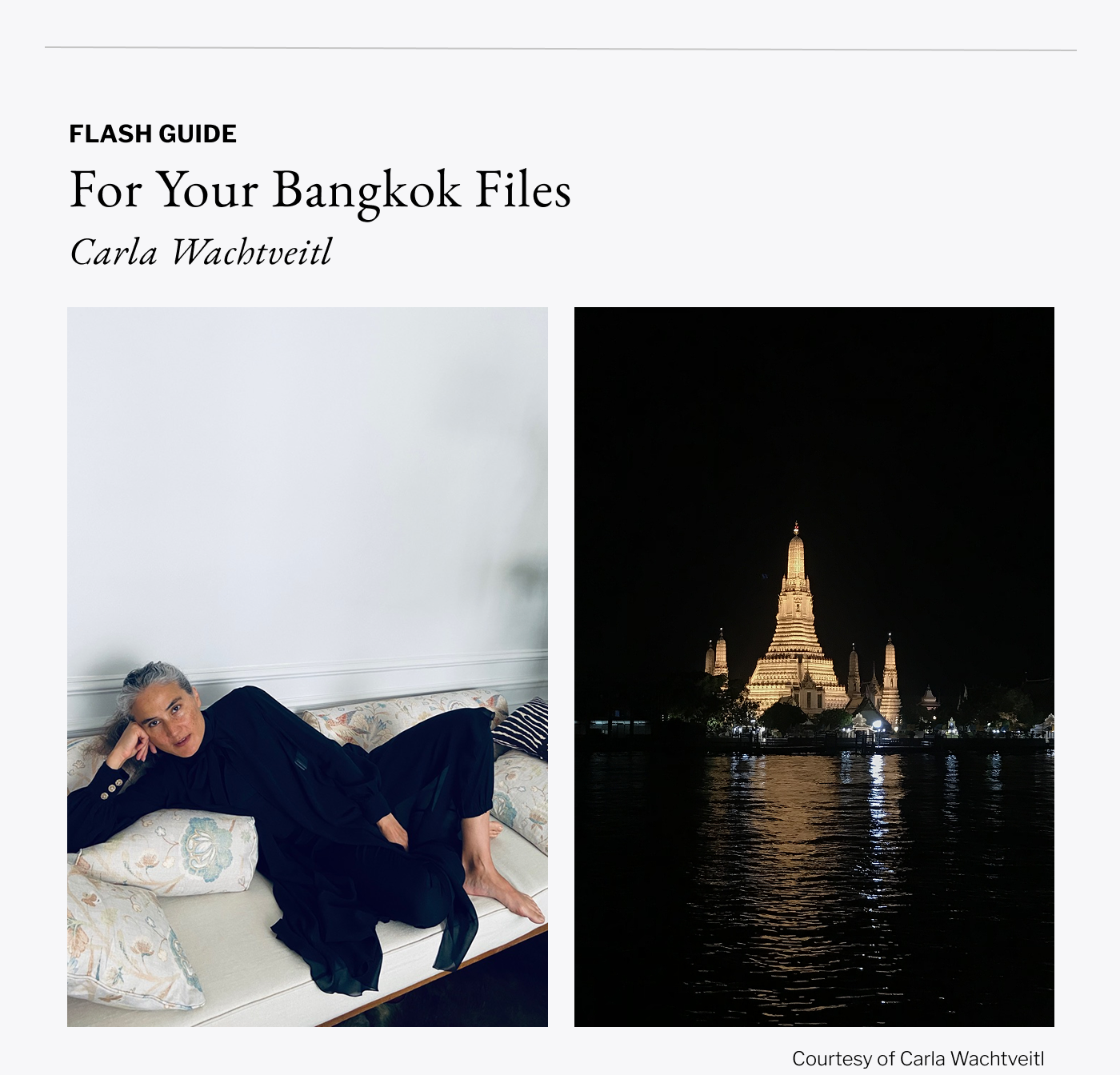
I was born in Bangkok (my mother is Thai, and my father is German) in the 1970s, back when people lived in houses with tropical gardens, not in high-rise condos. Most of my Thai friends are from my childhood days, and I still have a wide array of relatives in the city. My relationship with the city was also shaped by the Mandarin Oriental, Bangkok, where my father, Kurt Wachtveitl, was the general manager for 41 years. The hotel was my playground. Bangkok is an extreme city in many ways. There are paradoxes everywhere: It’s electric and seedy, yet spiritual, mystical, and superstitious. It’s also fun and sweet. It’s awake 24 hours. Temples, spirit houses, and places of worship are sprinkled all around. It’s messy. Traffic is horrendous. You might think that there aren’t any systems in the city, but there actually are. Not everything makes sense, and it’s fine! There is something magical and surreal within the chaos.
More than anything, I love the Thai people and Thai ways of life, particularly the balance of sanuk (fun and joy) and sabai (comfort and peace). Thais are very playful and have their own way of doing things. It isn’t always linear, but it is about living in the moment.
Here are a few places in Bangkok that embody that energy. Something to eat and drink … For lunch, Rongros is a lovely restaurant by the river, with a fantastic view of Wat Arun (Temple of Dawn). Other great midday choices include Sri Trat, At Isan on Sukhumvit 33, and Vistro Vegan. I also love Araksa Tea Room which is close to the Mandarin Oriental and hidden from the crowds. Khao Tom — a local place in Chinatown’s Kunsthalle (a multidisciplinary art space) — is perhaps best to visit with a local friend. “Khao” means "rice", and “tom” means "boiled". Thais eat this dish for breakfast and also for dinner; it’s the ultimate comfort food. Alonetogether is a jazz bar with good cocktails, and Charmkrung is a choice dinner spot. It has tapas-style dishes, a great wine list, and good music. Finally, if you’re looking for a nice bottle of wine, order from Wine Garage.
Something to see … Wat Suthat, with its exceptional murals and Giant Swing, as well as the Golden Mount for sunrise or sunset views. If you like snakes, check out the Snake Farm at the Red Cross Center. There is a show about venom extraction and whatnot; you learn a ton — Thais have a great way with snakes. Chinatown, the historic part of Bangkok, is wonderful (particularly the Talad Noi area) for simply walking around. I love the smell of its apothecaries, and its gold shops are pretty fab, too. Be sure to get lost in the markets: Prahurat (for textiles) and Sampeng (for everything) are in or near Chinatown, and there’s also Talad Plu on the Thon Buri side of the river.
Speaking of the river, take a slow boat ride on the Chao Phraya River (River of Kings) and through its khlongs, then stop at The Siam Hotel for lunch or a drink. Bangkok has been called the “Venice of the East” because of its canals. If you’re staying at the Mandarin Oriental, ask the concierge for a slow, old-fashioned boat. Most tourists take a longtail speed boat, but it’s cooler to be sabai-sabai. As for art, stop by the Kathmandu Photo Gallery, founded by artists Manit Sriwanichpoom and Ing Kanjanavanit. The street it’s on also houses particularly beautiful garland vendors (selling offerings for shrines or spirit houses). Visit the 100 TonSon Foundation and the Jim Thompson Contemporary Art Center. If you don’t know who Thompson is, he basically revitalized the Thai silk industry in the 1950s and ’60s, when synthetic fabrics were on the rise. You can visit his gorgeous house by the khlong and the contemporary museum next door, with exciting curation. Something to take home … Anything from Khomapastr. This Thai silk-screen printing house was established in 1948. It’s what Lilly Pulitzer is to Americans or Liberty prints are to Brits. You can buy cushions and accessories — or fabrics to have made into a dress at World Group Tailors next to the Mandarin Oriental. A Mandarin Oriental silk dressing robe is another great option, or you can buy silk at Anita Silk (there's a branch on Silom Road) and use it to have one tailormade. Anita’s color range is mind-blowing, and I also like its travel jewelry cases and other small items, such as lipstick holders. At Patcharavipa, the owner, Pat, designs fab jewelry and revamps vintage watches. Shop there, then go next door for tea or lunch at Nai Lert Park Heritage Home. Its garden is an oasis ( Aman Nai Lert Bangkok is also within the complex). Pick up Sexy Little Beach Thai fisherman pants by my friend Rai von Bueren. They’re well-cut, in cotton, linen, silk, or velvet, with a straighter, narrower leg than traditional styles. Finally, get a piece of clothing embroidered by artist Jakkai Siributr. Only in Bangkok … The Siam Society, a center in the Sukhumvit area, where you can learn all about Thai culture. The society organizes trips and talks and has a fine library.
A secret place … Yoga and bodywork with Cerissa. I’m in bliss after each session. Contact her via email: cerissanyen@gmail.com.
|
|
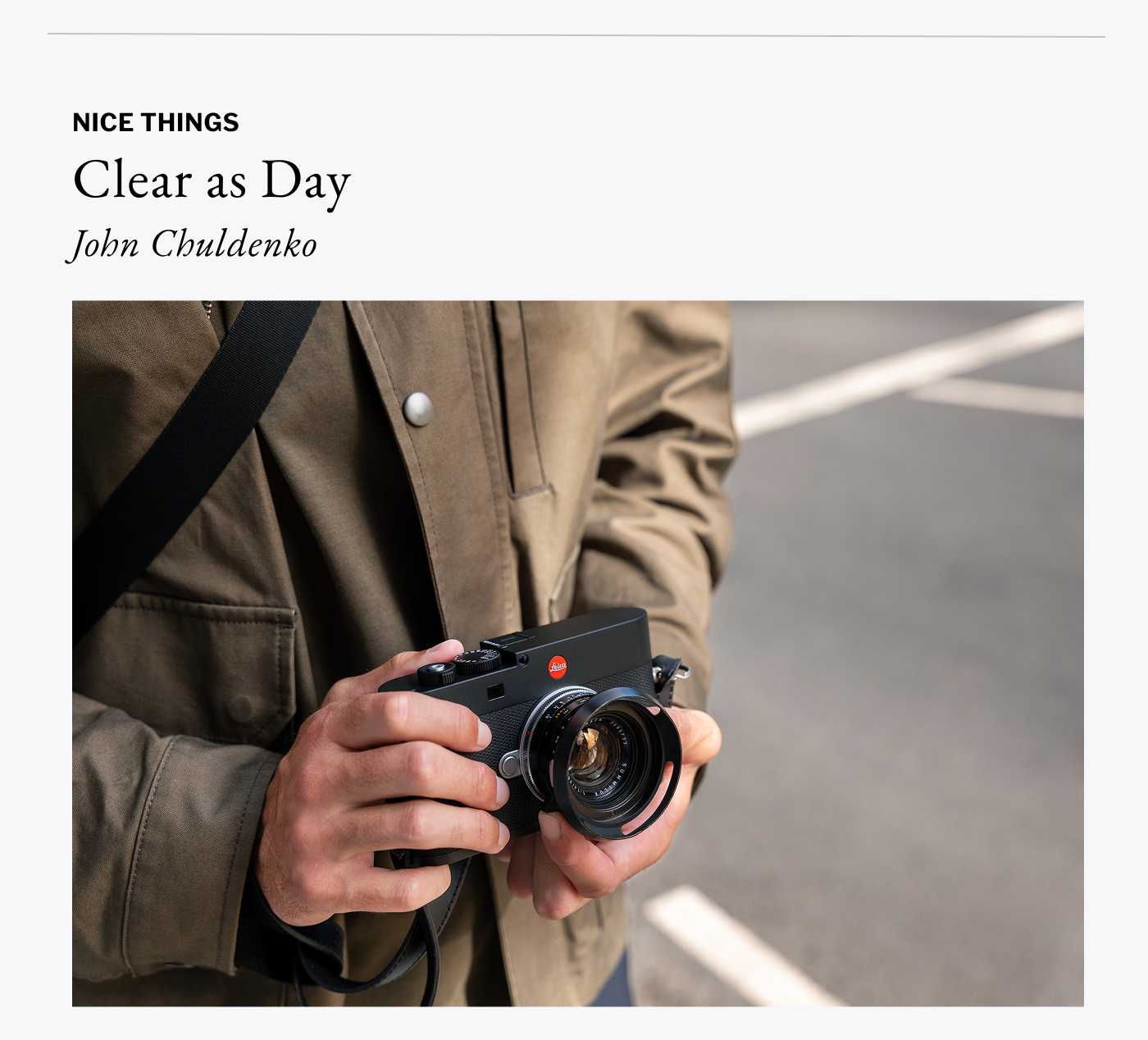
Right now, in Wetzlar, Germany, a Leica craftsman is meticulously twisting an M lens by hand until it feels perfect. The company’s M-System cameras render images with distinctive character, color, and bokeh (the specific quality of an image's out-of-focus areas). Each iteration of an M lens is as unique as a fingerprint and, like a favorite band, many enjoy legendary reputations and passionate followings.
Previously, if you wanted to experience Leica's M-System, you had to master the rangefinder — a process that involves turning the lens' focal ring to visually align a pair of images in the camera's optical viewfinder. It’s a skill Leica users have instinctively practiced since the M arrived in 1954. Now, that's all changed. Leica has recently released the M EV1, its first M-System camera with an electronic viewfinder — an open invitation for even casual photographers to enter the Leica fold and experience the quality of M lenses. Handling the M EV1 for the first time, I found that the camera felt slightly lighter than previous models (a result of the deleted rangefinder components) but, reassuringly, still every bit an M: solid and impeccably built. Each dial and control snaps into place with positive assurance. Looking through the eyepiece, I was presented with a high-resolution, electronic viewfinder display that renders exactly what the lens is seeing.
Proper focus, while still manual, is clearly indicated in the viewfinder by colorful highlights or a digital zoom feature, and both focusing aids are quickly activated by flicking a traditional lever on the front of the camera. With only a few hours of practice, the process becomes intuitive, and fun. The display's precision proves ideal for using Leica's breathtaking (and focus critical) large-aperture Noctilux lenses and its ultra-wide-angle lenses. Casting novelty aside, the M EV1 feels simple and timeless. |
|
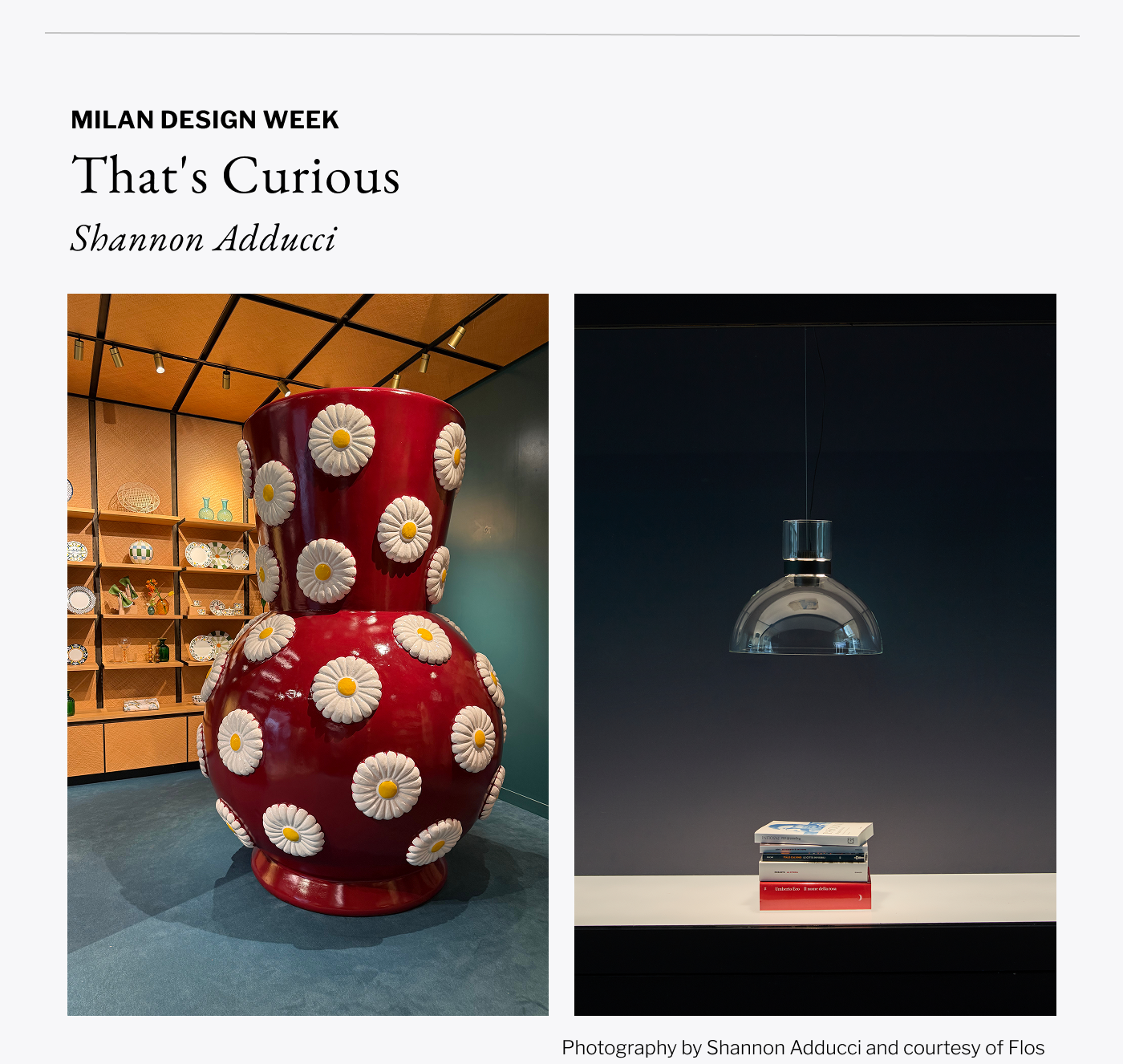
There’s no shortage of ideas at Milan Design Week, expanding from Fuori Salone to the traditional fair: Salone del Mobile. In fact, it can be downright overwhelming to take it all in. Deciphering what is external buzz and what one is truly drawn to is an act of introspection, forcing you to confront personal context, experiences, and memories — and to also identify the joy of witnessing beauty. In an era of cultural flattening, this is an important exercise, to ask: What do I like, and why do I like it? This week in Milan, the following discoveries sparked my personal light.
The Pi object from Belgian furniture designer Xavier Lust, which was part stool, part table, sculpted in bronze in the shape of the mathematical constant and Greek letter. A handcrafted, sterling-silver frutti di mare platter, the centerpiece of Buccellati’s Aquae Mirabiles installation, which also debuted the company’s silver Caviar tabletop line. Ombré shades of sienna, burgundy, soft pink, tangerine, and yellow on knotted, suede fringe tassels at the end of a new Hermès cashmere blanket.
The exquisitely minimal Nocturne lighting collection by Konstantin Grcic, shown at Flos as an immersive installation inspired by the final scene of Stanley Kubrick’s 2001: A Space Odyssey — the most prescient of films for our current moment; an Alice in Wonderland-esque stack of gigantic teacups stretching to the ceiling at La Double J and, on a nearby shelf, scaled-down versions: a collaboration with Villa San Michele, A Belmond Hotel.
The Job Smeets colorful, lacquered dining table for Mouromtsev Design Editions, with legs made to look like the old-fashioned bubblegum dispenser my grandmother had at her house. Armani/Casa’s Baloon armchair, first introduced in 2008 and now reupholstered in tactile, mint-green Bergen fabric. The plush nubs of polka dots on the Venetian-crafted Punteggiato velvet textile that Gio Ponti designed for Rubelli in 1934. Andrea Mancuso upholstered his new collection at Nilufar in the historic fabric. A side-by-side view of two B&B Italia chairs from different eras, celebrating the brand’s 60th anniversary and return to Salone: one, the round and compact Luigi Caccia Domioni chair from 1958; the other, Vincent Van Duysen’s rattan-wrapper chaise longue, debuting this year.
Loro Piana’s singular interpretation of plaid weaving techniques through a variety of displays and motifs, from vintage alpine scenes to elaborate embellished florals. A series of delicate, handmade lamps in paper and bamboo from the late architect Andrea Branzi, as part of Rosewood’s debut at Milan Design Week, curated by Deyan Sudjic. Cadar’s Circle of Light candles made with customizable layers of colorful, hand-blown Murano glass by Venini — a journey into synesthesia, with each hue corresponding to a different scent, inspired by jewelry designer Michal Kadar’s New York City shop.
The serenity of a compact courtyard room in the Park Hyatt Milan, tucked away from the aperitivi bustle of Brera — not to mention the perfectly hidden whirlpool located in the hotel’s subterranean spa. The tableside aperitivo service at Portrait Milano’s 10_11, where an Americano is made with the bar’s own amaro and finished with Essentia’s Foglie di Limone , a gastronomic essential oil made from Sicilian lemons. |
|
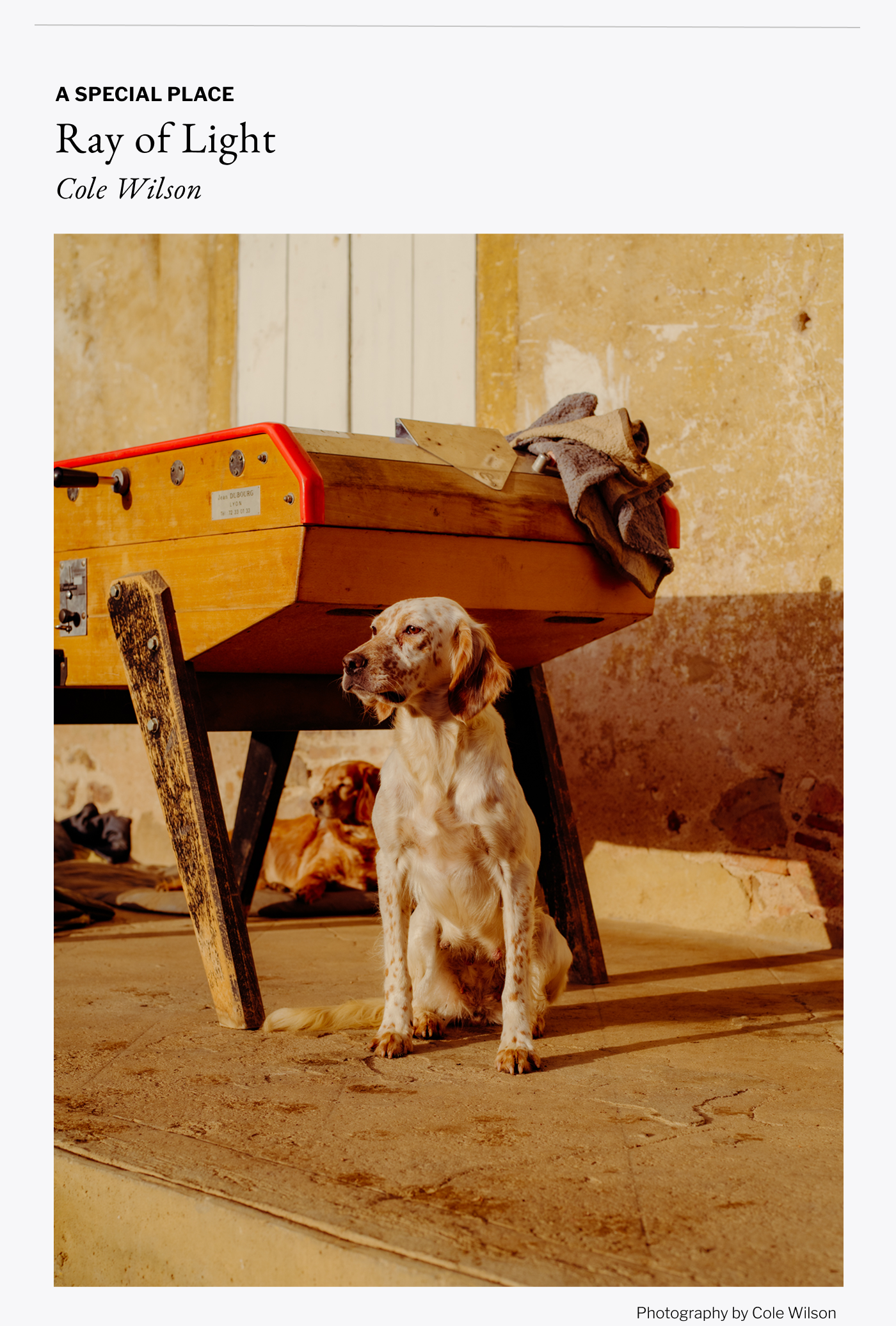
In 2019, I visited one of my best friends, Sam Rogers, while they were working with Julie Balagny during harvest in Moulin-à-Vent, Beaujolais, France, sponging information from a mentor with the same winemaking ethos as their own.
Upon stepping through the old, stone archway into the cellar, I was hit by a wave of energy and inclusion. It was impossible not to feel the love and generosity Balagny passed onto her guests — just as others had done for her when she adopted the region as her home in 2009. She was an absolute force of nature, crafting delicious wines of character and soul with the region’s dominant grape, gamay.
There is a certain romance I associate with raw hospitality. Balagny didn’t have time for pleasantries, but her world was yours — just pick up after yourself and read the room when it’s your turn to chip in. Her disheveled farmstead was a home for friends, dogs, chickens, sheep, and wayward seasonal workers. There was no fanfare, no red carpet, just the immediate, jarring grasp of radical welcome.
Balagny passed away in 2023, and I was able to attend a memorial for her in New York City, sharing memories and tasting back vintages of her wines, graciously poured from private collections to eager disciples of her work. |
|
Good Things, Small Packages. Bar Sinizki is ideally positioned at the end of my street in Los Angeles. Inside, chef Scott Zwiezen makes Ukrainian pierogies from his grandmother’s recipe (her wooden spoon hangs near the bar). Piercing the crispy, scallion-strewn dough reveals dreamy potato filling, which melds with the delicious brown butter left on the dish. It’s my comfort food when the clouds roll in. –John Chuldenko
April Showers. My friend just moved into her first solo apartment so I made sure she hung some rolled out eucalyptus in her bathroom. The oils elevate the scent of any room, but shower steam is the best activator. She tells me that her nightly shower routine now feels like spa time. –Alessandra Berge
Art and Craft. I finally checked out Comal, the artful Manhattan restaurant (literally, it has a rotating selection of large-scale, gestural paintings by Mexican artists on the walls) in the old Gem Wine space. Its chicken liver is fantastic — like a spread of rich, salty dulce de leche — as is the seafood entree, an abundant assembly of tender octopus disks, head-on shrimp, and peppers over stew-y butter beans. –Sophie Mancini
|
|
54 Franklin St #2R NY, NY 10013. ©2026 Dossier Projects, LLC.
|
|
|
|
|