I have always been proud to consider myself part of Generation X. While this cohort has come under fire in recent years for being apathetic and having not properly dealt with the traumas we endured growing up in a pre-Internet age, I still claim “Gen X” as a badge of honor.
I was born in the early '70s, spent large chunks of my childhood wholly unsupervised, and watched the Space Shuttle Challenger explosion on TV. I also went to college in the '90s, attended the first three years of Lollapalooza, saw Reality Bites in the theater (twice), witnessed the dawn of the World Wide Web, and weathered all-things grunge. More importantly, I am actually old enough to own an original, hardcover copy of Generation X, the 1991 Douglas Coupland novel introducing the moniker that would effectively define my entire generation. For all these reasons, I was very excited to spend a weekend in Vancouver, B.C., at the very chic Fairmont Pacific Rim, a gorgeous hotel in downtown, just a stone's throw from the harbor. Even more exciting — and the specific reason for my visit — was the opportunity to spend time in Suite X, designed by Douglas Coupland himself. Though he is arguably still best-known as a writer (his 13 novels are translated into 37 languages), Coupland has spent the past several decades creating an expansive body of work as a visual artist and designer. And while his pieces are shown globally, they are particularly impossible to miss here in his native Vancouver, which is home to several of Coupland's large-scale, public installations.
A block from the Pacific Rim is “Digital Orca” — a towering, steel, "pixelated" rendering of a leaping killer whale that appears to be made from black and white cubes — which Coupland created for the 2010 Vancouver Olympic Games. Just inside the hotel, guests are welcomed by another Coupland piece, “Moneyboy & Moneygirl,” two massive, revolving sculptures positioned over a lobby fireplace. The figures, which look like exaggerated versions of Japanese toys in the form of a boy and a girl, are both funny and formidable (eerily reminiscent of the giant doll of doom made famous in Squid Game). Seeing them slowly turning, gazing out over the very opulent room speaks to the general cheekiness of Coupland's work. It’s a visual delight that gets more interesting and cleverly subversive the more you stare at it.
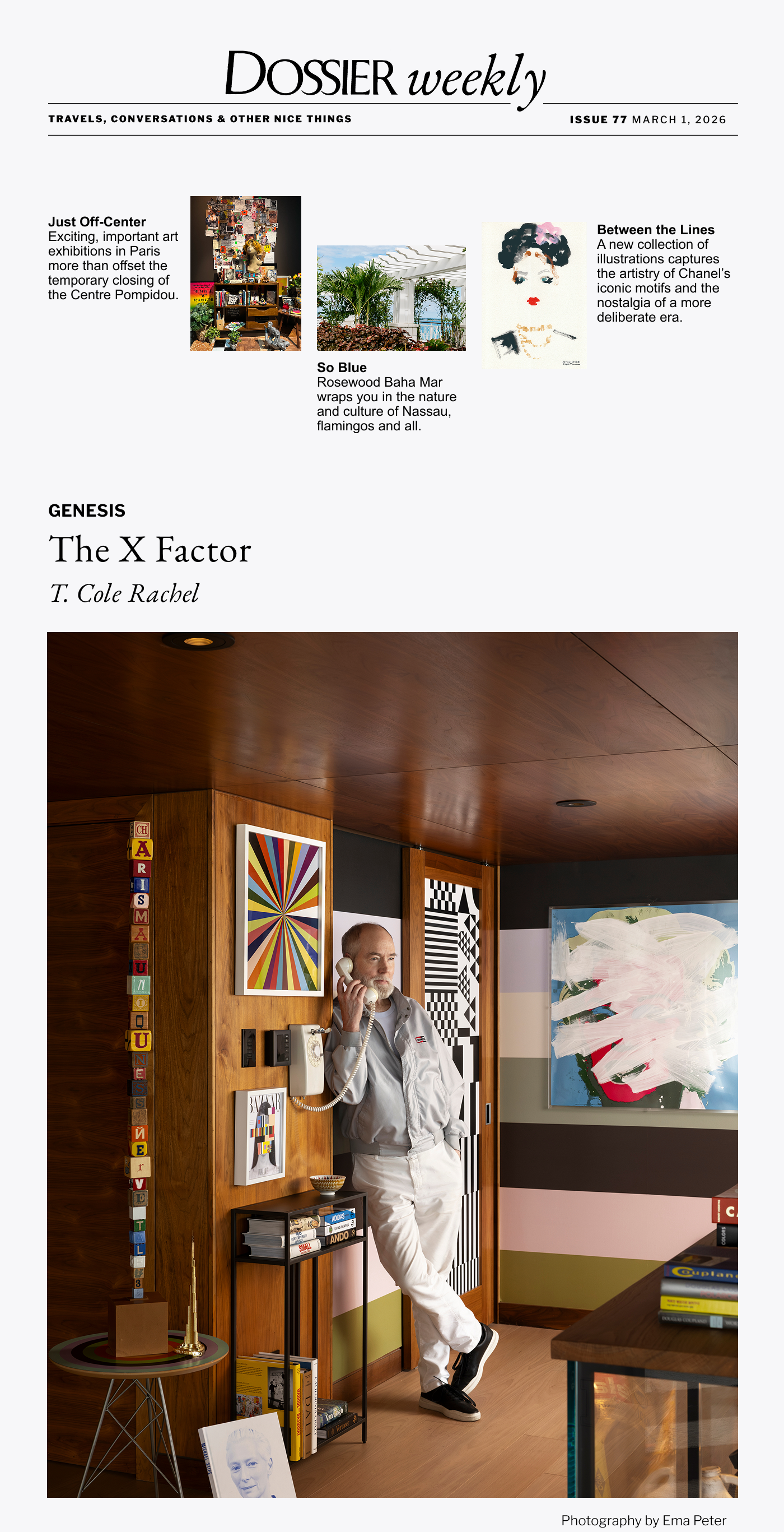
For a person of a certain age (i.e., mine), the experience of staying in Suite X is not unlike having a significant chunk of your subconscious writ large. The 2,230-square-foot suite, which has views of Coal Harbour, Stanley Park, and the North Shore Mountains, is packed with art, books, and ephemera. Many of the items either feature Coupland's work (copies of his novels in various languages) or contain sly references to it (e.g., a wall lined with several defaced versions of Andy Warhol's 1967 print series of Marilyn Monroe, a reference to Coupland's 1998 novel Girlfriend in a Coma). For Coupland, the suite is not only a way to pay homage to his city (there are countless pieces about Vancouver and its history within the space) but also the natural accumulation of his many interests. "This hotel suite is about my life and my city and my world," he explains. "It's the hotel room I wish I could have found during four decades of relentless traveling." There’s a constant sense of discovery within the suite. I was jolted by the nostalgia of the wall-mounted, rotary-dial phone as well as oversized, vintage IBM and Fiorucci ads. And despite the perfect weather and the city calling, I could have easily spent both days reading the books Coupland has curated: a collection of polaroids by Linda McCartney, a book of Michael Stipe's photography, an illustrated history of shoes by FIT, a treatise on pop art by Jarvis Cocker. I made a list of every title that caught my eye so I could track them down when I got home.
And while there is much to be said about the amenities and the incredible service of this five-star hotel, my favorite thing about the suite was ultimately the art, particularly Coupland's use of glass vitrines to show off meticulously organized relics. In the expansive living area, a glass coffee table contains objects like inside-out soccer balls, Japanese license plates, a Mr. Peanut penny bank, and a small model of the Burj Khalifa tower. Nearby, an entryway vitrine is home to beautifully organized and embellished ocean debris from the 2011 Japanese tsunami, while a Plexiglas display tucked behind the mini bar shows off a collection of retro hair sprays and deodorants, the sight of which struck a chord somewhere deep within my psyche. Everywhere, advertising and pop culture iconography from the '60s and '70s abound, even on the ceiling. "I think of them as a kind of portraiture," says Coupland of the advertising images. "I love their colors, their crispness, and the faces speaking back to us from another slice of time."
It's worth noting that I did actually leave Suite X during my stay — Coupland graciously ferried me around town to see the sights and visit a selection of Vancouver's finest thrift stores. Between running out to explore downtown and swanning around Suite X trying to mentally catalog all of my favorite pieces, my days would invariably end with a stop at The Pacific Rim’s Botanist Bar to sample a theatrical drink. My favorite was a smoking bourbon cocktail emerging from a sizzling veil of pillowy steel wool that had somehow been set on fire. It turned out to be the perfect complement to what was ultimately a much-too-short, decadent, irreverent, and delightfully unexpected stay.
Sidebar ... How Douglas Coupland really feels about Generation X.
TCR: The term "Generation X" is ubiquitous at this point, but people still love to argue about it. Does the term as people understand it now feel wildly divorced from the book you published in 1991? How do you feel about Generation X these days?
DC: The (long) truth is that the “X” comes from a chapter in a 1983 nonfiction book written by Paul Fussell called Class. Fussell posited a new class called the "X Class" for people who wanted to get off the class hamster wheel. In the 35 years since I published my book, not one reporter has ever written that — or if they did, it got edited out. (Borrring!) As for Generation X, I like that it's now been shrunk down to GenX with no space. It's like a cool, new drug. If you were born after 1959 and don't remember the JFK assassination, then you're X. It's always been so simple. People often want to start it in 1966 because that's when the pill began shrinking family sizes. GenX has morphed into the dutiful generation who cleans up the house once the party's over. There are some really funny YouTube videos on this. We get along far better with the Greatest Generation than Boomers ever did. And I take pride in the fact that I'm technically the first person to ever say "Hey, Boomer." I'm so used to GenX now that it doesn't register the way it once did, but I looked at the book two nights ago and everything in it seems as fresh and real as it did then, so I don't find it divorced from the book. It really did hit nails on heads. |
|
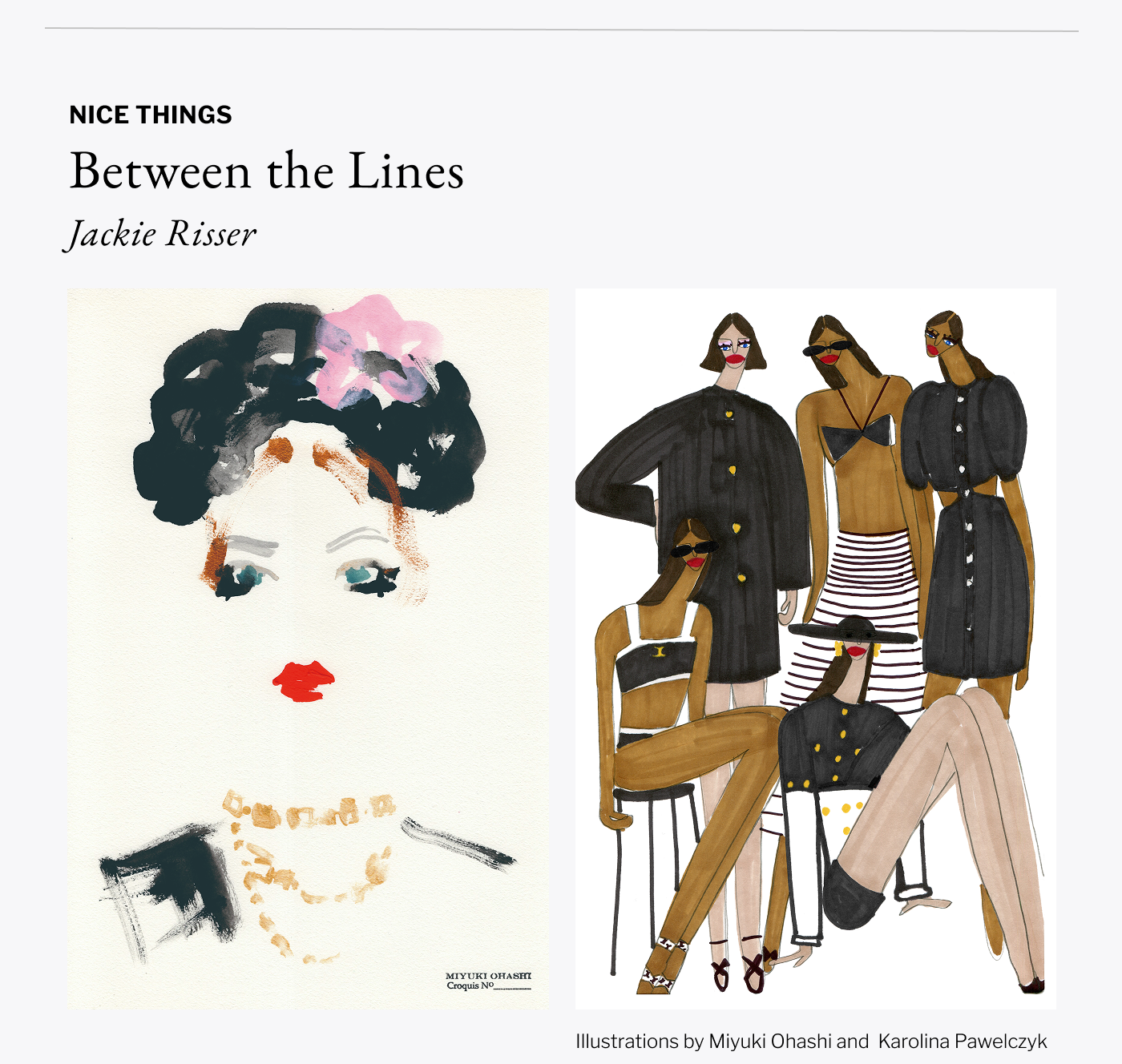
In an era of nonstop photo documentation of personal style, a fashion illustration feels like a breath of fresh air — somewhat ironic given the medium’s roots. Fashion illustration took hold in the 16th century, when global exploration triggered both curiosity and fear; highly detailed drawings of cultural dress were published to demystify new worlds.
Dressmakers, tailors, and fashion designers eventually used illustrations as templates for client designs. In the 20th century, photography gained prominence and digital design emphasized efficiency, transforming fashion illustrations from realistic documents into niche art. Today, the works enchant with novelty as well as nostalgia. They’re a reminder of a slower, more deliberate era.
This studied spirit is beautifully captured in Chanel Illustrated, a recently released collection of hand-drawn interpretations by 25 illustrators from around the world of the maison's iconic motifs, from its tweed jacket to the camellia flower. |
|
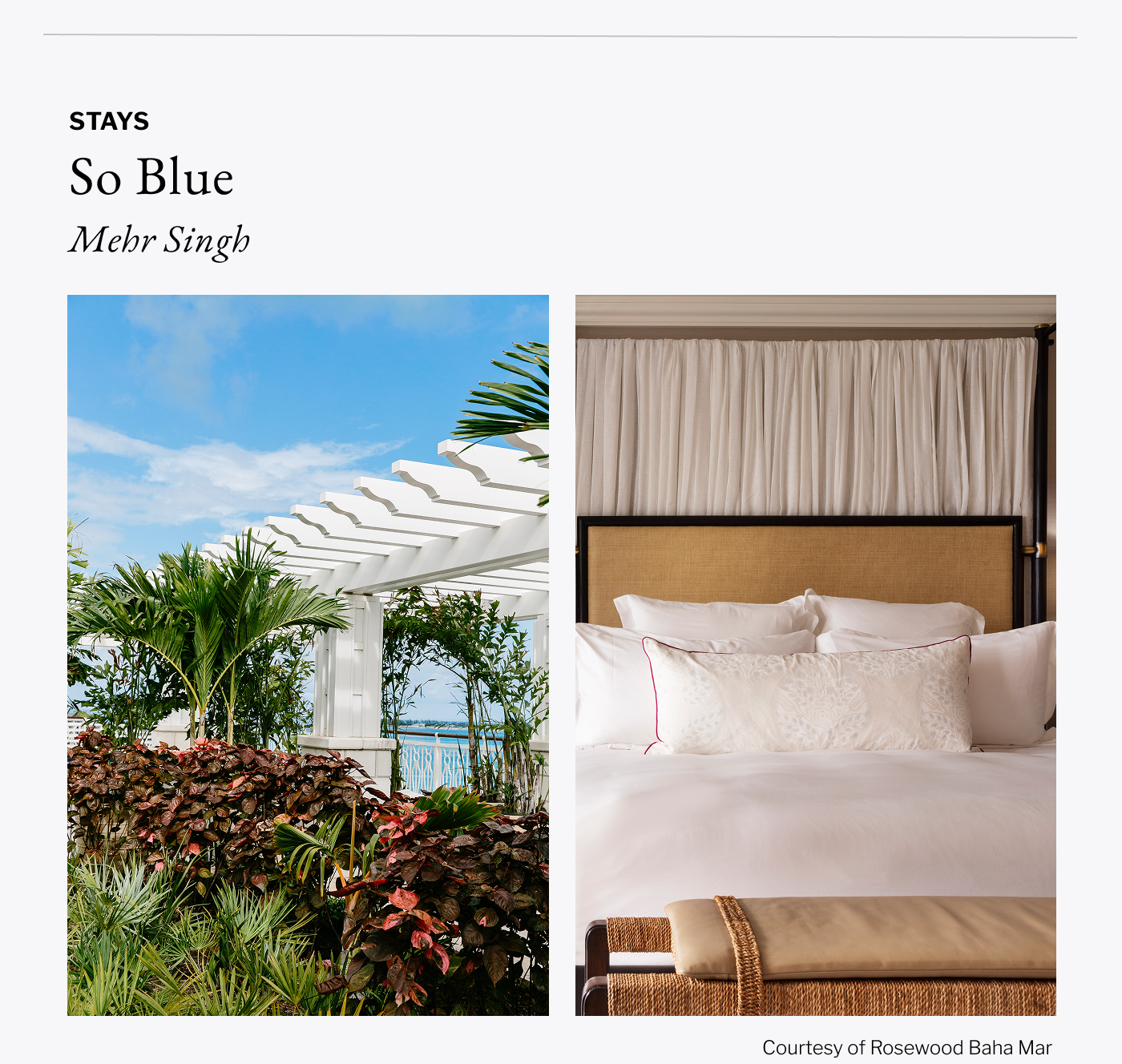
My visit to Rosewood Baha Mar marked the first time I had been anywhere in the Caribbean. On our way to Nassau, we flew over the Tongue of the Ocean, an ocean trench merging deep blue-green waters with underwater dunes visible even from 2,500 feet. “ Summer” by The Carters immediately came to mind. I have visited beach hotels from Phuket to Nice, and it’s easy for them to fall into the tiki trap, with blasé palm and seashell motifs. But Rosewood Baha Mar deftly balances smooth marble and immaculate white linen with pops of greens and gray, including the property’s signature green-gray wallpaper painted by Bahamian artist John Cox and his team. The setting is serene, creating a clean slate for a riot of experiences.
There was high tea at The Library, which concluded with Bahamian teas; mine was sapodilla, caramel sweet and deeply fragrant. A ceviche-making class at Costa, the hotel’s Mexican restaurant, turned into a lively dinner with passionfruit margaritas. And a boat ride dropped me into the waters around Sandy Cay, or “Gilligan’s Island,” where I spotted bright fish and submerged sculptures while snorkeling.
Of note … There are over a dozen flamingos (the national bird of The Bahamas) on the property. Flamingos have lots of personality and enjoy being around people, after they’ve completed their daily rounds of the premises. The best thing about my room … The rattan chandelier, just one of the details that celebrate the island’s local handicrafts. The best view … The hotel’s mezzanine opens onto a split staircase that spills down to the beach, glowing in the light of sunset. Each evening before dinner, I lingered there, watching the sky’s colors shift behind the palm garden’s silhouette. A dish I’d recommend … The eggs Benedict on johnny cakes, traditional cornmeal flatbread similar to a scone, at Café Boulud. On the spa … The EviDenS de Beauté range used at Sense Spa smells like a rainforest. It’s an efficacious Japanese-French brand found in Rosewood spas across the world. A local tip … Goldie’s Conch House, which serves conch every way imaginable (including the “scorched” version) was incredible. Sadly, the restaurant was destroyed in a fire in November 2025, after my visit, but its owners are working to rebuild and accepting donations to aid them in their efforts. Also, grab a round of cocktails at Bon Vivants, a jewel-box bar that’s on the World’s 50 Best “Discovery” list, with a hidden wine shop inside.
|
|
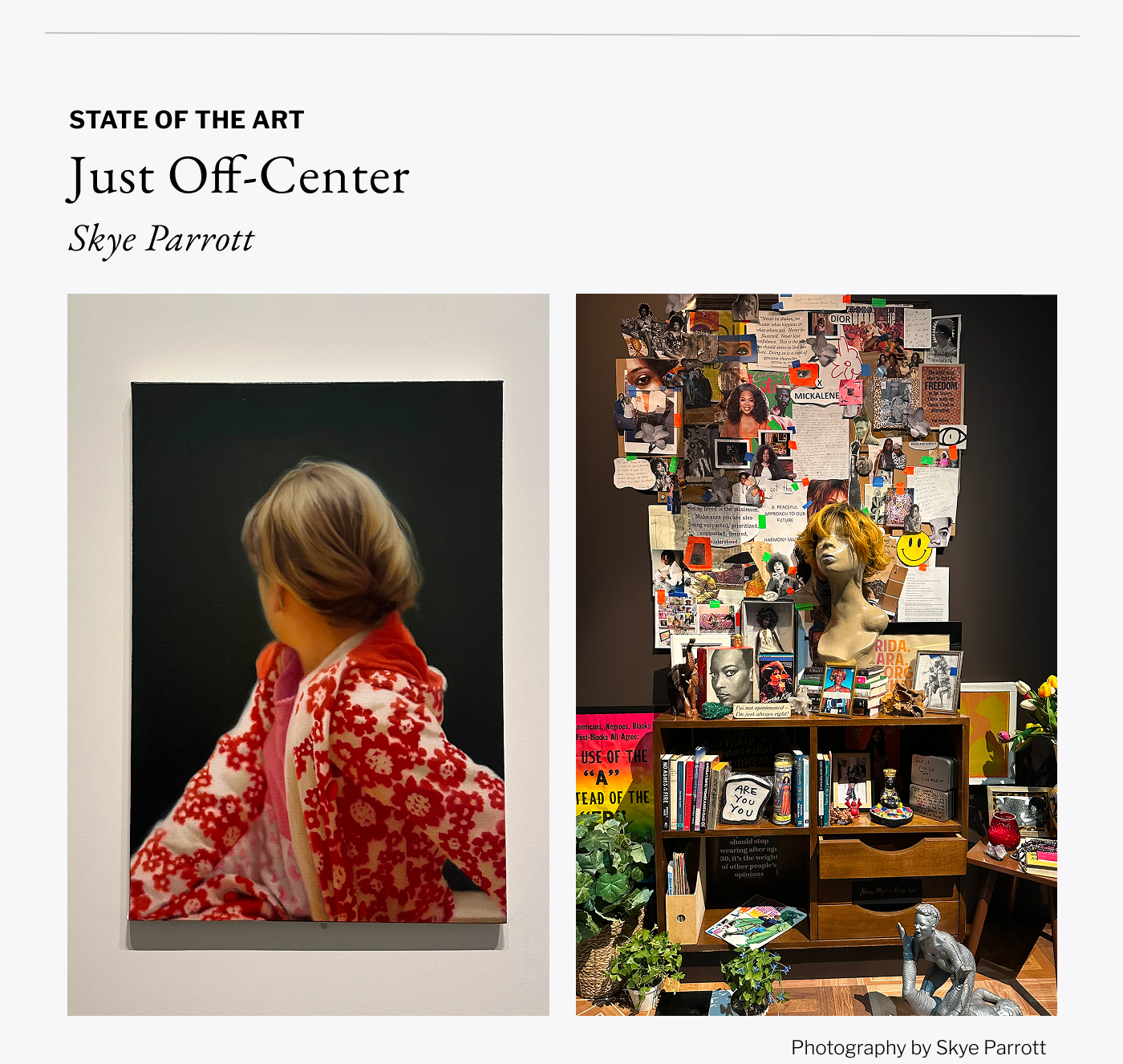
At the end of 2025, the Centre Pompidou closed its iconic 1970s headquarters for an overdue, five-year renovation. But I can’t say the shuttering of Paris’ largest modern and contemporary art institution has particularly impacted the city’s art scene, partially because of how the closure was handled. I’m sure plenty of French people have complaints about it — because they have a lot to say about everything, coupled with exceptionally high standards — but to me, an American, the plan the Pompidou put in place reflects one of the many things I love about this country: The French take art very seriously. As such, the institution’s works will be on the road for the next five years, with exhibitions scheduled in other Parisian galleries, further afield in France, and around the world, ensuring the collection remains accessible.
If anything, the art scene here has felt even more vibrant this year. At an opening recently, a friend mentioned this may be reflective of big shows coming to European institutions, rather than landing in American ones. That’s especially true for artists whose work addresses subjects such as race, gender, politics, and sexuality. (Nevermind that one might have a hard time imagining compelling art that didn’t touch on at least one of those subjects). So while I shed (yet another) tear for America, I also invite you to see one of the excellent shows taking place here in Paris.
All About Love. Mickalene Thomas’ retrospective is an exuberant, celebratory show. Taking its title from All About Love: New Visions by Bell Hooks, it (like the book) explores themes of joy and self through a Black, queer, feminist gaze while showcasing the artist’s enormous talent in a range of mediums, from painting to collage to installations. It is also, incidentally, the first solo exhibition by a Black artist at the Grand Palais — another cause for celebration.
Drawing Without Limits. The night of the Mickalene Thomas opening, I slipped across the Palais into this exhibition, which had opened the night before. So while everyone was jostling for space at Thomas’ show, Drawing Without Limits was empty. In it are over 300 works from the Pompidou’s collection (this is one of its roaming shows) showcasing 120 artists, from Jean-Michel Basquiat and Robert Longo to Kiki Smith and Paul Klee. I got to walk through them virtually alone, one of my favorite ways to see art.
Gerhard Richter. I have yet to be disappointed by a show at Fondation Louis Vuitton, and this is no exception. The consistent quality of Richter’s work, visible from very early in his career, is incredible — as is his creative commitment to exploring new mediums, and, of course, his sheer output, as evidenced by the show’s 275 works, spanning from 1962 to 2024. I walked away from the show humbled, thinking what an extraordinary testament it was to the artist’s life’s work.
1925-2025: One Hundred Years of Art Deco. Debuting 100 years after the exhibition that propelled art deco onto the world stage, this show brings together over 1,000 objects — from furniture to fashion to jewelry to train carriages — in an exploration of the lasting impact of the seminal design aesthetic. I haven’t seen it yet but I plan to next week, and everyone who has been says it’s amazing.
|
|
For as long as I can remember, Zanzibar has been a place of passage for me. Growing up on the mainland in Dar es Salaam, Tanzania, I was constantly traveling to, from, and through the island, often arriving with a purpose — be it to learn how to kite surf in Paje or to earn my PADI scuba diving certificate in Nungwi — but rarely to linger. So much of my relationship with the island, rightfully so, was shaped by its waters. I was 13 when I became a certified scuba diver so the island’s turquoise horizons, verdant reefs, and thriving marine life feel more familiar to me than its streets.
This past autumn, I returned to Zanzibar after almost 10 years for my sister’s wedding, and I observed a shift — in me and in my relationship with the island. For much of my life, I’d avoided traversing Stone Town, the old quarter of Zanzibar City. Despite its designation as a UNESCO World Heritage Site and its rich, multicultural history, the area’s density felt overwhelming to me as a child. Its narrow, maze-like corridors and heavy air stood in stark contrast to the openness I sought in the water. And its history was too complex for me to truly appreciate.
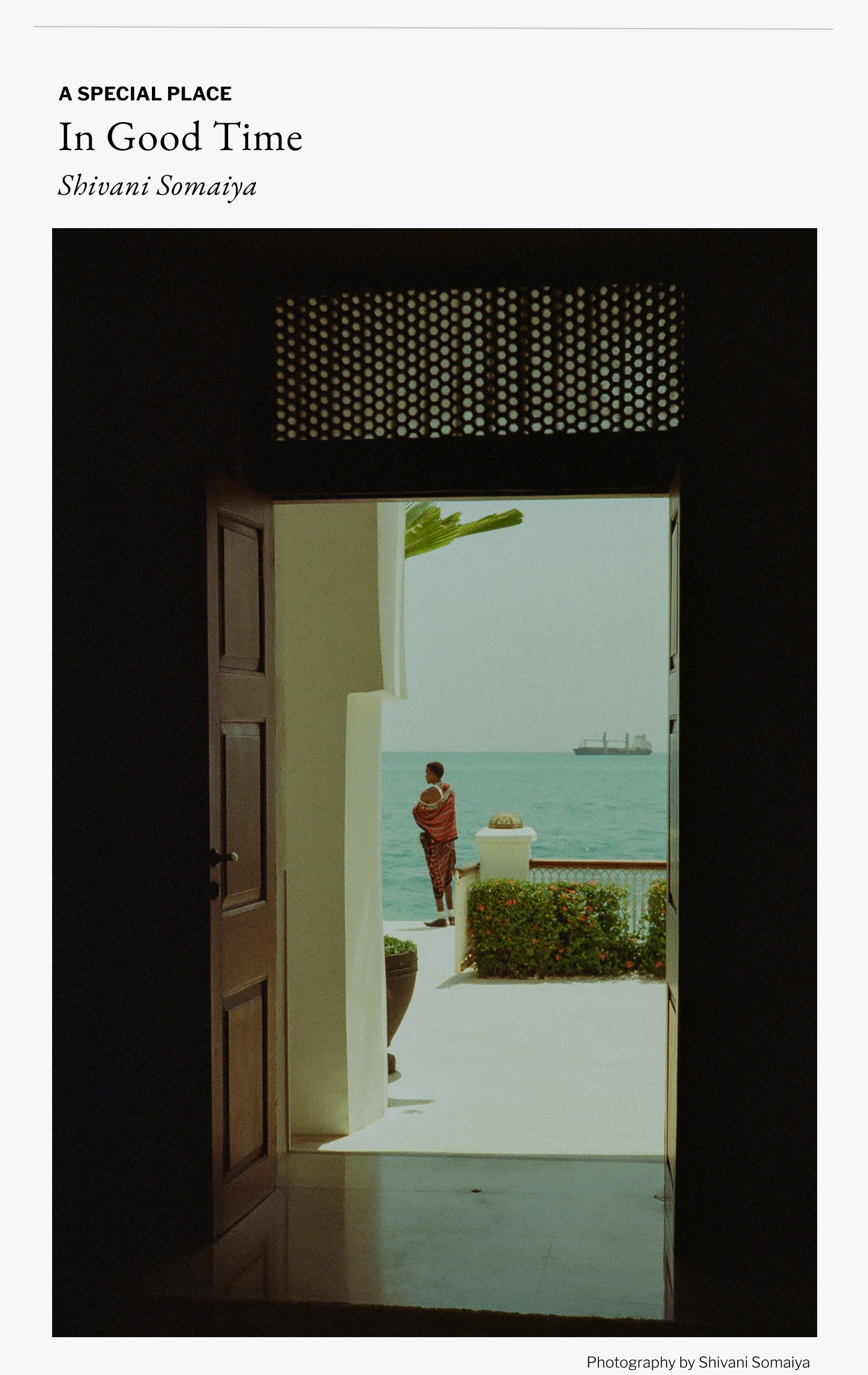
After the wedding festivities wrapped up, my husband and I decided to spend our final morning in Stone Town. We arrived at the Park Hyatt Zanzibar, which sits on the small port’s shoreline in the heart of Stone Town. On our way out, I observed this solitary Maasai guard. He stood framed by the doorway, wrapped in a traditional shuka, gazing toward the Indian Ocean as the cargo ships approached the port. Even though this composition feels accidental, there’s an unavoidable precision in how it speaks to the island’s layered history. The carved wooden doors, manicured fronds, and Maasai staring out at the endless blue horizon all exist in quiet conversation. Each element carries its own lineage within Swahili culture but, when seen together, they reveal a uniquely Zanzibari composite. Word to the wise … To experience Stone Town in all its renown, check into the Park Hyatt, then stop for coffee at Karafuu Coffee House. Afterwards, allow yourself to get lost in the historic quarter, where hand-carved Zanzibar doors with brass and gold-studded embellishments each reveal a story. Shop for fine jewelry at Lithos, and pop into Doreen Mashika's showroom for contemporary silhouettes crafted from fabrics that integrate traditional East African kanga cotton prints with modern, sustainable materials, such as silk, cashmere, velvet, and Bemberg satin. Explore the Freddie Mercury Museum before stopping for drinks and dinner at 6 Degrees South, an ideal place to watch the sunset.
|
|
Stitch by Stitch. If you see someone wearing a white T-shirt embroidered with “Dossier” walking around Manhattan (or an airport), it’s definitely me. I was in the market for something custom so I reached out to Abby from Abbode, which creates personalized embroidered goods — from boxers, eye masks, and tanks to pillowcases, dopp kits, and luggage tags — in New York City’s SoHo neighborhood. The shop offers same-day embroidery for those in the city (though they also ship everywhere), and Abbode’s packaging is a gift in itself. Yes, this could be a teaser for forthcoming Dossier merch. –Elysha Beckerman
Sound Off. My favorite concert memories are nearly always in small venues, in the pit, close to the performer. But Raye’s recent performance at Accor Arena in Paris might have changed my mind. Her theatrical entrance in a white fur coat, with a sparkling red dress underneath, set the tone for her breathtaking vocals. And the show took so many forms, blending jazz inspirations into pop and soul sounds — it even included a nightclub segment that transported the whole audience (all 20,000 of us) into what felt like a cozy, after-hours bar. The North American leg of This Tour May Contain New Music starts in March. –Anna Kaplan
Sweet Escape. Winter in Paris can feel interminable. But one of the upsides of the cold and grey outside — the only one I can think of, actually — is the pleasure of going inside and getting cozy. To that end, chefs Jérôme Banctel and Jordan Talbot have teamed up to create Signature Hot Chocolate at La Réserve, and my younger daughter and I recently braved the elements to experience it. Stepping off the rainy Champs-Élysées, we were quickly installed in front of a crackling fire. There, I indulged in the chocolat chaud grand réserve made with Peruvian and Venezuelan chocolates, flavored with orange peel, vanilla, cinnamon, and spices. She kept it simple with the chocolat chaud retour en enfance. And both of us savored our bottomless pots of chocolate with the pairs of dipped, marbled madeleines that accompanied them. –Skye Parrott
|
|
54 Franklin St #2R NY, NY 10013. ©2026 Dossier Projects, LLC.
|
|
|
|
|