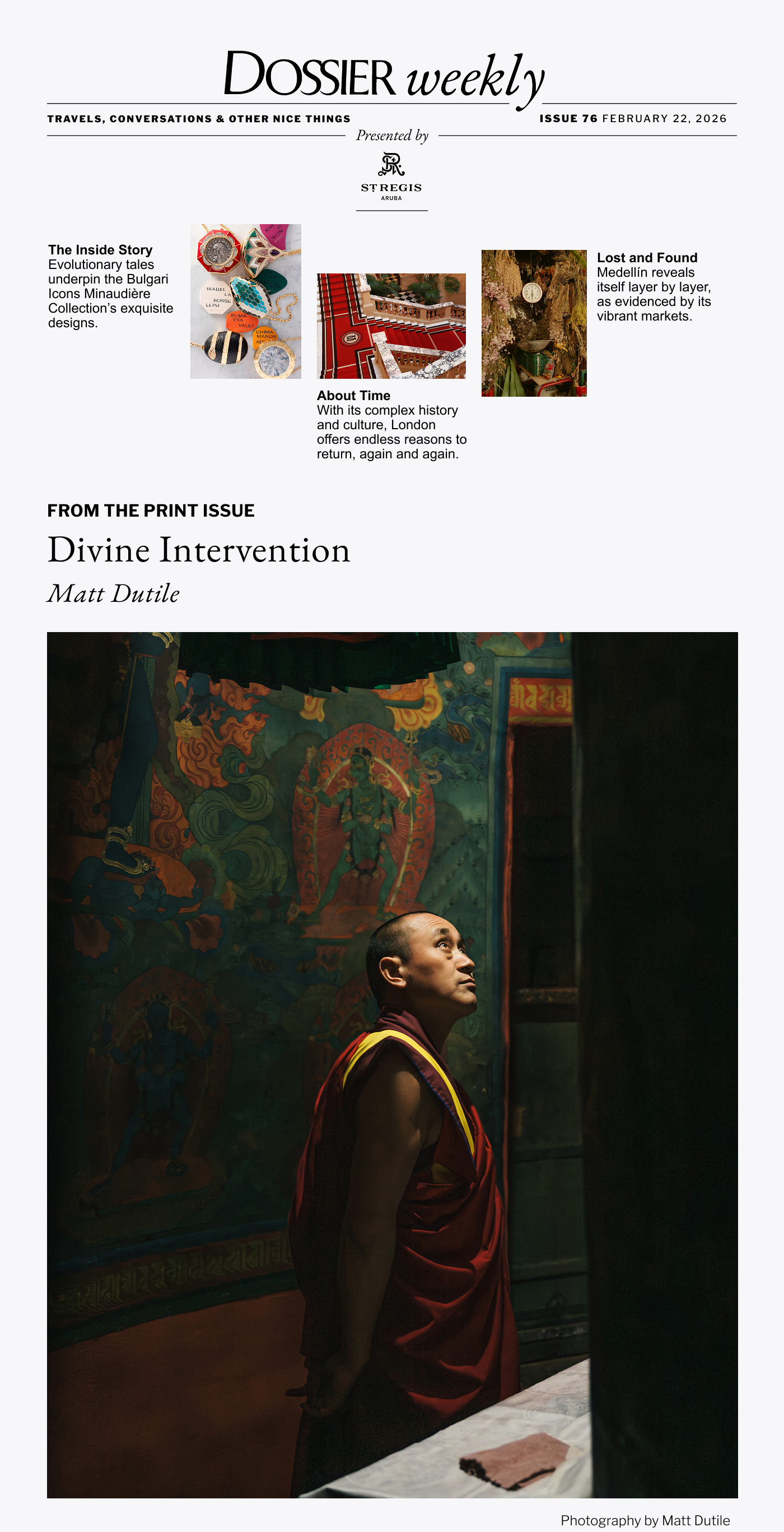
In the dim light of the Jangtsa Dumtseg Lhakhang temple, I glimpse a pair of scarlet robes just before they vanish. They disappear behind a circular column painted with bright yellow and orange Shakyamuni Buddha figures seated in the open-palmed lotus position. The whispers of my guides — two Lopen, a title given to mean both teacher and master in Bhutan’s monastic order — coax me forward through the building’s ring-shaped center. The spherical temple, built in the 15th century, is an oddity in the otherwise angular sacred spaces of the Himalayan nation. Tucked into a quiet corner of Paro, surrounded by rice terraces and farmhouses, the temple is unassuming until you step inside. There, three ever smaller and higher concentric stories reveal masterworks of artisan monks created centuries ago. Hundreds of Buddha line the first story; wrathful Mahakala patrolling Bardo, the transitional state between death and rebirth, coat the second; and 84 Mahasiddha, the tantric masters of Vajrayana Buddhism practiced throughout Bhutan, glow in various forms across the third. Some interpret these stories to represent the planes of heaven, hell, and earth.
Legend has it that the temple owes its conical shape to Thangtong Gyalpo, a wandering Tibetan yogi and master engineer of the early 15th century, who demanded the temple be built with a hollow interior to entice a troublesome naga spirit to wrap around it, thus subduing the spirit’s power and bringing peace to the surrounding land. In the 19th century, the 25th Je Khenpo (the spiritual head of the monastic body) Sherab Gyeltsen added a protective 12-pillared octagon and outer temple. The resulting architecture recalls a set of wooden blocks: a cone stacked upon a flat circle on top of a square box.
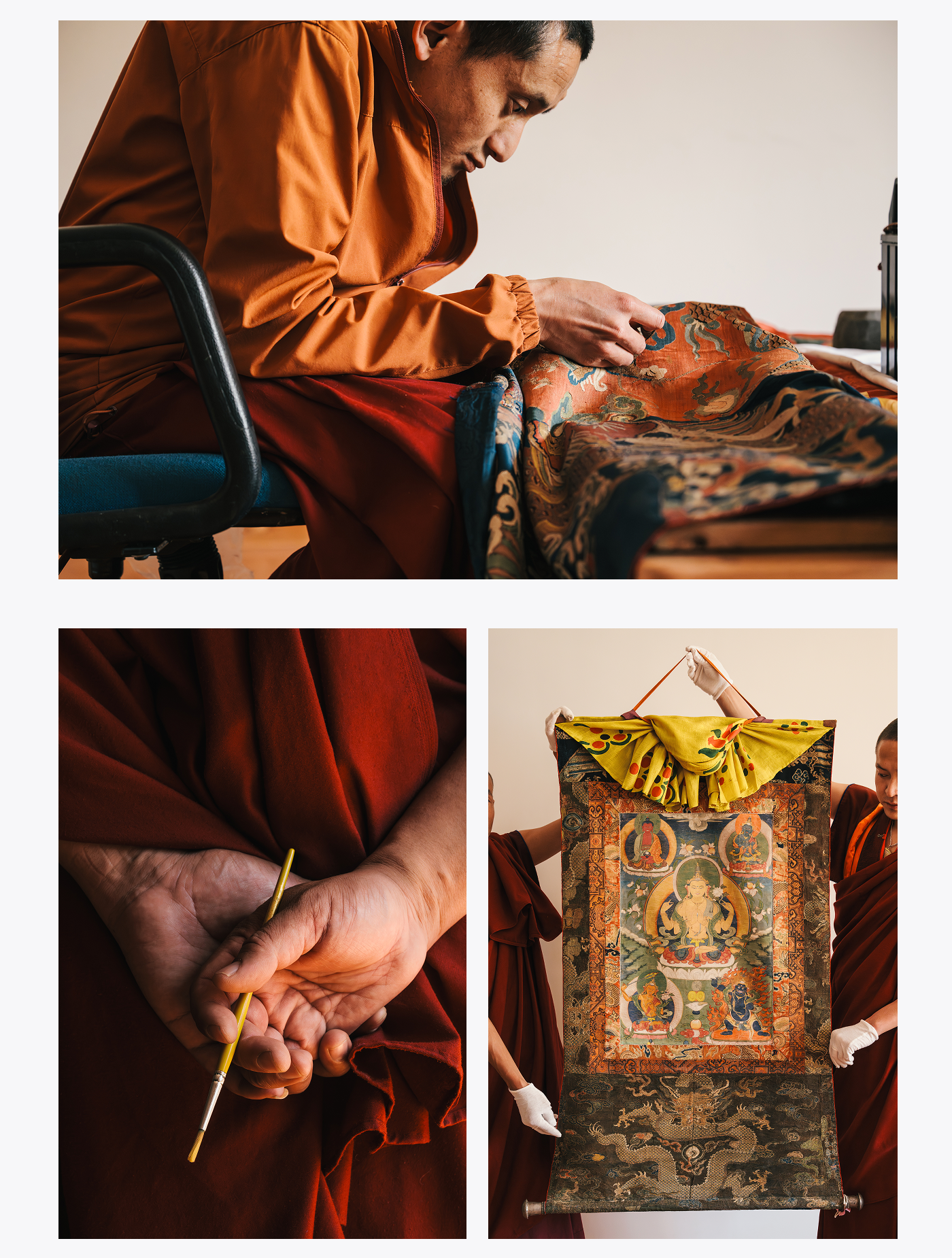
It is the temple’s latest round of renovations, completed in 2019, that have brought me here, to meet with my robed guardians, Lopen Sonam Tshering and Lopen Namgyel Dorji of the Zhung Dratshang Preservation & Antiquities Conservation Center. Founded in 2003 by a small team of monks, the center is dedicated to the preservation and continuity of Bhutan’s spiritual heritage. Whereas monks once created the sculptures, murals, scrolls, and thangka (religious scroll paintings) of the Himalayan region, they now serve as the artworks’ custodians. |
|
Read the full feature and more close takes on a wide world in our latest print issue. Order now.
Word to the Wise … Dutile traveled to Bhutan as a guest of luxury tour operator Himalayan Echoes. Visit the company’s website to learn more about its curated collection of immersive experiences, or email concierge@himalayanechoes.travel for more information.
|
|
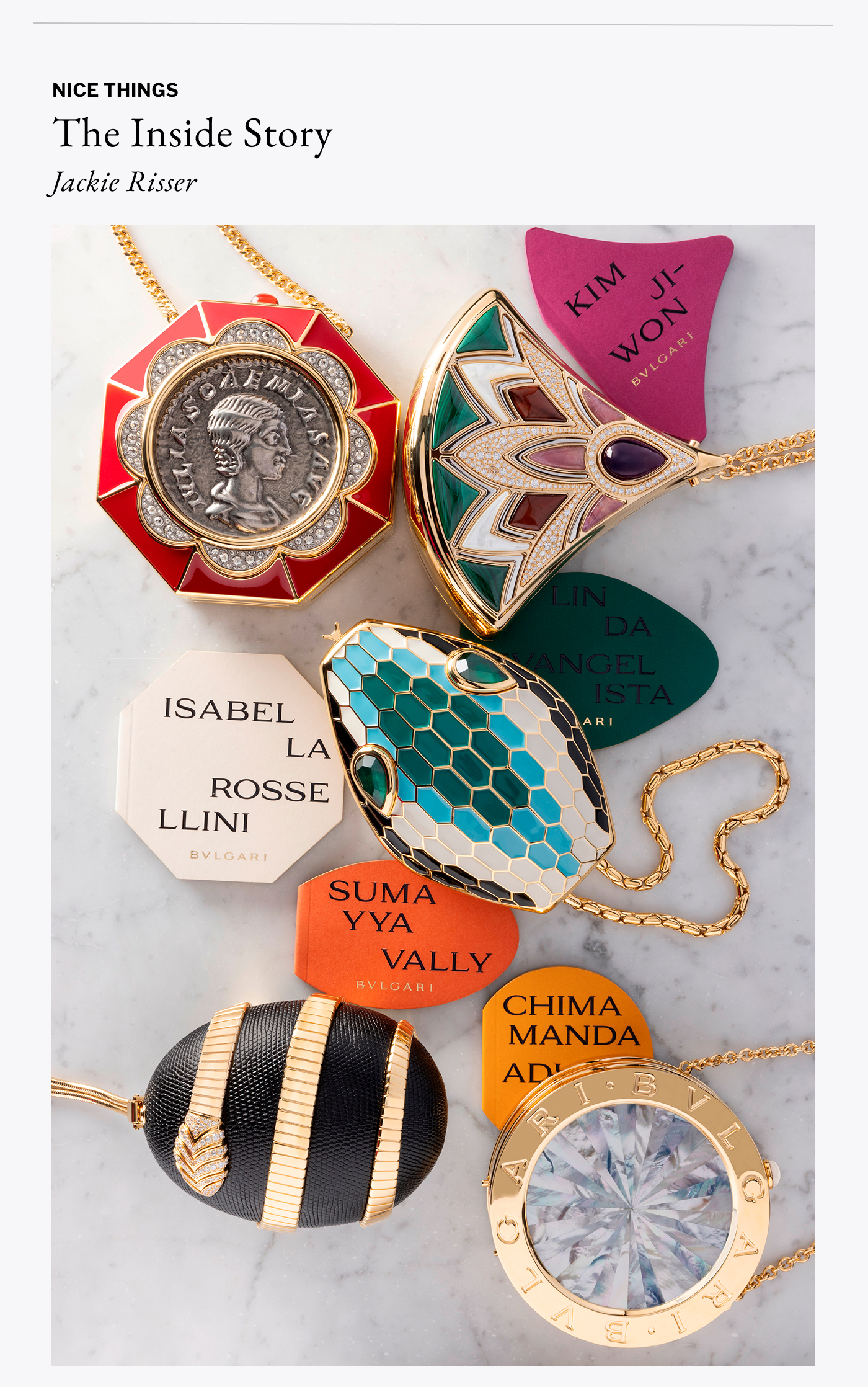
The relationship between a woman and her handbag is complex, layered with history, personality, and taste. Purses, as stylistic expressions, first emerged in the 19th century, transforming previously concealed pockets on strings into wardrobe essentials that communicated their wearer’s character. A red bag could be said to reflect a passionate disposition, black a more traditional temperament. By the 20th century, many of the world’s most famous bags, in fact, took direct inspiration from specific women — princesses, actresses, models. Bulgari advances this heritage with its new, limited-edition Bulgari Icons Minaudière Collection, blending its 140-year past with the values of five extraordinary women. Respectively, author Chimamanda Ngozi Adichie, model Linda Evangelista, actor Kim Ji-won, actor and model Isabella Rossellini, and architect Sumayya Vally represent identity, transformation, allure, wisdom, and strength. These traits are translated into tiny, jewel-like bags via the Roman house’s high jewelry craft techniques — such as lost-wax casting and hand-applied enamels — paired with Bulgari’s signature colored stones, including amethyst, tiger’s eye, mother of pearl, and malachite.
Within each minaudière lies a little book, titled Notes On, written by the woman with whom the design is aligned. Featuring her personal reflections, these tiny, handbound tomes put a fine point on evolution — of Bulgari’s craftsmanship and design, of the role of handbags within society, and of women’s influence in the world.
|
|
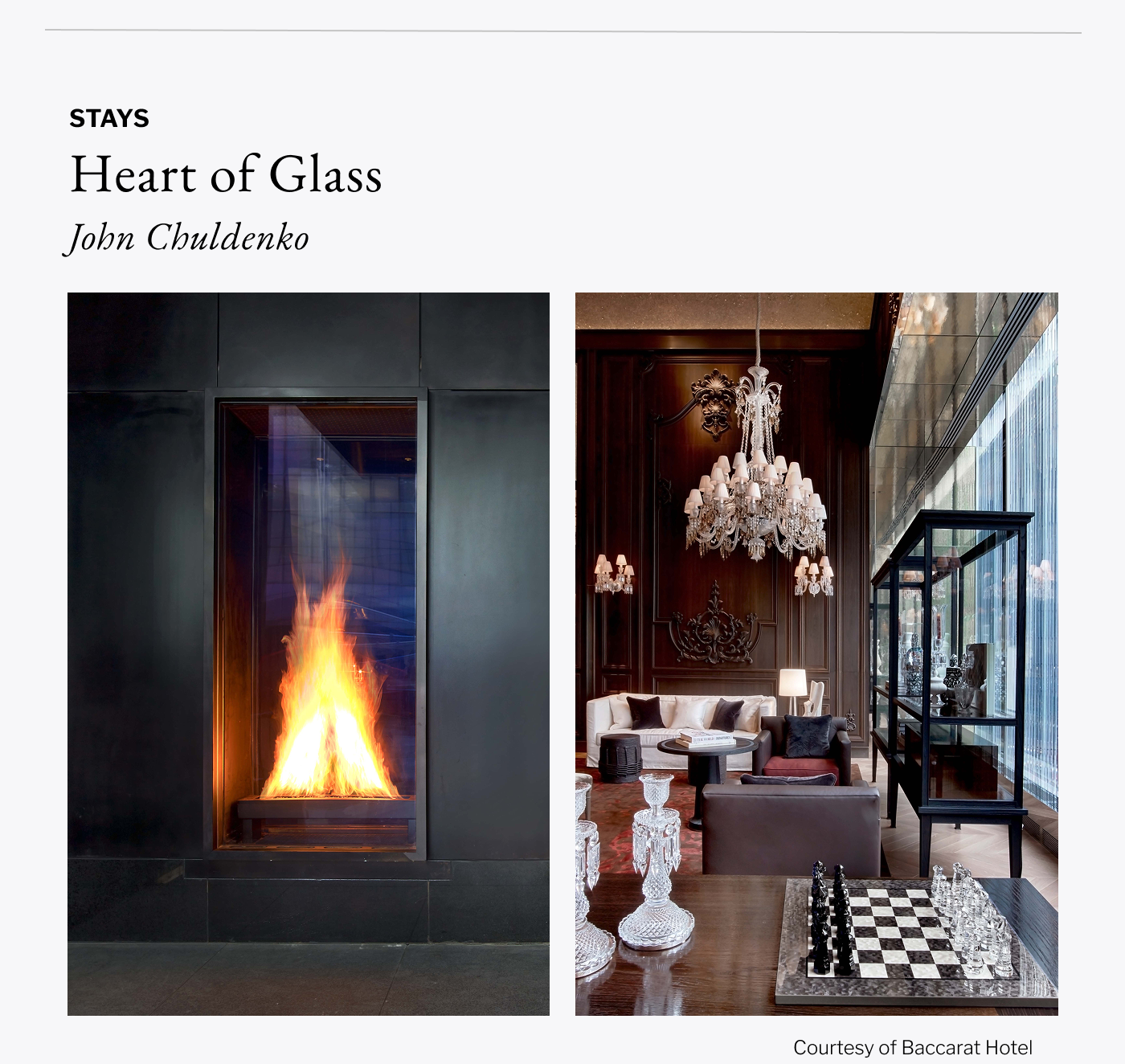
When I arrived late to the Baccarat Hotel New York, bleary from a cross-country flight, the property’s kaleidoscopic Harcourt Wall — crafted from 2,000 backlit Baccarat glasses — greeted me with a moody, mesmerizing glow. I love a hotel that leans in, eschewing a “something for everyone” philosophy, instead embracing a singular identity. In the case of Baccarat, it’s an identity rooted in a 250-year heritage of crafting some of the world’s finest crystal. And transparent touches are everywhere. Like a kid on a scavenger hunt, I delighted in the detail: room numbers inlaid into marble, sculptures housed in crystal vitrines gracing the entrance of every suite. Swinging open my guest room door, I found an interplay of shimmering crystal, chevron-laid wood, and thick marble slabs soaring to the ceiling. More porous elements included woven rugs and soft throws over cozy chairs.
My reference room service burger arrived superbly cooked with remoulade and gruyere. Then, moments later, the doorbell rang again, signaling the arrival of a replacement cone of fries atop a silver tray. Apparently, the fries I had already mostly devoured were of the standard variety, not truffle fries. I accepted the gracious gesture before meeting a friend at the bar, where I marveled at a triptych of gorgeous Baccarat crystal chandeliers. Drifting off to sleep that night, I left the minibar door cracked to illuminate glassware framed in a vibrant red lacquer case, just because it was pretty.
The following morning was bright and crystalline. Sunlight streamed through silk drapes, reflecting off the mirrors of the Grand Salon. As I sat above 53rd Street, enjoying my breakfast, the hotel’s transparent, lenticular façade bent the city below, throwing it into a faceted, zoetrope-like animation, as if I were in one of Baccarat’s superbly crafted vessels. In a sense, I was.
|
|
I’ve spent the past three summers in London’s Notting Hill. During these slow, gentle days, my beau’s British accent, increasingly blending into my American one, returns to its Anglo slant. We take massive, lolloping walks. We drink lots of Guiness.
Today, as I type from my little home office, I see the Empire State Building through my window, shrouded in fog. It’s raining and grey as a pigeon wing — not so dissimilar to that place across the pond. Consequently, I’m feeling wistful about my (second) favorite city. Ah well, we can always return to that which we miss through writing. Below, some London gems on my mind right now.
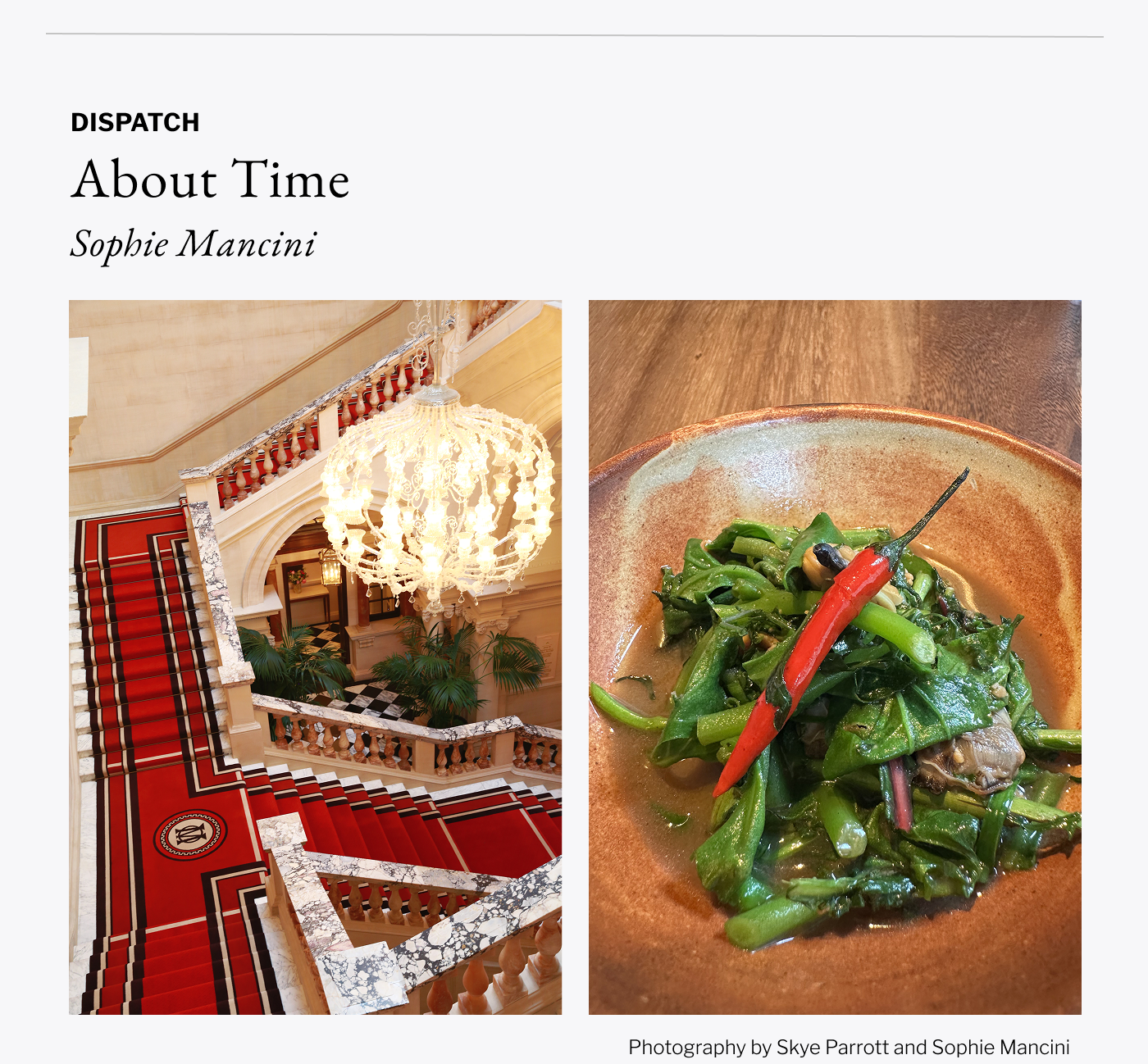
Raffles London at The OWO. Power is the first word that comes to mind at this address, housed within Westminster’s storied Old War Office — the former meeting place of Britain’s greatest politicians, spies, and military leaders. You feel it upon entering. The grand upper hallways feature smoldering red, black, and cream tones; rich wood panelling; and geometric carpeting. And the property’s bombastic scale evokes Harry Potter’s Ministry of Magic. Indeed, the hallways measure nine feet across — built to allow for extra desks for emergency staff, as well as the passage of bicycles used to deliver express messages within the building. The hotel’s restaurant is fantastic (order the soft-as-a-butter-slice squid starter if it’s in season), and its spa is stately (cap your sauna session with a holy swim in the 20-meter pool underneath double-height ceilings). But the real draw here is the history, making the OWO’s best experience its daily historic tour. Led by a knowledgeable staff member, the tour takes you from Winston Churchill’s office to the building’s underground corridors — once top-secret storage vaults for MI5 and MI6 agent intel. Another space of note, now containing the hotel’s Spy Bar: Room 007. Cue the James Bond theme song.
AngloThai. Tucked onto a quiet street in the Marylebone neighborhood, AngloThai is the first permanent home of chef-sommelier couple John and Desiree Chantarasak, and it received a Michelin star within months of its November 2024 opening. The restaurant’s concept is a love letter to the couple’s dual heritage: Thai culinary tradition filtered through the lens of British produce. Think wok hei, coconut-smoked elements, and charcoal grilling expressed via Cornish monkfish, Hebridean hogget (a young sheep), British-grown herbs, and native grains (a stand in for non-native rice). Dishes like Carlingford oysters with sea buckthorn and fermented chili or simple wok-fired greens studded with juicy clams are masterclasses in the bold, bright, exacting flavors of Thai cuisine.
Alounak. Opened in 1995, this Persian restaurant in the Bayswater neighborhood offers succulent charcoal-grilled meats, bouncy saffron rice, and an enchanting Old World interior, with glowing mosaic lamps and patterned cushions ideal for leaning back on with a full belly. Alounak’s freshly baked taftoon (earthy broad circles of flatbread) come steaming, straight from the clay oven by the front door. Its mixed starter dish — a platter of dips ranging from eggplant to hummus — is a must. I love this place for lunch, when daylight flows through large windows and the space hums with family chatter. Dinner is equally delightful. Come with a group and BYOB.
Dorian. Historically, the English do quaint and quiet rather well. But they also do sexy and swaggering with exceeding panache. Dorian is a case in point. The modern bistro in the heart of Notting Hill offers wood-fired cooking with a side of scene. Everyone around me the night I dined seemed to be on a date — there were lots of women with jackets over their shoulders, delicate wrists lifting martini glasses, rosy slabs of meat, and bedroom eyes smouldering over white tablecloths. The establishment is famous for its charred meats, served with great pomp in pools of rich, brooding sauces. But a star dish for me was of a subtler strain: humble monkfish. Mine was grilled over smoking oak and charcoal, glazed in clam butter, and served with grilled sweetcorn puree, Namayasai farm leaves, and potato and clam chowder. However, the menu changes weekly (sometimes daily), which is to say: I’ll probably never taste this dish again. Isn’t that romantic?
Tart. I squealed with excitement when Slutty Cheff — London’s buzziest anonymous chef, internet personality, and now author — slid into my DMs, introducing herself and offering to send me a copy of her debut memoir. When it arrived on my boyfriend’s doorstep, the book and I became inseparable. In fact, it was my only friend when I got sickly with Covid and would take air in the back garden like a consumptive Victorian. Cheff's raw retelling of her love life, cooking, and the veins of hunger running through both, made for a most delicious read. (I’m probably the 700th person to use this pun, but there’s no better descriptor.) She made me love London even more.
Ishkar. Founded by two former Afghanistan residents committed to supporting traditional artisans, Ishkar curates and sells handcrafted goods — rugs, glassware, jewelry and homeware — from regions affected by conflict, all shaped by generational expertise. The pair’s store on Columbia Road presents artful displays of hand-knotted rugs woven from Ghazni wool, gem-like blown glass from one of Afghanistan’s last traditional workshops, and intricate jewelry stamped with ancestral patterns. I bought the Carnelian Chunky Ring. Handcrafted by master artisans in the old city of Kabu, it holds a red stone with a warm glow, semi-translucent like strawberry jam. I’m now eyeing the Green Agate one.
|
|
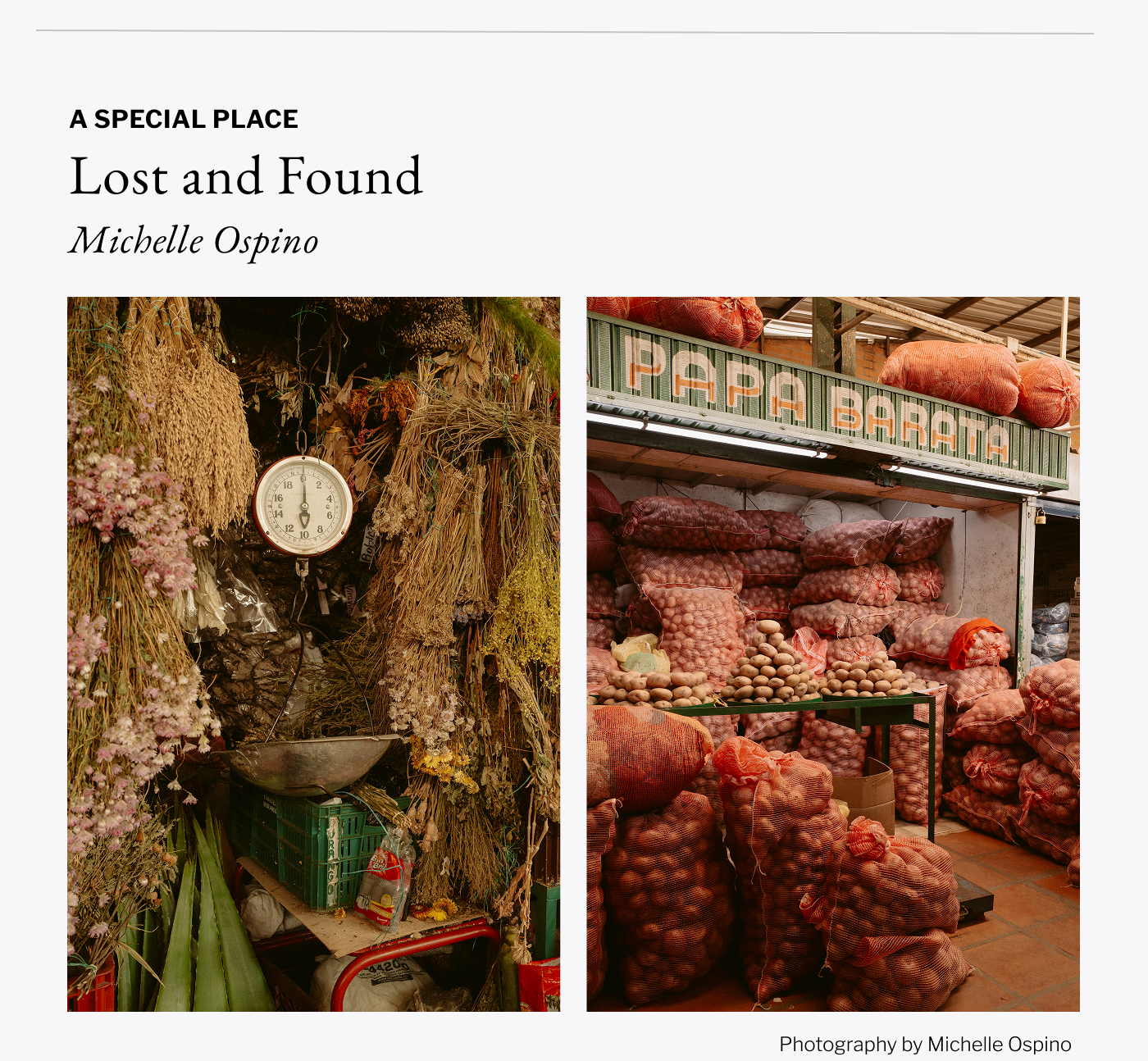
My home for 20 years in New York City was called Little Colombia so when I moved to Medellín, Colombia, two years ago it felt a bit like a homecoming. The familiar warmth of Paisas (people from Antioquia, the region in which Medellín is located) and waking up to distant notes of salsa music mingling with the smell of coffee drifting through my windows bring me a deep sense of comfort and nostalgia. But living in a place different from where you grew up sparks a new kind of curiosity; it’s been a powerful catalyst for my creativity.
One of my favorite ways to experience the city is exploring its vibrant markets, where you can find everything from fruit and flowers to kitchen supplies, candles, and secondhand clothing. I recommend going on an empty stomach and tasting your way through the stalls. In Colombia, they say you can eat a different fruit every day of the year. Some even joke that if you can’t find what you are looking for in La Minorista, one of Medellín’s largest markets, then it doesn’t exist. I could spend hours wandering the market, getting lost, chatting with vendors. Medellín is a place that reveals itself slowly, layer by layer. Every time I leave, I find myself counting down the days until I return.
|
|
The Real Thing. My little sister will, on occasion, operate a speakeasy out of her garage in Hollywood. There, several months ago, on one hypnotic night, I was fortunate enough to see Tyler Ballgame captivate a few dozen friends from her makeshift stage. Last week, I caught Ballgame’s performance on the UK’s Channel 4 in support of his debut album For the First Time, Again, and I was reintroduced to the artist’s utterly distinctive voice. With a soaring lilt and just a hint of Roy Orbison, Ballgame croons over captivating melodies and tumbling drums reminiscent of Aimee Mann’s legendary Bachelor No. 2. In an era of algorithmic sameness, he’s a true original. –John Chuldenko
To Have and to Hold. If you were to open the kitchen cabinet housing my coffee mugs, you might think I live with a family of five (I do not). I have too many mugs, yet a little voice seems to whisper "never enough,” so I was delighted to receive The Mug from East Fork, a boutique brand out of Asheville, North Carolina, founded by potters. The aptly named item has heft but not bulk, it's smooth to the touch but not shiny, and it's in soothing Blue Ridge, a shade inspired by the majestic Blue Ridge Mountains, where The Mug was made. –Jackie Risser
Perfectly Stuffed. February is a great month to hibernate, which, for me, means cooking. Last Sunday afternoon, I was craving pasta, something stuffed and warming, so I tossed Ripi Beef Short Rib Ravioli into the pot. A project from chef Joe Sasto, one of my favorite sfoglini (fresh pasta masters), Ripi is rooted in carefully sourced ingredients and made to be cooked straight from the freezer. After about three minutes, the ravioli floated to the top of the boiling water so I transferred them into a reduced red wine and browned butter sage sauce, finishing the restaurant-level dish with Parmigiano-Reggiano cheese. –Elysha Beckerman
Dinner Theater. On a cold, rainy night, I walked through the doors of Ogata, a transportative experience that feels like stepping from a quiet street in the Marais straight into Japan. Spread out over four floors, Ogata is the lifework of its designer Shinichiro Ogata, who, it turned out, would be dining next to me that night. The occasion was a week-long pop-up by Chef Hiroki Odo (his namesake New York City restaurant, Odo, has been awarded two Michelin stars). On the second floor of Ogata, Odo’s team prepared a faultless, seven-course omakase meal in an open kitchen. Their Japanese cuisine drew on French ingredients — from Perigord chicken to plump Normandy oysters — paired with Brooklyn Kura, sake brewed in Industry City, creating a meal that only heightened the dissonance I felt when I found myself, afterwards, once again on the streets of Paris. –Skye Parrott
|
|
54 Franklin St #2R NY, NY 10013. ©2026 Dossier Projects, LLC.
|
|
|
|
|