Once, when I was a girl, entranced by the sight of lit windows on a nighttime walk, I asked my father how long he thought it would take for me to look inside every home on Earth.
“How long would you stay?” he asked. Bless him for always taking me seriously.
“I’d just take a quick tour,” I said.
He did the math. There were then about 5 billion people on the planet, and some lived together, so he estimated around a billion households. At roughly five minutes a pop?
“More than a lifetime,” he told me.
I wasn’t sure I believed him. At the time, I felt like I’d live forever. But even if I couldn’t manage to see every domicile on the planet, it seemed like a good way to spend my days.
It still does. Thanks to the internet, I’m now able to see into many people’s homes — the ones for sale, at least. And I spend more and more time doing this. When depressed, bored, or overwhelmed, I travel the world and fantasize about life elsewhere. Not about vacations — that’s a different kind of dreaming — just about the maintenance of daily life in another place. I find a spot that looks beautiful and mentally transport myself (and my belongings) to it. Umbrellas in a stand by that door, fruit in a bowl on that counter, an afternoon spent with a trowel in that struggling little patch of grass.
The practice could be described simply as scrolling — or, looked at differently, as a form of inner emigration. The basic idea is: By flying away in our minds, we can vacate a difficult reality. The term “inner emigration” is originally German and was used to describe the compartmentalization of those who disagreed with the Nazi regime but stayed in the country anyway. It was repurposed in the Soviet era to describe the practices of dissidents who managed totalitarianism by mentally opposing the regime and cultivating rich interior lives. Though inner emigration is easy to romanticize as a subtle form of resistance, it can also be cast as capitulation. I like the phrase for the ways it encompasses this ambiguity, because I don’t know how to characterize my own habit of mentally transporting myself — it could be a harmless escape or a compulsion, a form of refusal or of complicity.
Whatever it is, lately, I need these dreams more than ever. As the news grows more nightmarish, and seemingly more unavoidable, I’ve taken to spending more and more time cultivating alternate lives. Aided by algorithms, I follow international real estate and design accounts on Instagram and bookmark sites on my browser. I find a house I’d love to call my own and then learn about the surrounding area. When modern life feels overwhelming, I use these modern tools to escape. Here are some of the places I go.
An apartment in Durrës, Albania. In Durrës in the heat of summer, warm air off the Adriatic Sea blows through the sliding door’s screen. From my place on the fifth floor, I have a clear view to at least a strip of sea, a ribbon of sapphire that ends at the horizon, where another blue begins. …
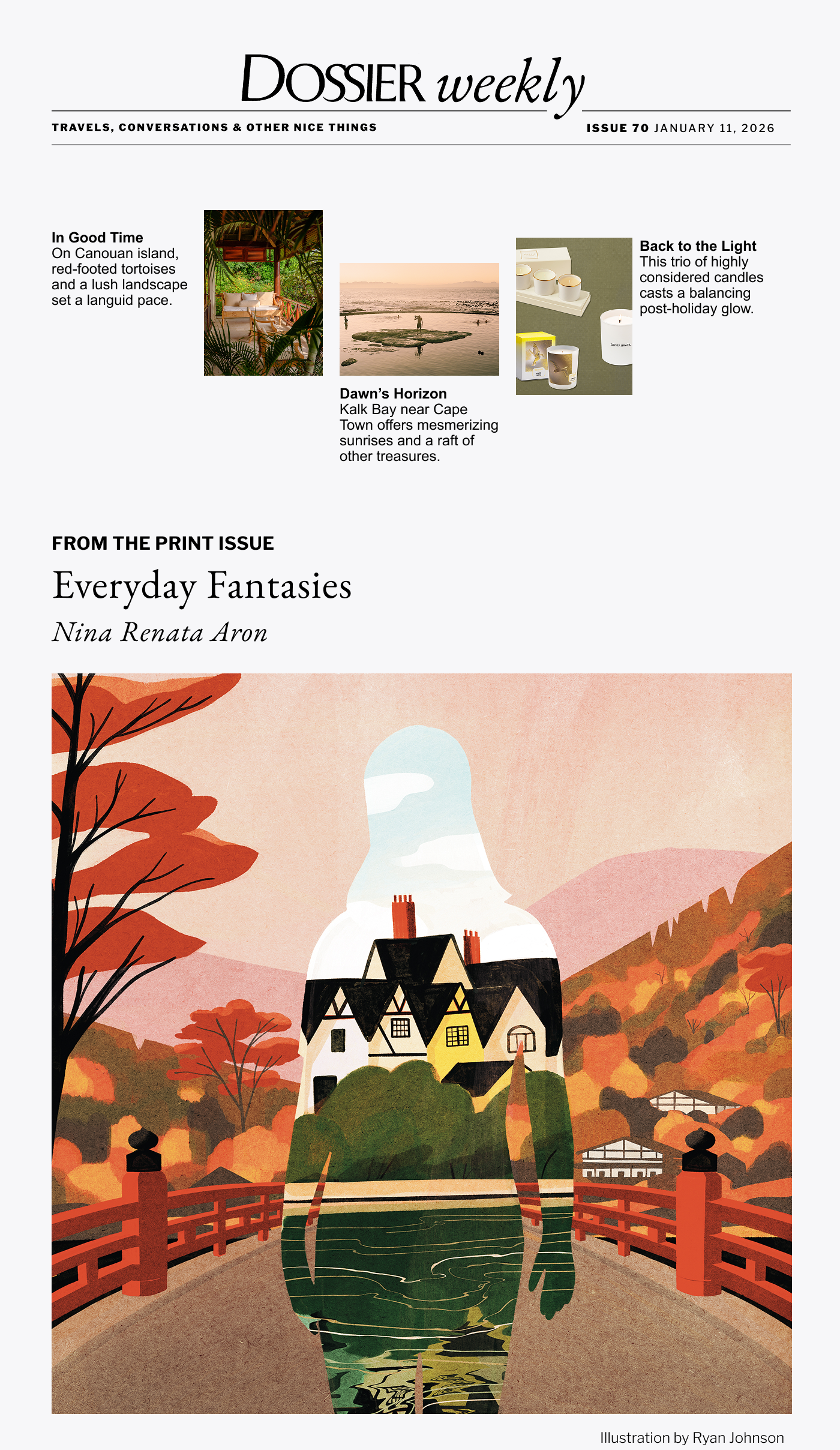
A hillside home in Hida-Takayama, Japan. Takayama is in the Japanese Alps, which is good because I like to hike. In autumn’s cool air, I depart my house just after dawn in good boots, with a walking stick, and climb through the lush forest. …
A rowhouse in Bradford-on-Avon, England. I’ve long imagined living in a quaint English hamlet, so I feel perfectly at ease walking along the river in town, taking in the Georgian architecture. …
A thatched-roof house in Tomelilla, Sweden. Yes, the roof looks like nature’s shag rug, but this is typical of 19th-century farmsteads in Skåne County, southern Sweden. And inside, the house is like something out of a fairy tale. …
Do I actually need to move or is digital wandering enough? I recently read an interview with the individual behind a popular Instagram account that showcases rural properties for sale in far-flung corners of the globe. In spite of having posted hundreds of houses, he reported that he knows of only a handful of people who’ve purchased one and made the move. Will I be one? Friends love to remind me that every place has its nuisances and downsides, that people are basically the same no matter where you go. That may be true. “Sure,” I reply defiantly, “but I won’t understand what they’re saying.” For a time, until I’ve integrated more fully, I won’t get the nuances of local politics, won’t know the long-standing challenges of a particular bureaucracy, or who’s at the center of town drama. And maybe that’s what the dream is really about: a withdrawal from the familiar webs of responsibility, networks of accountability, and, ironically, life online. A withdrawal from noise. Maybe beyond the pleasures of perusing other places, trying on lives like articles of clothing, this longing has a larger purpose: to remind me to keep reaching for the beautiful, ever more rare experience of being a keen but passive observer.
Read the full essay and more close takes on a wide world in our latest print issue. Order now.
|
|
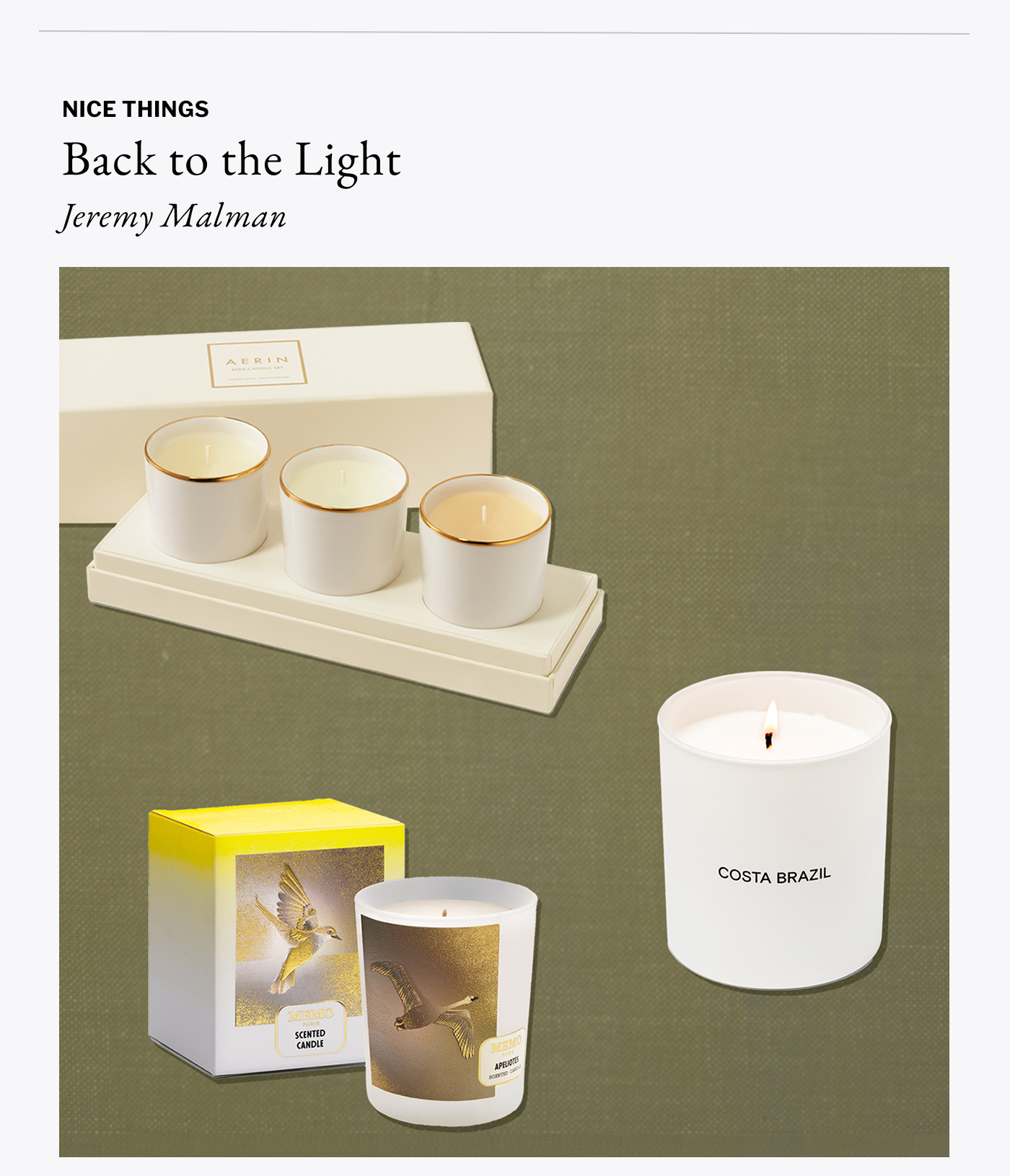
I love Christmas, but it comes at the expense of my beloved routine: I wake up, usher the kids to school, write, go to the gym, feed, go to bed, repeat. In the absence of these rituals, the holidays with my wife, our three children, and an increasingly unpredictable pair of in-laws leave me feeling a bit lost, like a baby without its pacifier. As I ease back into the everyday, these are the candles I’m burning to regain my footing.
Flamingo Estate Blossoming Camellia with Monica Lewinsky Candle. This limited-edition candle donated 100% of its proceeds to anti-bullying organizations across the U.S., U.K., and Australia. Its description indicates that it contains notes of lemon, vanilla, and clove, but when my 19-year-old son asks me, “Who is Monica Lewinsky?” I just think how much better it smells than yesterday. Although this scent is no longer available, you can’t really go wrong with any of the company’s hand-poured, plant-based candles.
Baobab Collection I Love Ski Scented Candle. This hand screen-printed vessel contains a mid-sized, four-wicked candle that makes your at-home workspace smell like fig leaf and iris, rather than your and your kid’s grilled cheese sandwiches.
Les Bougies de Frédérique Candles. These sculptural designs are hand dipped, then hand shaped by Frédérique in her Parisian workshop. Every candle takes two days to make because she doesn't use molds and her process requires each wick to be soaked at least 24 times. And while they're all unique, each will stand at least 12 inches tall and cast a gorgeous Old World glow over whatever it is you're trying to achieve. |
|
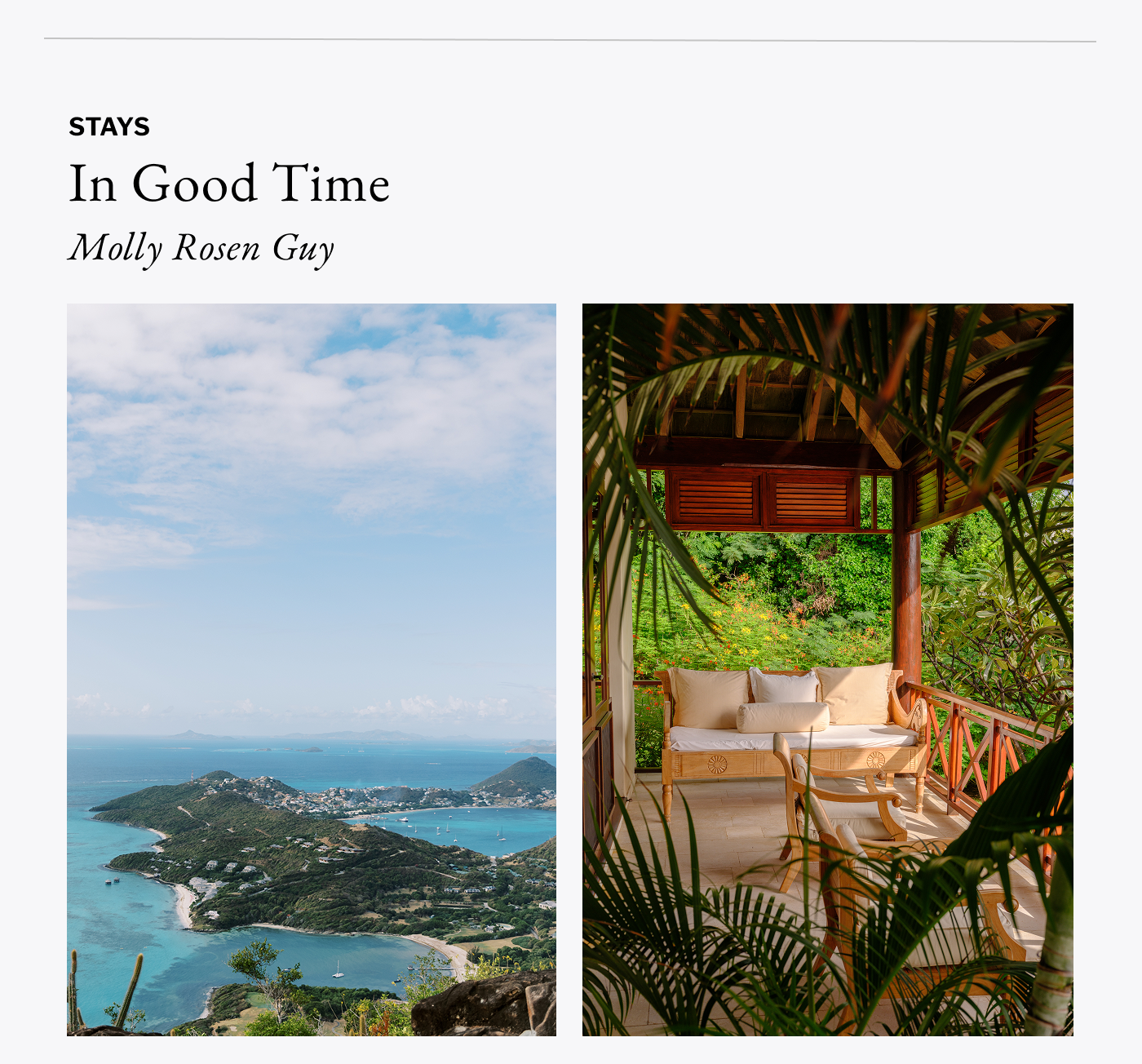
The first thing you notice about Canouan is the turtles. Red-footed tortoises everywhere — ambling through tall grass, inching across hot sand, halting traffic in their deliberate, prehistoric way. They look like tiny relics from another era, yet carry the playful ebullience of a house pet. The people of the island treat them with reverence. Cars slow to a stop, drivers smiling as they wait for a turtle to complete its crossing. When one needs help, it’s lifted gently, always face first, so as not to startle it. At the Mandarin Oriental, Canouan, hatchlings are sheltered in a lush, sustainable garden, fed and tended until they are strong enough to return to the wild. This tenderness extends beyond the tortoises. It defines the ethos of Canouan itself — a jewel of an island barely a mile wide in St. Vincent and the Grenadines, with fewer than 2,000 residents. White-sand beaches shimmer with crushed coral, lagoons unfold into aquamarine shallows, and reefs flicker with parrotfish and rays.
Begin at The Mandarin Oriental, Canouan, a resort so seamlessly woven into the landscape, it feels as though it’s always been there. Twenty-six suites and 21 villas are set across a former sugar plantation, each with soaring ceilings and French doors opening to the sea. Mornings unfold to the sound of waves, followed by a walk to a hillside spa suite, where a therapist kneads warm essential oils into your shoulders as the Caribbean exhales below. Breakfast at Asianne restaurant might be chai-spiced granola with green apple, pepitas, and local honey — eaten while the horizon dissolves into the Atlantic. Later, a golf cart tour carries you through rolling hills, a Tom Fazio-designed course, and the Circularity Lab, where a team works to ensure the resort remains plastic free, recycling and remaking everything from glass bottles to toiletries.
Then the island shifts tone. You move to Soho Beach House Canouan. The property feels clandestine, pared down, like stepping into a private beachfront living room. The atmosphere is quiet and intimate. Low-slung cabanas sit on stilts, while hammocks sway in the breeze. In linen-filled rooms, freshly baked cookies appear on your bedside table. Lunch is a conch salad with an ice-cold Coca-Cola the same shade as a thatched cabana. Afternoons are made for naps, snorkeling alongside turtles in crystalline coves, or floating in the sea with a paperback propped against the sun. Dinner is barefoot and elemental: jerk chicken tacos alongside conch fritters and lobster pulled sizzling from the grill, eaten with your hands as waves lap in the darkness. At night, the bar becomes its own small universe. Smoky ribs, rum cocktails bright with lime, the hum of conversation dissolving into impromptu karaoke. Canouan is like that — quiet until suddenly alive, shimmering and secretive, moving always at its own unhurried rhythm. It’s an island where even the turtles seem to remind you: The true pace of wonder is slow. |
|
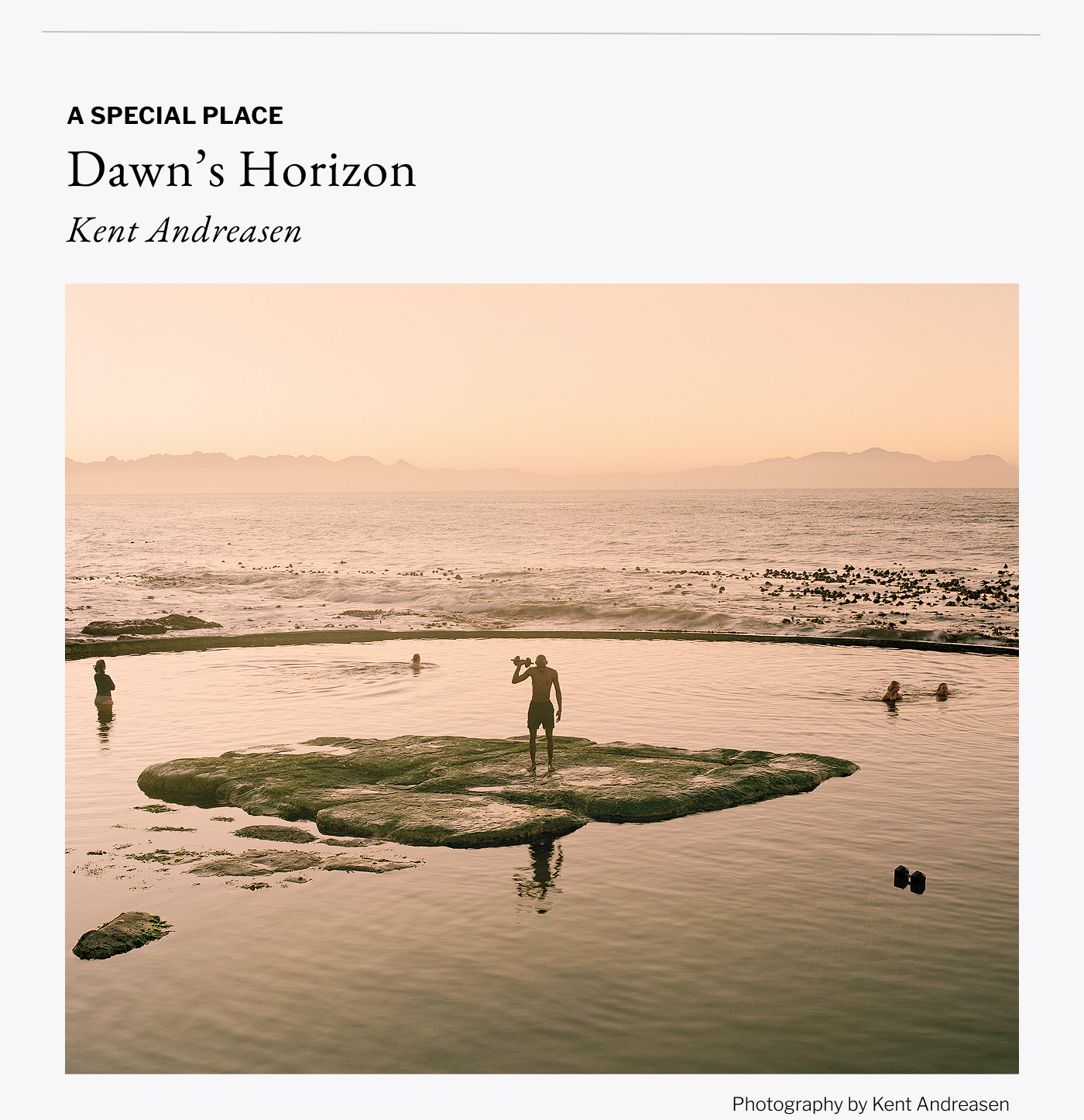
This shot is of Dalebrook Tidal Pool in Kalk Bay at first light, in the Southern Peninsula of Cape Town, South Africa. It’s a well-known spot for early morning swimmers, families, and beachgoers looking for relief from the heat in summer — or for those braving the elements of our cold, rainy winters.
Kalk Bay is home to a wide range of sites, from its small bookshops and galleries to its theater, Olympia Cafe and Deli, and famous harbor, which is further renowned for its fish and chips. It is also special because part of the Table Mountain range rises directly above it, while the ocean sits just below. If you’re a surfer, there are several breaks to choose from, ranging from the beginner-friendly stretch at Muizenberg, one of South Africa’s surf homes, to the more advanced reef break in Kalk Bay. If you’re heading for a quick swim at Dalebrook, stop by Dalebrook Café (formerly Chardonnay Deli), just across the road, for coffee, pastries, and snacks — as well as an assortment of bespoke products, such as my mother’s chilli relish, Chilli Lizzi. It’s a very walkable area, which means you can explore the coastline, climb one of the old cobbled staircases to Boyes Drive for the view, then make your way back down for a good meal.
Discover more of Andreasen’s memories in his aptly titled monograph Memory Bank, a collection of everyday work, staged photography, archive, and self-discovery.
|
|
Worthy Material. One of January’s few attributes is its intersection of glacial, dark days made for movie watching and Academy Awards season, which places exceptional films in cozy theaters. Sentimental Value by Norwegian director Joachim Trier — which is up for Best International Feature and a host of other awards — is among this year’s gifts. A gripping, emotional inhale, it’s a chiaroscuro portrait of family legacy and personal character that examines the entrenchment of darkness and how an (even imperfect) exorcism can lighten its shadow. Searing performances from cinematic stalwarts, including Stellan Skarsgård, Renate Reinsve, and Elle Fanning, also leave their mark. –Erin Dixon
Keeping the Faith. Omakase loosely translates to “I’ll leave it up to you,” and that’s exactly what Sushi Koju invites you to do. Tucked inside the Ace Hotel Brooklyn, this intimate restaurant is the stage of a multicourse menu crafted by executive chef Kevin Garrison, formerly of Sushi Zo Hanare. Garrison’s flavor, knife work, and pacing expertise, paired with his genuine warmth, make for an unforgettable experience — further elevated by exemplary cocktails and a turntable sound system. –Elysha Beckerman
Locked In. Checking a bag leaves me on edge (past luggage mishaps will do that). However, on a recent 16-hour, transpacific journey that worry was lifted thanks to the July CaseSafe, a first-of-its-kind design that features an integrated, trackable TSA lock. Available in both check-in and carry-on sizes, the luggage contains a device that links to both Apple and Google smartphone tracking networks, so you can keep tabs on your belongings, even from 30,000 feet. –Lisa Lok
|
|
54 Franklin St #2R NY, NY 10013. ©2026 Dossier Projects, LLC.
|
|
|
|
|