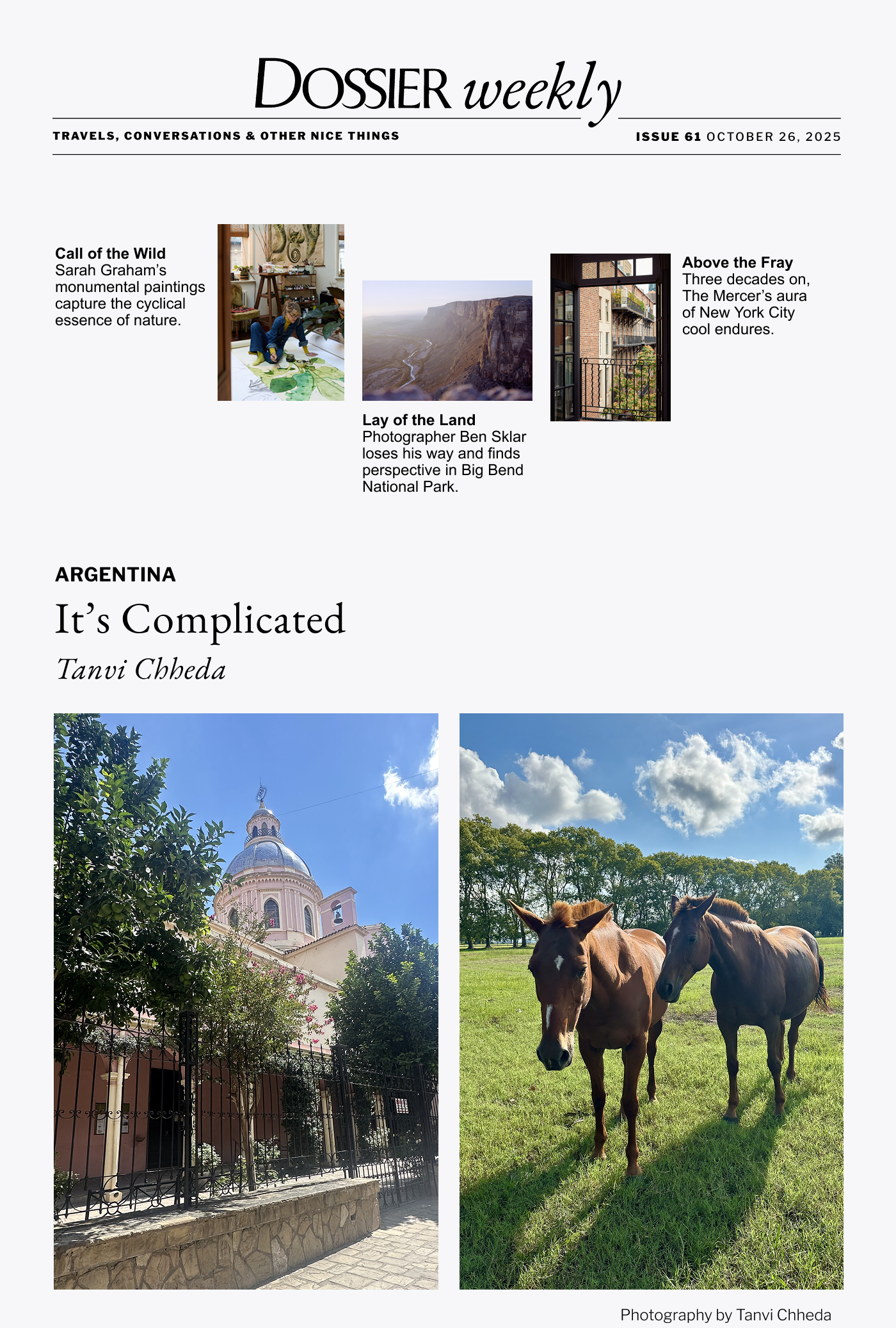
“Es complicado” states my grandfatherly chauffeur halfway through our 90-minute drive from the small countryside town of San Antonio de Areco, Argentina, to Buenos Aires. Despite my less-than-masterful Spanish and his basic English, we’ve managed to sustain a conversation on topics ranging from the economy and family to soccer and patriotism. I nod and smile in reaction to his declaration. “ Es lo mismo en los Estados Unidos,” I commiserate, acknowledging that things are equally messy in the United States. It is, indeed, complicated to feel frustrated with one’s country and yet also celebrate it as home. I’m heading back to Argentina’s capital after spending a few days in The Pampas, fertile grasslands in the country’s center, where nomadic gauchos once roamed, herding cattle and wild horses. My stay at La Bamba de Areco — a colonial-era, crimson-hued estancia (cattle ranch) that has retained much of its original charm — was wonderfully slow, characterized by long walks around the manicured grounds, ample bird watching, and farm-to-table fare. A nearby indoor-outdoor museum, Museo Gauchesco Ricardo Güiraldes, showcases gaucho paraphernalia, including saddles, ponchos, and facón (knives), as well as manuscripts and personal objects belonging to national poet Ricardo Güiraldes, whose words idealized the horsemen’s way of life. I’ve visited Buenos Aires once before, so my time in the city is purposefully short, excluding a sublime 18-course vegetarian tasting menu at award-winning Aramburu. This return trip is dedicated to Argentina’s less-traveled corners, with stays at a few Relais & Châteaux properties along the way. My next stop is Iguazu Falls. Located on the border of Argentina and Brazil, not far from Paraguay, it’s remote but hardly unknown. Literally translating to “big water” in the Indigenous Guaraní language, Iguazu Falls is absolutely spectacular. The force and spray of the cascades at the Devil’s Throat viewing platform drenches me. I’m left chuckling with glee. The panoramic vistas from the Brazilian side — the falls system spans nearly 2 miles — are simply tremendous. The hidden gem of my Iguazú visit, however, is Awasi Iguazú, a sustainability-minded lodge comprising 14 villas built on stilts, each with a private plunge pool. My sprawling, high-ceilinged accommodation is appointed with woven jute chairs, watercolor paintings of endemic birds and flowers, and a stone-clad bathroom with a soaking tub. Even more impressive is Awasi’s culinary program offering Michelin-caliber meals in the midst of the jungle. My pretty pre-dinner cocktail features strawberries encased in a giant ice cube, topped with a fresno chili slice. Turmeric-laced torteletti in a bowl of broccoli leaves broth follows. The finale: a scrumptious, nut-studded vanilla square with pistachio gelato. The weeklong trip concludes in Salta, in the foothills of the Andes, where layered rock formations and salt flats dominate the terrain. It’s an area that has intrigued me since I first sampled crisp, aromatic torrontés wine years ago; the white torrontés grape varietal grows abundantly in the province, particularly in the high-altitude Cafayate area, which is increasingly giving Mendoza, considered the heart of Argentina’s wine country, a run for its money. I’m thrilled to finally make it to this quaint, sleepy city, where shops still close midday. I take my own siestas at the House of Jasmines, a romantic estancia that reminds me of a French farmhouse, complete with a vegetable garden and adorable family of burrowing owls. Its sense of place comes from colorful textiles woven from alpaca fiber, gorgeous black-and-white photographs of local mountain communities, and mushroom-stuffed empanadas — all of which recalls past visits to Peru, particularly to Cusco. This makes sense: The countries along the Andes share strong Indigenous influences. Along with mountains and wine, Salta’s other claim to fame is a fascinating mummy display inside the Museum of High Altitude Archaeology (MAAM) that holds the Llullaillaco Children, three well-preserved mummies of Inca children. Believed to have been part of a sacrificial ritual more than 500 years ago, they were discovered in 1999, preserved in ice near the summit of a volcano.
Traveling through these distinct regions, I begin to comprehend the incredible degree to which Argentina is vast and varied. The porteños, residents of Buenos Aires, stroll about leafy neighborhoods, in museums, and through gardens. In the tropical Misiones province, home to Iguazú National Park, wildlife — hyacinth macaws, jaguars, otters and capybaras — seems to outnumber people. Up in Salta, mountains and history collide. It’s a complicated, layered country, certainly, but the more I discover, the more I’m inspired to explore. |
|
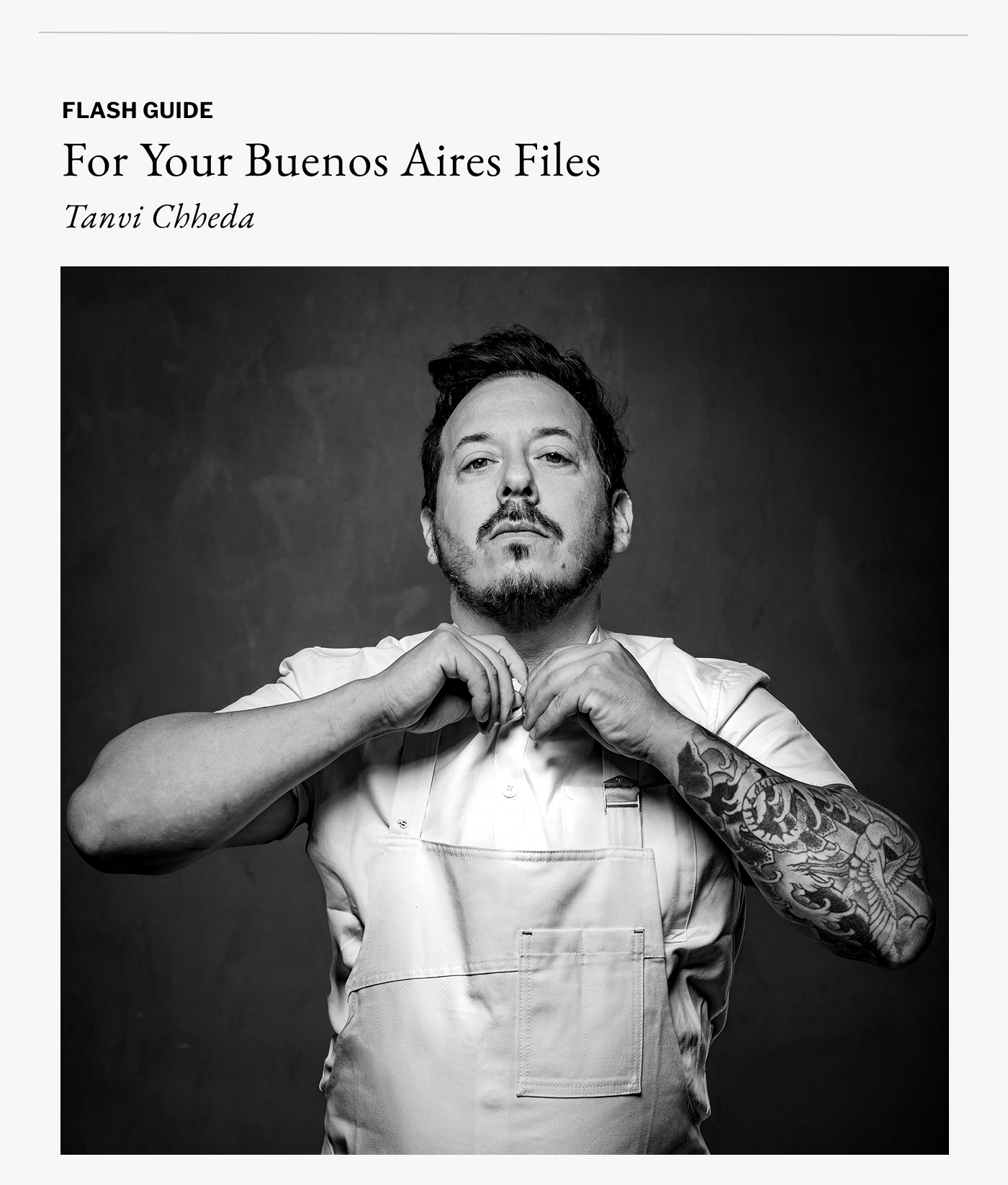
Chef Gonzalo Aramburu’s interest in gastronomy ignited when he was 20 years old. “I started cooking and never stopped,” he says. The Buenos Aires-born chef went on to train at the Argentine Institute of Gastronomy and the Lenôtre School in Paris before working with the likes of Daniel Boulud, Charlie Trotter, Joël Robuchon, and Martín Berasategui. In 2007, Armaburu returned to Buenos Aires to open his namesake Aramburu restaurant, which serves what the chef describes as “haute cuisine, mainly due to the tasting menu format of 18 courses, through which we showcase seasonality and the best products from across our territory, using technique and creativity.” In 2023, Aramburu became the first Argentine restaurant to be awarded two Michelin stars, making Aramburu, himself, the country’s first Michelin-starred chef. Here, he shares a few favorite spots in his hometown.
Something to eat and drink … A rib eye and a red wine from Roux, owned by Martin Rebaudino, a very good friend of mine. It’s such a welcoming spot with a fantastic, extensive red wine list, with many of the bottles from Argentina.
Something to see … El Obelisco, in the heart of Buenos Aires, is an imposing monument to the city and country. I love seeing it after having been away — it brings back memories from my childhood.
Something to take home ... a Baron B Sparkling Wine from Chandon, which began in Mendoza, Argentina, in 1959 — well before opening wine production in Napa, California; Brazil; Australia; and more.
Only in Buenos Aires … a night at the Teatro Colón. The architectural details, the feeling of grandness … I’m inspired every time I go.
A secret place … The Shelter Coffee, where I like to begin my day with a good coffee. I go to the one in Recoleta, near my home. They roast their own beans and have great pastries too. |
|
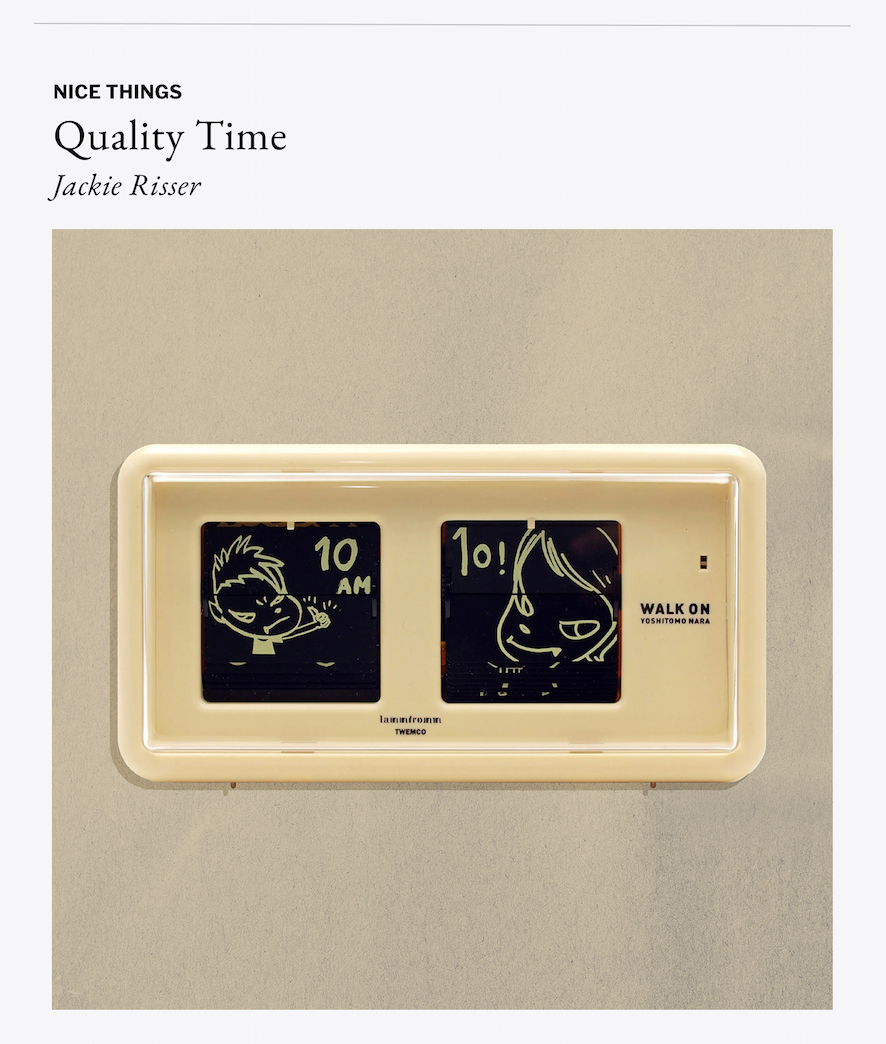
I’m prone to counting hours, minutes, seconds … out of excitement, perhaps, or thanks to nerves, which partially explains my love of the Yoshitomo Nara Walk On Flip Clock. The other reason is the clock's cheeky design showcasing 84 original illustrations by its namesake artist. Nara is among Japan’s most celebrated contemporary artists. And his work — inspired by children’s books, manga, cartoons, and more — explores the tension of innocence and angst, often featuring a disgruntled little girl who is undeniably cute as she wields knives, fangs, or flaming torches. From Nara’s signature heroine to scowling raindrops, a sassy little dog, and a satisfying f-bomb when the clock strikes zero, the artist’s images are a welcome distraction, providing genuine utility in the process. |
|
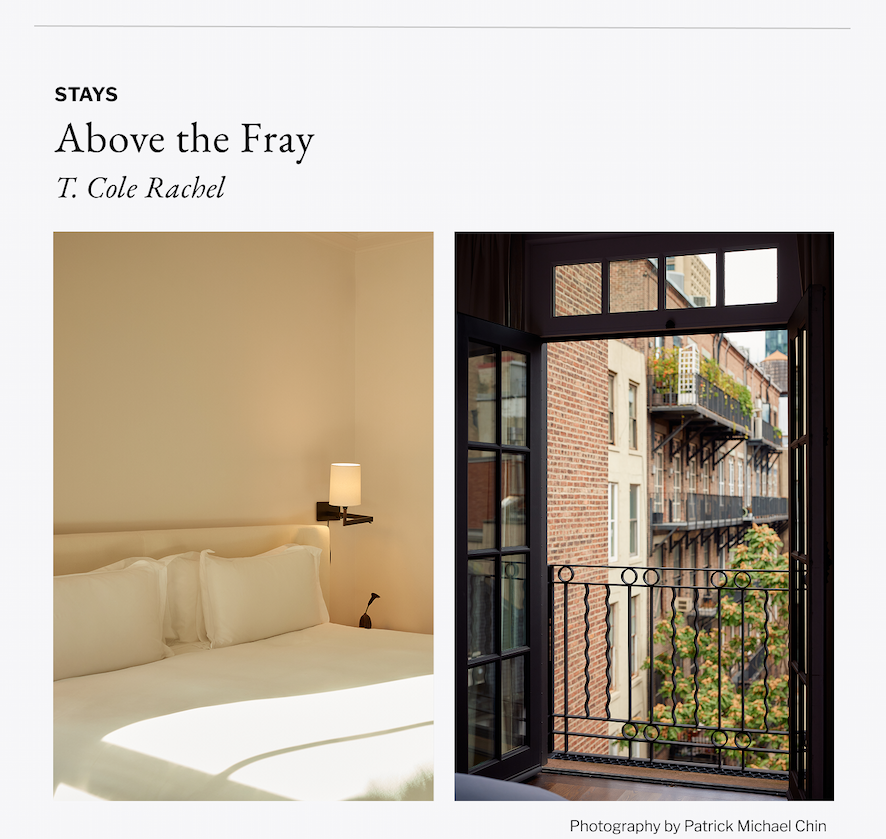
As a person who spent a lot of time in downtown Manhattan in the early 2000s, I can confirm that few places radiated an aura of cool quite like The Mercer. Designed by the late French interior designer and architect Christian Liaigre, the hotel was the ultimate see-and-be-seen place to have drinks, hang out, and — if you were a young actor, famous model, or a member of The Strokes — spend a few nights. On the other hand, I was a struggling journalist in the early aughts. So, I would often purposely walk past the hotel on the way to my lowly office job, on the off chance that I might spot someone famous exiting the premises. (I was rewarded only once: I saw Leonardo DiCaprio outside on his phone.) When I eventually booked my first big celebrity interview, the subject chose to meet me in The Mercer's quiet, underground bar. Karl Lagerfeld also often called this hotel home when spending time in the city. Now, some 30 years after it first opened, the property has been given a subtle refresh (upgraded technology, new finishes, enhanced amenities) without tampering with the basic ingredients that have made it a SoHo neighborhood staple. Yet, I’d never actually spent the night there or even stepped inside its guest rooms, despite having spent ample time loitering in its lobby and eating at its former restaurant, Mercer Kitchen. A few weeks ago, I righted that reality. As it turns out, the hotel’s guest rooms are large and airy, with dark wood floors, Liagre-designed furniture, and exquisitely outfitted bathrooms featuring Danby marble from Vermont and top-shelf amenities that seemed as if they had been chosen just for me: natural-bristle toothbrushes from C.O. Bigelow and votive candles from Trudon. My Corner Loft also included a variety of lush houseplants, fresh flowers, and a view that not only framed the Manhattan skyline but also provided a direct sightline into the Prada store across the street. It quickly became apparent why so many out-of-towners consider this hotel their go-to. It was like staying in an incredible apartment — the ideal of what a New York City abode might look like if you were a movie character played by Julianne Moore. That is to say: The decor is warm, exceptionally tasteful, and still effortlessly cool. Though I was tempted to spend the entire weekend locked in my suite, ordering room service and languishing in the giant soaking tub, I smartly made a dinner reservation at Sartiano’s. The hotel’s signature restaurant features a breezy ground-floor cafe and a basement-level fine dining space that feels like a very upscale wine cellar, with exposed brick, leather seating, and understated lighting. Tucked away downstairs, in a corner banquette, my friend and I overindulged in freshly baked focaccia, impeccable plates of lobster buccatini, and fusilli with wagyu beef ragu — all chased with incredible wine. It was a meal on par with the accommodations, one so good, in fact, I was grateful that my huge, luxurious bed was only a short elevator ride away. Back in the loft, I closed the linen shades, nibbled on the cookies left for me during turndown service, and proceeded to have one of the best nights of sleep I’ve had in years, lulled by the calming, ever-present buzz of the city just outside my window. |
|
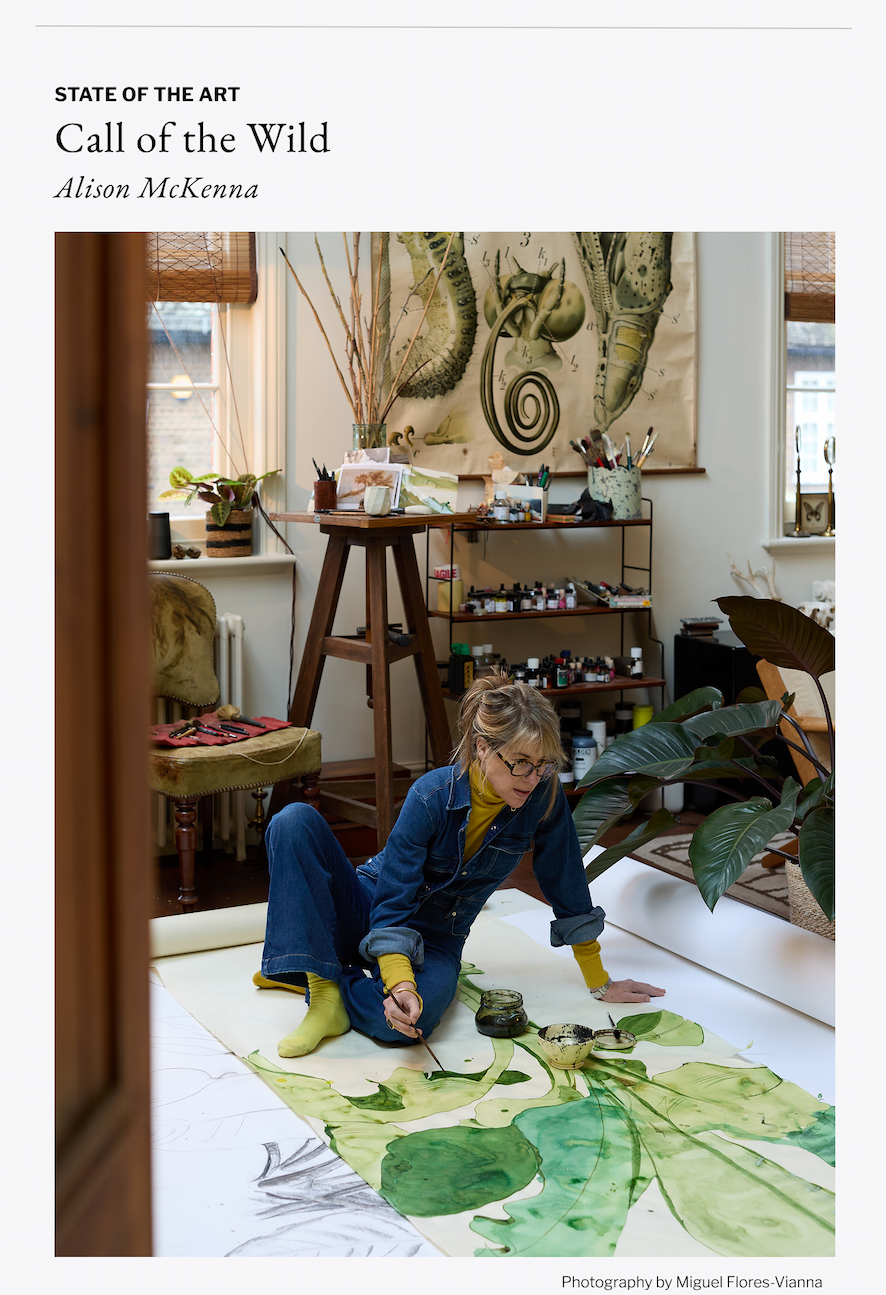
At the Lyndsey Ingram gallery in Central London, monumental botanical paintings hovering between figuration and abstraction fill two rooms. Humid, tropical, and vast, they evoke the skies and plains of Africa. Petals and leaves swell into luminous, sculptural forms as washes of plant-based inks stain and bleed across the canvas, creating a tension between beauty and unease, order and entropy, vitality and decay. Pigments run, edges dissolve in osmosis, and parts of the canvas remain raw and unworked, where delicate traces of pencil and charcoal linger on the surface. Musa acuminata, 2025, an artwork featuring a banana blossom, unfolds and overlaps, resembling a botanical study that’s abstracted enough to suggest the soft wind and gentle light of the untamed Kenyan landscape, where the London-based artist Sarah Graham created the paintings for the exhibition Genius Loci. Within its layered petals, glimpses of tangerine heat, saffron wind, sunbaked ochre earth, and golden sunlight debut alongside a luxurious deep blue-black, the hue of the sky after twilight. These plants are not passive subjects but living carriers of time and metamorphosis. The African light seems to have expanded Graham’s palette, introducing a new intensity of color, while the artist’s choice of ancient materials (charcoal, squid ink, and oak-gall ink, which has been used for writing since the Middle Ages) infuses the works with timelessness and primal energy. They are meditations on the passage of time and survival, creating a sensation of being fully immersed in a foreign land. To make the paintings, Graham left London for a three-month residency in Kenya, working near Lake Naivasha and the Samburu National Reserve in a makeshift studio exposed to the elements, with minimal resources. “I found the endless plains, the invigorating light, and the wildlife all around me completely intoxicating,” she recalls. “I had very little with me, and it was cathartic to empty both my mind and my environment of all the things I usually carry around at home.” Sharing motifs of interconnectedness and a fascination with organic forms, the banana blossom — possessing both male and female structures — deepens its symbolism of lushness, sensuality, and duality. Through it, Graham captures the cyclical essence of nature itself.
Genius Loci is on view at Lyndsey Ingram in London through November 14, 2025. |
|
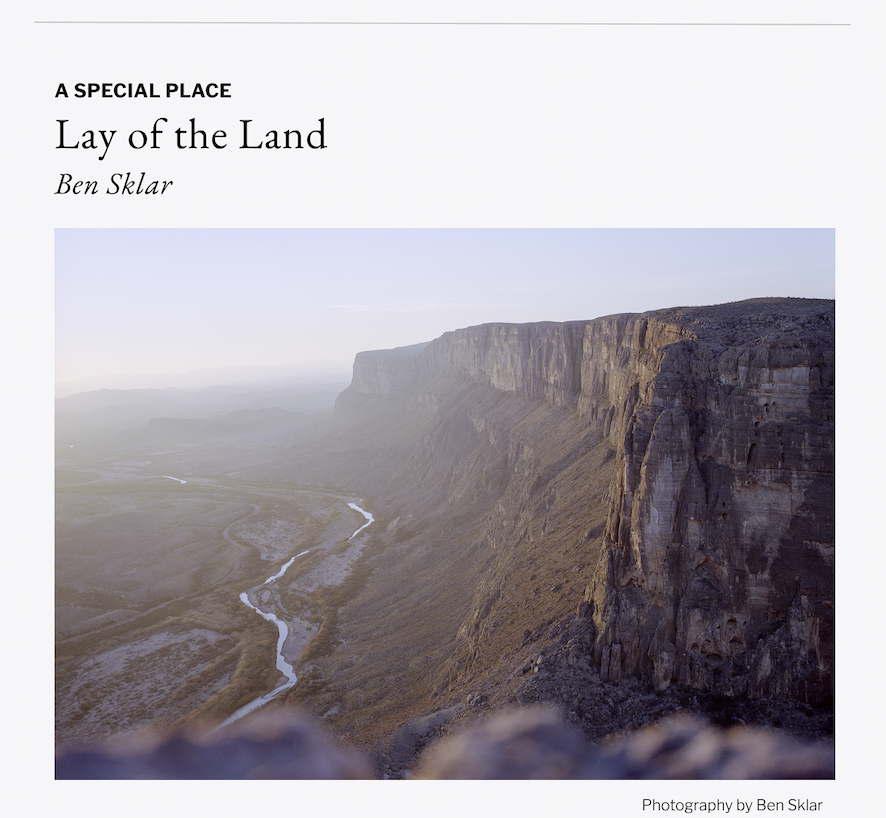
I went walking with my friend Joey. It was winter in Big Bend National Park, Texas, and — thanks to government shutdowns and border patrol issues — we had long awaited our chance to hike across a 14-mile mesa on the far western edge of the park. The trail is only accessible from the border town of Lajitas. There is no water, shade, or services of any kind. Temperatures swing from freezing at night to 80°F under peak sun. And after 7 miles, the route disappears into the Mesa de Anguila, which may be why park officials discourage visitors. Both Joey and I had grown up visiting Big Bend country on scouting trips and family adventures, so this was a special hike and type-B fun for us to share. We walked for one evening and the better part of two days, each carrying 10 liters of water (weighing 22 pounds) in our hiking packs, across 28 miles of terrain: rolling hills of high-desert plants glued to the rough landscape of rock slides, river-carved mesas, and remains of the prehistoric seafloor. We lost our way and found ourselves at the river, keeping it to our right as we wound to a point above the canyon. It was a big reward: a stunning panorama of Santa Elena Canyon. The endless views south to Mexico and north to the United States offered perspective on our humble place in a world of such dramatic natural splendor. |
|
Reality Check. Tucked into the heart of Silicon Valley, Nobu Hotel Palo Alto seems to teletransport you to Japan. Wrapped in the sleek, minimalist style of a modern ryokan (traditional Japanese inn), you nearly forget you’re surrounded by the tech industry's biggest players. Plus, Nobu Restaurant Palo Alto marks the brand’s first foray into the Bay Area dining scene. Once a local floral shop, the space is now a little sanctuary, complete with serene landscaping. –Elissa Polls
Siren Song. If I'm being honest, I wasn't entirely sure what was happening in Oratorio for Living Things at New York City's Signature Theatre. But a third of it is in Latin, and the play’s nonlinearity is also why I loved it. Written by MacArthur Fellow Heather Christian, the stunning piece, first performed in 2022, blends classical, jazz, blues, soul, and gospel to reflect on time, existence, and humanity’s place within both. Twelve exceptional singers weave through the intimate theater-in-the-round, often making direct eye contact to draw you into their otherworldly harmonies. It was a spiritual experience, one that left me humbled and curious — and a reminder of the power of being in concert with one another. Catch it through November 16.
–Jackie Risser
Soft Shoes. While exploring New York’s Catskill Mountains, I stopped by Gardenheir, an upscale gardening store in Windham. In addition to apparel and tools for those with a green thumb, the boutique also offers an enticing array of fragrances, skincare, pantry items, Japanese denim, and more. Though I live in the city and don't often find myself digging into the dirt, I was drawn to the shop’s Easy Garden Clogs, which I picked up in the “oxblood” hue. They possess the comfort of Crocs, with a sleeker look worthy of being seen beyond the soil. –Alessandra Berge |
|
54 Franklin St #2R NY, NY 10013. ©2025 Dossier Projects, LLC.
|
|
|
|
|