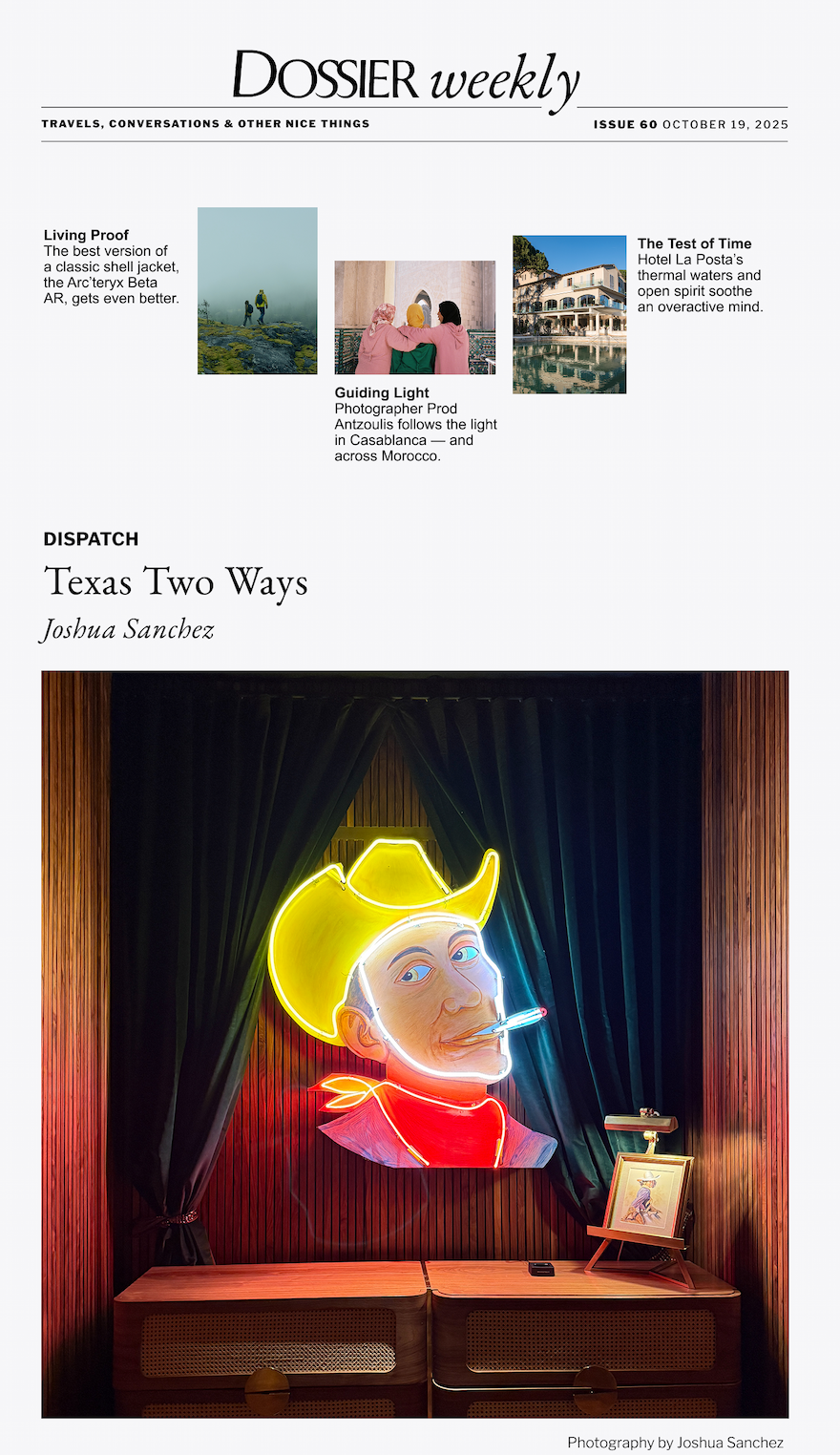
I return to my hometown of Houston, Texas, every year to visit my family, whom I love. But spending several days in a row with them tends to leave me emotional and stressed. So, this year I decided to break up my relative time with a little hotel time in the state’s major cities, reconnecting me with the region’s unique charms, remarkable diversity — and my patience. I started with a solo stay and spa treatment at The Post Oak Hotel. Located in Houston’s busy Uptown district, a short walk from The Galleria (the city’s landmark shopping destination), the sleek hotel offers panoramic views and world-class dining. I opted for a superb tapas dinner at Stella’s Wine Bar, then picked up a rainbow-hued plateful of macarons — vanilla bean, salted caramel, lemon — from Bouchée Patisserie to take back to my room. The Spa at The Post Oak’s offerings are likewise first-rate, comprising a globally inspired menu of treatments, which range from holistic rituals to a signature biohacking facial that combines innovative skincare technologies, such as radio frequency and microcurrent, with rejuvenating modalities, such as oxygen infusions and aqua peels. I stuck to unwinding in the spa’s extensive facilities — a whirlpool, steam rooms, and a sauna — before experiencing a Purely Relaxing massage, the ideal precursor to a three-hour road trip to Dallas, where I checked into Hôtel Swexan. Tucked away in the city's swanky Harwood neighborhood, the luxury boutique hotel was conceived to reflect its owner’s Swiss Texan family heritage — an uncommon pairing that manifests in a remarkably European-feeling property that’s design forward, with hits of Texan flare: There’s a swanky bar and a rooftop pool, as well as tastefully deployed cowhide rugs. Upon arriving, I enjoyed a drink at Isabelle’s, the hotel’s natty, library-themed cocktail lounge, and warmed myself by the fireplace before heading to my room. Here, floor-to-ceiling windows displayed spectacular views of downtown visible from a Texas-sized bed (among the most comfortable I’ve ever slept in) and from a clawfoot bathtub. The Texas landscape looked very different than it did in my youth when seen from that serene vantage point. Meanwhile, the juicy steak, creamed corn, and jumbo onion rings I had at Stillwell Steakhouse checked all the requisite Texan boxes, alongside the welcome addition of cocktails served with an urban cowboy twist: the Smokin’ Fashion, for example, replaces a classic Old Fashioned’s whiskey and rye with tequila and mezcal, and its expected aromatic bitters is swapped for orange and grapefruit bitters. Thanks to the hotel’s proximity to downtown, I was also able to visit the Dallas Museum of Art’s incredible contemporary art collection, which is currently hosting Yayoi Kusama’s sprawling All the Eternal Love I Have for the Pumpkins, as well as explore the eclectic shops and cafes of the historic Deep Ellum district, where you can pop into Flea Style’s “hat bar” to design a custom cowboy hat or pick up some vinyl at Off The Record, a record shop that doubles as a bar. Still, my favorite excursion of the trip was to Fort Worth’s breathtaking Kimbell Art Museum, architect Louis Khan’s masterpiece. That’s the thing about Texas (or family), just when you think you have it figured out, it often surprises you — sometimes for worse, more often for better. |
|
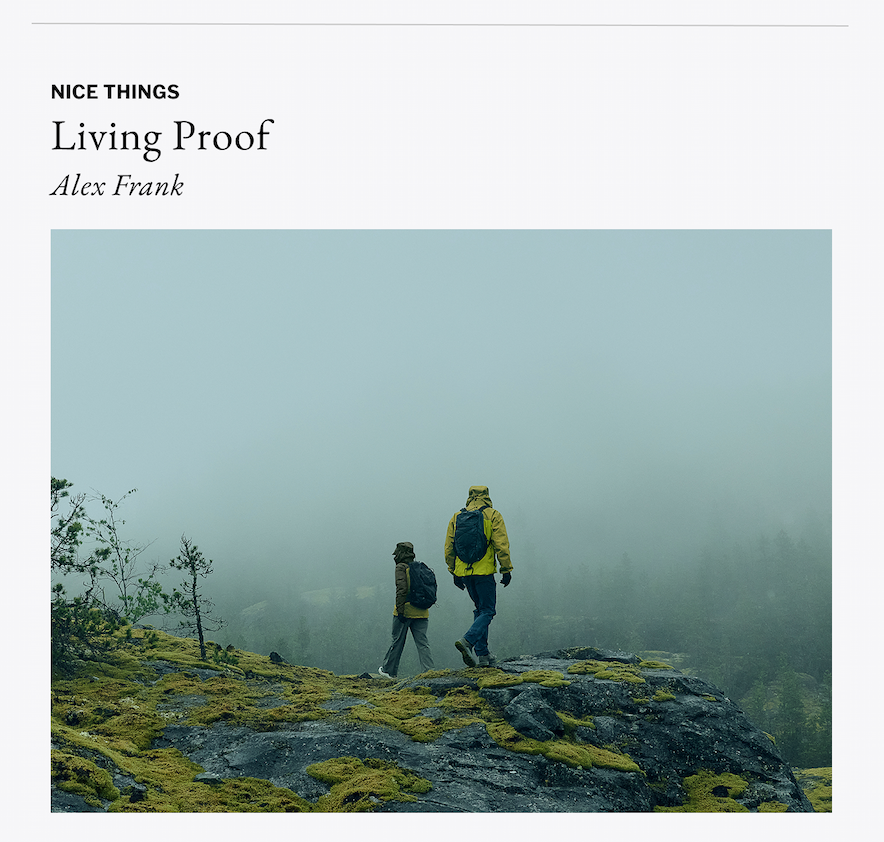
The Arc’teryx Beta AR is the best version of a classic shell jacket. It’s an ingenious piece of breathable, waterproof clothing that keeps you dry when it’s rainy, warm when it’s windy, and just ventilated enough when your plane’s stalled on the tarmac and the cabin gets stuffy. The jacket is also foldable and stuffable; it can be origami-ed around your waist when the sun’s beating down and shoved into a backpack (or carry-on) when you’re on the move. Once untangled, it quickly reclaims its shape without wrinkling or puckering. And now, Arc’teryx — the outdoor adventure company known for its quality and innovation— has made the Beta AR’s DNA even stronger by crafting the garment from GORE-TEX PRO ePE, which is lighter and more durable than its predecessor. Pop the jacket’s hood up over your head on misty mornings, layer the Beta AR over a hoodie in the mountains, or pair it breezily with shorts on a citywide trek; it is the definition of adaptable apparel. Believe me: This jacket should accompany you on every fall or winter trip, even (or especially) when limited luggage space demands tough packing decisions. |
|
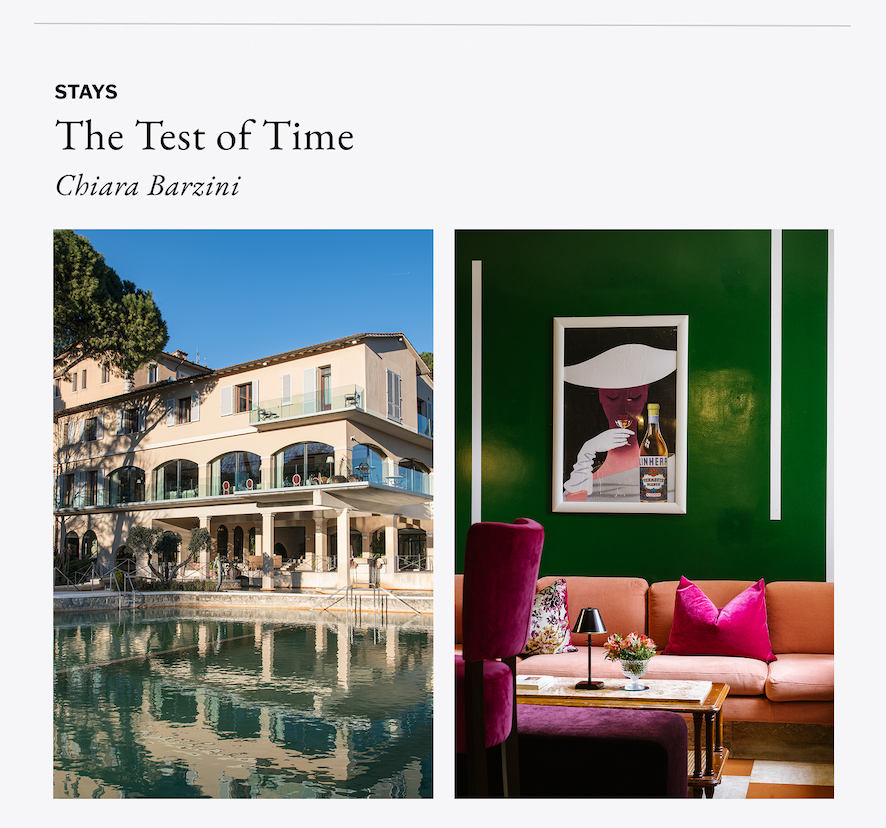
There are thermal waters that heal you, and there are waters that know you. In Bagno Vignoni, a tiny hamlet perched above the soft folds of the Val d’Orcia in Tuscany, Italy, the thermal springs seem to do both. Rich with sulphates, magnesium, and mystery, these volcanic waters have lured everyone from Roman nobles to Soviet filmmakers to saints seeking penance. I’d been to them before, once or twice, but I had never quite managed to let go. I stayed tense in the shoulders, checking my email between soaks, convinced there was something I should be doing. This time, I arrived mid-afternoon, tired, overstimulated by a previous work trip, and vaguely annoyed with my terribly packed suitcase. I had just finished a city-heavy travel stretch and was staring down the start of a book tour. The time had come for me to feel less like a deadline and more like a person again. The air in Bagno Vignoni was an optimistic beginning. It felt different: slower, scented with minerals and rosemary. The centerpiece of this slow world is the Piazza delle Sorgenti, a vast 16th-century travertine basin holding thermal water that rises from deep within the Earth. In Nostalghia (1983), Andrei Tarkovsky used the square as a stage for a ritual of spiritual longing. His character crosses the vaporous waters with a lit candle, one of the moodiest and most memorable scenes I remember encountering as a child. Ever since I saw the film, I’ve felt haunted by this place. I’d always hoped to bathe in that same pool, but now it’s off-limits. The pool at Hotel La Posta is a perfect substitute, though, with the same melancholic and suspended air. Its water, a steady 120°F, doesn’t just warm your body; it also dissolves it. Your sense of gravity changes and thoughts blur at the edges. I once came out of a soak convinced I’d missed dinner, only to find it was 4:10 p.m. and I’d only been in the pool for 25 minutes. I began referring to this feeling as being cotta, a Roman phrase that expresses the feeling of being “lightly boiled” and can be associated with a sun-soaked day, or one spent immersed in hot waters. It’s rare to find such a laid-back, intimate air in large hotels, such as La Posta. Yet, I felt immediately linked to everyone there. The hotel occupies what was once the first postal station in the Val d’Orcia. In the 1800s, messengers arrived with letters and news. Horses were fed and the travelers stayed the night. So, hospitality in the village has always been about rest and recovery. Cecilia Via, my Virgil for the stay, walked me through the hotel’s layered history. We flipped through old family photos and wandered through rooms, each with a different mood, none over-designed. The Marcucci family ran La Posta for over 150 years, preserving its charm until (recently) passing it to the Costa family (of Hotel La Perla, in the Dolomites). Wisely, the Costas didn’t try to reinvent the hotel; they just let it breathe a little more deeply. There are armchairs, quiet reading corners, a turntable spinning Mina and Luigi Tenco on crackly vinyl in Bar Verde, the hotel’s glorious emerald hideout. Its irresistible decor was another good reason to lose track of time. Tucked inside the hotel, the bar became my late-afternoon haven. It doesn’t overlook the pool or the garden, and that’s the point. It’s a space for grown-up solitude, including precisely executed cocktails and the friendliest servers. I’d sit with a Negroni or a pale-pink concoction involving bergamot and thyme, listening to records and feeling happily, completely unproductive. My favorite morning ritual was to enjoy a coffee while reading the hotel’s daily pamphlet narrating stories of local figures who shaped the valley. I loved discovering the tale of Emily Thompson, a nurse from America who, in the summer of 1944, turned an abandoned villa into a haven for refugees: Italians, Jews, foreigners. She cooked, she treated wounds, she hung an American flag from the window that read, simply: “Here, those in need can find help.” That spirit still lingers in the hills. The hotel also carries a few endearing quirks: Ernesto Costa’s collection of clocks — some working, some permanently frozen at 5 p.m., supposedly the time the Constitution of Italy was signed — decorates the halls and seems like a pun about time itself. Costa also owns a small motorcycle collection, because why not. The food is all local (even the foie gras) and the menu, shaped by chef Nicola Laera, is graced with a wide range of flavors — not just the meat-and-beans cuisine from Tuscany, which is great but can tend towards heavy. The spa waters at La Posta are untreated by chlorine and are called “liquid gold” for a reason. Their minerals soothe arthritis and sore joints, but I’m convinced they also do something metaphysical. I began having very kind dreams (not to mention sleeping, a rare luxury). My skin stopped complaining. The itchy need to “do something useful” dulled to a pleasant buzz. Somewhere between one soak and another, I realized I was ready. Not in a checklist way, but in the sense that my mind had unfurled just enough. The waters had done something to my physical person as well as to the more abstract machinery of my mind. I was no longer trying to squeeze words out. Like Tarkovsky’s character crossing the pool, I felt I’d carried something fragile, a little flame, across a stretch of time and arrived, warm and intact, on the other side. |
|
Explore The Dossier — a collection of thoughts, ideas, recommendations, and discoveries from all over the globe — and more close takes on a wide world in our print issues. Order now. |
|
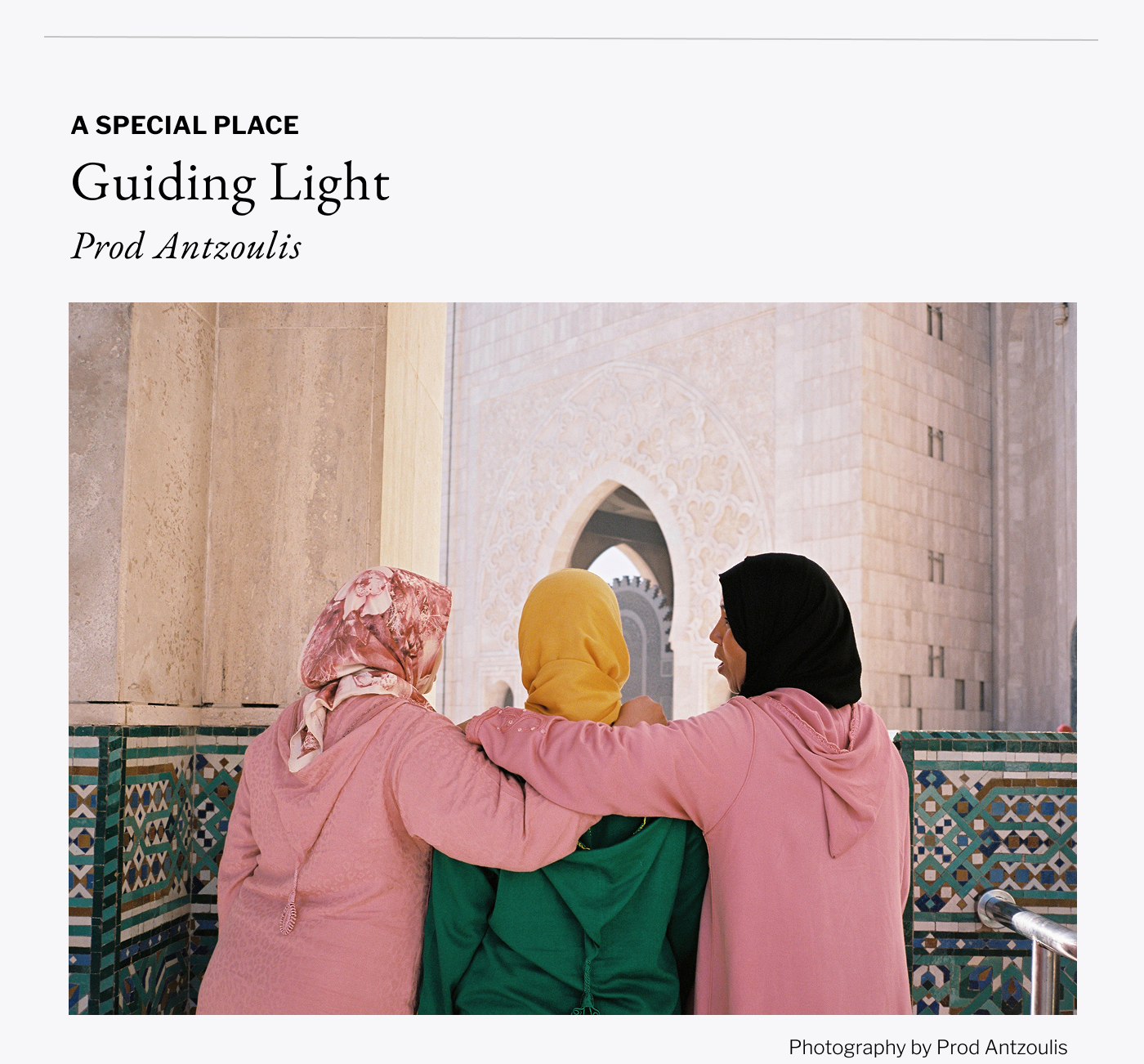
The November sun warmed Casablanca as though it were summertime. My first stop in the city was at this mosque, still and majestic in its symmetry. The scene was muted, almost monochrome, until these three women appeared — their warm hues contrasting the cool marble. The quiet moment marked the beginning of a journey: two weeks across Morocco, led by color, light, and unexpected softness.
In Casablanca, I was also captivated by the city’s blend of vibrancy and serenity, including the tranquil waters of the Hassan II Mosque. From there, I traveled to Marrakech, Fes, and, finally, Chefchaouen, the legendary Blue City. Residents there live at their own pace, slow and timeless, which made me feel deeply grounded amid the winding streets, vivid colors, and softened lumière.
You can soon find more of Antzoulis’ work and discoveries on Beit Prod, a curated platform and shop featuring limited-edition prints, design objects, and collaborations — all rooted in memory and contemporary nostalgia from across the Middle East and beyond. |
|
Plugged In. I should have known by the line of 20-somethings stretching down the Sunset Strip that something was up. The hotel formerly known as The Pendry in West Hollywood has reinvented itself as The Sun Rose Hotel, taking its name from the intimate music venue housed inside (live music is a cornerstone of the rebranded property’s new, indie spirit). To celebrate, Aussie rock band 5 Seconds of Summer played a secret show for a few hundred frenzied, phone-wielding superfans. As I bobbed along with the throng, I took heart that rock will continue to resonate from the storied Strip. –John Chuldenko
Sweater Weather. Falconeri is known for its sublime textiles, impeccable tailoring, and some of the world’s softest Mongolian cashmere, making it a great source for enduring wardrobe staples and my absolute favorite garments: sweaters. I recently treated myself to the Italian brand’s Ultrasoft Cashmere Crewneck Sweater in fern green. Cozy but light enough to layer, it’s ideal for this fleeting seasonal moment before the winter chill sets in. –T. Cole Rachel
Close Up. When it comes to New York City theater, it's hard to beat the thrill of Playwrights Horizons, a "writer's theater" that has produced new works from Michael R. Jackson, Jordan Tannahill, David Adjmi, and so many more in the last five years alone. The destination, a couple blocks off Broadway, also invites you to witness tour-de-force performances in its intimate spaces. The other night, Jen Tullock (of Severance fame) embodied seven or so characters in varying accents for her solo play Nothing Can Take You From the Hand of God, co-written by Frank Winters. The play’s 70 fast-paced minutes, inspired by Tullock’s own evangelical upbringing, were undeniably moving, but her presentation was the true gift. Performances take place through November 9. –Jackie Risser |
|
54 Franklin St #2R NY, NY 10013. ©2025 Dossier Projects, LLC.
|
|
|
|
|