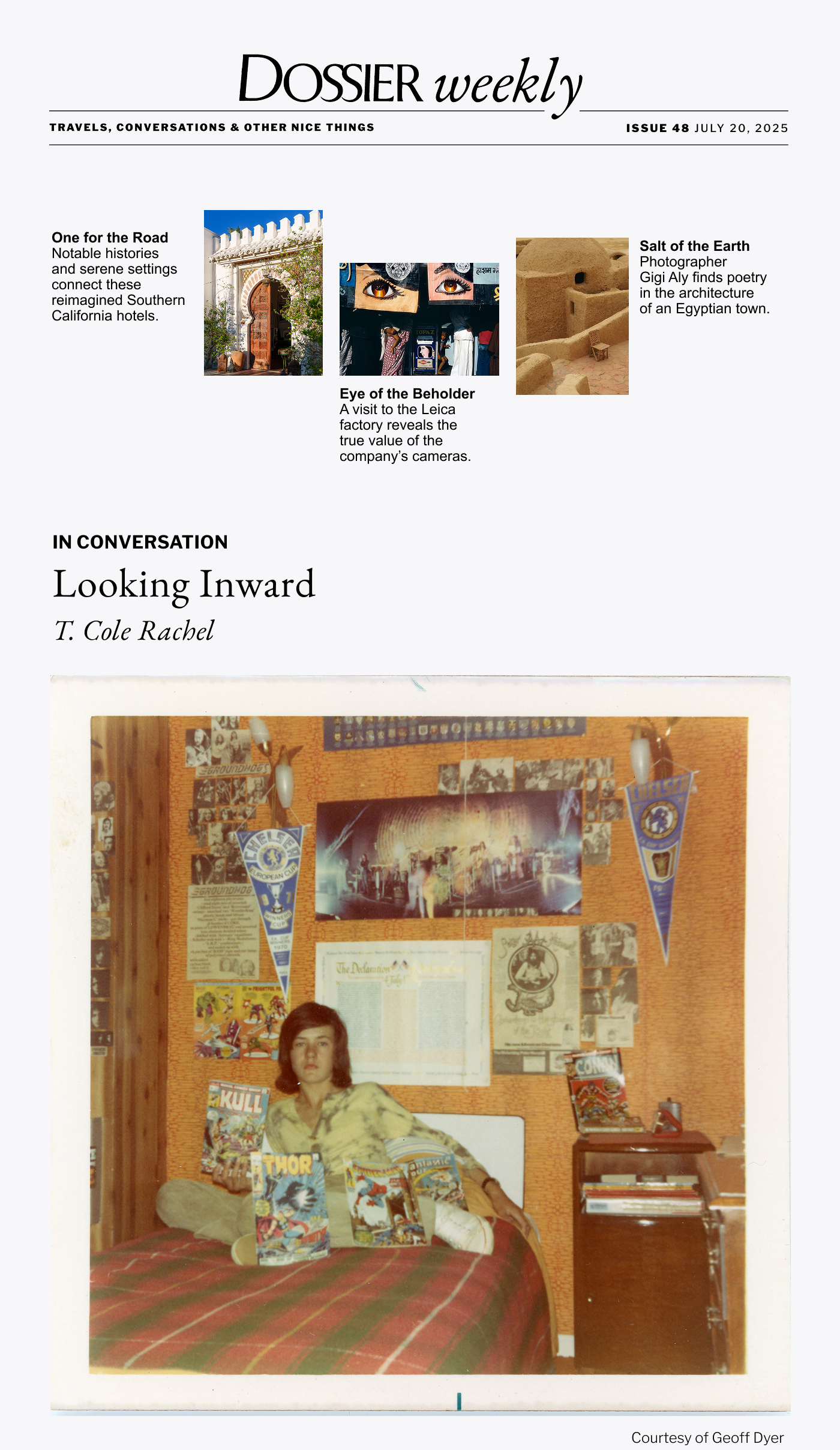
Given the breadth and scope of Geoff Dyer’s work, one imagines speaking with the English writer could be an intimidating proposition. Known for his circuitous style of autofiction and cultural examination, in which he often figures prominently (albeit in a slippery way), Dyer has published nearly two dozen books, both fiction and nonfiction, and written masterfully on subjects ranging from tennis and the First World War to jazz, D.H. Lawrence, and photography. A collection of his essays, Otherwise Known as the Human Condition, won the National Book Critic Circle Award for criticism in 2011. In his recently released memoir, Homework, the writer unpacks his childhood in post-war Britain as “the only child of a dinner lady and a sheet-metal worker.” The book is not only an astounding account of what it means to grow up into a life of books and letters but also a fascinating portrait of English history. Even when recounting the details of his own life, Dyer expresses a balance of wide-eyed curiosity and eloquent precision that is both fascinating and delightful.
T. Cole Rachel: Obviously there's a lot of you, or of your consciousness, present in all of your writing. Still, it can be a very different thing when the task is to write explicitly and directly about your own life. How did you find that process — did anything about it surprise you when you started thinking about these things in an almost forensic way?
Geoff Dyer: Any kind of writing is going to be forensic if it's any good because, as everybody knows, it's all about the details and the precision of observation. In order to render those observations adequately, you've got to be precise in the language. I think that also perhaps illustrates the paradox at the heart of an undertaking like [Homework] because, of course, it's about me. If you were reading a biography or a memoir by, say, Bruce Springsteen or Madonna, it might be interesting because you are interested in them. But my life? Who I am is of no real interest to anybody except me. So it is very important that this very detailed rendering of my own life also be interesting, in that it illustrates a larger question about much larger issues. But at the same time, those larger issues are much better expressed if they're not stated in some sort of manifesto way. So, obviously, what this book is overwhelmingly about is class in Britain. My story may not be of any particular interest to most people reading it, but that larger picture is worth documenting.
TCR: I spoke to the late, great Edmund White about his last memoir and how he managed to have such a detailed memory about things. He was like, "Well, I just remember it the way I remember it and some of it might not be right, but who cares?" How did you do it? You paint such a vivid picture of your childhood home; how did you go about reconstructing it in your mind?
GD: I think that early part of one's life is easier to recall than anything else. I don't know much about dementia, but I wouldn't be at all surprised to learn that, as the self is hollowed out, those might be the last bits to remain intact: the memory of early childhood. I was helped by the fact that, when I was young and first got into writing, I had nothing to write about except for my home life, and I'd kept all those pages written in my teens and early twenties. Even though the writing was no good, there was a real abundance of detail to pull from. The other thing is, as you start writing and you keep at it, everything which has seemed a bit unfocused and vague and misty acquires a greater clarity.
TCR: Homework provides such a humanizing and wonderful depiction of your parents.
GD: I'm glad you think that. I guess it's also important that one doesn't go the other way. You don't want to really go down the memory lane route where everything becomes idealized. It's important that it's not sentimentalized, isn't it? My parents are dead, but if they were readers, I think this book would explain to them a lot of things that ended up not being adequately sayable in real life.
TCR: Did you always have a sense that this book was looming in the wings?
GD: I think so. Partly because of the way England has changed, I really felt this era of British life was worth preserving. Then when I got married, my wife was always saying, “You should write this book.” The truth is, and I say this not with a sense of self-satisfaction: If I drop dead tomorrow, I really would have felt an awful sense of inadequacy and incompletion if I hadn't written it. For a surprisingly long while, I was resistant to writing it. I feel a great sense of — and I hate it when people talk about feeling proud of something they've done — but I feel a great sense of relief that I've done it.
TCR: I expect that people might have polarizing reactions when you write about things that touch so specifically on class. Has that been the case?
GD: I've got a few friends who grew up during the same era in Britain. One of them was, as he was reading it, saying, “Oh my God, that’s exactly what it was like.” He's pretty much the same age as me. So there's that kind of recognition. Beyond that, nobody's dissented from it yet. Some things are hard to write about honestly: recalling my state of mind as a randy 14-year-old — sadly my attitude towards girls wasn't as enlightened as it is now at the age of 67 — and things like writing about my dad and his, I would call it, mild racism. There's all that kind of stuff, which I could imagine people could find irksome. But I think it's a pretty crucial thing to accurately reflect, portray, and document what was going on at the time, even when it’s not easy to do so.
TCR: Can you recall the first trip you ever went on that profoundly shifted your view of the world?
GD: I recall a trip I made in the time between leaving school and going to Oxford, when we drove around Europe in a car. That was a huge adventure, even though, in truth, we didn't see very much — and, then, the very first time I flew on a plane. I was teaching at this place called Lucie Clayton College, which also doubled as a modeling school, a very posh place. Anyway, after that finished, I ended up dating someone I met there, and her mum was developing tourism on this idyllic, totally undeveloped island called Anguilla. That was the first time I flew on a plane. We went to this beautiful place. I picture it now as it was then — no cafes, no anything. Of course, it's since become a billionaire's resort.
It took me a while to get the hang of traveling and to see what the point of it was. It’s something we hadn't done at all when I was a kid. So, when traveling, I always missed the routine of home life. Then I gradually got into it. A crucial thing was when I started realizing that, once I'd become a writer, I could go away for longer periods to some new place and simply work there. So I went to New Orleans to write a book for two or three months. That was great, because on the one hand, everything was new; on the other hand, I could lead a nice life of habit as well. Then I really got into the habit of doing that. I lived in Paris and various places while working on books.
TCR: Do you travel much for pleasure these days?
GD: Yes, but often it’s for work as well. We’ve been living in California for the last 10 years, while I’ve had a nice teaching gig at USC [University of Southern California], but that’s ending soon. My wife and I are really keen to move back to London. We're looking forward to resuming taking advantage of proximity to Europe. I was in Kuala Lumpur for a month in December a couple of years ago, and it reminded me of just how great and how crazy it is to be in Southeast Asia for all those same cliched reasons people talk about when they go to London or New York. As soon as you go to these Asian powerhouse cities, you realize: Oh, actually they're not spending all their time wishing they were in New York, because there's a real sense of that futuristic, fantastic energy right here.
TCR: When I went to Bangkok for the first time I remember thinking: New York wishes it were this crazy.
GD: Right? It's so exciting and vibrant. On the other hand, [the Earth] is such a great planet, isn't it? There are so many great places to go. Last week we drove up to Death Valley, then at the weekend I was in Bombay Beach on the Salton Sea for this thing called the Bombay Beach Biennale. It's a sort of quasi Burning Man-type thing, but with a philosophy conference as well. So, yes, it will be great to be back in Europe, but, oh my God, I'll miss the American Southwest — that huge spaciousness.
TCR: You really can't imagine it until you have been there.
GD: You're right; you can't imagine it. And as the pictures on my phone prove, you can't easily photograph it either.
Geoff Dyer’s Homework was published by Farrar, Straus & Giroux in June 2025. |
|
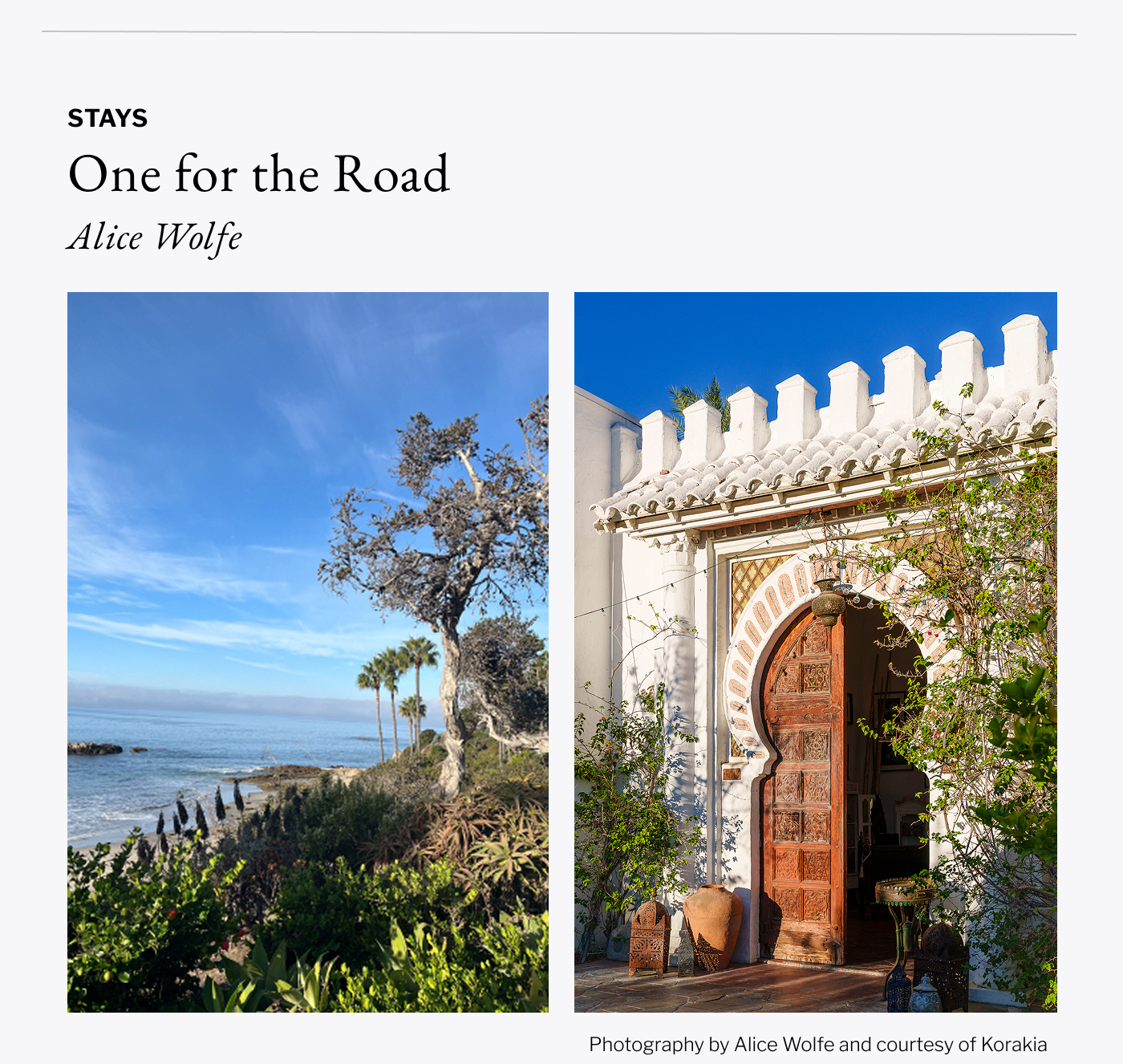
A few days before leaving for Southern California, I realized that I’d never been on vacation alone. I’d always traveled with a friend, family, or a partner. While the realization was momentarily unnerving, the profundity of the resulting experience quickly eradicated any tremors.
This evolution was due in large part to the hotels that hosted me: Korakia in Palm Springs and Hotel Joaquin in Laguna Beach. Part of Auric Road, a collection of historic properties creatively reimagined as “petite resorts,” they — and all Auric Road destinations — are connected through a route (of sorts) that currently winds from Montana to Arizona, through California, with many more destinations in the works. True to their origins, each hotel embraces a signature aesthetic, rooted in its legacy and surroundings. Korakia combines two heritage properties into one lush resort encircled by bougainvillea, white oleander, and citrus trees. Interiors lined with Moroccan tiles, tin lanterns, and rounded archways reflect the property’s past as a hideaway of painter Gordon Coutts, whose vision for the property was to recreate his life in Tangier. Another of Korakia’s past lives is found in its programming: Movies play under the stars every night, nodding to an onsite villa formerly owned by silent film star J. Carrol Naish and innumerable Hollywood stars who have made Palm Springs their choice getaway. The property’s setting — abutting the San Jacinto Wilderness, which offers sweeping views of the desert valley — heightens its sense of escape, as do restorative treatments in the sandalwood-scented spa. An intuitive, grounding massage focused on my body’s specific needs, such as detaching from modern-day overstimulation and more time spent barefoot in nature, while sound baths, yoga, and meditation classes offer additional paths to serenity.
In contrast, Hotel Joaquin is a biome of climbing nasturtium, purple morning glories, and natal plum bushes dotted with tropical, scented white flowers. Its structure is designed to resemble a classic coastal home, with warm wood paneling and natural tones punctuated by graphic details. The restaurant plays beachy, indie-pop tunes and experiences include astrology readings. Giulia, an astute Italian astrologer, spoke to my (recently ended) Saturn return, my ‘Lilith Wound,’ and which life paths might fulfill me. This oasis is also just a five-minute walk from an uncrowded beach, while a stroll along a paved coastline trail drops you into Laguna Beach’s downtown, which evokes an old-school, saltwater taffy-filled beach town that is, like everything in Greater Los Angeles, adjacent to an upscale, service-oriented borough.
Despite their differences, the hotels shared common ground underpinned by laidback yet elevated service — think a thermos of coffee delivered to your door at 7 a.m. or lavender-scented towels dropped around 3 p.m., just as the heat reaches its peak — and an enveloping sense of calm that followed me even after my stay, as did my new commitment to solo trips. |
|
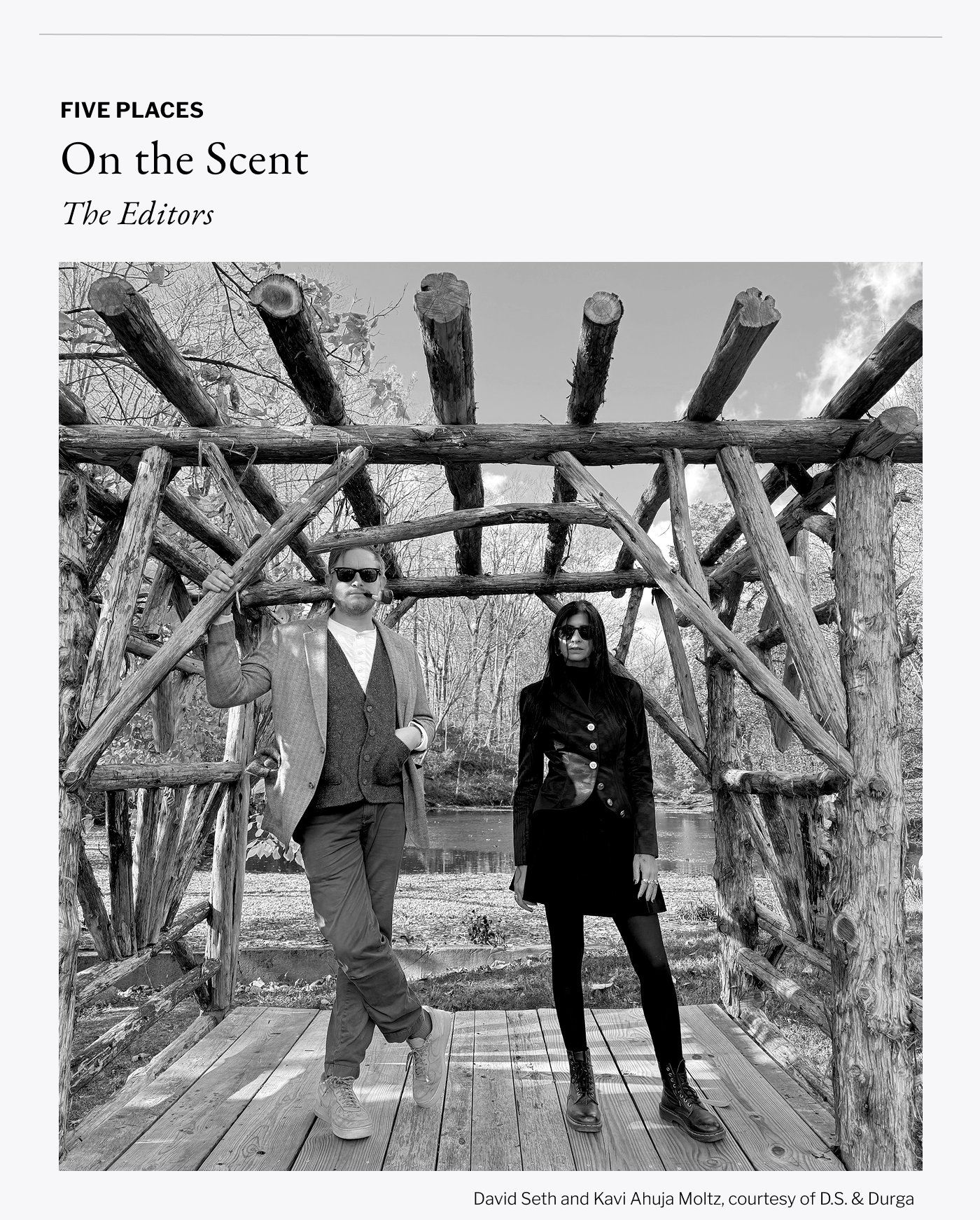
David Seth (D.S.) and Kavi Ahuja Moltz (Durga) are the creative force behind D.S. & Durga, a rebellious, New York-based fragrance company producing highly narrative perfumes that transport their wearers to real and imaginary landscapes, cultures, and moments. Steamed Rainbow, Jazmin Yucatan, Bistro Waters, Roman Ruin Cypress, and Radio Bombay are just a few of their evocative offerings. Below, Seth and Moltz share five sense-laden destinations (and special places within them) that continue to inspire them and their creations.
Big Sur. Here, the fabled reverberations of the 1960s echo, jaw-dropping cliffs tumble down from high mountains, and huge redwoods make deep, dark forest glades. The fog slowly rolls over the Pacific, bathing aromatic plants every morning … My first visit was with my band in college: We drove down Highway 1 in a huge van, swirling around the cliffs before stopping at Nepenthe and watching the sunset. More recently, on a trip with the kids, we found a grove off the side of the road covered in eucalyptus. It was the first time we’d found eucalyptus buds sprouting in the wild — they are insanely fresh and pungent. It had just rained, so the grove was dark and full of nose-opening mist, like a natural medicine lodge. This moment inspired our Big Sur After Rain scent. We also love wandering around the Post Ranch Inn, and the Big Sur River Inn is a great place to hang by the river over drinks and food. Julia Pfeiffer Burns State Park is awesome for hiking down to the beach. As for swimming, Andrew Molera is best — even if the water’s freezing. –David Oslo. Our first visit to Oslo was for an event at Gimle perfumery, a lovely shop with the coolest owner, who invited us to sip tea in her gardens then cooked us an incredible chicken dinner afterwards. We fell in love with the city’s warm, down-to-earth, slower-paced culture. The scent of the air is embedded with cool, clean breezes and the sea, with notes of seaweed as well as wood from the buildings and flowers from scattered gardens. The architecture is so attractive, with many art deco moments. We wandered into the Holmenkollen kapell, a moody, dark wood chapel that felt quintessentially Scandinavian in a way we didn’t often think of as the region’s style. We stayed at the Sommero and found ourselves getting lost in its sumptuous interiors. We also loved the crazy 15-course menu at Kontrast. Varanasi. I’ve always been drawn to the mythology of Lord Shiva, who represents destruction in the cycle of life and has always defined much of my relationship with Hinduism. Usually when my family visited India while I was growing up, we spent most of our time visiting relatives in Delhi and Bombay. Varanasi was my first introduction to a different side of the country, and it was the most visceral experience. I’ll never forget walking barefoot on the pilgrimage path to the main Kashi temple, taking a dip in the cold water of the holy Ganges, and partaking in the incense- and diya-filled aarti performed nightly on the ghats. With the scents of sandalwood and jasmine floating through the air, it was a sensory overload and the most chaotic, yet peaceful place, charged with ritual, history, and a sense of the beginning of time. It is said that if you die in Varanasi, you break free from the cycle of life. It’s a profound place on every level. –Kavi The Scottish Highlands. The region’s endless vistas of historic glens, cold North Sea air, green grass, and sea pinks stuck between massive rocks — not to mention whisky — have been an endless source of inspiration for us. We’ve even collaborated with both the Scottish Tourism Board and local whisky companies on some innovative scents, including Spirit of The Glen (a scent we crafted with Glenlivet) and a Johnnie Walker Blue candle. Our Tomb of the Eagles candle was inspired by a trip to the tomb in Orkney. If we’re lucky, we stay at Gleneagles, which is a dream that sits a little south of the Cairngorms. On the west coast, you must head to the Applecross Inn for squat lobsters, langoustines, scallops, and oysters. After, the Torridon is paradise, serving up the best whisky room we've ever seen — quiet, remote, and full of peace. When we crave the flavors of the destination, we love the lighter grassier Speyside malts, such as Glenlivet 18 (perfection), Highland Park (a lightly peated single malt), or Arbelour A'bunadh (a sherry fantasy). Paris. From visiting the Musée d'Orsay with my parents in 1996 to discovering the Musée de l’Orangerie, wandering through the streets at night after too much food and wine, and sneaking ciggies with Kavi at Café de Flore while the kids ran around in the square at sundown … Paris is eternally cool. We often stay at the Hotel Nolinski, which has a pool for the kiddos that stays open very late, perfect in jetlagged summer hours. I also love going to the food halls at Le Bon Marché and Printemps for cheeses, bread, jams, and wine to eat on park benches. Chez Georges and Brasserie Lipp are classic restaurants, while Chez Janou has a southern flair different from other spots. Mariage Frères is great for tea and strawberry creme brulée. We also love swinging by Musée de Cluny for epic medieval stuff, including unicorn tapestries. I’ve had a bunch of books shipped home from the Abbey English bookstore. There’s also no place in the world with a stronger perfume culture than Paris (even its soap and detergent scents are distinct), which Nose has captured in its cool concept shop. –David
|
|
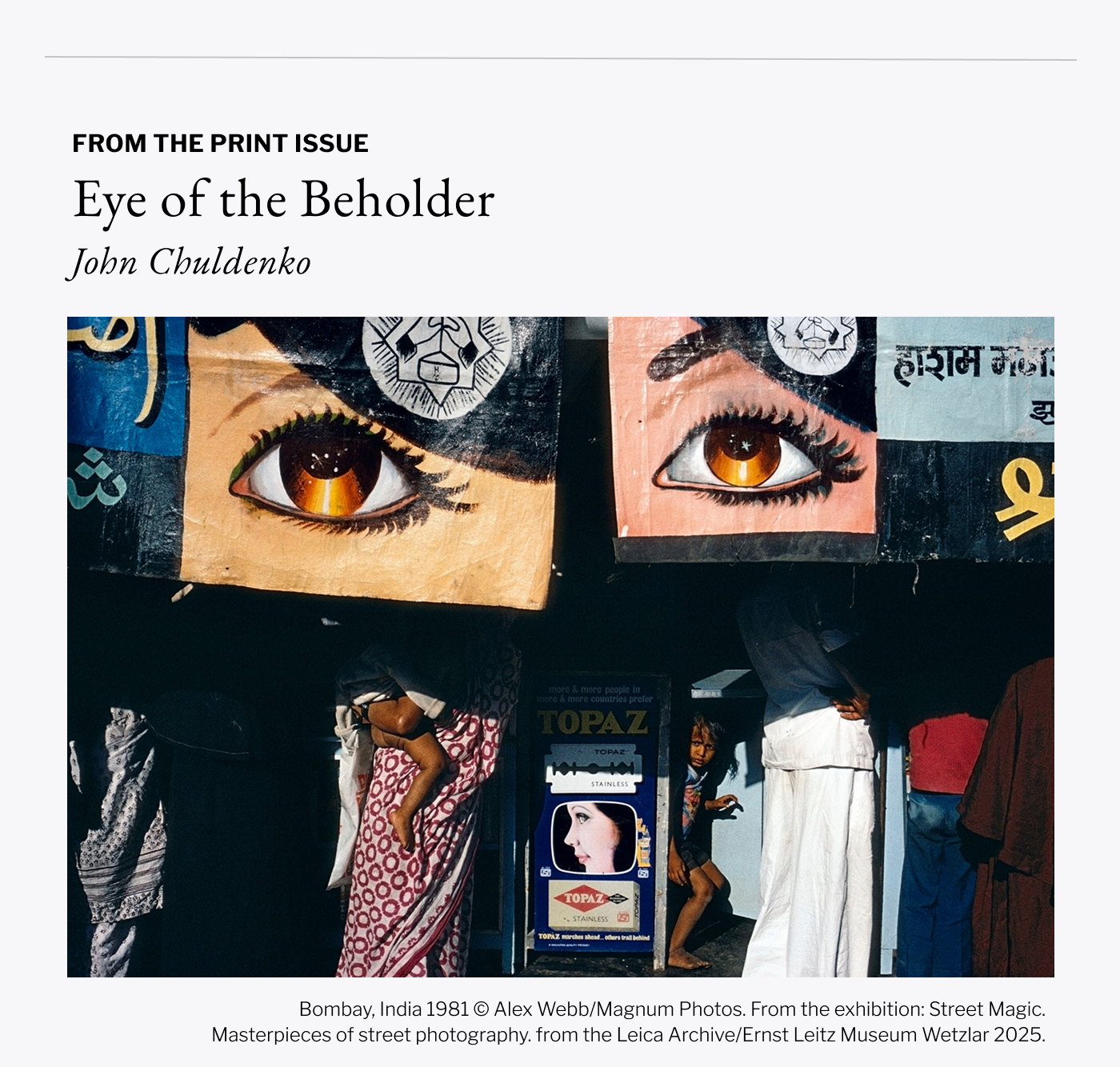
Many of the world’s most iconic images were shot with Leica cameras. You know the photos: that portrait of Che Guevara, Muhammad Ali's fist, the sailor kissing the nurse on V-J Day, James Dean in Times Square. For 100 years, the small machines have enshrined powerful moments with the muted click of their near-silent shutters. It was raining in Wetzlar, Germany, as I arrived at Leica headquarters, where a dozen or so photographers from around the world huddled under an awning, clutching bright red umbrellas. In a sense, this was a pilgrimage. We had gathered at the birthplace of what might be the most legendary camera ever crafted: the Leica M, with its various iterations hanging around our necks like talismans.
Knowing I'd be visiting the factory, I had brought my well-worn M6, along with a vintage lens from 1948, to drop at the service department for a little TLC. The camera earned its patina in the deserts of Saudi Arabia and on the streets of Sofia, Bulgaria — its dents and scratches marks of a photographic life well lived. It captured the births of my children, and I know that if properly maintained — these cameras are built to last generations — it might capture the births of my children's children.
After an organized photo excursion, we sat down to rounds of pilsner in tall mugs, dropped beside plates of schnitzel and sauerkraut. Our cameras lay strewn across our shared table like bizarre centerpieces. A young woman fell into the chair across from me. Svet Jacqueline is a documentary photographer who made the multi-day journey to Germany from Ukraine. When the war there broke out, she left her family home in Baltimore and traveled to the front lines to document the conflict and the stories of the people and communities impacted by the war. She'd brought her camera with her for service, too. It sustained damage when blowback from a landmine knocked her to the ground. The Ukrainian soldiers nearby suffered far greater damage. I listened, riveted, to her stories — my camera’s maintenance needs, suddenly insignificant …
Read this full dispatch and more close takes on a wide world in our print issue. Order now.
|
|
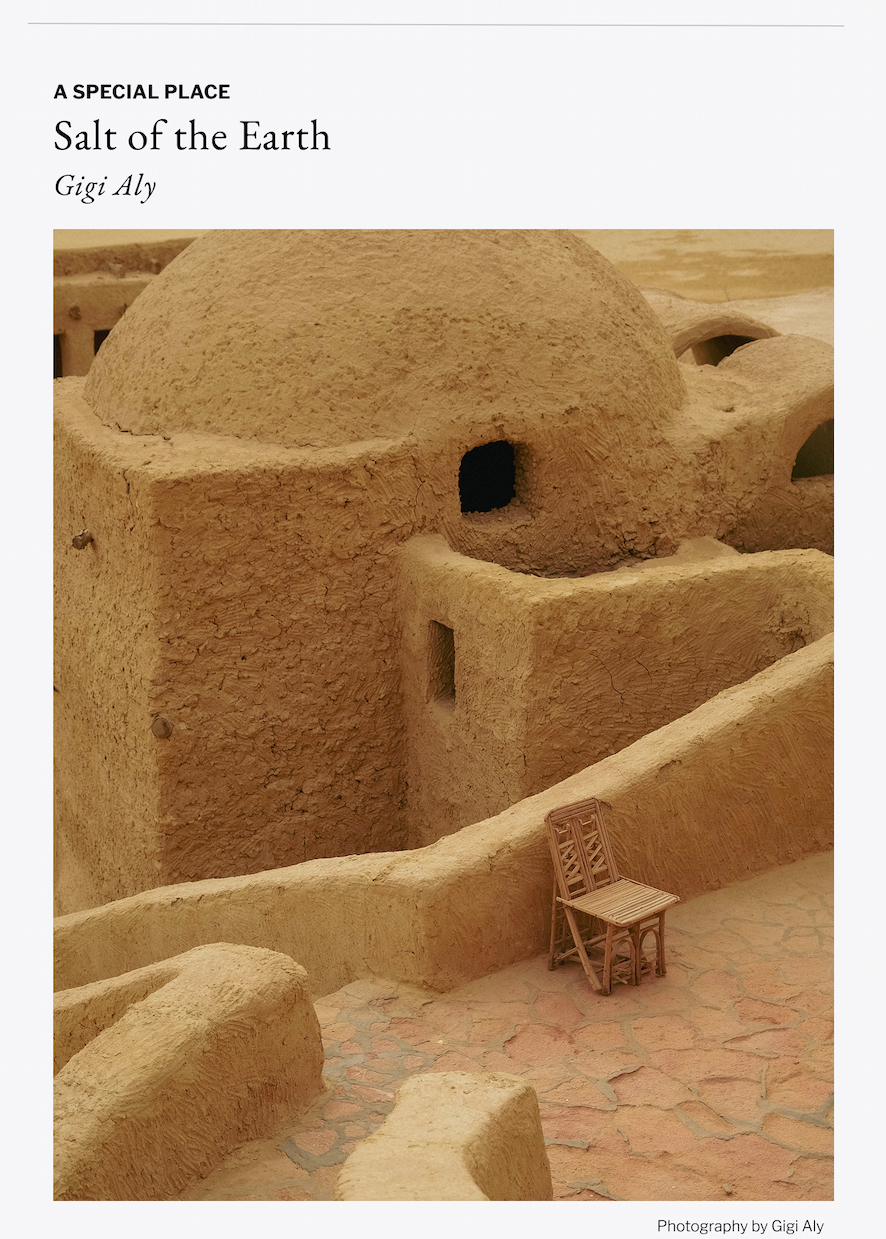
In Egypt’s Siwa Oasis, architecture becomes poetry written in earth and salt. Here, traditional constructions stand as a testament to building with the landscape rather than against it, where structures emerge organically from local materials.
The region’s heritage techniques are intriguing in their simplicity: Local craftsmen use kershef — a blend of desert sand with salt from ancient lakes — along with palm trunks as beams and fronds for roofing. This handwoven cane chair embodies the same philosophy: beauty achieved through working with nature's gifts.
There's something profound about design that knows its place in the world. The undulating walls mimic the essence of nearby dunes — their tan, textured surfaces blend into the surroundings. Standing there, observing this abode and chair, shaped by materials that will one day return to the earth that made them, I was struck by the beauty of architecture in perfect conversation with its environment. |
|
Among the Vines. Hiyu Wine Farm, as its name suggests, is not just a vineyard. It’s a majestic pocket tucked between Oregon’s Columbia Gorge and Mount Hood, with vineyards spanning both sides of the landscape and wines inspired by historic European blends and permaculture philosophies, defining the vintages as both surprising and refined. The bottles are similarly beautiful, thanks to co-founder China Tresemer’s artwork, which adorns their labels. Hiyu also offers among the region’s top dining experiences — from its highly seasonal plates to its enchanting setting, which features cows and pigs grazing through the wine tavern’s picture window. If you can’t make it to the farm, subscriptions allow you to armchair travel via highly allocated bottles. –Erin Dixon
Worth a Shot. I am one of those silly folks who watches awards shows, so I tuned in when the 2025 Emmy Awards nominations were released this week. Much to my delight, Adolescence appeared in several categories. The haunting British limited series follows a 13-year-old boy and his family after he is arrested for murdering a girl in his school. If that disturbing synopsis deters you, perhaps this will re-pique your interest: Each of the show’s four episodes were filmed in one continuous shot, requiring immense precision of the cast and crew. It's also perhaps the closest thing to theater on screen that I’ve ever seen. As a theater nerd, I was hooked. –Jackie Risser
Family Affair. Maybe it’s the gallery of family photos lining its entrance or nostalgic negronis and spritzes on its menu, but Bar Enzo in New York’s Long Island City felt familiar even on my first visit. The bar’s house cocktails inventively combine past and present, such as The Bambino, a twist on the go-to drink of founder Nonno Enzo, comprising red wine, cola, and ginger. My favorite detail, however, was an illustration featuring caricatures of Enzo’s Sicilian family — the combination left me imagining myself in their company, laughing and throwing back a few. –Lisa Lok
|
|
54 Franklin St #2R NY, NY 10013. ©2024 Dossier Projects, LLC.
|
|
|
|
|