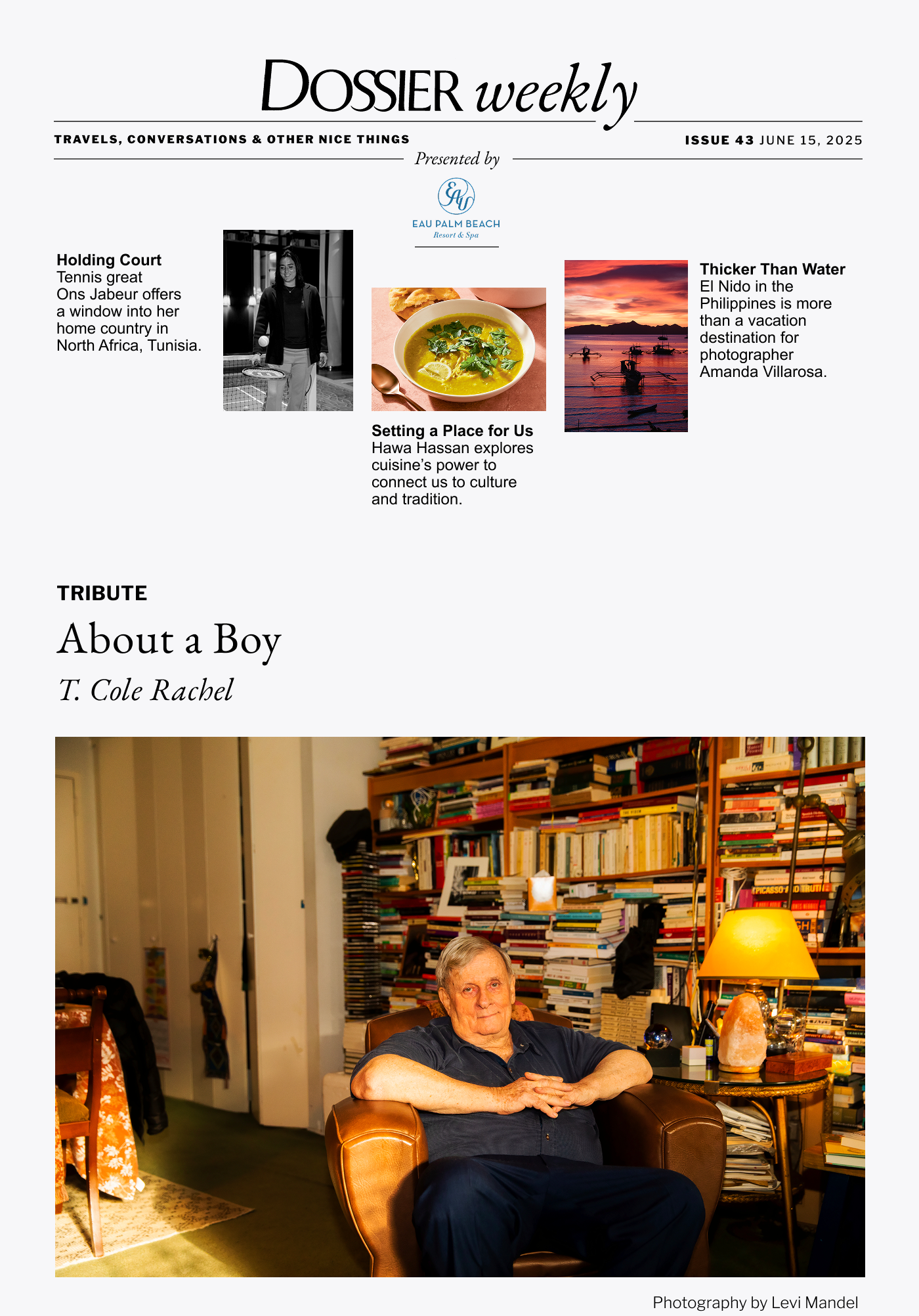
The great Edmund White has left us. I had the joy of a decades-long friendship with him, benefitting, like so many writers, from his kindness and support. His passing feels like an incalculable loss. While he will be rightly remembered as one of the greatest gay writers of all time — a trailblazer whose work, particularly A Boy’s Own Story, would light a path for generations of queer voices to follow — he was much more than that. White’s sprawling, genre-expansive body of work is a testament not only to his genius as a writer but also to his voracious intellect, his curious mind, his unrivaled understanding of art and literature, and his tremendous capacity for dissecting the human condition. In 2009, I spoke with White for the previous incarnation of Dossier. Our chat precipitated the publication of City Boy: My Life in New York During the 1960s and '70s, a memoir detailing his years as a struggling writer. At the time, I wrote: Sitting down to talk with Edmund White is an experience not unlike reading one of his books. He is charming, funny, simultaneously erudite and salacious, and wonderfully frank. A conversation about an old poetry book suddenly becomes a kaleidoscopic view of New York’s literary milieu and then, just as quickly, a story about sex. Revisiting the interview, I am reminded of White’s indefatigable charm and by the extent to which he was not only a witness to cultural history but also a remarkably active participant. I will miss him terribly.
Here, an excerpt of our conversation.
T. Cole Rachel: Do you feel like City Boy is the kind of book people have wanted you to write for a long time?
Edmund White: No, not really. A lot of people loved my last memoir, My Lives, and a lot of people were disappointed in it. You know, it wasn’t very serious. It was kind of frivolous and very sexual. Alan Hollinghurst, for example, said that it was about as far as you could go with being frank about your own life. On the other hand, Laura Miller reviewed it for The New York Times and hated it, because she thought I’d had this very interesting life and done a lot of interesting things and that it was horrible I didn’t mention any of my intellectual pursuits or the work I’d done in regard to fighting AIDS early on. So, this book is a sort of antidote to that book. City Boy is more of a traditional memoir and coming-of-age story. People my age have suddenly come to realize that the ’70s have become mythical to so many people — especially gay people. I find it amusing, since it still feels extremely recent in my mind.
TCR: In the book, you mention that your sister often criticized you for having a terrible memory, but one doesn’t get that feeling at all from reading the book. It’s full of a million interesting details and weird asides. Was it a difficult book to write?
EW: No, not at all — though I do think of myself as pretty forgetful. In fact, sometimes I think of forgetting as a kind of compositional principle. It’s a way we get rid of stuff. The things I do remember I tend to remember quite vividly. Christopher Isherwood used to say that most writers have lousy memories and are often really bad observers. Like, you could walk into the room with blue hair and they wouldn’t notice it. However, the things they do notice — things that are relevant to them — they tend to catalog and remember and use. I think he’s totally right, at least as far as I’m concerned.
TCR: Do you find that the more you revisit your own past, the more you start to remember things?
EW: Absolutely. It’s like psychoanalysis in that way. Details lead to other details; stuff comes back to you. I think someone should do a thesis on literature before and after the invention of Google. Actually, someone is probably doing that now. It used to be that in order to establish a few basic facts, even about a period that you actually lived through, you’d have to spend weeks in the library and engage lots of inter-library loans and travel to other cities to verify things. Now, all that information is available instantly online. I think that probably means books are a lot more accurate now than they used to be, but it might also mean things are much more overburdened with facts and details now, more than they really should be.
I’m writing a novel now about working at magazines in the ’60s. Back then, there would be these old-timers at the magazines who would keep files of all of these potential topics for articles. These files became invaluable. They built up these huge catalogs of files, and no one could really challenge them because they were the keepers of all this stuff: thousands of clippings and bits of information. It’s probably almost impossible for most people to realize what it was like to do research back then. So, even writing about your own life is made much easier now in regard to mastering all the facts.
TCR: You share a lot of good stories in the book, particularly about other writers, but you never get too mean or bitchy. Was it hard to hold back on that? Be honest.
EW: In general, I try never to be too nasty to other writers. It’s such an awful career and so difficult. Most of us, even after all these years and all these books, are still pretty poor and struggling. I don’t write negative reviews, either. I just don’t see the point in it. It’s not as if we need to guard the literary Mount Parnassus to try and keep all the riffraff out; they tend to die a pretty natural death anyway. It seems to me that the literature from, let’s say the 1920s and ’30s, the stuff that is still being read is basically the good stuff. The bad stuff — even the stuff that sold a lot — has pretty much disappeared. I translated some essays for Milan Kundera from French into English, and he once said to me that the initial reception of a book (the way it gets categorized at the time of publication) will affect its life for the next 30 years. I think I had said something to him like, “Maybe eventually I’ll move beyond the ‘gay’ category,” and he was just like, “No, you won’t.”
TCR: It’s good that you can be so objective about yourself, Edmund.
EW: I mostly just have a good sense of humor, which can help you to see yourself in a realistic light. Comedians are good that way. Only once did I ever hang out with Woody Allen, but he was absolutely tormented about the idea of dying. That’s all he could talk about. He was obsessed with cryogenics. Then about a year later, he made that wonderful movie about being frozen and waking up in the future. This was back in the ’60s. I thought it was great that he could take something that really bothered him and made him shake all over and turn it into a comedy. I remember thinking: Hmmm … that’s good.
|
|
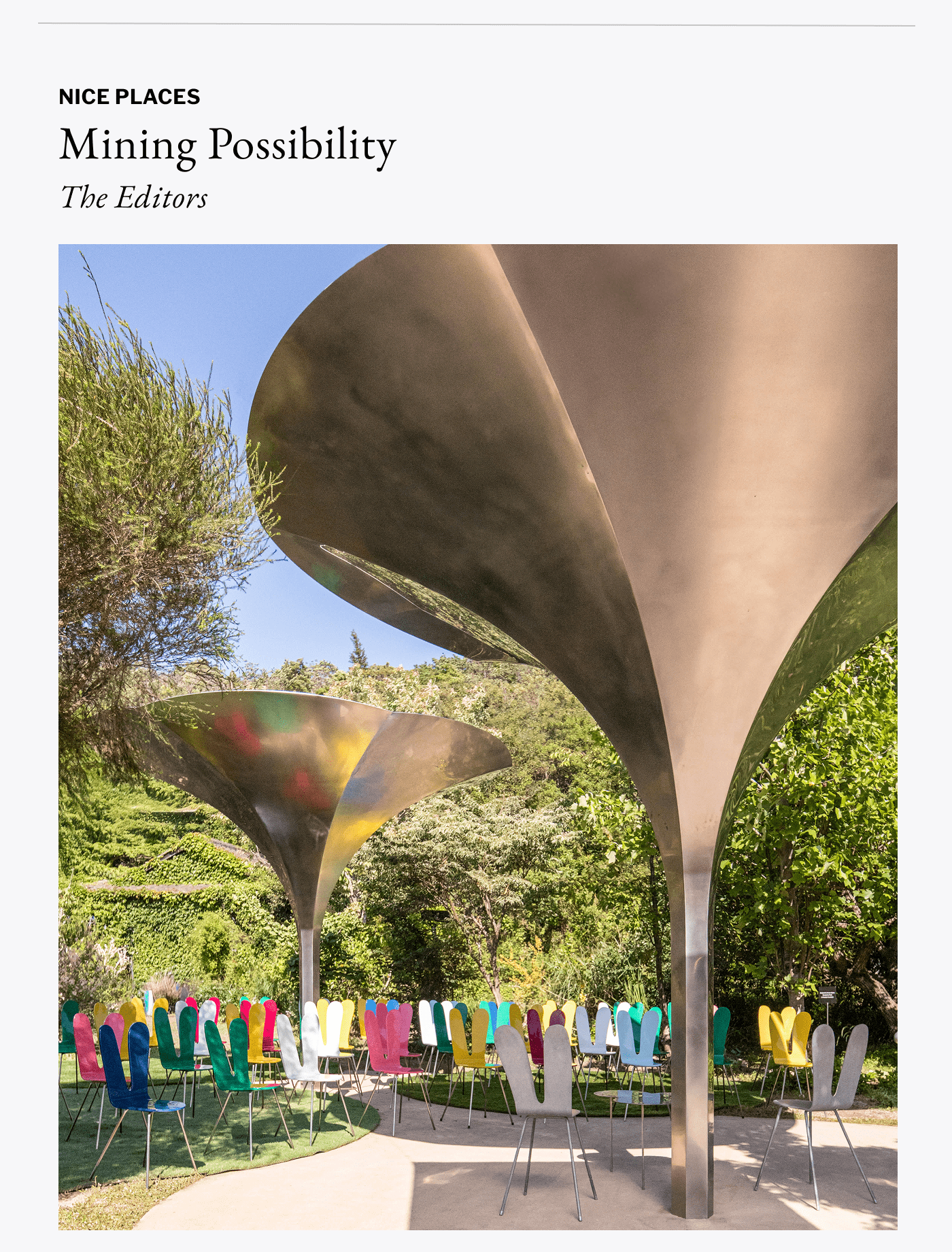
Nestled in the Seto Inland Sea, Inujima offers a scenic amalgamation of glittering seascapes, verdant landscapes, industrial history — and art. At the turn of the 20th century, the small Japanese island was primarily renowned for granite quarries and copper smelting, which drove the economy for its approximately 5,000 inhabitants. In the ensuing years, as manufacturing slowed, the refinery was abandoned and the population dropped, declining to just 40 residents (with an average age of 70) in 2008.
Yet, this nadir precipitated Inujima’s resurrection: This same year, the Fukutake Foundation opened the Inujima Seirensho Art Museum in the former refinery space, inviting celebrated architect Kazuyo Sejima and the Artistic Director Yuko Hasegawa to transform the island. Over the next 17 years, Sejima renovated older housing, built gallery spaces, organized workshops and a community garden, and constructed visitor accommodations to allow non-residents a deeper experience of the multifaceted destination. Prada Mode Osaka — the 12th edition of Prada Mode, a contemporary cultural series from the lauded Italian luxury brand — commemorated the architect’s successes this past week. In partnership with Inujima Project, it unpacked Sejima’s seminal projects on the island with an exhibition and the presentation of a permanent pavilion at Inujima Life Garden, designed by Sejima's studio, SANAA, and donated to the island by Prada. A series of conversations and workshops in Osaka, curated by Sejima, extended the moment, with architectural discussions; a workshop focused on tsumami-zaiku, the Japanese art of folding fabric to create floral motifs; musical performances with Nik Bartsch, Reggie Watts, and C.A.R; film screenings; art installations; and more.
In Sejima’s own words, “On Inujima, a tiny island rich in nature, visitors will encounter and experience Symbiosis — a landscape that combines history, architecture, art, and daily life. In Osaka, a city with historical ties to Inujima, this experience will be shared and expanded to reach a wider audience. At this edition of Prada Mode, Symbiosis took shape through conversations and discoveries, creating a new landscape that continues to grow with the participation of all.”
Prada Mode Osaka concluded on June 15, but Inujima remains a year-round destination, easily reachable by ferry or boat from Okayama.
|
|
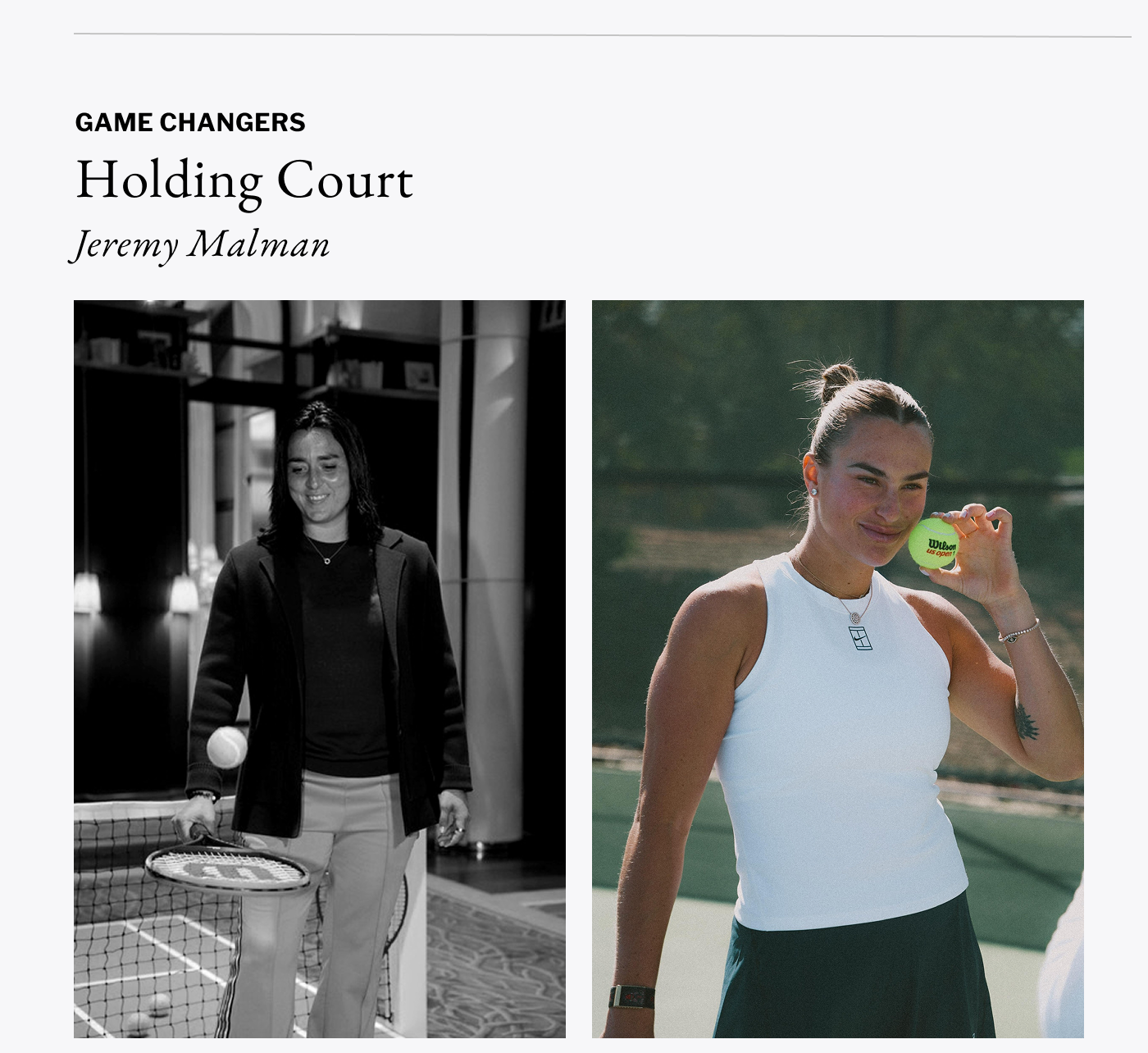
I love tennis. Actually, I love Break Point, the Netflix series which, with its front-row access to live play, allows me to charm my partner to sleep with spotty knowledge of the beautiful game from the comfort of my bed. I also love fancy hotels, and Le Royal Monceau – Raffles Paris — the five-star property with a coveted Palace de France designation, Philippe Starck interiors, a Michelin-starred restaurant, and a prime location right off the Champs-Élysées — is about as fancy as it gets. The hotel’s Royal Tennis Package, which included a meet-and-greet with Ons Jabeur and Aryna Sabalenka, two of the game’s biggest stars, gave me a prime opportunity to combine these two passions ahead of last month’s French Open in Paris. Arriving at Le Royal Monceau, I was shepherded into Le Bar Long, where about 50 people waited for the athletes. Given the players’ global fanbase, it felt like an incredibly intimate gathering. I made my way across the room to Sabalenka, currently ranked No. 1 in women's singles. Known on tour as “The Tiger,” she eventually became the French Open’s 2025 runner-up, but we talked about her home country, Belarus; her go-to food to combat homesickness, French fries; and her favorite hotel recommendations. She called out Le Royal Monceau — “It smells so good here. Also, the service … no one treats me better; they really make me feel like a queen.” — before leaving me her signature on a bright, imperial blue tennis racket. I also had the chance to chat with Ons Jabeur. Currently ranked No. 54 in the world, her career-high ranking of No. 2 makes her the highest-ranked African and Arab tennis player in WTA and ATP rankings history. She was at the event alongside her husband, Karim Kamoun, who is also her fitness coach. They were both as affable as they come across in the Netflix series — Jabeur is commonly referred to as “The Minister of Happiness” — and kindly shared some travel recommendations. Since she is a cultural ambassador for her home country of Tunisia, you can probably guess where her favorite places are located. |
|
Something to eat and drink … Tunis has a labyrinthine souk near the ancient port of Carthage. It’s a great place to try the country’s cuisine and buy all kinds of crafts. The locally famous restaurant Dar Belhadj serves delicious traditional dishes and its interior is lined with Moorish tiles.
Something to see … Sousse, my hometown, is a beautiful city on the Gulf of Hammamet with incredible beaches, and the weather is always good. Built on the ruins of the Phoenician colony of Hadrumetum, it is now a resort destination that also features Arab and Islamic architecture, including its sprawling Great Mosque. The nearby amphitheater of El Jem is one of the best-preserved Roman ruins in the world. [Editor’s Note: It was also featured in Monty Python’s Life of Brian.]
Something to take home … You have to see the souk in Sousse, which is a UNESCO World Heritage Site. It’s very traditional and you can shop for local Tunisian crafts or just sit at a cafe to take in the whole scene.
Only in Tunisia … The people are so friendly — such beautiful, loving people.
A secret place … Djerba lies off the coast of Tunisia in the Gulf of Gabès and is known for its pristine Mediterranean beaches and distinctive, cubic white-washed houses. The island’s unique culture has been shaped by Berber, Arab, Jewish, and African influences, and it was designated a UNESCO World Heritage site in 2023. |
|
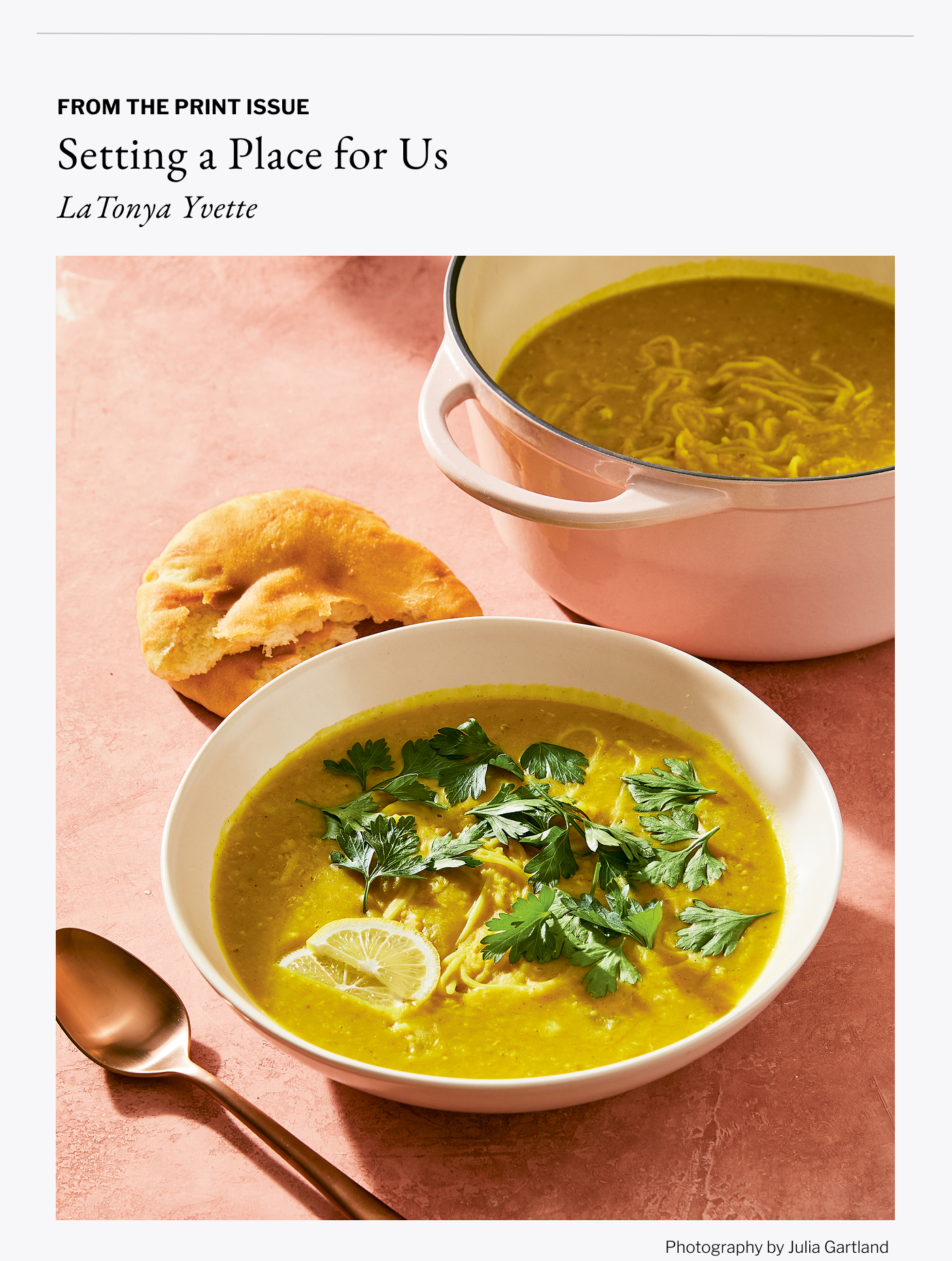
Hawa Hassan’s new book, Setting a Place for Us, compiles recipes and stories of displacement, resilience, and community from eight countries impacted by war: Afghanistan, the Democratic Republic of Congo, Egypt, El Salvador, Iraq, Lebanon, Liberia, and Yemen.
Hassan’s own story begins in Mogadishu, Somalia, during the country’s civil war. Fleeing the combat, her family landed in a refugee camp in Kenya. Setting a Place for Us threads wefts of this journey — from Kenya to the United States, from childhood to adulthood — into a magnetic compendium that dispels othering narratives through the universal language of food.
It dimensionalizes and celebrates the real people and everyday lives impacted by global events, yet flattened by media tales. Through tangible, tantalizing flavors and universally relatable stories, it underscores the sameness that connects “Us” to “Them,” making space for each, whomever either may be, wherever they now reside.
Below, Hassan shares just one of the book’s recipes, which comes from Iraq.
|
|
Read the full story and more close takes on a wide world in our Spring/Summer 2025 print issue. Order now. |
|
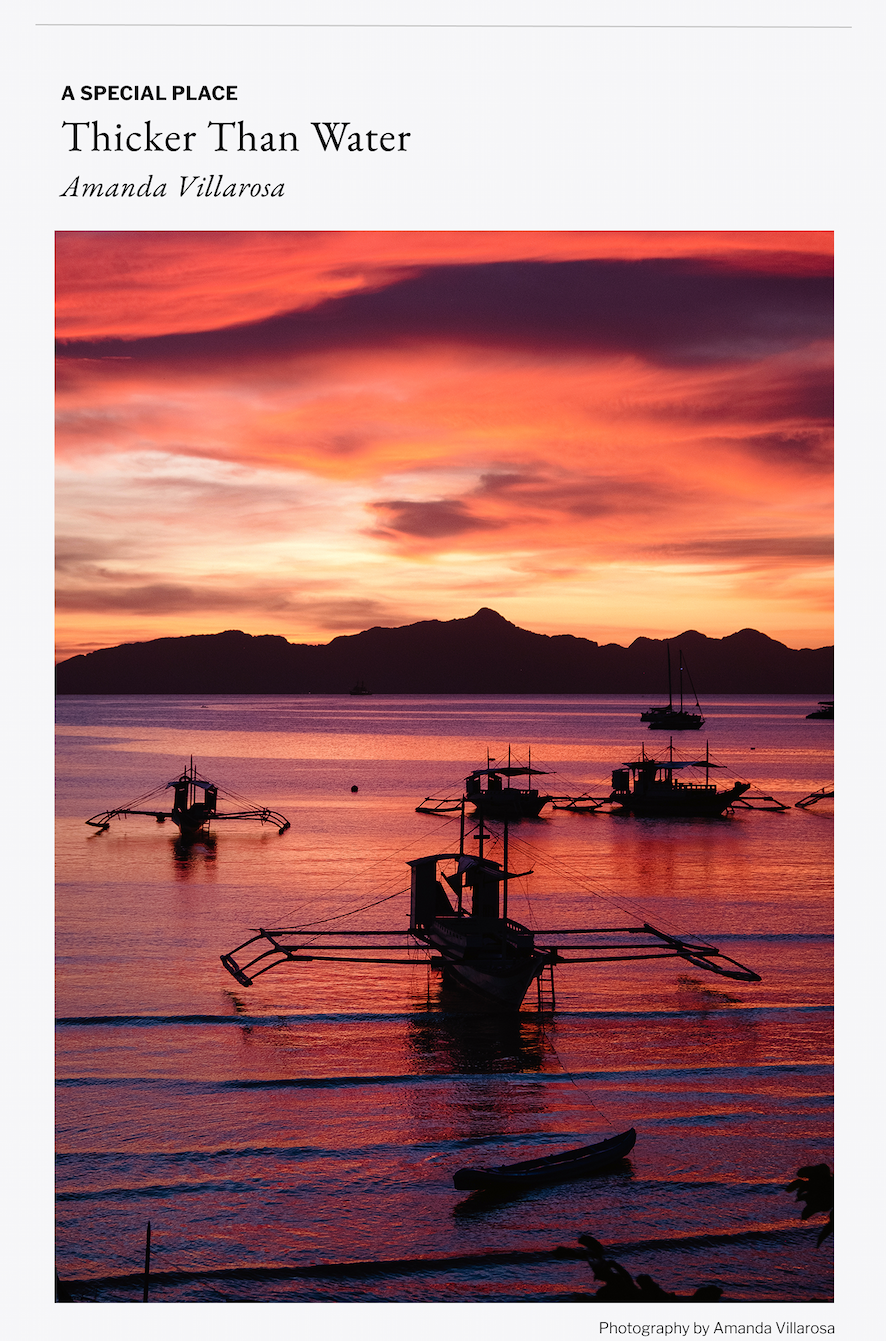
This photo was taken in El Nido, Palawan, one of several thousand islands in the Philippines. El Nido is a paradise, with crystal blue water, island resorts, snorkeling, and endless white sand beaches. But for me, it’s more than just a tourist destination.
I'm a first generation Filipina-American and grew up ping-ponging between two starkly different cultures and lifestyles. Home for me is Los Angeles, California, but over the years I’ve also found a sense of home in my parents’ birthplace, where I returned in the spring of 2023 after having been away for almost a decade.
Growing up in the States in an immigrant family, I didn’t quite understand the importance of holding onto heritage. But now, as an adult, my heritage is all I think about. The Philippines holds an incredibly special place in my heart for this reason, as do the boats pictured here. They recall a specific day out on the water, when I was sitting on a vessel’s edge, my legs stretched outward, hovering over the splashing waves. What a feeling to be in those ancestral waters. |
|
Pure Imagination. I picked up a copy of What Art Does: An Unfinished Theory by Brian Eno and Bette A. after hearing a single from Eno’s new album. It’s a pocket-sized, playful examination of our relationship with art in all its forms (from sprinkles to screwdrivers), illustrated in strategic spot color. Concise and insightful, the book is a reminder to recognize how art elicits feelings, even in the most mundane of places. –John Chuldenko
Last Words. In 1979, Jeffrey Horowitz founded Theater for a New Audience in New York, a modern classical theater that produces Shakespeare alongside classic and contemporary playwrights, from Samuel Beckett to Adrienne Kennedy. This year, Horowitz is retiring — and leaving with a bang in the form of Prosperous Fools by the incomparable Taylor Mac. The meta satire explores cultural philanthropy in a wild ride that ingeniously weaves together our modern day with Molière, commedia dell'arte, ballet, iambic pentameter, even Wallace Shawn. It's a courageous feat ("I don't like to bite the hand that feeds me. But I do like to get a little lipstick on it," Mac says), and, I imagine, emblematic of Horowitz's vision. Basically, the ultimate mic drop. –Jackie Risser
Dram Roll, Please. I recently sampled Johnnie Walker’s Couture Expression release. Co-created by the brand’s (first female) master blender, Dr. Emma Walker, and Balmain Creative Director Olivier Rousteing, the inventive collection features four seasonally-inspired blends handcrafted from 500 of the rarest whiskies in the Johnnie Walker Vault, with only 25 bottles produced per blend. Rousteing also designed the Baccarat crystal decanters, which almost appear as if they’re dressed in his signature silhouettes. –Annie Lin
|
|
54 Franklin St #2R NY, NY 10013. ©2024 Dossier Projects, LLC.
|
|
|
|
|