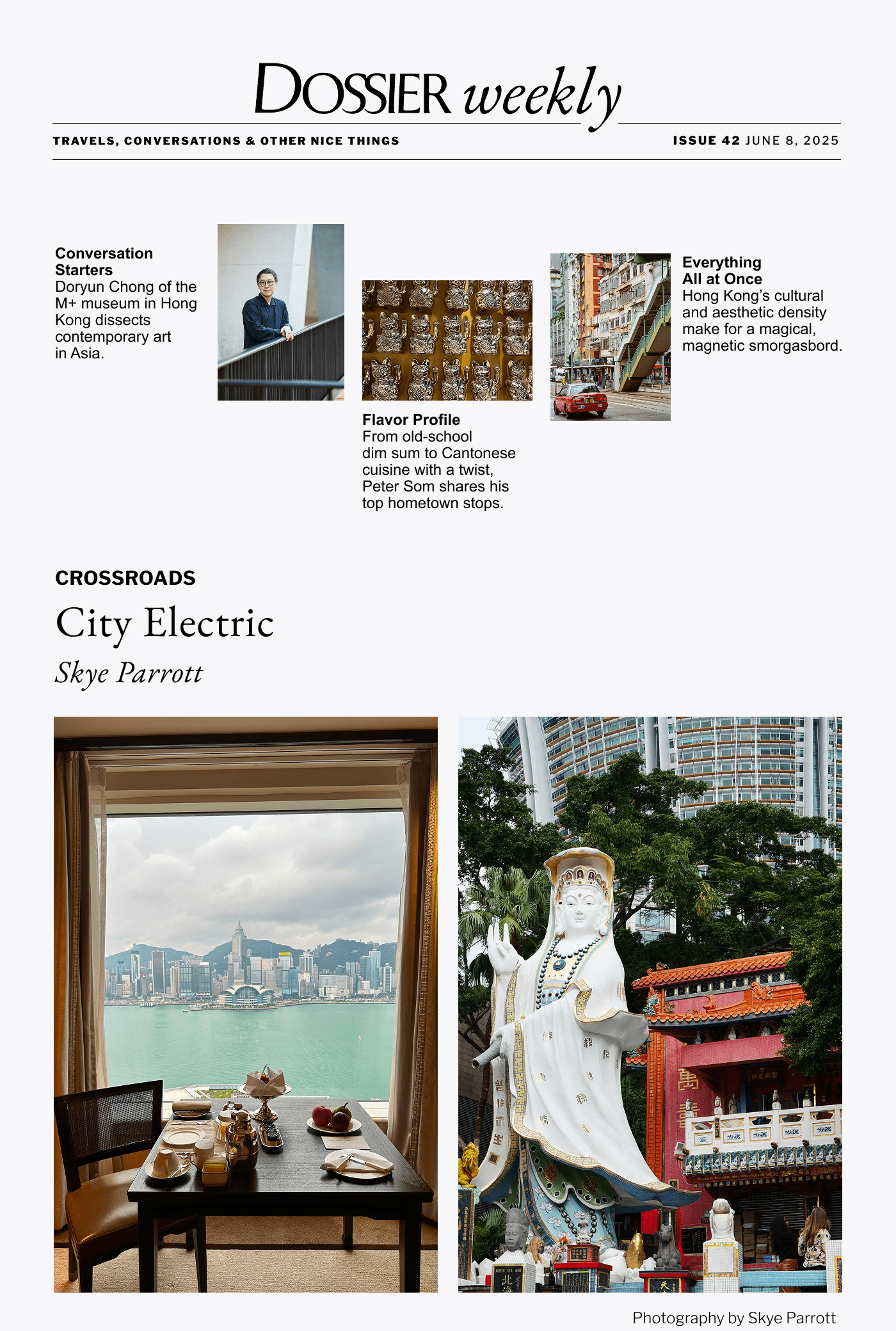
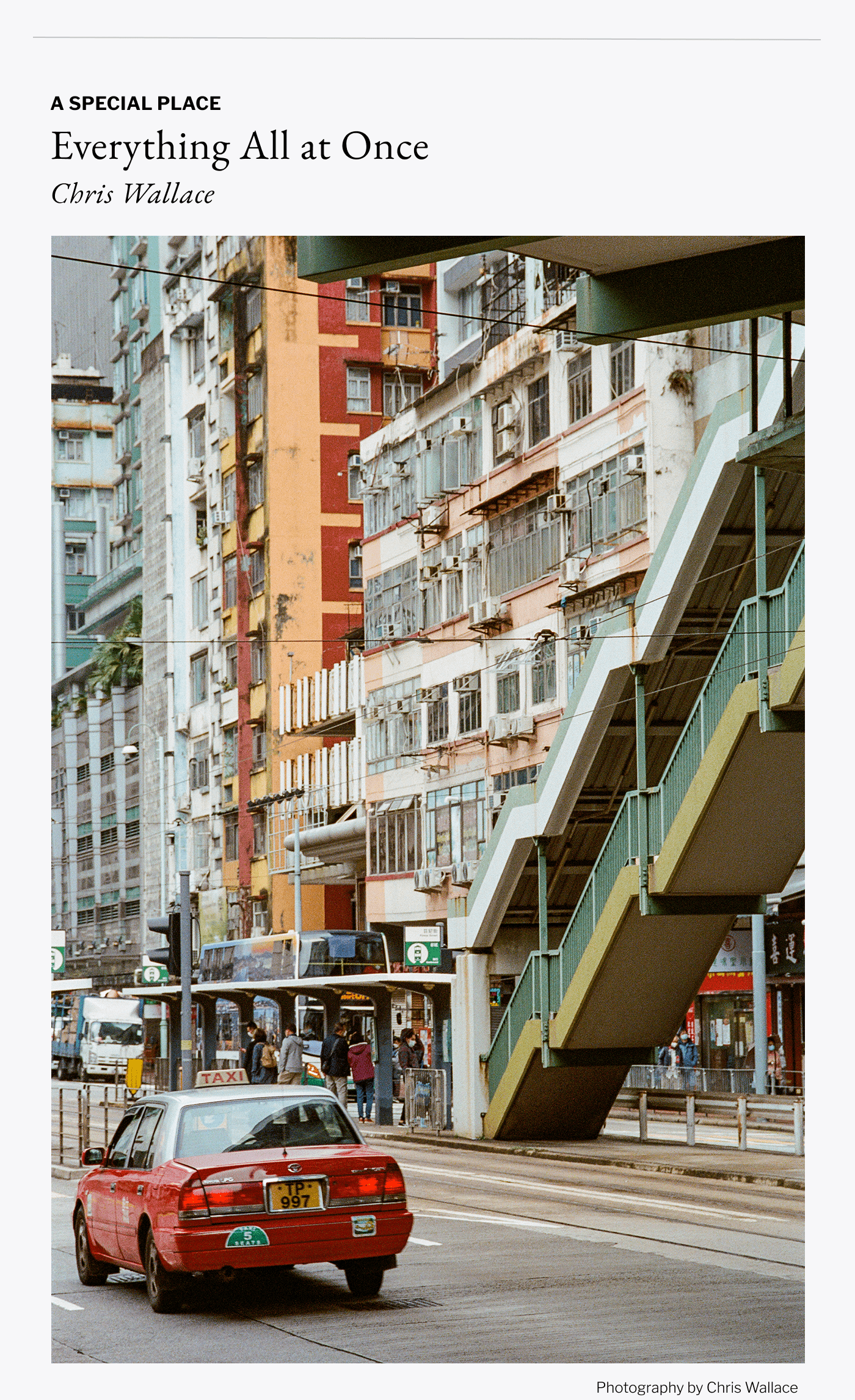
I came to Hong Kong to visit The Peninsula Hong Kong, the international hotel group’s flagship property. Often called the “grand dame of the Far East,” it has been welcoming guests to its colonial-style building overlooking Victoria Harbor since 1928. But as much as I was in the city to experience the hotel, I was also, as my invitation read, there to see how “Hong Kong is back.” After passing through a year of closed borders during the Covid pandemic and a mask mandate that lasted over 900 days, the port city is once again welcoming the world. Being ushered from the airport through misty, tropical, early-winter rain into a Rolls-Royce certainly wasn’t a bad start to my stay. (The Peninsula’s fleet of them, painted its signature green, can be reserved for transfers.) But it was as the car glided along on a highway laced between small islands topped with lush, jungle-covered peaks; through the city’s massive commercial port; past towering glass skyscrapers; and, finally, down tight, hilly urban streets that my attention was properly piqued.
As this was my first visit, I can’t say what Hong Kong was like before the pandemic. But today, its tropical landscape paired with the city’s intense bustle is incongruous and fascinating — and, for an Anglophone visitor, the ubiquity of English makes for quite a soft landing. Hong Kong reminded me of New York in its grittiness and diversity, but it also feels incredibly safe, with clean, functional public transportation. It has a similar electricity, the kind that can only be created by lots of different kinds of people living very close together.
I ate at an array of restaurants serving a range of cuisines. The Peninsula alone has nine offerings, from the Michelin-starred Spring Moon (Cantonese) to Imasa (Japanese) to Chesa (a Swiss chalet that looks like it was transported directly from the Alps) to the lobby’s famous Afternoon Tea. Beyond the hotel's doors, as in any great city, the options are endless.
The city’s art (almost) overwhelmed me with its riches. On my first afternoon, I saw an excellent multimedia exhibition tracing the area’s trade history at the Hong Kong Museum of Art. The Hong Kong Palace Museum hosts treasures from the Forbidden City (the only place they’re on view outside of Beijing), and my top museum pick, M+, is somewhere I could have spent a full day. Considering it’s one of the most densely populated areas on Earth, Hong Kong also offers copious and easy access to natural beauty. After riding the Peak Tram, one of the world’s oldest funiculars, I went for a walk around Victoria Peak, meandering through the rainforest with views of the city from 1,300 feet. Later, I visited a brightly painted Buddhist temple in Repulse Bay. Friction is a powerful force that can make things spark, cities included. I felt it each time I walked out the doors of The Peninsula into the streets of Kowloon, where world-class museums and super-luxe malls live alongside numerous tiny, family-owned businesses. I stopped into William Cheng & Son — a 60-year-old bespoke tailor located on the second floor of an office building, whose walls are lined with every fabric imaginable — as well as Harry Lee & Company, a custom jeweler whose 87-year-old founder was still manning the register. (He convinced me to buy an owl-shaped, handcrafted gold charm.) My favorite part of the visit, though, was returning to my room — or, rather, its view. Far below it, the busy harbor was constantly criss-crossed by boats of all shapes and types, from commuter ferries and huge barges pulled by tugs to traditional junk ships with red sails. Like any truly great city, Hong Kong offered an endless parade of things to see. I could have sat there forever, just watching it pass.
|
|
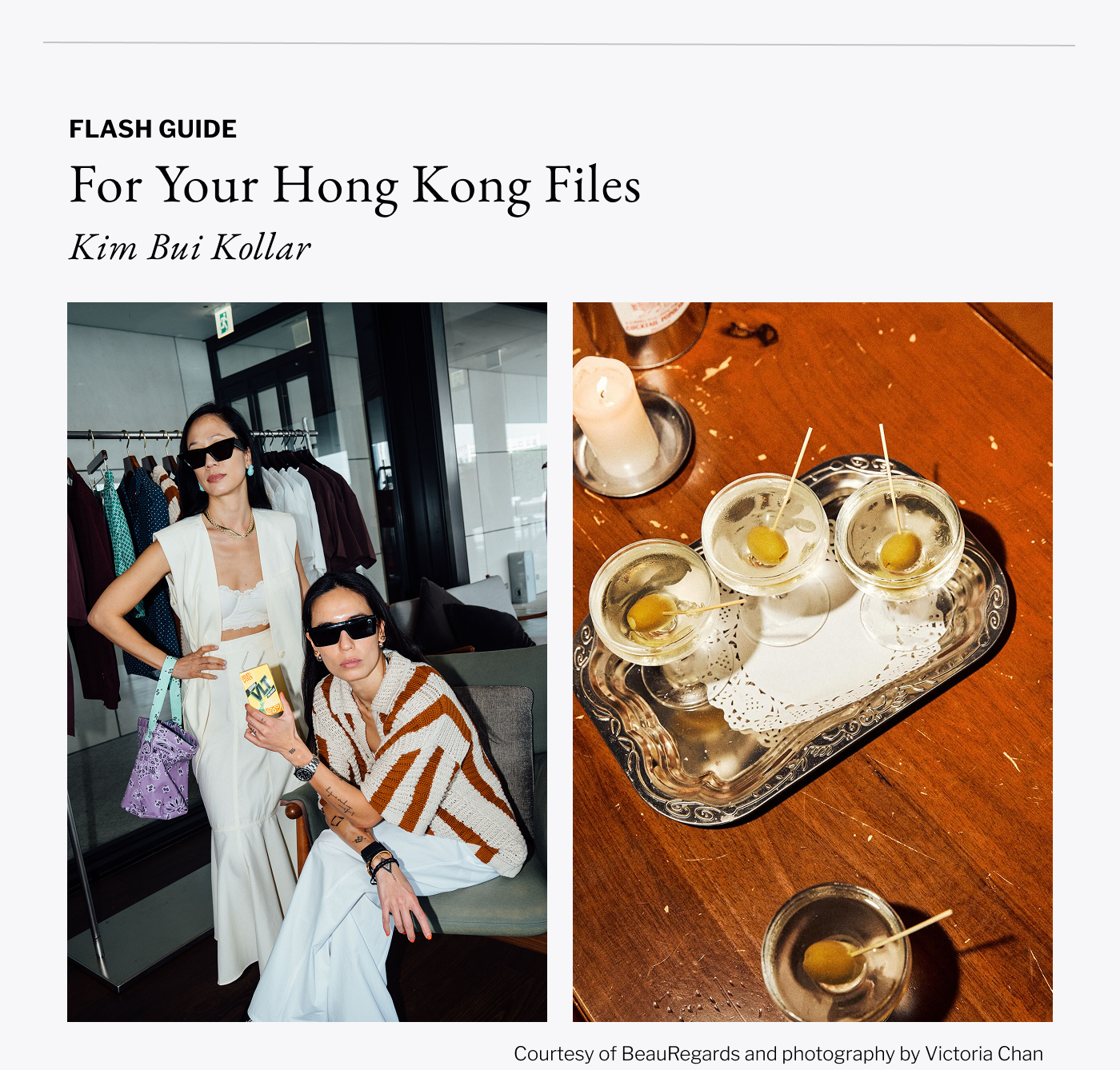
After a decade in New York, grinding in the fashion industry for brands spanning 3.1 Phillip Lim and The Pedder Group (one of Asia’s premier luxury retail groups), Kim Bui Kollar needed a sabbatical. So when her partner was offered a transfer to Hong Kong for a year, she joined him. That was 15 years ago. “When people ask me what brought me to Hong Kong, my answer is: I moved here for love,” she says. But the city’s constant buzz, urban-island landscape, remarkable efficiency, cultural scene, and (government-supported) entrepreneurial spirit have kept her there. Earlier this year, she joined forces with fellow fashion veteran Kelly Wong to launch BeauRegards, a luxury concept store designed for travel-minded individuals, tucked into Rosewood Hong Kong.
Here are a few of her other favorite haunts in the city.
Something to eat and drink … the scrambled eggs at Australian Dairy Company, a cha chaan teng (traditional Hong Kong diner) in the Jordan neighborhood on the Kowloon side. They use Kowloon Dairy milk in their food and drink (evidenced by crates of the locally bottled milk stacked at the front of the restaurant). The other must-orders are Hong Kong classics, such as macaroni pasta soup with ham, which might be even more comforting than traditional chicken noodle soup, and dong ling cha (iced lemon tea). Expect a long line, a bustling atmosphere where being rushed is the norm, and very little English. For wonton noodle soup, head to Mak’s Noodles, where the noodles have snap and the shrimp in the wontons has spring. The bowls are small, which makes this a great snack stop. Fat J’s Char Siu serves up the most incredible Cantonese roasted meats. Bar Leone specializes in aperitivi, but its Filthy Martini made with smoked olives would win any martini competition (even for dry martini diehards). Also, people don’t talk about the white bread from Hong Kong enough: It’s fluffy, spongy, and slightly sweet. Sandwiches here are so simple, in fact, because the bread is so unique.
Something to see … Hong Kong Ballet. Septime Webre has led the artistic direction for the ballet company for nearly five years, weaving Hong Kong culture into his productions and tapping talent from the area, as well as internationally. If you have the chance to see one of the classics — The Nutcracker or Alice in Wonderland — you must. Shows are usually held at the Hong Kong Cultural Center in Tsim Sha Tsui, which is right on the waterfront, a lovely place for a walk and nightcap at one of the hotels along the strip.
Something to take home … Flagrant Hot Sauce. Chef Matt Abergel is a James Beard Award-winning chef who has earned a global following for his Michelin-starred yakitori restaurant Yardbird. Flagrant is a yuzu-based hot sauce he developed with two friends while experimenting with fermented chilies. It has such a distinct taste that uplifts both Western and Eastern cuisines.
Only in Hong Kong … A hike on Violet Hill, Dragon’s Back, or The Peak is an absolute must to take in the spectacular views and the visual contrast of urbanity and nature. One of the things that blew me away when I moved here was discovering that the lush, tropical area of Hong Kong is just a 20-minute drive from the city center.
A secret place … There is a tiny opera house on Po Toi, the southernmost island in Hong Kong, called the Bamboo Theater, where Cantonese opera is performed during the Tin Hau festival. It stands upon large beach rocks that can be seen from the ocean. To the point: There is only one way to get to Po Toi — by boat. Share a vessel with friends, tour the temple and theater, then have a Chinese seafood lunch at Ming Kee, near the water.
|
|
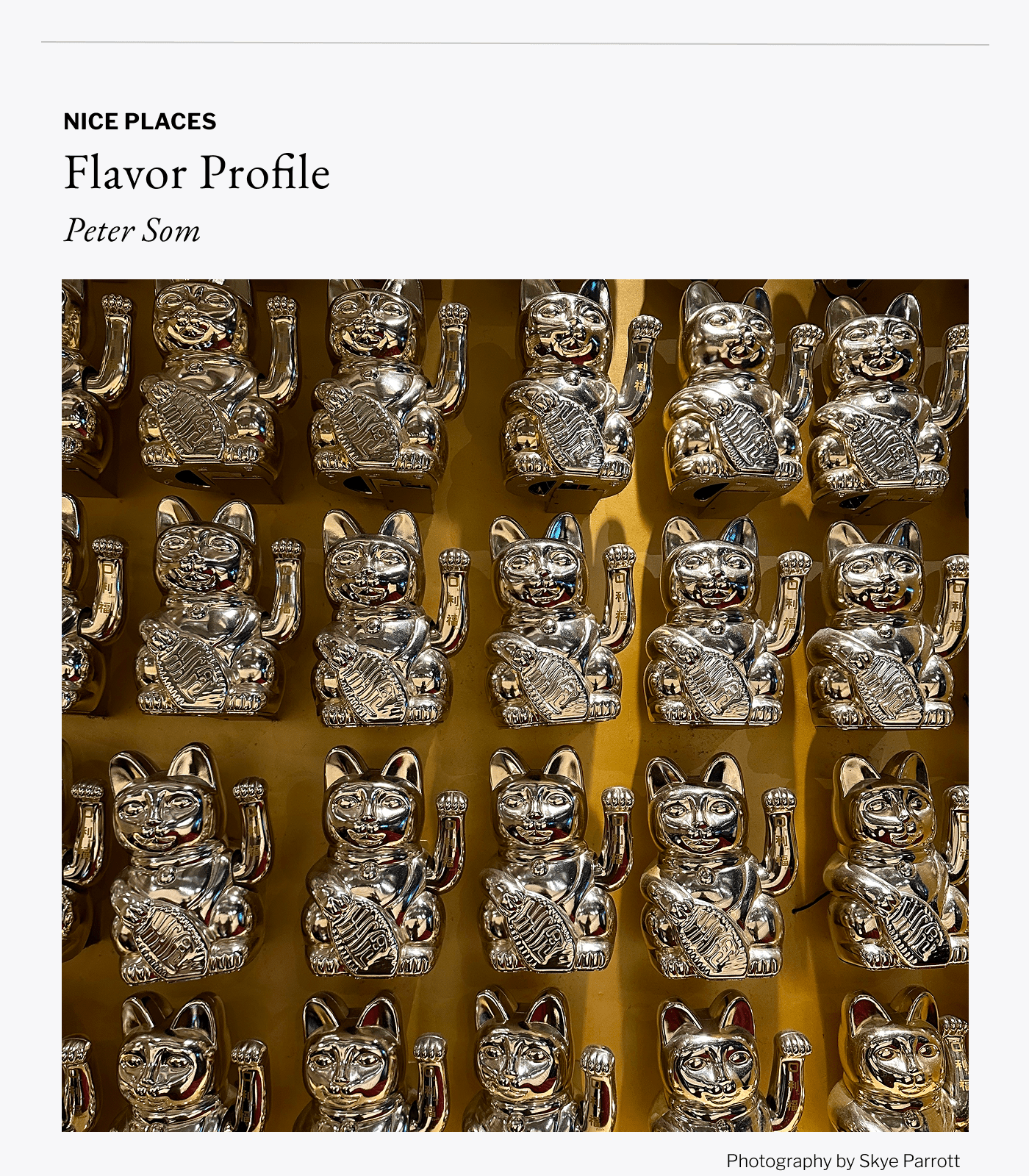
Hong Kong holds such a special place in my heart. I love the old-school elegance of dim sum at Luk Yu Tea House. Yes, it’s touristy, but those wood-paneled walls and steaming har gow are pure nostalgia. When in town, I also never miss an opportunity to sample the iconic egg tarts from Tai Cheong Bakery, located just around the corner. Ho Lee Fook is another favorite spot, serving up bold Cantonese with a twist. Add funky interiors and it feels like a night out and a great meal rolled into one. Back in New York, I’ll often eat at Cha Cha Tang — one bite of the Cantonese duck amidst that lacquered interior sends me right back to my hometown. I also always have a jar of Yu Kwen Yick chili sauce in my kitchen. It’s spicy, tangy, and instantly transports me to my childhood. |
|
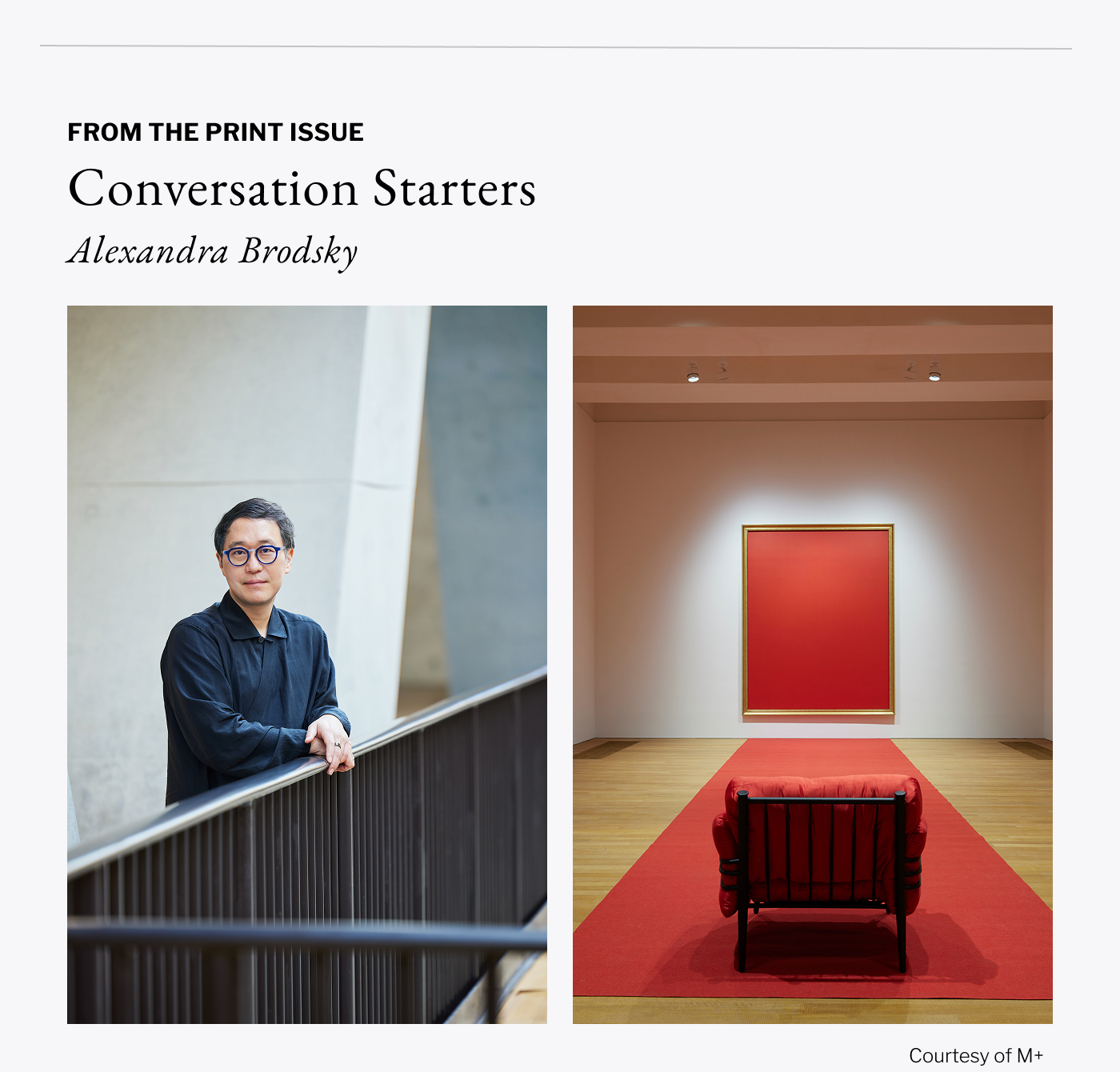
Doryun Chong, Artistic Director and Chief Curator at M+ in Hong Kong, has been engaged in shaping the museum of visual culture’s vision since 2013, an experience he described to me as “the most fulfilling of his life.” In our conversation, he also reflected upon the museum's significant Sigg Collection, and how M+ represents not just Chinese contemporary art but also a broader spectrum of Asian and global visual culture. He offered insights into the museum's curatorial approach, highlighting the recent M+ Sigg Collection: Another Story exhibition, which challenges traditional narratives and encourages dialogue between Eastern and Western artistic traditions. And he provided a fascinating glimpse into the dynamic, evolving world of contemporary art in Asia.
Alexandra Brodsky: Was there something about Hong Kong from a curatorial or cultural perspective that drew you to the city? Or was it the project of the museum itself?
Doryun Chong: All of the above. Growing up in South Korea in the ’80s, my generation of people have very fond memories of Hong Kong. I always try to explain to our young colleagues here, who are in their 20s and 30s, that Hong Kong was to us what South Korea is for them, which is the place: an amazing global culture powerhouse with music, film, TV dramas, and just everyday popular culture. It was so influential. I think all of us had a certain romance [with it].
AB: I wanted to speak a little bit about the Sigg Collection. Uli Sigg donated around 1,500 works to the museum in 2012. Was the building designed with the collection in mind, or was the collection brought to the building after its design?
DC: One of the first things that Lars Nittve, the museum’s first executive director, did was talk to Uli [Sigg] because part of his mandate was to build a permanent collection from the ground up. If you look back on the histories of important museums, like MoMA for instance, you need a major anchoring donation to be able to build it right. And Uli Sigg decided that M+ and Hong Kong was the place his collection needed to go. It is the world's most important collection of contemporary art that came out of China over the course of 40 years — from the late ’70s to early 2010.
And as significant as that collection is, M + has a bigger envelope. We look at visual art from across all of Asia and even beyond. Design and architecture is the next discipline, and moving image is the third discipline.
AB: How did you arrive at the narrative focus of the M+ Sigg Collection: Another Story exhibition? Were there any particular works that anchored the show?
DC: The very first exhibition of the M+ Sigg Collection was called M+ Sigg Collection: From Revolution to Globalization. It sequentially and chronologically walked through the birth of contemporary art in the wake of the Cultural Revolution, going through the most important movements and phenomena that happened in art in China.
We really felt that first-time visitors to the museum needed to walk through the history in the most clear, textbook-like way. Having done that, we decided to immediately change the story to say: Well, that's not the only way you can understand Chinese art history. There's always another angle. That's why we called it Another Story. And that exhibition has perhaps a lot more ambiguity. It is, at times, very impactful. But it has kind of, sort of grand emotional feelings, and there's sometimes also much more subtle and ambiguous feelings …
Read the full conversation and more close takes on a wide world in our Spring/Summer 2025 print issue. Order now.
|
|
Ah, Hong Kong — that marvelous density of information, color, texture, and patina. Brutalist buildings covered in turquoise tile next to smoked glass skyscrapers rusting in the tropical air like a Star Wars droid. A magical smorgasbord of food, light, and sound. One of the great joys of my life has been getting to know the real Hong Kong and marveling at its difference from the cultural references I had in my head before arriving — how monumental and panoramic it is in comparison to the intimate hot houses of Wong Kar-wai films; how remarkably compact and easily navigable it becomes via curlicue highways and gurgling ferries; how endlessly enchanting it can be, coaxing you into stays of weeks, months, more … Especially if you are lucky enough to tuck into a cozy wood-panelled room inside The Upper House overlooking Victoria Harbor, watching the odd junk sail by, torn between the exquisite pleasure of floating in the sky and the pull to rush out into the streets. |
|
Bubbled Over. Domaine Carneros produces some of my favorite sparkling wines. If you’ve driven through Napa Valley, you’ve likely spotted its famous château, where you can sit on the patio and sip the aforementioned bubbly or an equally lauded pinot noir, accompanied by views of the estate’s expansive gardens and vine-covered hills. If you’re as taken by the vintages as I am, you can also join The Château Society, the domaine’s popular wine club, which gives you access to tastings in the winery’s private room — with seasonal pairings spanning caviar, oysters, lobster, even pizza — and delivers bottles to your doorstep throughout the year. –Elissa Polls
Daddy's Girl. In Eurydice, now playing at New York’s Signature Theatre, a tragic love story is expectedly present. But in playwright Sarah Ruhl's terrific reimagining of the classic Greek myth, the primary relationship is actually between Eurydice and her deceased father. The addition of parental love made the theme of mourning — its necessity as unbearable as it may be — particularly poignant, as did the tender performance from Brian d'Arcy James, who basically squeezed, stretched, and massaged my heart for 90 minutes. Maya Hawke as the titular character is also brilliant (putting any jabs at her nepo baby status definitively to rest). –Jackie Risser
Food for Thought. If there’s one thing guests are unlikely to do on a luxury cruise ship, it’s go hungry. This is especially the case with Silversea since its S.A.L.T. (Sea And Land Taste®) culinary program not only serves you high-end cuisine, it also teaches you how to prepare it. On a recent Saturday, I boarded its Silver Moon ship to experience it all firsthand. Walking into its test kitchen felt like entering an episode of Chef’s Table. Soon I was chopping green onion, searing mahi-mahi, and dicing tuna as an expert chef guided me through Hawaiian recipes reflective of the ship’s next destination. I debarked post-meal with a story, skill, and the sensation of having dined on the islands. –John Chuldenko
|
|
54 Franklin St #2R NY, NY 10013. ©2024 Dossier Projects, LLC.
|
|
|
|
|