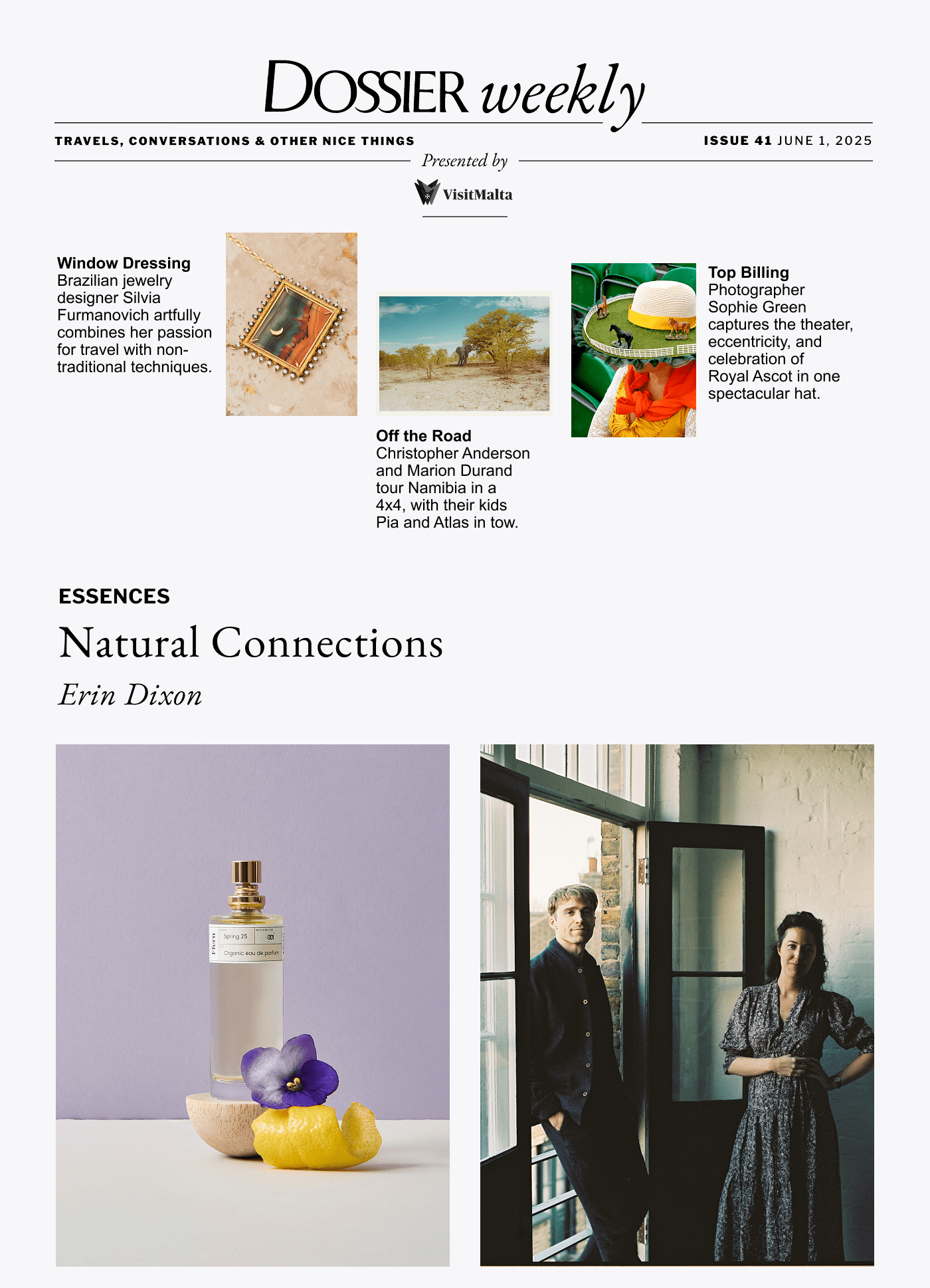
Siblings Emily Cameron and Owen Mears’ childhood was stamped in scent — those of Europe’s first biodynamic herb farm, in Somerset, England. Its owners were their neighbors and friends, so the pair spent their days running through fields of echinacea and lemon balm and marshmallow, distinct fragrances that changed with the seasons and mingled with spices, such as cardamom and cumin, which the farm’s owners shipped in from abroad. “It was a really heady concoction, an incredibly rich tapestry of scent,” Cameron remembers.
Decades later, quite like their childhood neighbors and in the same landscape, Cameron and Mears are weaving their own tapestry, creating natural perfumes inspired by nature and nostalgia, designed to connect their creators and wearers to the natural world. It is a link Mears missed while at college in Oxford and which precipitated his interest in fragrance, eventually leading him and his sister to found their organic eau de parfum company Ffern. “The more I dug beneath the surface of the fragrance industry,” Mears recalls, “the more I realized that, today, it has almost nothing to do with the world of growing and horticulture. But we came at it from our world and thought: This is such a shame. This product has so much potential to connect you to nature, connect you to something really beautiful, to be something with so much story behind it. Yet nobody’s doing that. That was the clear vision behind Ffern — to elevate perfumery and treat it like a true craft product, as opposed to a synthetic commercial product.”
Ffern’s unexpected, modern, non-gendered eau de parfums are created in collaboration with house nose Elodie Durande, protégé to legendary perfumer François Robert, who also worked with Ffern to shape the house style and who remains a great friend of the company. Its ingredients are invariably sustainable and organic, and range from traditional (bergamot rind and rose de mai) to experimental (peach water byproduct and Italian potato vodka). Production is small batch and centered on seasonal scents that evolve year on year, like a fine wine.
For example: Spring 2025 recalls the scent of Spring 2024, but is subtly different, akin to how Château Mouton Rothschild changes with each vintage, Mears explains. “We want to make cutting-edge natural perfume, to harness something from the past but not feel like we’ve returned to it,” he elaborates. “There are so many exciting things you can do if you apply really modern methods and really modern thinking to the field of natural perfumery. The end goal of every single thing we do is to have the wearer fall in love with their perfume — to have them find it brings them joy and that they feel deeply connected to the seasons and to nature.”
The Scent of Spring. This season’s Ffern fragrance captures the company’s philosophy in a fresh, sparkling scent that drops you into a woodland field, just awakening from its invernal slumber. Delicate notes of rose de mai, lavender, and ylang-ylang gently dialogue with the perfume’s hero, violet leaf, to capture the intoxicating brightness of the spring, lifted by the fresh zest of Sicilian lemon rind and grounded by warming orris, the root of the iris plant.
At the same time, the scent showcases the magical ability of perfume to metamorphose, responding to its wearer’s body chemistry and awakening personal memories — for me, they are of dew-soaked Pacific Northwest forests enlivened by fleeting sunshine; for its makers, they are of an imagined fairytale forest filled with childhood stories and intrigue. This inspiration is reflected in the box of ephemera that accompanies all Ffern fragrances upon their arrival. Spring 2025’s contains a redolent portrait titled “Violet” by artist Lizzie Riches, a violet-pressed diffusion stone, and candied violets.
The scent is also available in the company’s first Perfumer’s Candle. True to Ffern’s foundational ethos, it's made from a 100% plant-based, nontoxic, paraffin-free wax blend and beautiful inside and out. The recycled double-walled steel vessel that holds the candle is designed by Mears to be repurposed as an objet d’art, drawing inspiration from traditional silverwork and stamped with an enamel artwork by Cory Feder. Set into the lid, it features an ethereal figure resting in a field under a blanket of stars, with a celestial hare by her side. |
|
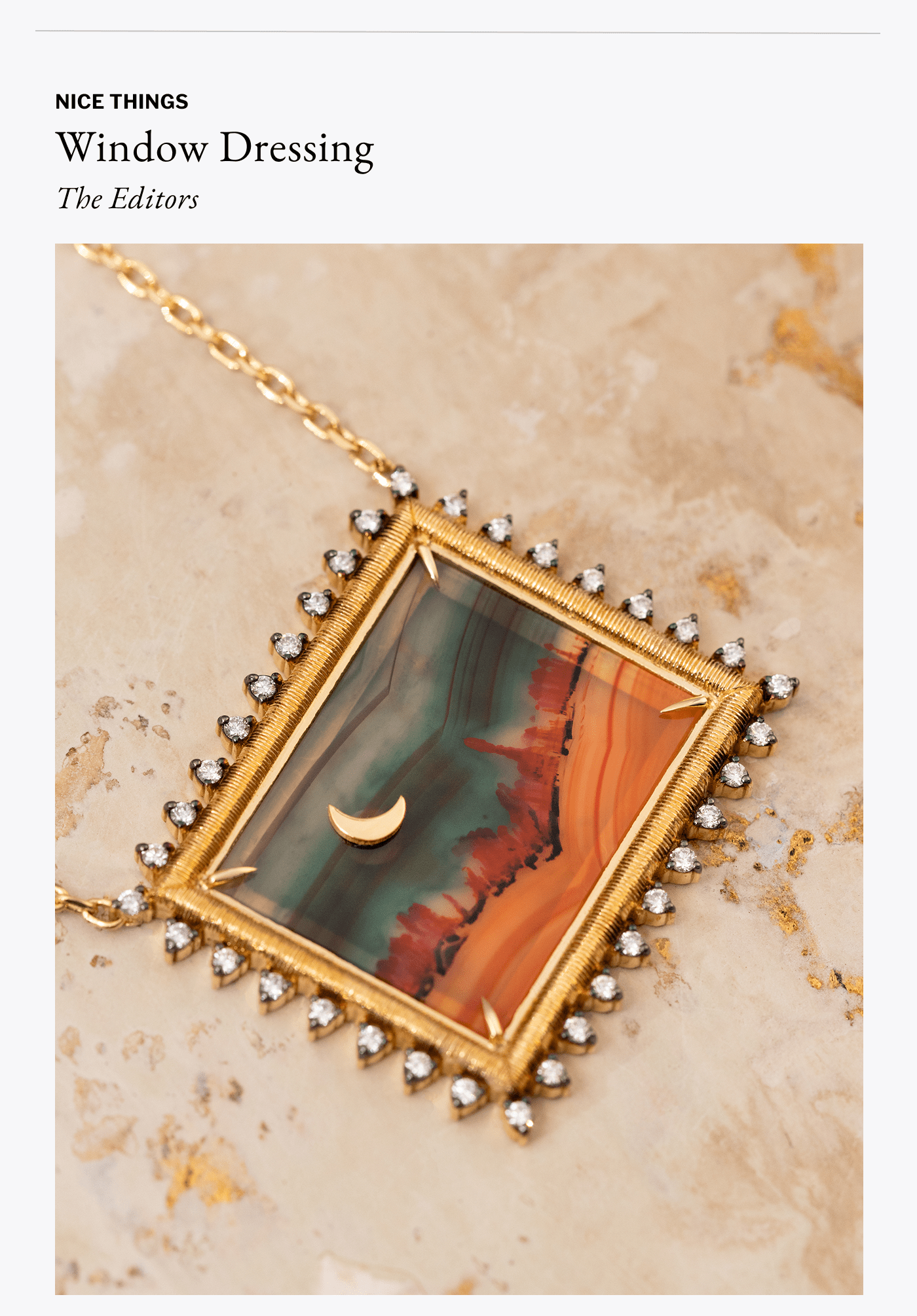
From wood marquetry to horse-mane weaving, Silvia Furmanovich employs non-traditional materials and techniques to create designs that regularly elicit oohs and ahhs. Born in São Paolo, Brazil, to a line of Italian goldsmiths, the jewelry designer combines this meticulous attention to craftsmanship and detail with her passion for travel into symbolic pieces that toe the line between art and fashion. Imagine bifurcated butterfly earrings; carved, jewel-inlaid scarab rings; and sculptural orchid bracelets. This signature ethos also memorably manifests in the painterly pendant we spotted at Bergdorf Goodman in New York, where the designer recently unveiled Around the World, an exhibition celebrating her namesake company’s 25th anniversary. Featuring a slice of agate sourced from a Japanese collector framed by a gold square trimmed in white diamonds, the scene could be a portal to a majestic desert landscape. And it would look just as fitting on a museum wall as it does laid against décolletage. |
|
For my husband’s birthday last week, my eight-year-old daughter suggested we take him to dinner. “I know, Mama! Let’s go to Le Tout-Paris,” she brightly proposed. It took me a minute to process — because Le Tout-Paris is a Michelin-starred restaurant, and what eight-year-old would suggest that? Mine. The same one who had recently invited me to her room to play “restaurant.” Before I arrived, she’d drawn stars on a piece of paper and affixed it to her door. “Welcome to my restaurant,” she’d said. “It has three stars.”
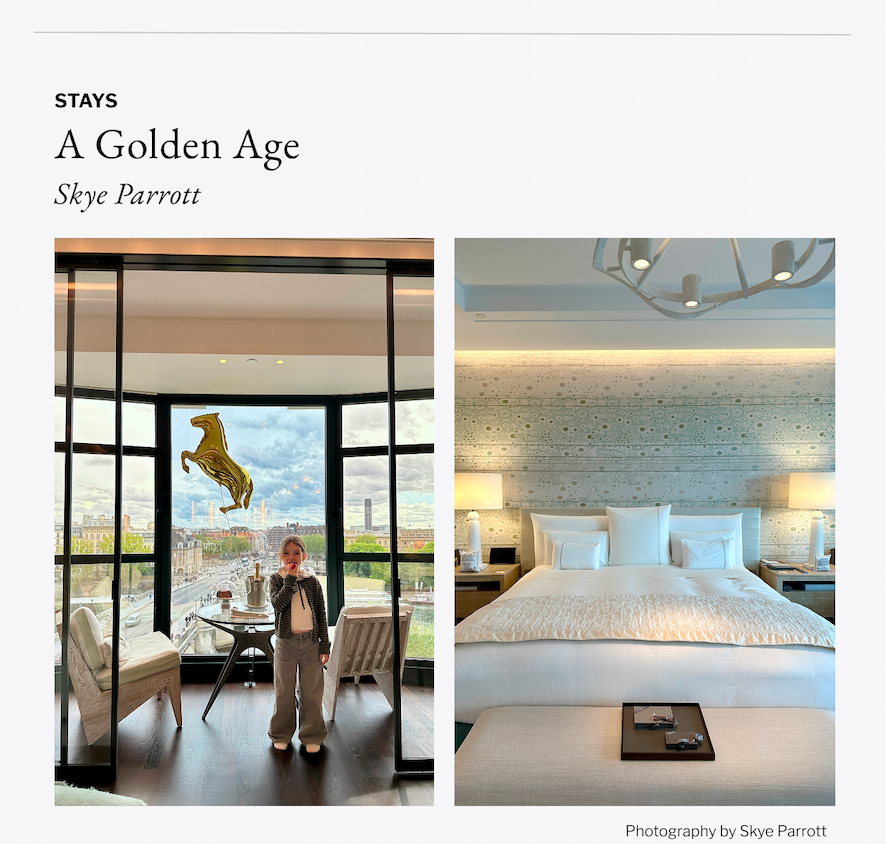
This is my fault. My daughter is aware of the lauded Michelin Guide’s rating system because it’s part of my work, and I certainly didn’t do anything to assuage the situation by taking her to dine recently at Le Tout-Paris. It was her birthday and she had joined me for a stay at Cheval Blanc Paris, the hotel it sits atop. Cheval Blanc opened in 2021 after seven years of construction and immediately received entry into Palaces of France, a coveted designation the country offers properties that are five star — but even more so. Cheval Blanc presents a lustrous and very specific concept of luxury, one that is in active conversation with the rest of its owner LVMH Moët Hennessy Louis Vuitton’s portfolio, particularly with its fashion brands.
The hotel occupies the front section of the building that houses Samaritaine, a chic (LVMH-owned) department store, allowing guests to book private shopping experiences; it features a Dior spa with incredible facilities and exclusive treatments; and it sits catty-corner to Louis Vuitton’s imposing headquarters. The entire scene looks out over Pont Neuf, the city’s oldest and most storied bridge, which always reminds me of LVMH’s supreme prominence in Paris: In 2023, the luxury conglomerate shut down the historic bridge and covered it in gold foil to host a runway show for Pharrell Williams’ debut Louis Vuitton menswear collection. This genre of audacious luxury is on display at Cheval Blanc. The property is jaw-dropping and meticulous. Its cavernous lobby and interiors are designed by Peter Marino (whose retail collaborations include Dior, Louis Vuitton, and Tiffany), and it’s bursting with art. Many guestrooms feature terraces perched dreamily above the Seine, and Le Tout-Paris is but one of the 72-room hotel’s two Michelin-starred restaurants. In the spa, along with a hammam, sauna, and ice shower, there’s a massive pool with a digital projection of the river flowing past.
I was invited to experience the hotel with my daughter because Cheval Blanc, along with being the sine qua non of composed French luxury, is also, quite family friendly. We were not the only mother-daughter duo dining at the restaurant that night, and she was far from the youngest guest. We spent part of our meal waving at a young visitor who kept stopping by our table. The waiters looked entirely unbothered, and the environment was remarkably relaxed during our three-hour meal. Returning to our room afterwards, we found a bubble bath drawn for my daughter.
The hotel’s kids’ club, Le Carrousel, was another revelation. Designed in collaboration with French sailor Maud Fontenoy, it features two rooms: one bee-themed (a nod to Dior’s emblem) and the other inspired by Twenty Thousand Leagues Under the Sea, complete with a tank of glowing jellyfish and another with axolotl. It’s where my daughter stayed while I got a facial at the spa. (Had we planned better, she could have joined me: Treatments are available for and tailored to children ages three months to 18 years). When I came back to the club, I found her playing with a butler, Victor. He was on all fours galloping across the room — her “pony,” she explained to me. I was slightly aghast at the scene, which reminded me a little of The Toy, an early ’80s movie in which Richard Pryor is hired to be, well, a human toy for a spoiled child. But Victor was young and fit and jumped up from his crouched position, assuring me playing was one of the best parts of his day.
After 24 hours at Cheval Blanc, I wanted to remind my daughter of her normal life, so when the staff offered to call a taxi, I demurred. Instead, we walked across the street to catch the metro home. Back to normal — or so I thought until my daughter had a sleepover at her friend’s house. The following day, we heard from the friend’s parents that when they rolled out a mattress for my daughter to sleep on, she sat on it, gave a little bounce, and nodded her approval before declaring: “Comfortable, but not as comfortable as at Cheval Blanc.” |
|
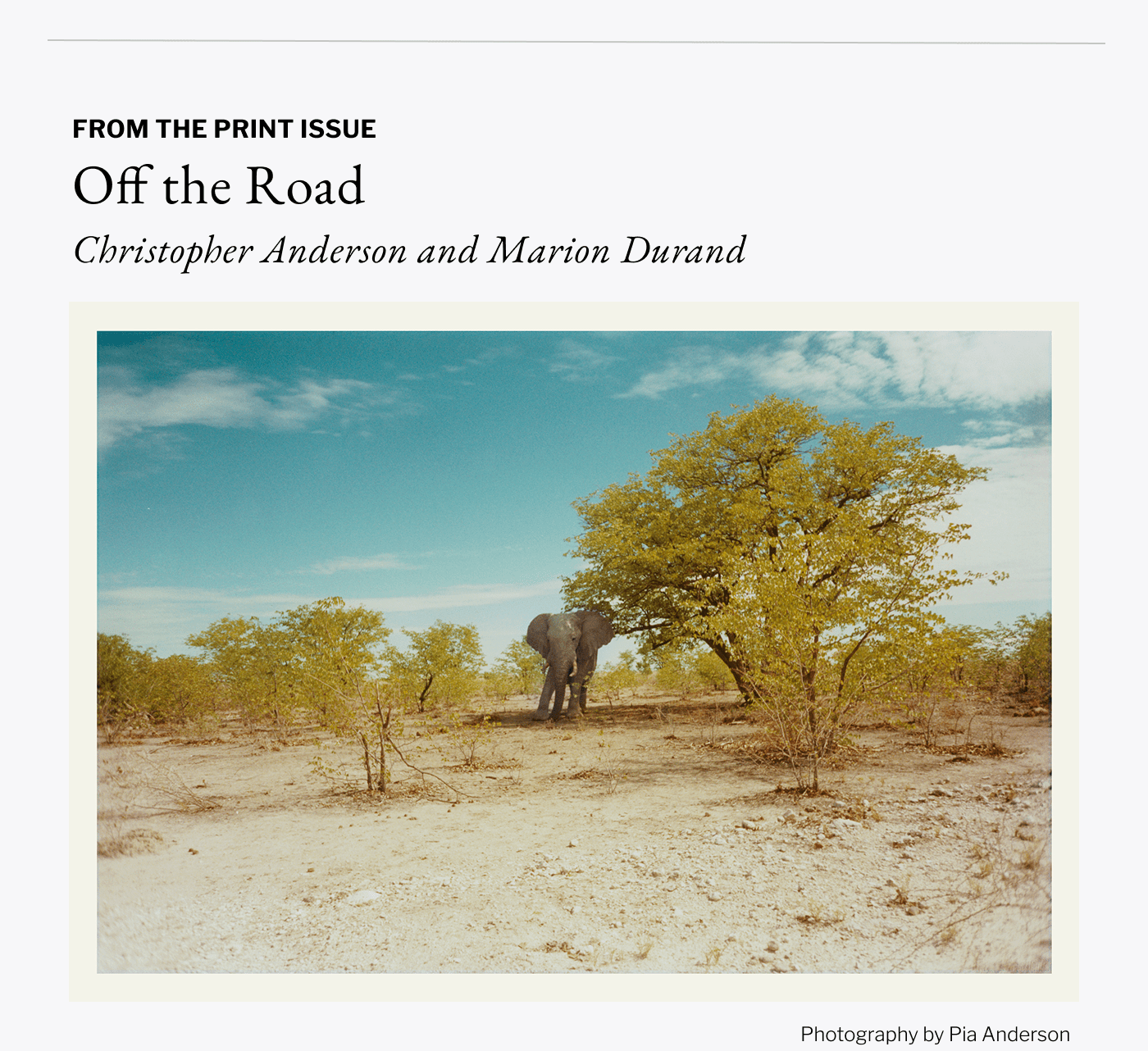
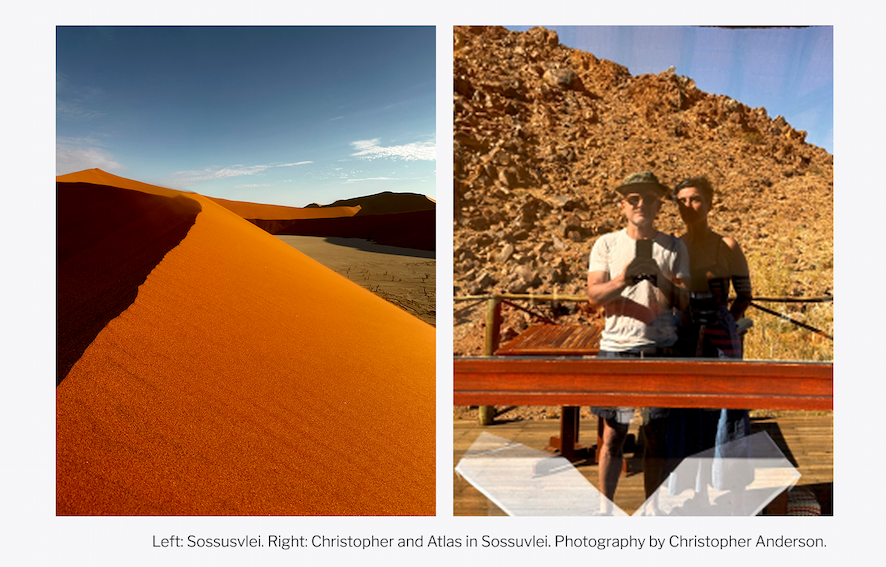
Namibia was a big trip we dreamed of taking for a long time — the kids were growing up and we really wanted to see the animals. We made a big loop around the country in a 4x4 with two tents perched on the roof … |
|
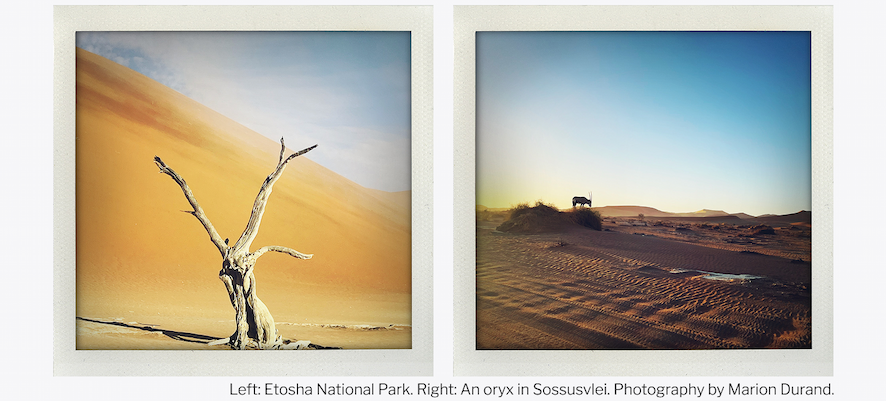
Sossusvlei is a salt and clay pan surrounded by massive orange sand dunes and desert. Its trees are believed to have died around 700 years ago, but their wood hasn’t decomposed because the area is so hot and dry. |
|
We stayed two days at Etosha National Park, which is situated up north on a salt pan formed over 100 million years ago and where around half of Namibia’s animals reside — wildebeests, springboks, lions — along the side of the road.
View the full portfolio and more close takes on a wide world in our Spring/Summer 2025 print issue. Order now. |
|
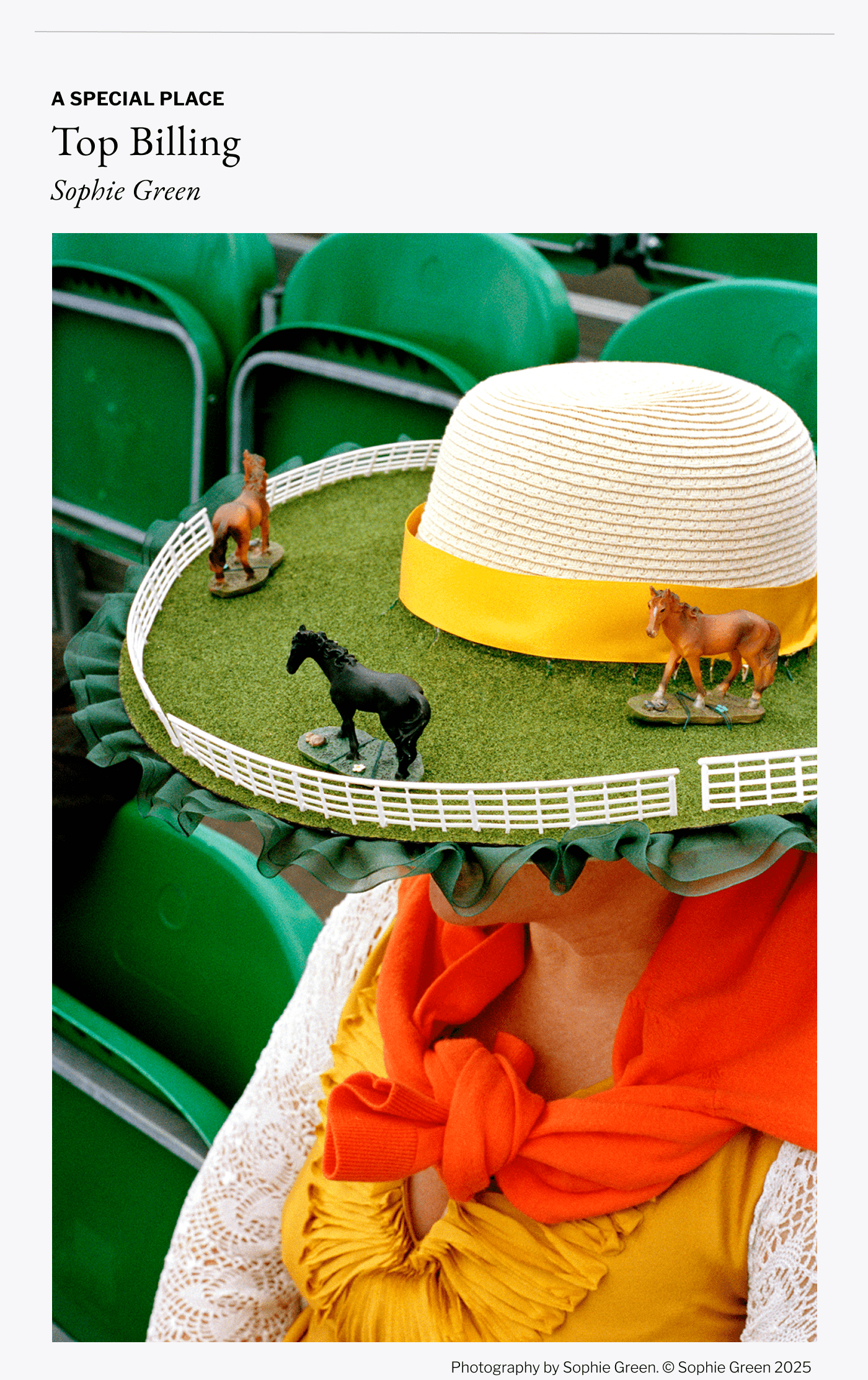
For most, a Royal Ascot adrenalin rush is seeing their horse win. For me, it was spotting this woman’s fabulous hat — a self-made masterpiece complete with astroturf, plastic horses, and a grazing scene. Dressing for the races is often an eccentric performance, and I felt she was subtly mocking the event’s pomposity.
Ascot is, in many ways, a microcosm of British society. The sharp contrasts are everywhere: in the food, the fashion, and the experience itself. Some guests sip champagne and eat canapés in private boxes; others picnic on sausage rolls and drink warm beer from plastic cups in the general enclosure. The class distinctions are visible but also fascinating in their transparency.
This woman’s cheeky hat summed it up perfectly: a celebration, a satire, and a statement — all worn on her head.
For more of Sophie Green’s work, view her recently released book, Tangerine Dreams, an exploration of belonging in contemporary British life. |
|
Safe and Sound. I spend an inordinate amount of time on four wheels, so I feel confident in saying that Volvo’s upcoming, all-electric EX90 can turn anyone into a car person. It’s awash in tasteful finishes and textures — light ash, wood, wool — that link the design to its Scandinavian roots. It’s also poised to be Volvo’s safest car ever, with cameras, radar, lidar, and integrated AI, all trained to evaluate the outside world and avoid impending incidents. There are also cameras and sensors aimed at the driver that detect distraction and fatigue. I test drove it along Santa Ana Mountain roads, noting how the three-row model remained stable and smooth through curves. And with two motors, the car’s as quick as it ever needs to be. Still, it’s remarkably quiet — even for an EV, until I played the Atmos mix of “When Doves Cry” through its Bowers & Wilkins stereo. There are flashier, more opulent SUVs, but nothing that’ll exude this kind of low-key confidence while gliding silently through the school drop-off line. –John Chuldenko
Cover Story. Dermatologist-favored, editor-acclaimed skincare brand Colorescience has a lot to recommend it, starting with science-backed formulas such as its Barrier Pro 1-Step Cleanser. But I first fell in love with its offerings thanks to Sunforgettable Total Protection Face Shield Flex, a tinted lightweight mineral sunscreen I apply daily, year-round. I’m now layering it with another of the company’s offerings: Sunforgettable Color Balm, which protects and hydrates lips, cheeks, and eye lids while adding a flattering pop of color (including two new seasonal shades: Glow and Savanna). This tiny SPF 50 stick has taken up permanent residence in my purse alongside Colorescience’s award-winning powder sunscreen, which comes in a compact tube with a built-in brush applicator for easy on-the-go protection. –Erin Dixon
Fit for a Queen. My family goes all out for my grandmother’s birthday, and this year was no different. We took her to Bellefeuille, the Michelin-starred restaurant tucked inside Saint James Paris, the 19th century mansion turned hotel. Nature plays a central role in the restaurant’s elegant dining experience, from its lush green seating and botanic wallpaper to a vegetable-forward, seasonal menu crafted by chef Grégory Garimbay. We savored delicate white asparagus, Culoiseau chicken, and an artistic chocolate dessert. With only a few tables, the intimate venue was grandmother approved — as was the very patient staff who happily kept up with her requests. –Anna Kaplan
|
|
54 Franklin St #2R NY, NY 10013. ©2024 Dossier Projects, LLC.
|
|
|
|
|