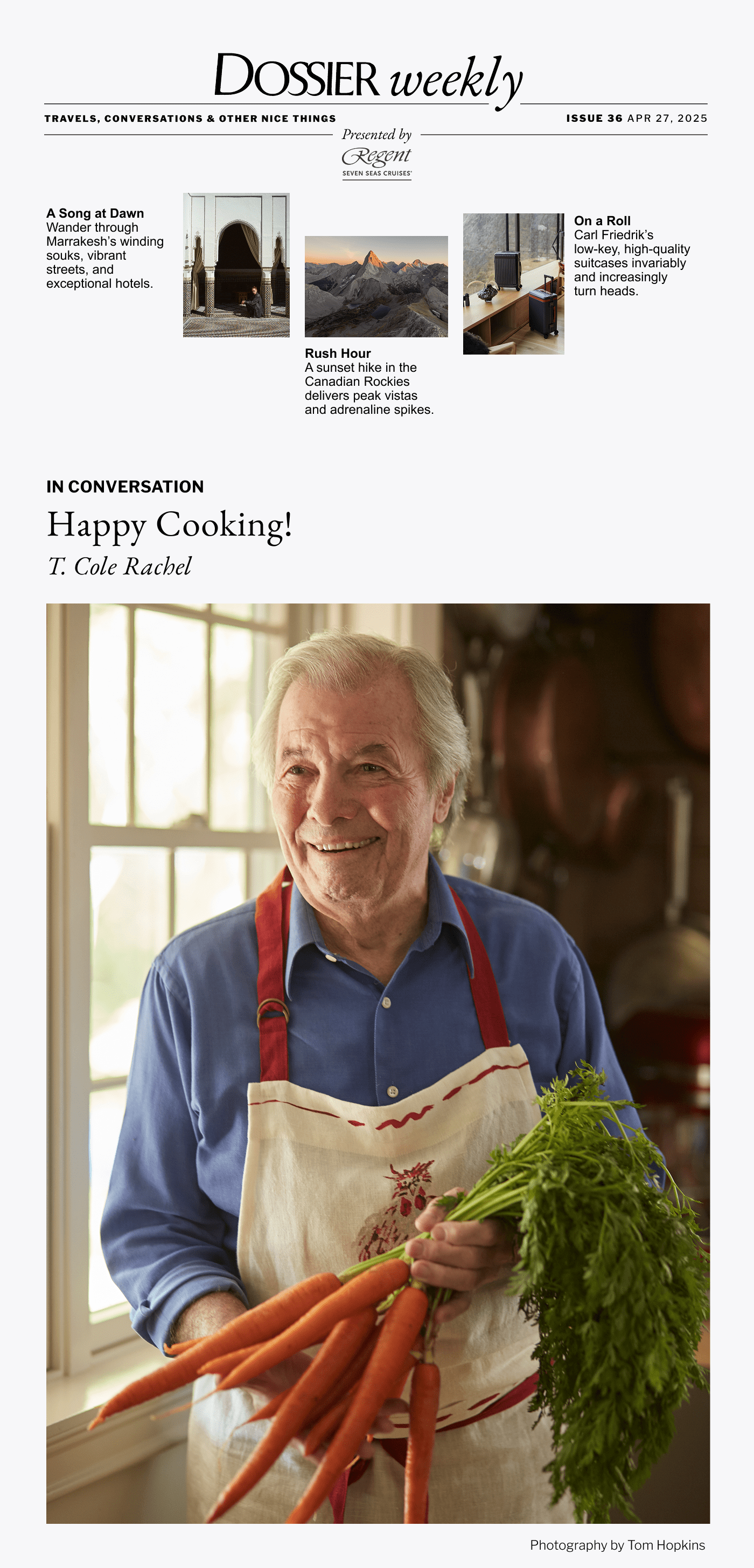
Few chefs command the same universal good will — or can claim the same vast influence on the culinary world — as
Jacques Pépin, with the possible exception of
Julia Child. Over the course of his career, Pépin has published over 30 cookbooks, collected 16 James Beard Awards, and filmed hundreds of episodes of television shows (his PBS series with Child,
Julia and Jacques Cooking at Home, picked up an Emmy Award in 1999). He is also the only person I’ve ever met who can not only boast about serving as personal chef to French president Charles de Gaulle but can also say that he turned down the same job when it was offered by John F. Kennedy.
To celebrate Pépin’s 90th birthday this forthcoming December, the
Jacques Pépin Foundation is hosting a series of 90 dinners across the country. Helmed by a who’s who of famous chefs and notable restaurants, they are designed to both celebrate Pépin and raise funds to help further the foundation’s mission: to offer life skills and training to individuals with high barriers to employment and to provide grants and educational materials to further culinary training in communities across the country.
I had the good fortune to share a celebratory dinner with Pépin and his family at Manhattan’s
Gramercy Tavern, an event hosted by chefs Danny Meyer and Michael Anthony to kick off the festivities. Ahead of the meal, I sat down with the venerable chef and Rollie Wesen, executive director of the Jacques Pépin Foundation, to talk about travel, education, and of course — good food.
T. Cole Rachel: Having worked around the culture of food for so long, you must have been surprised to see how radically that world has changed in terms of how chefs are elevated and our literacy around cooking and food.
Jacques Pépin: There is no question about it. But if you live with it, then you don't realize the change as much, of course. But, yes, back when I was chef to the president in France (between '56, '58) not once did anyone call you to the dining room to say ‘thank you’ or ‘hello.’ Are you kidding? The cook was in the kitchen. I had never had one interview in France. The cook was really very low on the social scale.
That’s one of the reasons I came to America, where I worked at
Le Pavilion, a great restaurant. In 1960, I was up for the job at the White House, but I went to work for Howard Johnson instead. People always ask me how I could have made that choice, but you have to look at it in the context of the time. I had been in New York for a year or so; I was studying at Columbia [University]; I had friends in New York; I didn’t want to charge everything again. I didn't really think of the potential of the White House because of the experience I’d had in France. It didn’t sound all that glamorous or amazing. It would just be a different kitchen.
Frankly, I went to work for Howard Johnson because of Pierre Franey, the executive chef at Le Pavillon. Howard Johnson was a regular customer at Le Pavillon; he hired Pierre. Working for Howard Johnson — imagining those restaurants — was a different world. When I left Howard Johnson after 10 years, I opened
La Potagerie on Fifth Avenue. I was a consultant for The Russian Tea Room. Then I opened the World Trade Center with Joe Baum. We served between 30 and 40 thousand meals a day. I would never have been able to do any of those jobs without the training of Howard Johnson. I would have never worked with chemists and with mass-production stuff. I learned a great deal at Howard Johnson.
TCR: I was thinking today about the evolution of the American perception of fine dining. I grew up on a farm in Oklahoma in the 1980s; the only cooking shows I saw were on PBS. I would often see your show and I would see Julia Child. It was before the Food Network existed, before the democratization of food culture.
Rollie Wesen: That was really the beauty of Julia Child when she was on television doing The French Chef. Prior to that, we had this idea of Continental cuisine; we had this idea of the really stuffy and powerful maître d'. It was class prohibitive. It was cost prohibitive. It was language prohibitive, because the menus were written in French. Then here comes Julia: She was just fearless and courageous and didn't care if you made a mistake. She said, "If you make a mistake, don't worry about it. No one's going to see it. Just go for it. You can do it." At the same time, there was Craig Claiborne, the American restaurant critic, going to Le Pavillon and the other restaurants in New York saying, "We have great restaurants. It doesn't have to be French. It's often French, but it doesn't have to be." The confluence of that, then Jacques coming on the scene, really changed a lot of people’s thinking around fine dining.
JP: Craig created the vocabulary of food criticism while at The New York Times. I knew him from there; he did a piece on Le Pavillon and he introduced me to Helen McCully, who was the food editor of McCall's and House Beautiful. She kind of became my surrogate mother and she introduced me to James Beard, because she spoke to him almost every day. At some point Helen asked me, “Have you heard about that woman who wrote a book on French food? She sent me the manuscript. You want to take a look at it?” She said, "She lives in Boston. She's going to come to New York. You want to cook with her?" She also said, "She’s a tall woman with a terrible voice." Of course that was Julia. So I knew Julia Child and Craig Claiborne a year after I was here. The food world was really, really small. There was no great American chef at that time. All the chefs I knew in New York were either Swiss, French, or Italian — a totally different world.
TCR: As your career grew, you were often on television and in the public eye; was that hard to become accustomed to?
JP: No, it was never hard for me, really. I stayed focused on the cooking, and I feel very comfortable doing the cooking. I never look further than that. Doing cookbooks was harder. I remember when we did
The Art of Cooking back in the mid ’80s. There were something like 3,000 pictures. It took five years. We broke it down into two volumes, with around 1,500 pictures in each. That is very different to what I do these days, like
on Facebook, for example. At the beginning of the pandemic someone said, "Why don't you do small things — three, four minutes — to show people something simple?" Now we have 1.9 million people following along. It's a different type of cooking, but still … just cooking. Also, the fact is that I'm older now. My metabolism changed; your idea of cooking changes. You don't put as many embellishments on the plate anymore. Now, I’d rather take things away. So, yes, things have certainly changed, and I have changed along the way.
TCR: How has the work of the Jacques Pépin Foundation changed in reaction to how much culture has changed and how supply chains, the way people eat, and the way people buy groceries have changed?
JP: People are perhaps cooking less than they ever have and more than ever before — both feel true. I saw a lot of people get back to cooking for themselves during the pandemic; on the other hand supermarkets are filled with even more pre-made sandwiches and prepared foods than ever before. Recently, in a restaurant, a woman said to me, “We’ve decided that rain or shine, no matter what else is going on, every Wednesday night we’re going to cook at home for our kids.” I said, “That’s a great commitment, but what about the other days of the week?”
Two or three generations ago, everyone learned to cook for their family from their actual family. Then we seemed to skip a generation, where some people didn’t cook at all, and then you see people, now, trying to grow all of their own food. It’s interesting … and also kind of amazing how little people really know about food.
RW: From the foundation's point of view: We teach and inspire people to cook. And we value learning how to cook in a variety of different ways. It helps you grow personally. It helps you improve your health. It helps you save money, and it can help you get a job if you're looking for that skill set and you love being in the kitchen.
We've leveraged everything that Jacques has done in his life, because he loves food and he loves cooking and he loves teaching — plus he's taught in so many different ways. He taught in these little cooking schools all over the country, when he was on the road 45 weeks out of the year. He's done hundreds of hours of television. He's still doing television with the Cooking At Home, but all of it is about teaching and inspiring people to cook.
I’m really interested in what he was just saying about the inequity of our understanding about food. The concept of food literacy is bothering me more and more all the time because, like you said, people are not learning how to cook in school, because we don't teach home economics, and they're not learning how to cook at home, because their parents don't know how to cook. We're like a half a generation away from completely losing our basic understanding of how to cook.
JP: And, on the other hand, there have never been as many great restaurants in America or any part of the world as there are now.
TCR: When I go back to rural Oklahoma, where my family lives, I often go to the grocery store just to see what they have. I’ve been impressed by how the quality and variety of food, even in that small-town grocery store in Oklahoma, have changed in recent years.
RW: They have Sriracha!
JP: When I came to America, a big supermarket opened at 50th Street on First Avenue. Before then, I would have my fish guy, the vegetable place … You had to go to all of these different places to get what you needed, but with this new supermarket everything was under the same roof — great meat, including lobster meat, which for me, as a French guy, was really fancy. But there was only one lettuce, called iceberg. That's it. There was no leek, no shallot, no variety of vegetables. Sometimes there was parsley, very often not. But basil? Forget it. To go to a supermarket now? It's another world compared to what it was 50, 60 years ago.
RW: At the same time, though, the industrial food system has led to a kind of blandification of food. We have more variety in the grocery store, but just this last June, when I was eating delicious strawberries from a local farm, I was pondering how many people have never had a strawberry that wasn't produced by mass-factory farming. It's not the same. I think we're losing some of our taste at the same time we are theoretically gaining variety. We have more things available to us, but are they the right things?
TCR: And are we doing the right things with them?
RW: Right. Are we fostering a local, short chain of commerce that's bringing the right product to the market? The thing that struck me about France the first time I was there was that you would have the most beautiful strawberries or the most beautiful apricots, and it would last for three weeks. Then, for the other 49 weeks, you just wait until they're back in season. Now, we want to have pineapples and avocados and mangoes and strawberries all year round, but they don't taste like anything.
TCR: We grew all our own vegetables when I was growing up. Then we canned things, so in the months when you didn't have the garden you had canned things from the garden.
JP: We did that in France, too. My mother made a lot of canned stuff in jars. Teaching kids in a family how to cook, that's what's important. I remember coming out of school, going home, and running directly into the kitchen. The smell of the kitchen, the taste of the kitchen, the voice of your father, your mother, the cooking and the cleaning up, that stays with you the rest of your life. It's really a big part of growing up. Those memories of food transcend almost everything else. What does the young soldier think of at night when he’s far away from home? He thinks of his mother, grandfather, his father; he thinks about food, of shared meals. Food really becomes love. It becomes security. Our childhood memories are almost always connected to our memories of food and family. When you lose that, or if you never have it, you lose out on this very important part of life. For me, all good things in life connect to the sharing of good food.