Copenhagen has become synonymous with the best of responsible Scandinavian design — in large part because of Copenhagen Fashion Week: What began 20 years ago as the merging of two trade fairs has become the leading biannual event for responsible fashion, with 19 required standards for participating. As the owner of an agency dedicated to advancing brands upholding the highest ideals of craftsmanship and production (related to both raw materials and human rights), I’m deeply inspired by this dedication to future-forward axioms — and drawn back to Copenhagen again and again, not only for fashion week. The city’s array of conscious, luxurious, and distinctly Danish offerings is an exemplary (and replicable) case study of how craft and care can coexist. Below are a few of my most-prized finds. FRAMA. If you want to understand Copenhagen’s approach to sustainable design, start with FRAMA. Its design space and apothecary are housed in the city’s oldest pharmacy, in the Nyboder neighborhood, a historic row house district of former Naval barracks. The brand’s furniture, lighting, and home goods feature that distinctly Danish version of quiet luxury: They’re made with honest materials, such as untreated wood, stainless steel, and natural oils. Everything is meant to patina over time, which is the whole point: Buy it once and let it live with you. The space also smells of the brand’s beautiful apothecary offerings and delicious food from its adjacent Apotek 57 cafe.
Mfpen. Danish menswear tends to lean towards either razor-sharp tailoring or ultra-casual sportswear; Mfpen exists in between. Founder Sigurd Bank has a distinct voice and aesthetic that comes through in his clothes and store … even the music: An epic 600-plus song playlist created by Bank reverberates through the space. His slouchy blazers, boxy shirts, and soft knitwear in muted tones feel effortless, but they’re deeply considered — with most pieces constructed from deadstock fabrics and leftover materials that would otherwise go to waste.
MKDT Studio. Mark Kenly Domino Tan (MKDT) worked in haute couture before starting his brand; this experience shines through in each garment’s detail, meticulous cut, and originality. Every time I visit his atelier in Copenhagen, I leave with one special piece I know I’ll wear over and over again. Last year it was a long, coated canvas trench; this year it was elegant, comfortable dark denim jeans. The brand focuses on sharp tailoring, refined silhouettes, and a commitment to craftsmanship. Tan also sources high-quality, durable fabrics and produces everything locally to ensure ethical standards.
Aiayu. While I’ve not yet mastered the art of pronouncing “Aiayu,” it’s a label with a name worth mastering. Its simple knitwear essentials and home goods reflect an obsession with natural materials and ethical production. Since 2005, it has directly sourced its high-quality textiles — such as Bolivian llama wool and organic Indian cotton — from artisans, making “slow fashion” before it was a buzzword. Everything is produced with transparency and without synthetic fibers. Everyone receives fair wages and the company only uses biodegradable dyes. It’s the kind of operation that has redefined the meaning of luxury.
Reform. This innovative decor company initially gained recognition for offering custom cabinet fronts that fit onto IKEA's kitchen systems, allowing customers to upgrade standard bases with high-end, architect-designed facades. Since then, it has expanded its offerings to signature modular kitchen systems built with durability and sustainability in mind. Many of the designs incorporate recycled materials, and the modular approach means you can swap parts in lieu of replacing the entire structure. The results are striking, functional, and built to last — in other words: very Danish.
|
|
The story of Dwarika’s Hotel in the Kathmandu Valley begins in the near-distant past. In 1952, Dwarika Das Shrestha stumbled upon ornate antique carvings native to the ancient Newari-style houses of this region in Nepal and saved them from destruction. Out for a jog, he saw construction workers ripping the old woodwork from a building that was being torn down. They were sawing the carvings into pieces and throwing them into a fire, along with other debris. He ran over to stop them, offering money for the carvings; the construction workers couldn’t understand why he’d want to buy what they thought of as trash, but they agreed. Shrestha’s experience that day so moved him that he made it his mission to preserve the ancient Newari architecture and Nepalese cultural history. Whenever he heard about an ancient building being demolished in the name of modernization, he would rush to purchase its carvings. By 1964, his passion for conservation along with his collection of carvings inspired him to build a Nepali-style brick building featuring handmade terracotta bricks, with the reclaimed carvings installed as its architectural centerpieces, and open it as a hotel. Shrestha was the grandfather of Rene Vijay, the hotel’s current owner; Vijay and his mother have become custodians of the 80-room hotel and its woodworking workshop. Along with integrating the carvings into the facade, the property features traditional shrines, furniture crafted by the heritage carpenters it employs, and hand-woven textiles and embroideries featuring Nepali patterns. And the hotel’s location smack dab in the center of the bowl-shaped Kathmandu Valley in the Himalayan Mountains — a pilgrimage site for both Hindus and Buddhists for centuries and a region that’s home to seven UNESCO World Heritage Sites, including sacred temples — offers a globally relevant lesson in preservation.
Read the full article alongside more close takes on a wide world in our latest print issue. Order now. |
|
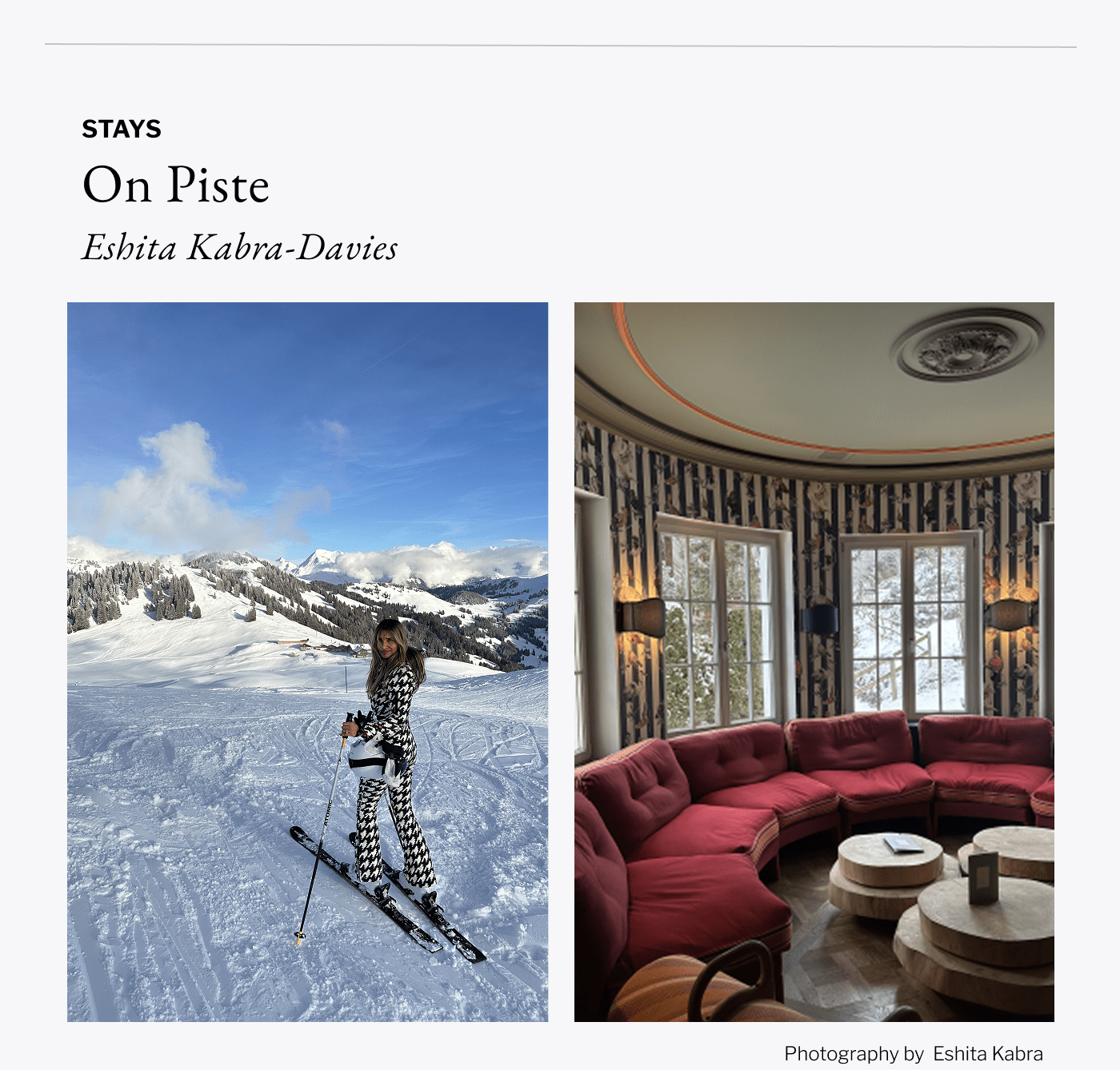
Despite Gstaad's (long-standing) cultural and (present) viral prominence, I had never visited the Swiss alpine town. But all it took was a short flight from Heathrow to Geneva and a two-hour transfer to catch up to the zeitgeist, which found pinnacle expression in my accommodations: Le Grand Bellevue Gstaad, an over 100-year-old, family-owned-and-operated property. Nestled steps from the town’s iconic promenade, the hotel’s palatial exterior telegraphs a traditional, stately ambience. Its characterful interior, however, is best described as accidentally Wes Anderson, with vibrant sofas and animal-print wallpaper dialoguing with mirrored tables, checkered and floral textiles, curated bookshelves, and delightfully quirky details, such as stone bulldog lamps. This eclectic charm extends to the guest rooms — with my particular corner suite also benefiting from abundant natural light and clear views of the renowned Glacier 3000 ski area with its snow-dusted forests. Reclining in bed against plush down pillows, I watched flakes fall on the neighboring Gstaad Yacht Club and imagined what it would be like to spend an entire winter here, far from my very busy life in central London, with a new cast of characters and destinations in its place. Gstaad’s mix is equally cosmopolitan and global, as evidenced by its worldly inhabitants and multitude of old-school and modern dining establishments, including the nearby Olden (offering traditional alpine dishes in a sophisticated setting) and Le Grand Bellevue’s signature restaurant, Leonard’s (just one of its numerous culinary offerings.) In preparation for the slopes, I headed to Leonard’s for a leisurely continental breakfast and “Kobi” eggs, named after a well-known, local farmer who looks after 2,000 laying hens! (I also highly recommend stopping in for dinner: Order the black truffle tagliolini.) Although I only began skiing in my mid-20s, I’m quite confident, always looking to tick off the most challenging runs within a resort. My favorite of the trip turned out to be the infamous Tiger Run on the steepest slope in the region: Wasserngrat, which is similarly home to the Eagle Club, a private members’ ski club and restaurant. I also highly recommend Glacier 3000 for its panoramic views and excellent snow — and capping off any ski day with a session in Le Grande Bellevue’s Le Grand Spa. Spanning over 30,000 square feet, the spa houses more than 17 wellness facilities, ranging from ice rituals and reformer pilates to a hay sauna stocked with my favorite Bamford products. Sleeping in public is a rarity for me, but the spa’s Salt Inhalation Grotto did the trick, thanks to its approximately 113-degree heat and the mist of fine Himalayan salt floating through the air. Given my thoroughly relaxed state, I opted to enjoy my final dinner at Le Petit Chalet, which is nestled within the hotel’s park. It’s a wood-hewn little hut with the personality of a mountain chalet all the way down to the menu, as my hearty and well-deserved raclette evidenced. This was my first trip to Gstaad, but not my last: If I had to start an alpine tradition, it would without doubt be an annual stay at Le Grand Bellevue. |
|
Once you’ve entered a relationship with Costa Brazil, there’s no going back. The ethical, eco-beneficial skincare brand’s products inextricably get under your skin: They’re incredibly efficacious and feel divine, with wonderful scents that instantly imprint on your memory. All of this made the temporary absence of the brand’s Face Serum and Kaya Anti-Aging Face Oil carry the emotional resonance of an unanticipated breakup. Their return, however, provides welcome evidence of founder Francisco Costa’s ongoing mission to return the brand to its roots, physically and philosophically, since buying Costa Brazil back from its parent company last year. Like all of Costa’s products, the aforementioned duo’s formulas are centered around rare, natural Amazonian ingredients. The Face Serum pairs hyaluronic acid, açai, and Brazilian botanicals to help brighten and moisturize the complexion, as well as soften fine lines. The Kaya Anti-Aging Face Oil employs the brand’s proprietary cold-pressed Jungle Complex, containing mineral-rich Kaya, antioxidant packed Cacay, and sacred, soothing properties of Breu resin, to improve skin firmness and smooth fine lines — plus hydrate and revitalize skin. |
|
I made this image on assignment in Jamaica. The boys were outside the storefront and I noticed how the tires framed the scene. I don't normally photograph with black-and-white film but was touched when I got the roll back and saw this one. If you visit the island, be sure to go to The Cheffing Don in Kingston — great food! It is known for its bowls, but they weren’t available when I was there, so I got a plate with rice, pumpkin takari, and shredded greens. |
|
Heart to Hand. The Dolce & Gabbana exhibition Du Cœur à la Main at the Grand Palais (through April 2) is the talk of Paris, for good reason. The clothing on display exhibits impeccable craftsmanship and palpable passion. Each room is its own incredible universe. The intricate details of coats, gowns, and shoes inspire awe — as well as the desire to book a trip to Italy: The scenography is also incredible. My favorite space was the Sicilian room. I won’t reveal too much — the surprise is what makes it so special, but I will give you an insider tip: Visit on a weekday rather than a Sunday afternoon (my mistake). – Anna Kaplan
Color Story. In the late 18th century, mineralogist Abraham Gottlob Werner established a system of identifying colors that Scottish botanical artist Patrick Syme turned into Werner’s Nomenclature of Colours. First published in 1814, the book is a taxonomic guide to the hues of the natural world that has been celebrated by both artists and scientists for more than two centuries. Not only is it fascinating for its backstory and beautiful illustrations, it also provides inspiration for creative projects of all genres. – Joshua Sanchez
Starting Fresh. It was recently pointed out to me by a well-intentioned family member that my eyes were looking “perpetually tired.” The constructive feedback propelled me towards The Rich Eye Cream by Augustinus Bader. (I’m a longtime devotee of the brand, and this product is among its newest.) As innovative as the formula is (it employs Bader’s proprietary TFC8® technology), it does not alleviate stress or magically offer more sleep. But it does make the skin around my eyes look and feel firmer, less like I was startled awake. It also just feels great — thick, creamy, and deeply nourishing — and comes with a chic little applicator: a tiny magic wand. – T. Cole Rachel
|
|
54 Franklin St #2R NY, NY 10013. ©2024 Dossier Projects, LLC.
|
|
|
|
|