As one of the most storied jewelers of all time, Cartier is known for many things. A sumptuous art deco coral and onyx jabot conjures the lore of 1925 Paris. A Victorian diamond tiara points to the maison’s reputation as the “Jeweler of Kings,” especially in London. A Love bracelet commemorates New York City in the freewheeling 1970s. These three cities have defined the brand’s triumvirate of flagship locations ever since the third-generation Cartier brothers decided to divide and conquer (Louis took Paris, Jacques moved to London, and Pierre sailed to New York).
Melbourne is, notably, not on Cartier’s heritage roster, located as it is 10,410-mile proximity from Place Vendôme. But a recent tour of the 2026 Melbourne Winter Masterpieces presentation, Cartier, on view now through October 4 at the National Gallery of Victoria, provides a distinct point of view on how the maison is finding novel ways to showcase its ever-expanding archival jewelry and watch collections — all while paying homage to the terroir of new and sometimes unexpected locations.
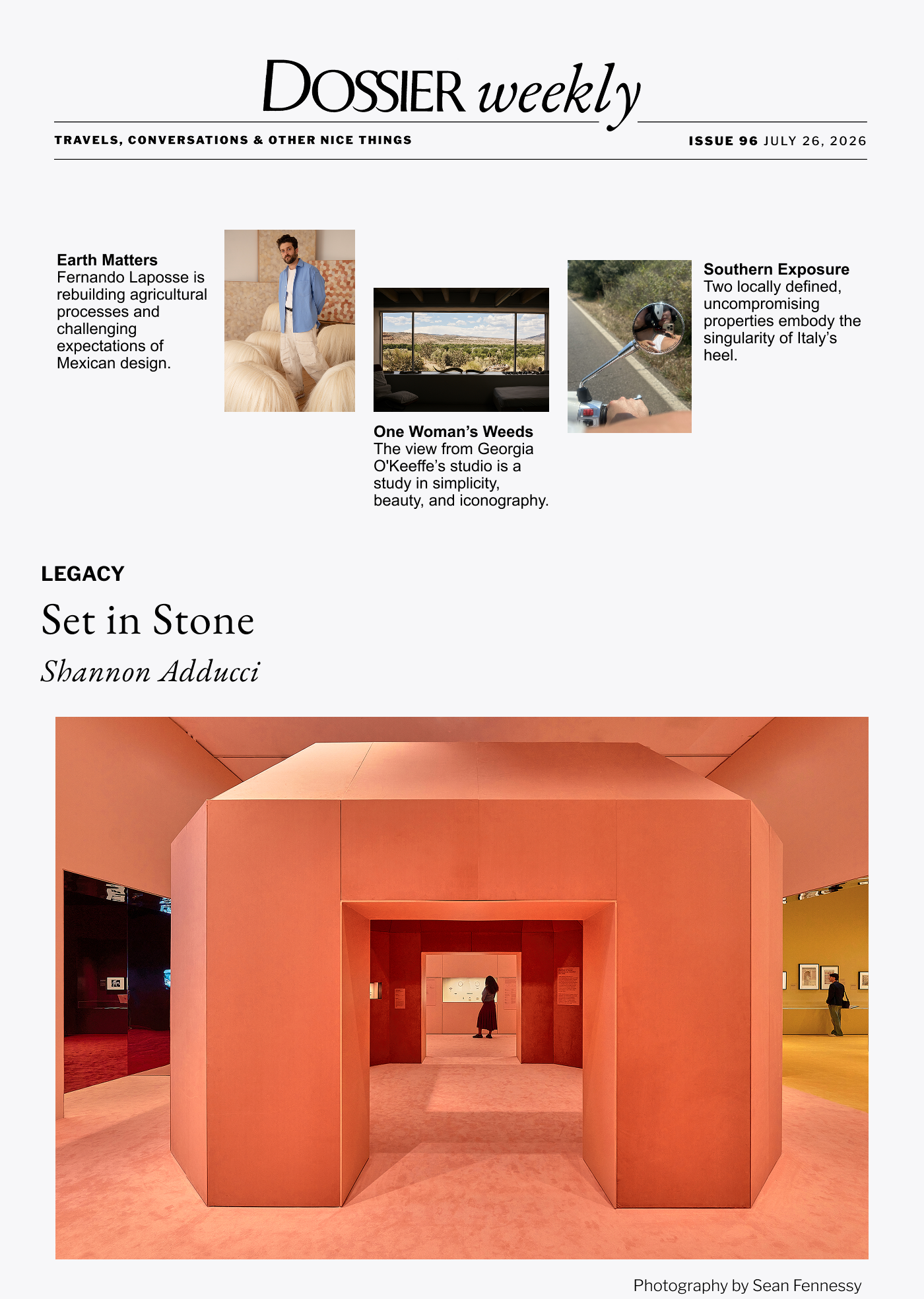
Using last year’s eponymous exhibition at the Victoria & Albert Museum in London as a foundation for the NGV show, Cartier pulled some 400 pieces from its archives — along with accompanying design drawings, sketchbooks, and photos — to weave together a comprehensive view of its history. The show opens with the Manchester Tiara, a piece made for Consuelo, the Cuban American Dowager Duchess of Manchester in Paris in 1903, setting the scene for Cartier’s international aspirations. From there, various rooms highlight the many global destinations that have delivered both clientele and design inspiration for Cartier, from the brand’s well-known Egyptian revival period and colossal Indian gemstones to lesser-known influences from Japan, China, and Iran — plus various Islamic design motifs.
The expanded exhibition reflects Cartier’s ongoing, long-term effort to acquire its archival pieces, buying them back from collectors, auction houses, and anywhere else the gems might be unearthed.
“When we buy a piece, it’s because we think of it as representative of something different; that it says something additional about Cartier in terms of craftsmanship, material, aesthetics,” says Pierre Rainero, Cartier’s image, style, and heritage director. “But there is no Cartier museum, so the collection is only visible through this type of exhibition. The curation comes from our partners. It’s about what they find meaningful.”
The most surprising part of the exhibition is, undoubtedly, its design. The NGV tapped Dutch artist and designer Sabine Marcelis and architect Paul Cournet to create a series of rooms that conceptualize the qualities of cut and color in gemstones. Using Marcelis’ work with colorful resin (reminiscent of her popular Candy Cube pieces), the references are a striking foil to Cartier’s more antique designs, which were themselves considered wildly modern in their own eras.
The show also has a few clever nods to Melbourne and to Australia. In a room dedicated to Cartier’s obsession with stones, a bracelet features a massive 189-carat, Australian-sourced opal (the country sources most of the world’s precious opals, the rarest from its Lightning Ridge mines in northern New South Wales). But it’s the collection of Dame Nellie Melba that truly connects the show to its city.
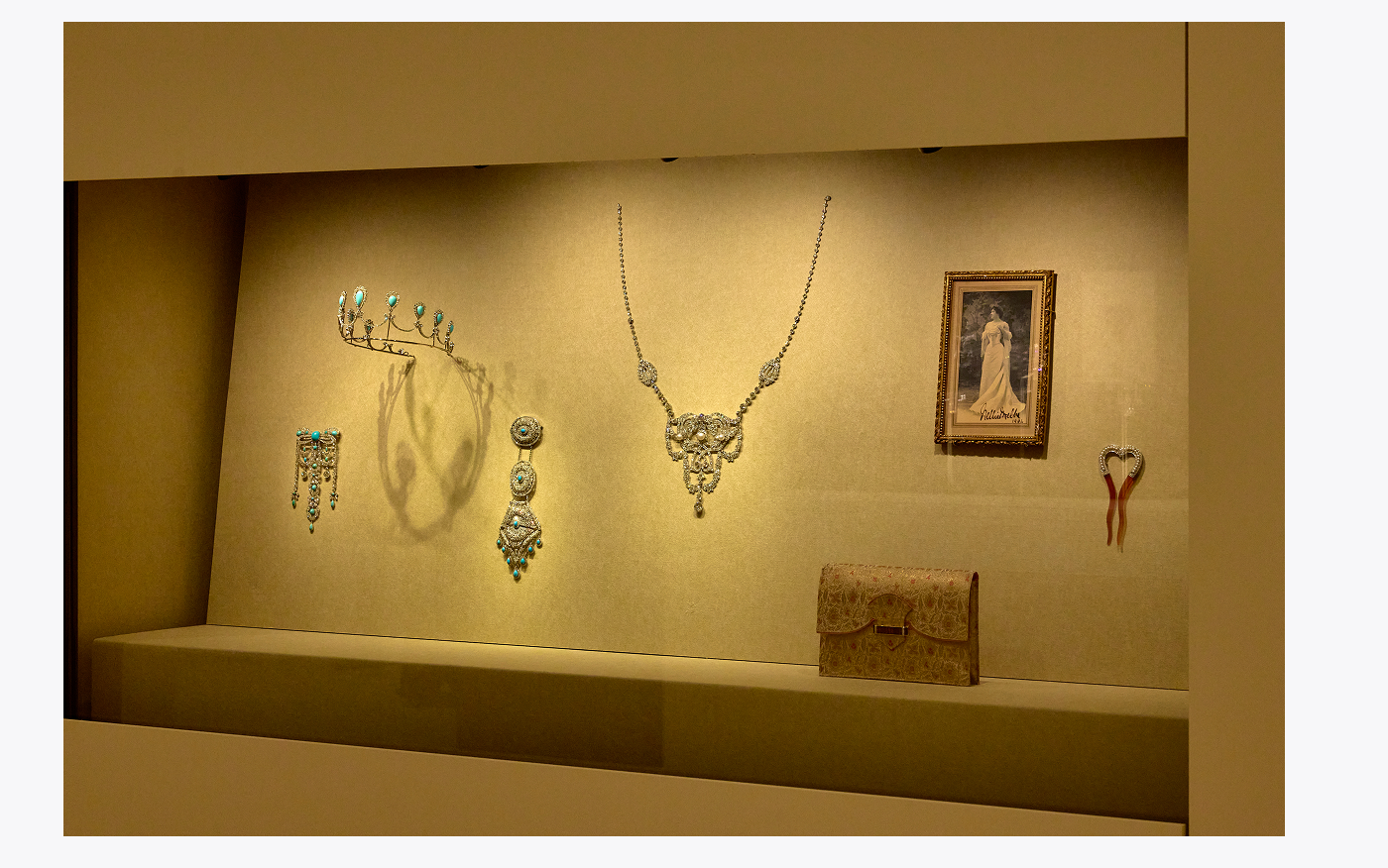
The Melbourne-born opera singer who rose to fame in late 19th century London was a loyal patron of Cartier, collecting special orders and gifts from the jeweler throughout her life. On display, a circa 1912 celluloid, platinum, diamond, and pearl hairpin; a diamond and gemstone evening bag; and a diamond, platinum, and pearl corsage ornament all show the soprano’s idiosyncratic, exacting style. Across the room, a giant portrait of Melba from 1902, with something of a smirk, hints at Australia’s beloved culture of irreverence. |
|
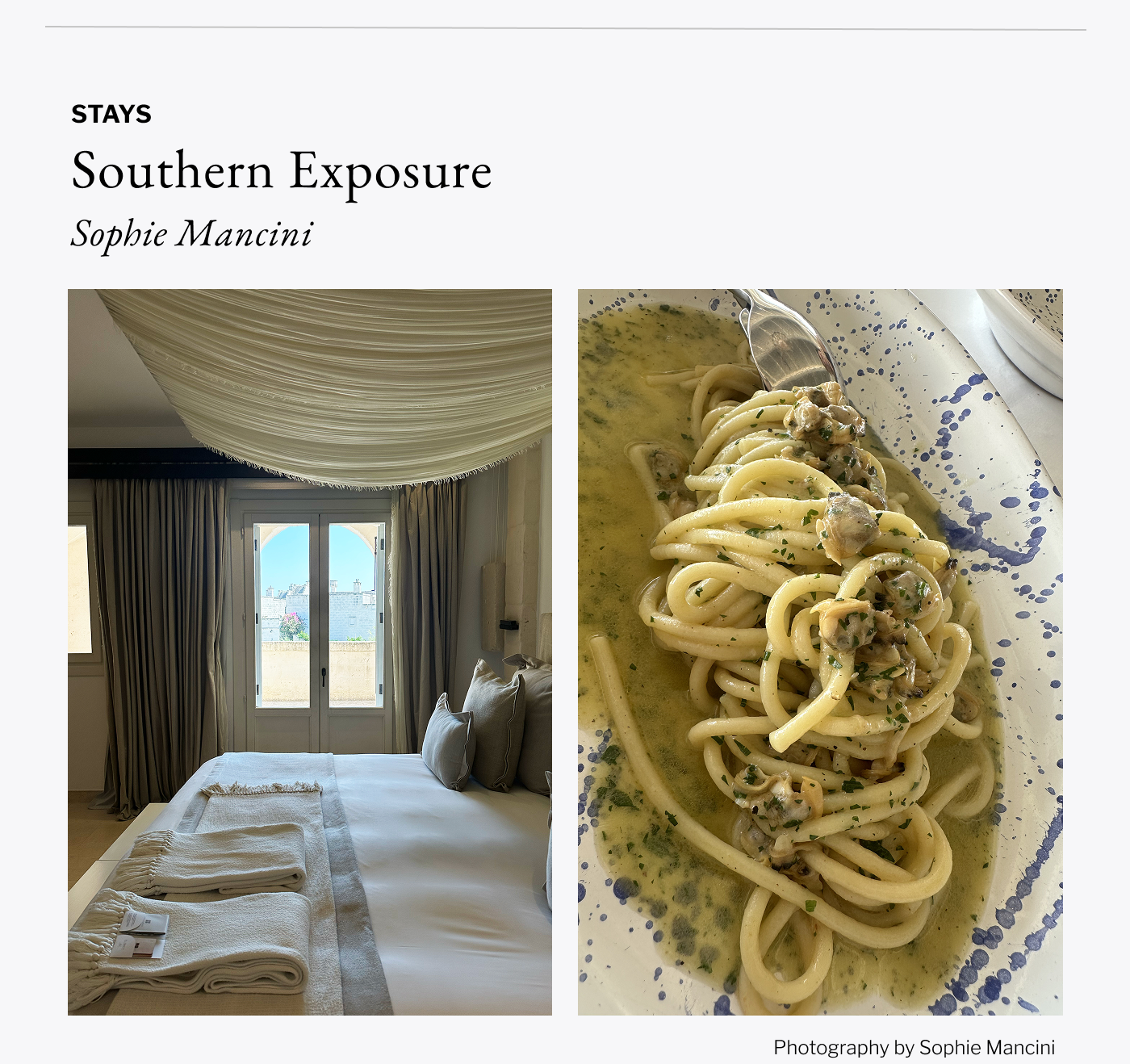
From a sweeping, pioneering resort to a historic 6-room guesthouse, these two stays offer two completely different, equally stunning sides of Italy’s heel: Puglia. Borgo Egnazia Before the early 2000s, an Italian friend explained to me, Puglia wasn’t much of a destination for foreign travelers. Borgo Egnazia, which opened in 2010, helped change that, bringing the heel of Italy’s boot into competition with the country’s international headliners, like Amalfi and Capri.
To call Borgo Egnazia a “hotel” or “property” would be an understatement. It’s more like a small city or, specifically, a recreation of an historic Puglian village: full of cobblestone lanes, locally hewn stone architecture, and spaces built to feel rooted in centuries-old tradition. After dinner, a little walk through its piazza is dreamlike and ethereal, as meticulous and immersive as a movie set. But, to be clear, it is in no way fake: Borgo Egnazi has created around 800 jobs for local Puglians in the surrounding area, making a deep, lasting, and very real impact on the community, A dish you’d recommend to a friend … The hotel’s beachside restaurant, Cala Masciola, has the most beautiful seafood: raw, sweet, glistening as if shellacked with lip gloss. Its seafood tower — an array of jammy langoustines, salty oysters, and toothsome clams — was extraordinary. The best view from the hotel … The property’s perimeters at sunset. I have no real directions to share, except: Just keep walking in any direction until you hit the path that traces the edge. It’s lined with all sorts of fruit: plump grapes, magenta cactus fruit, pomegranates — ruby seeds bursting from splitting rinds. As the light lowers and the sky blushes, the scene gives the impression of some martian utopia. Something not to miss … A bike tour through Borgo Egnazia’s olive groves with Salva. His knowledge of the land and this integral part of Puglian agriculture is astounding. The olive oil trees here are thousands (yes) of years old and the oil their fruit produces is liquid medicine. He taught us how to ascertain the quality of olive oil through taste and smell and how to read a bottle correctly. Salva also led us through a number of old, nearby masserie: fortified farmhouses and agricultural estates full of cows and cheese and history. Something unexpected … Giuseppe Cupertino, the hotel’s wine experience manager, has been curating La Cantina, Borgo Egnazia’s wine cellar, for the past 12 years. The cellar is all about the preservation of valuable wines, with a particular focus on Puglian vintages. On this note: La Cantina is part of a wider property focus on archiving. Its next chapter tackles the recovery and cultivation of ancient seeds. Borgo Egnazia is currently collaborating with an agronomist who has spent over 20 years salvaging ancient fruit and vegetable varieties in hopes of increasing the land’s biodiversity. The hotel is working on creating a living archive, where local varieties are protected, passed on, and eventually returned to the land. A local tip … Speaking of fruits and vegetables, make sure to try the cucumber slices served at breakfast (they can also be found in salads across the property’s various restaurants). Puglian cucumber is a sweet, native varietal. It tastes like honeydew melon’s subtler sister. A song that embodies the property. “Crepusculo Sul Mare” by Piero Umiliani. |
|
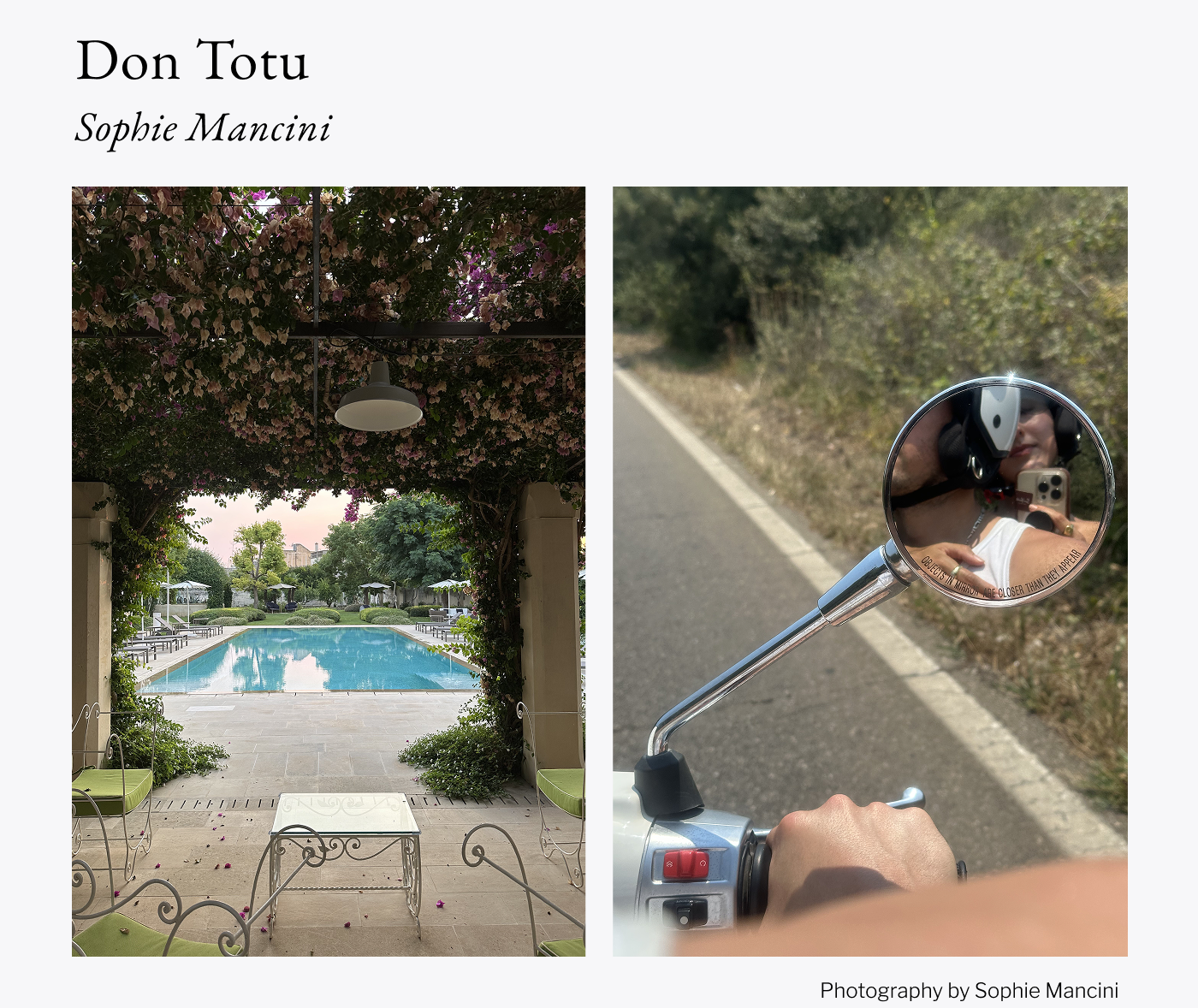
The six-bedroom Don Totu, an 18th-century dimora storica (historic house) feels, aptly, like a private villa. This might have been amplified by the fact that I was the only guest there; I had the entire place to myself. I capitalized on this exclusivity by swimming naked in the pool at night after the staff departed. It was as freeing as one could imagine.
The house itself reminded me of the Italian villas director Luca Guadagnino features in Call Me By Your Name and A Bigger Splash. It was rambling, with towering ceilings, archways, and chandeliers, like in the former film and spread out, with different structures dotted throughout the property, connected in rabbit warren-esque ways like the latter.
There’s also no official restaurant at the hotel. But you can coordinate to have the property’s small but mighty team prepare breakfast and lunch, with options from a tidy menu. After a morning meal of sliced fruit, cured meat, ricotta, freshly baked frittata, and delicate, savory omelettes, served with a rainbow of bright juices, I split my time between enjoying the property — the beautiful ceramics, a fragrant oasis of a garden, the achingly elegant, poplar-lined pool — and exploring Salento. Aboard a Vespa, I drove to the coastal towns of Otranto and Castro, appreciating their beaches and restaurants before returning to the hotel's sweeping pergola draped in fuchsia flowers for an aperitivo, served every evening at the property from 6 p.m. to 8 p.m. Your favorite thing about your room … My bathroom was like a cathedral, with double-height, vaulted stone ceilings and two carved, brown marble sinks. No rooms are the same at Don Totu, and the sheer uniqueness of this bathroom was the best example. The best amenity … The hotel’s small fleet of Vespas for guests. They support the rhythm of your days: an adventure in the morning to swim in salt water before the sun is too high and hot, then a breezy return to laze at the house. A dish you’d recommend to a friend … The staff bakes gorgeous cakes and jammy tarts every day. They serve them at breakfast, then keep them in the fridge for you to snack on later should you wish. Fresh, airy, never overly sweet, they’re phenomenal. Something unexpected … Don Totu barely announces itself from the street. Historically, noble or steward residences in small Salento towns were intentionally discreet. This house, in particular, was a gift from the town’s lords to its land steward, Don Totu: the hotel’s namesake. A local discovery … Caffè Leccese, the traditional iced coffee of Puglia. It’s what you order after lunch, and it’s a treasure. Baristas pour espresso over ice and mix in almond syrup. It reminded me of Mexico’s carajillos (sans alcohol). A song that embodies the property … “Mi sei scoppiato dentro il cuore” by Mina. |
|
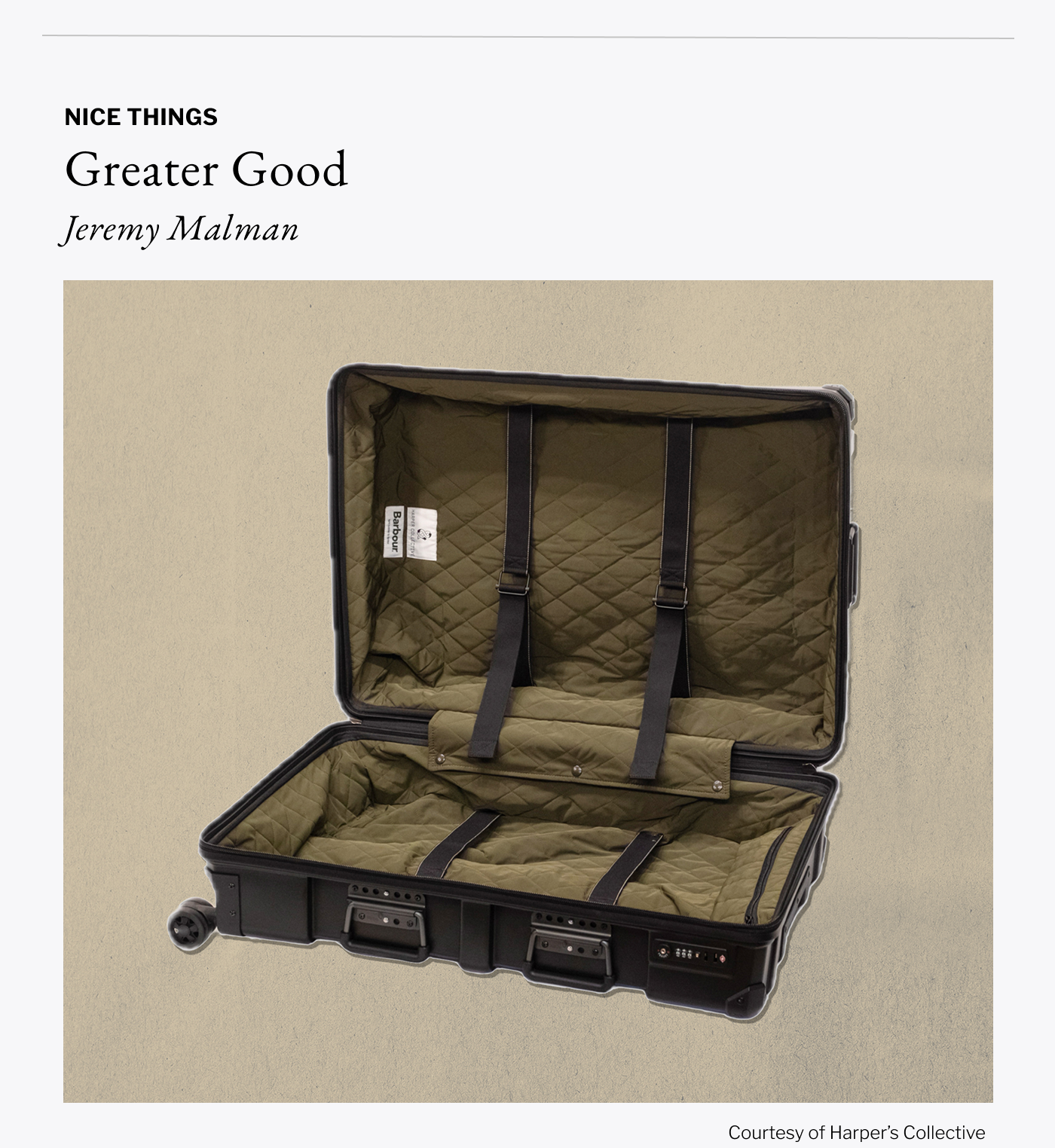
I first came across the Harper Collective Cabin suitcase at a press event in Paris. It had a fantastic backstory, which included 13 tons of recycled sea plastic and a painstakingly slow manufacturing process that utilized real human hands in heritage factories across Europe. I loved that I’d be able to tell people this, but, more importantly, the suitcase looked really, really good. I know there are some people, like my 19-year-old son, who’d be happy to forsake aesthetics in order to promote something elevated and meaningful, but I prefer the whole enchilada. It needs to look cool, tell an interesting story, and work perfectly.
The suitcase’s rugged exterior, made from that recycled sea plastic, is hyper utilitarian, but also polished and refined, like a vintage Land Rover that’s been fully restored to eliminate all of the inconveniences of “vintage,” making it, like this bag, incredibly functional. But it was the bag’s interior lining, featuring signature diamond-quilted trim from the British heritage brand Barbour, that put it over the top. It reminded me of Quentin Tarantino’s True Romance, in which Dennis Hopper, Christopher Walken, Brad Pitt, Tom Sizemore, Gary Oldman, and Val Kilmer (whose face we never see) all committed, with an unprecedented pairing of swagger and humility, to being a small part of something bigger than themselves. This made their “smaller” roles, collectively, as significant — maybe more — than the larger ones. Likewise, Barbour’s willingness to be a part of the whole suggests that they so completely believe in this thing, that they’re willing to do anything just to be a part of it. |
|
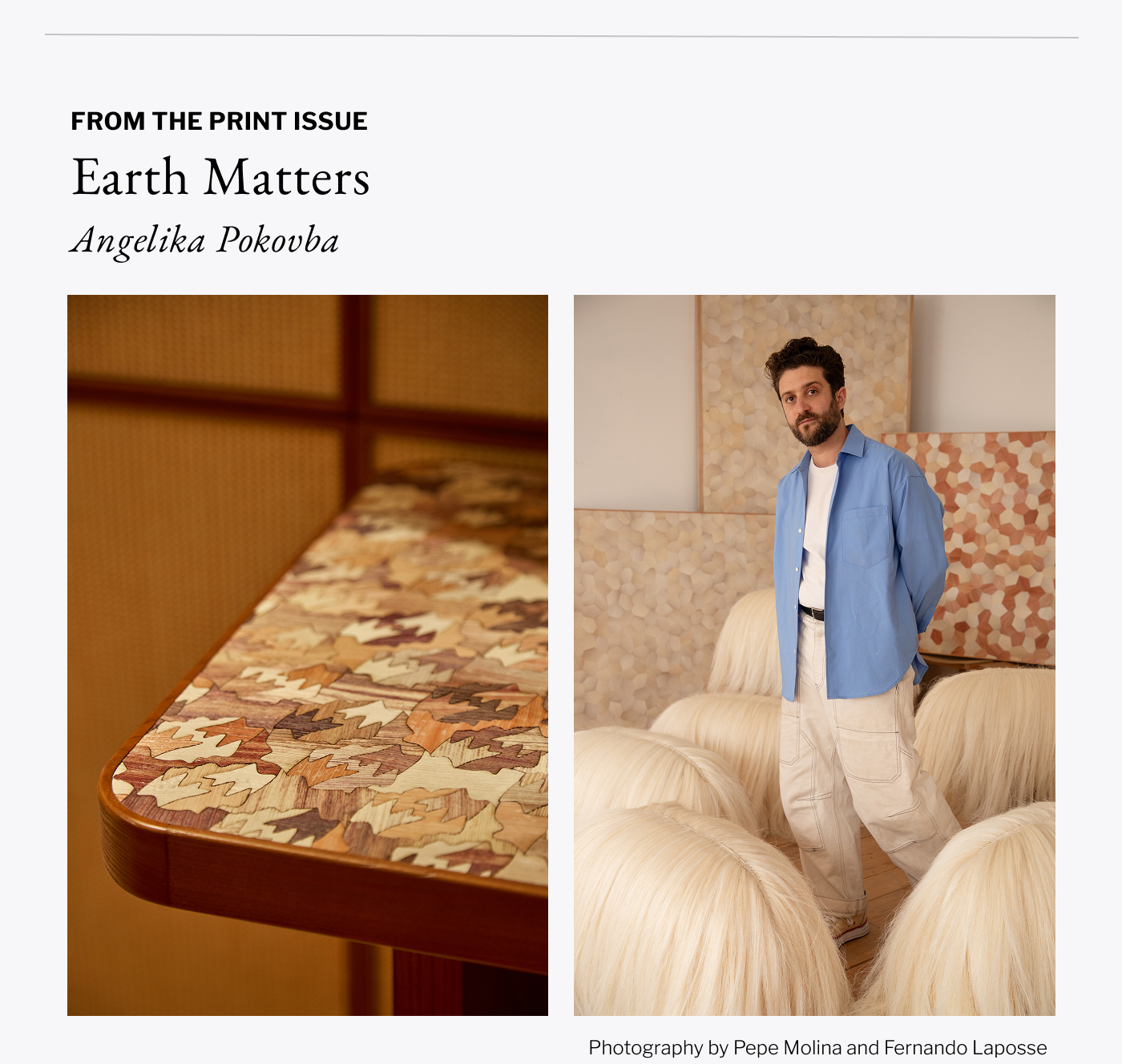
Furry monsters, hairy benches, and intricate marquetry tell a striking tale, but these fantastical creations represent only the surface of Mexico City-based designer Fernando Laposse’s work. The real labor happens elsewhere — in the soil, in planting systems, and in the redesign of local agriculture itself.
His practice does not preserve craft in amber, nor does it stylize it for the mass markets. Rather, it treats craftsmanship as a system to be rebuilt, shaped by the agricultural and political conditions that determine material long before it enters a workshop.
“What I want to do with my work is redefine what ‘Made in Mexico’ signifies,” he says. “Unfortunately, craft here is still very linked to poverty. And yes, there’s beautiful vernacular craft with a kind of wabi-sabi aesthetic [a Japanese concept that celebrates handmade imperfection and natural aging] that’s very appealing. But that association is something I want to challenge.”
Over the past decade, Laposse has developed methods for working with corn husks, avocado skins, agave fibers, and even loofah — dehydrating and shaping them into panels and patterned surfaces that form the foundation of his furniture and object design. “My goal is to innovate without sacrificing tradition and without piggybacking on existing craft,” he says. “That’s a self-imposed challenge.”
In his studio in the Guerrero neighborhood of Mexico City, vaulted ceilings filter light across a steel picnic table that doubles as his desk. He wears a bright-orange wool cardigan. Cochineal-tinted silk panels glow soft bubblegum pink nearby. A pink plate from La Lagunilla flea market rests among collectible design pieces in the open kitchen.
Several furniture pieces await shipment to Qatar. At the edge of the space, a meditation garden forms a quiet threshold. In one corner, a sauna fitted with an Estonian heater is fueled by leftover wood from his furniture production. Across the warehouse, a disco ball turns slowly against wood-paneled walls. His bedroom sits just upstairs. Sometimes he wakes in the middle of the night to adjust a wall panel, arranging laser-cut pieces one by one.
To understand Laposse’s practice, you have to let go of the idea that he designs furniture. Fernando Laposse works alongside farming communities, rethinking crops, planting patterns, and water management in rural Mexico. The object actually comes last. Read the full feature and more close takes on a wide world in our Spring/Summer 2026 print issue. Order now. |
|
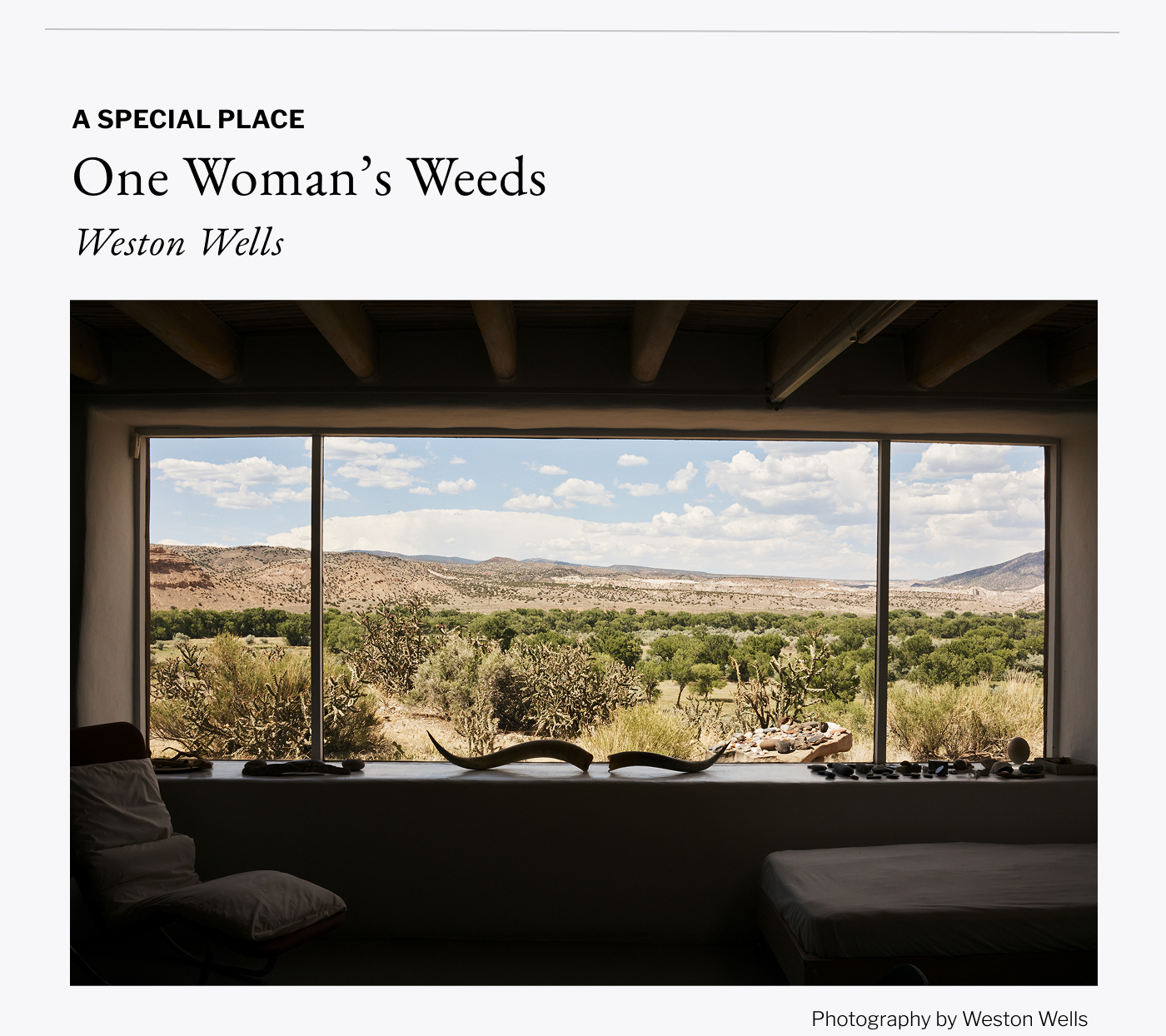
I was delighted to discover that this was the view from Georgia O'Keeffe's studio. A long-time admirer of O’Keeffe’s paintings, I had been to several exhibitions of her work and had visited her other New Mexican residence at Ghost Ranch, but I had never been to her home and studio in Abiquiu, about an hour’s drive from Santa Fe.
Upon entering the studio, I was hit with the overwhelming sense that its view had served as endless inspiration, informing the beauty and simplicity of her work. I’m sure a picture like this one has been taken many times, but I had to have one of my own.
I try to make it to New Mexico once a year to see family, and the journey never disappoints. Just watching the sky change throughout the day is enough to pull you outside to take a few pictures. |
|
Quite Remarkable. If a sprawling country estate with lavish classical details and a field of Highland cattle in the heart of Edinburgh, Scotland, sounds too good to be true, you’ll be delighted to discover Prestonfield House. Located just 10 minutes from the city’s Old Town, the hotel is also home to Rhubarb, a fine dining experience with decor that almost outshines the food. I visited to celebrate a friend’s birthday with the restaurant’s three-course tasting menu, which started with a signature cocktail, The Rhubarb Patch, crafted with homemade rhubarb syrup (the estate was the first in Scotland to propagate rhubarb in the 18th century). Warm garden pea velouté followed, appropriate given the rain outside. Additional standouts were smoked pork belly with corn ribs; malted, yeast-roast celeriac (worth the heartburn that followed), and roast pollock fillet. We found ourselves passing around each dessert — my favorite was the bees’ salted honey cheesecake). After your meal, be sure to explore the grounds for the resident peacock, who may be kind enough to give you a show. –Lisa Lok Oud of This World. Is it possible to have too many fragrances? More specifically, is it possible to have too many oud-based fragrances? Apparently the folks atBond No.9 New York don’t think so, having just released two incredible new takes on the formidable scent: My Oud and Super Oud. The former is a lighter, breezier interpretation, featuring notes of grapefruit, beeswax, and patchouli; the latter lives up to its name. It’s a super-sized oud scent that blends saffron, suede, and amber for an opulent fragrance that recalls being draped in expensive cashmere. I wear them both, just never at the same time. –T. Cole Rachel Signed, Sealed, Delivered. SO/ Paris has always felt like the cool, younger sibling of the city's luxury hotels. The first time I stepped into its lobby, it was a refreshing reminder that Parisian hospitality doesn't have to follow convention. Bold architecture, sweeping views, and an essential creative energy have made it one of my favorite places to visit. As an active player in the capital's cultural scene, the hotel also regularly hosts collaborations with artists, designers, and brands. This summer, it teamed up with the legendary department store La Samaritaine for a postcard-inspired activation. Titled “Bon Baisers de la Samaritiane,” the collaboration (on through August 31) celebrates the art of a Parisian holiday by inviting guests to browse a curated selection of fashion and accessories in the lobby, try their luck at a claw machine filled with prizes — from gift cards to a stay at another SO/ property — and enjoy a complimentary appointment at La Samaritaine's private styling salon. –Anna Kaplan |
|
54 Franklin St #2R NY, NY 10013. ©2026 Dossier Projects, LLC.
|
|
|
|
|